


The next major disruption to the global semiconductor and defense industries may not originate in a chip fabrication facility or a military manufacturing plant. It could begin much further upstream, in the supply chains responsible for producing the specialized minerals and materials that make these industries possible.
China is at the helm of the global rare earth and critical minerals supply chain. The U.S. and other countries are trying to establish alternative supply chains to reduce reliance on China and strengthen their self-sufficiency. Three recent developments illustrate this shift.
- Project Vault initiative in the U.S. to accelerate strategic mineral stockpiling
- Export control restrictions from China on yttrium
- Capital expenditure among 24 major mining companies declined by 9% in 2025
Kings Research is actively tracking how critical mineral supply chains are changing due to export controls, government-backed stockpiling efforts, the development of processing infrastructure, and rising investments in rare earth mining. Can the global economy diversify its strategic mineral supply chains quickly enough to protect industries from uncertainty and minimize pricing and production risks?
Why is China So Important in Critical and Rare Earth Mineral Supply Chain?
China's influence over the global critical minerals industry extends well beyond its mining capacity. Its position across processing, refining, separation, and downstream manufacturing significantly influences the availability of raw materials in strategic industries.
Share of China in Global Mineral Processing Capacity
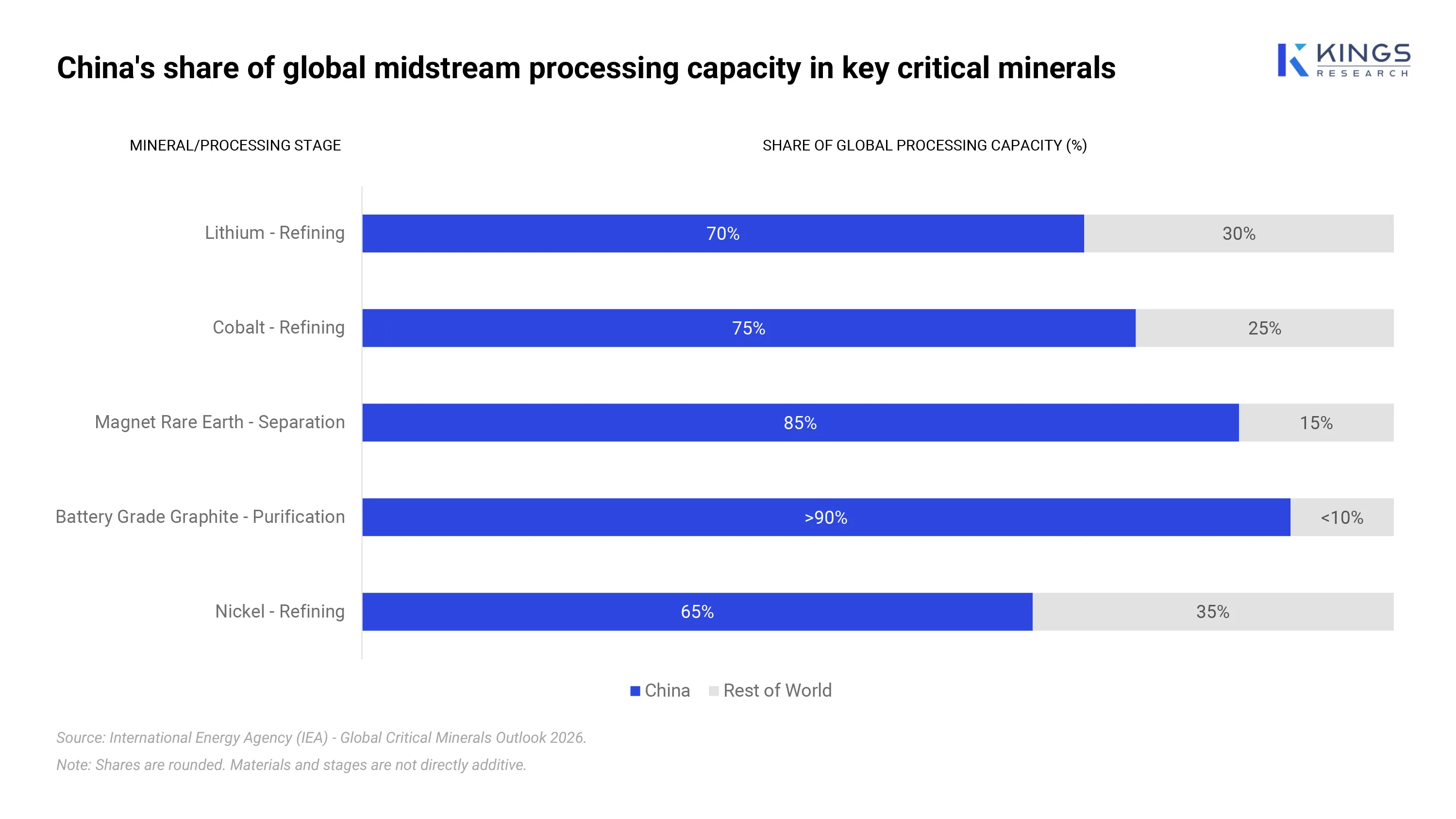
The concentration of supplies of several critical minerals and rare earth elements in China increases risks for manufacturers and businesses that depend on them. China demonstrated this by implementing export controls on various critical minerals and rare earth elements. These controls are not merely intended to restrict commodity shipments; they also help China improve technological advantage and geopolitical leverage.
The timeline of these export controls can be categorized as:
- 2023-2024: Establishing leverage. China introduced controls on semiconductor materials, graphite, antimony, and selected processing technologies.
- 2025: Expanding the scope of control. Controls expanded to additional critical minerals, seven rare earth elements, processing technologies, and selected downstream products.
- 2026: Managing geopolitical leverage. China introduced additional country- and entity-specific restrictions, including measures targeting Japanese entities. In November 2026, it extended the suspension of certain previously imposed export controls until January 10, 2027, while retaining other restrictions, including the April 2025 controls on seven medium and heavy rare earth elements.
Major impact of these export controls and fluctuations in the critical minerals supply chain can be observed across the semiconductor and defense industries.
Semiconductor Manufacturing Exposed to Strategic Mineral Fluctuations
Minerals and rare earth elements account for only a portion of semiconductor manufacturing costs. They have specialized applications in the industry and cannot be replaced without technical validation and process adjustments. Semiconductor manufacturers need to assess their exposure to changes in the mineral supply chain across direct suppliers, component manufacturers, and upstream processors. Businesses should also evaluate whether alternative materials can meet performance requirements without affecting production yields or product reliability.
Gallium: Supporting compound semiconductor technologies
Gallium is used in compound semiconductors, including gallium nitride (GaN) and gallium arsenide (GaAs). These materials support applications requiring high-frequency performance, power efficiency, and thermal management.
Their importance extends across telecommunications, radio-frequency components, power electronics, and selected defense technologies. Restrictions affecting gallium availability could increase procurement uncertainty for manufacturers dependent on these specialized materials. Developing alternative processing capacity and securing qualified suppliers will therefore remain important priorities.
Germanium: Enabling advanced optical and electronic applications
Germanium is used in silicon-germanium technologies, infrared optics, and fiber-optic applications.
Its industrial relevance extends beyond conventional semiconductor production to communications infrastructure, sensing technologies, and advanced defense electronics. Supply disruptions can affect businesses operating across these interconnected markets, particularly when alternative materials require engineering changes or additional qualification.
Rare Earth/Critical Minerals and Their Applications
|
Material |
Semiconductor Applications |
Aerospace & Defense Applications |
|
Gallium |
GaN/GaAs compound semiconductors |
Radar and high-frequency electronics |
|
Germanium |
Advanced chips, optical fiber applications |
Infrared optics and sensing |
|
Yttrium |
Protection of fabrication equipment from harsh plasma corrosion (Yttrium Oxide) |
Aviation part coatings, high-performance materials |
|
Rare Earth Magnets |
Magnets in specialized electronic systems |
Motors and actuators in aircraft, missiles, naval, and ground systems |
Want a complete assessment of how export controls and changing mineral supply chains affect the semiconductor industry? Want to know more about a specific critical mineral or rare earth material? Connect with Kings Research analysts to find answers to these questions and other similar ones regarding your business.
From Electronics to Defense Capabilities
The defense industry relies on specialized materials across multiple products, making it vulnerable to shifts in critical mineral and rare earth supply chains. Modern military platforms require materials capable of performing under extreme temperatures, mechanical stress, electromagnetic conditions, and demanding operational environments.
Rare earth elements support permanent magnets used in various military applications, including aircraft systems, precision-guided technologies, naval equipment, and advanced electronics. Therefore, shifts in critical mineral and rare earth supply chains can disrupt industries and could also influence national security and defense capabilities of countries.
Yttrium illustrates how supply-chain disruptions could threaten defense capabilities in certain countries.
In April 2025, China mandated that exporters obtain a dual-use export license before shipping seven medium and heavy rare earth elements, including yttrium. On January 6, 2026, China prohibited the export of dual-use items to Japanese military users that could contribute to enhancing Japan's defense capabilities. Then, on February 24, 2026, China added 20 Japanese entities associated with activities it said supported Japan's military capabilities to its restricted list and another 20 entities to its watch list, imposing additional export-control and licensing requirements.
The impact of these export controls is expected to be evident in Japan, but their extension to the U.S. is also critical. Since the U.S. relies heavily on imports for its yttrium supply, evaluating supply risks and managing demand are essential.
Yttrium Import Dependence in the U.S.
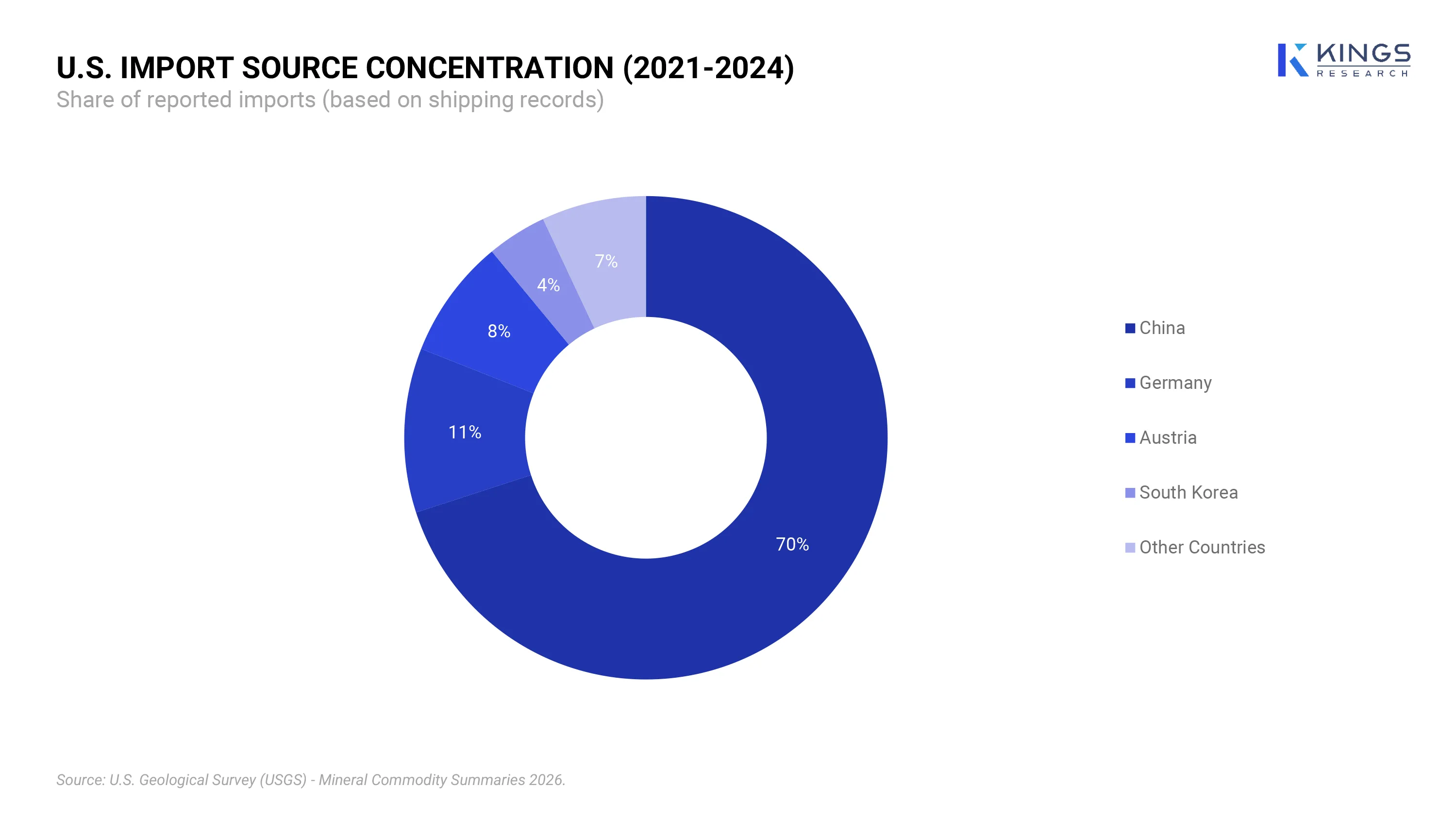
The U.S. is also exposed to yttrium supply risks: USGS reports 100% net import reliance in 2025. However, the extent to which China's restrictions on Japanese entities could affect U.S. defense supply chains through Japanese components containing yttrium remains unclear. These restrictions could disrupt the supply of yttrium-based components and increase delivery times for manufacturers dependent on affected supply chains.
These restrictions are likely to prompt defense manufacturers from the U.S., India, Japan, and the European Union to seek alternative yttrium sources. South Korea, Thailand, and Vietnam may be considered in broader supply-chain diversification strategies. However, their ability to serve as alternative yttrium suppliers will depend on demonstrated production, separation, processing, and export capacity.
Efforts to circumvent these restrictions and export controls imposed by China are gaining traction around the world. In February 2026, EXIM, in coordination with the White House, announced the launch of Project Vault, an unprecedented and uniquely American decentralized approach to strengthen U.S. critical minerals supply chains. Backed by up to USD 10 billion in EXIM financing and nearly USD 2 billion in private-sector investment, Project Vault establishes the U.S. Strategic Critical Minerals Reserve, an independently governed public-private partnership designed to store essential raw materials in facilities across the U.S.
In October 2025, the Korean government announced the launch of an inter-ministerial task force on rare earth supply chains to prevent adverse impacts on Korean companies due to China’s export controls. Other measures in response to China's export controls include support for critical mineral recycling and plans to establish a USD 175.03 million (as per conversion on October 31, 2025) Critical Minerals and Energy Supply Stabilization Fund.
In January 2025, the Union Cabinet of India approved the launch of the National Critical Mineral Mission (NCMM). The mission aims to build a resilient critical minerals value chain to support India's green technology ambitions. The project has an outlay of USD 3.96 billion (as per conversion on January 29, 2025) over seven years and encompasses all stages of the value chain, including mineral exploration, mining, beneficiation, processing, and recovery from end-of-life products. The outlay comprises INR 16,300 crore in government expenditure and an expected INR 18,000 crore in investment from public-sector undertakings and other stakeholders.
In December 2025, the European Commission announced the RESourceEU Action Plan to strengthen the EU's resilience against raw-material supply disruptions. The initiative includes USD 3.5 billion in EU funding over the following 12 months to support projects that can provide alternative supplies in the short term and aims to reduce dependencies by up to 50% by 2029.
Reducing dependence on China is expected to be critical for countries to navigate the changing export control landscape of China surrounding the critical and rare earth mineral industries. The trade war between China and the U.S. is also expected to change the direction of the critical minerals supply chain. Sanctions, export controls, and tariff increases from both countries are expected to have global implications that could disrupt businesses.
According to the IEA's Global Critical Minerals Outlook 2026, aggregate capital expenditure among 24 major mining companies declined by 9% in 2025, ending several years of growth. Exploration spending also fell by more than 10%, reflecting weaker investment sentiment amid market uncertainty and price volatility. At the same time, public financing commitments in advanced economies reached approximately USD 65 billion in 2025, more than four times the 2023 level. However, these commitments should be distinguished from actual capital disbursements.
What Should Businesses Do to Protect Their Supply Chains?
Businesses should evaluate the origin and processing history of the materials embedded in their products to move beyond their traditional sourcing approaches. Priorities for securing supply chains are expected to differ from business to business. According to our analysts, the following priorities are essential for most businesses:
Map Dependencies Beyond Direct Suppliers
Businesses should identify critical minerals used across components, subassemblies, and finished products. The analysis should extend beyond first-tier suppliers to include processors, refiners, and intermediate manufacturers. A supplier located outside China may still depend on Chinese-origin feedstock or processing capabilities.
Diversification of Suppliers and Processing Locations
Establishing alternative suppliers is only effective when diversification extends across the entire value chain. Companies should assess whether their alternative suppliers rely on the same upstream processing facilities or geographical bottlenecks as their existing procurement networks.
Fast-track Material Qualification Efforts
Alternative materials and suppliers must satisfy technical and regulatory requirements before they can be integrated into production. This is particularly important for defense and semiconductor applications, where material specifications, reliability, and manufacturing consistency can restrict substitution. Early qualification can help reduce the time required to respond to unexpected supply disruptions.
Establish Strategic Procurement Partnerships
Long-term offtake agreements, joint ventures, strategic inventories, and recycling partnerships can improve access to specialized materials. Businesses should also evaluate whether direct investment in processing or manufacturing partnerships could provide greater supply security than conventional purchasing arrangements.
The Next Industrial Advantage Will Depend on Supply Chain Control
Competition across the critical minerals and rare earth industries is intensifying. Access to critical minerals is becoming a competitive factor in industrial capacity, technological development, and national security. Supply chain security priorities are evolving with the changing geopolitical landscape and growing export restrictions.
For semiconductor manufacturers, the priority is securing reliable access to specialized materials that support advanced electronics and compound semiconductor technologies. For defense contractors, the challenge is establishing dependable access to rare earth elements, high-performance alloys, and other materials required for advanced military systems.
For investors, the opportunity extends beyond mineral extraction into refining, separation, advanced materials, permanent magnet manufacturing, and recycling. However, building alternative supply chains will require more than capital commitments and new mining projects. It will depend on commercially viable processing infrastructure, technical capabilities, qualified suppliers, and sustained demand from downstream manufacturers.
Analysts at Kings Research can help businesses and investors evaluate emerging market opportunities, assess competitive positioning, and identify the supply-chain developments shaping the future of the global critical minerals industry.