
Inquire Now
Key Strategic Points
The aerogel market comprises the production and commercialization of ultra-lightweight, highly porous materials that offer exceptional thermal insulation, fire resistance, and low density for use across industrial and commercial applications. The extensive adoption of aerogels in oil and gas, building and construction, automotive, and marine sectors drives market growth. The market is further driven by the increasing emphasis on energy efficiency, decarbonization, and sustainable building practices, creating opportunities for developers to innovate next-generation aerogel materials with enhanced mechanical strength, flexibility, and durability.
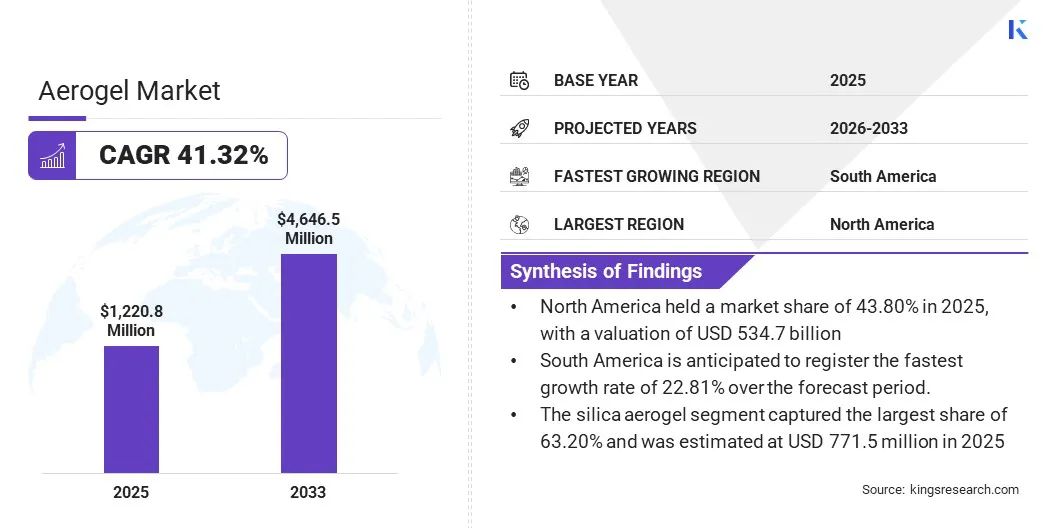
The global aerogel industry size was valued at USD 1,220.8 million in 2025 and is projected to grow from USD 1,417.4 million in 2026 to reach USD 4,646.5 million by 2033, representing a CAGR of 18.48% over the forecast period (2026-2033). Stringent energy-efficiency regulations in construction and the increased deployment of thermal management materials in electric vehicles, industrial systems, and oil and gas insulation systems are presenting significant growth opportunities for the aerogel market.
Key players operating in the market, including Aspen Aerogels, Inc., Cabot Corporation, Armacell International S.A., BASF SE, Aerogel Technologies LLC, CN-Aerogel, and Aerogel-it GmbH, are enabling novel aerogel product launches to address varying demands across diverse end-use sectors.
The demand for lightweight, high-performance insulation materials is leading to the widespread adoption of aerogel in the building and construction sector. Their ultra-thin, lightweight, and high thermal conductivity make them ideal for energy-efficient buildings and retrofitting of existing structures without compromising usable space or architectural integrity.
Additionally, the rising demand for low-density and high thermal resistance materials is accelerating their adoption in aerospace applications. Their lightweight structure and high-temperature resistance enable their use as protection materials in spacecraft, satellites, planetary rovers, spacesuits, launch vehicles, and aircraft. Aerogels are also being increasingly used as insulation materials in cryogenic fuel tanks, for the protection of sensitive electronic components, and to improve the efficiency of heat shields for re-entry and hypersonic flight, thereby supporting market growth.
Aerogel insulation production faces significant cost barriers that limit its widespread adoption despite superior thermal performance. Manufacturing expenses for aerogel materials are considerably higher than conventional insulation alternatives such as fiberglass or mineral wool, owing to the energy-intensive supercritical drying process and specialized raw materials. The purity of the silica precursor influences pricing, as high-purity sources provide superior thermal conductivity, hydrophobicity, and durability.
Additionally, the variation in manufacturing complexity across multiple forms of aerogel, requiring nanoscale precision to replace the liquid component of a gel with gas without destroying its porous 3D structure, further restricts market growth opportunities. For instance, flexible aerogel blanket production requires combining aerogel particles with needle-punched felt or non-woven fabric, involving multiple dipping, drying, and curing steps, which lead to higher labor and energy costs. This price differential creates substantial challenges for market penetration beyond specialized applications.
To address this challenge, market players are adopting cost-efficient manufacturing technologies, alternative raw materials, and capacity expansion strategies to lower production costs and improve scalability.
The inclusion of aerogels as EV battery barriers, owing to their high thermal conductivity and high insulation resistance, is emerging as a notable trend. Thermal runaway in lithium-ion batteries poses significant risks and occurs when a cell is exposed to conditions such as overheating, mechanical damage (crushing or penetration), or overcharging. The exothermic chemical reaction results in the generation of excessive heat and flammable gases, causing rapid cell decomposition and increasing the risk of fire or explosion.
The adoption of aerogel in the form of pads in EV battery packs offers thermal insulation, flame resistance, and mechanical adaptability, thereby minimizing fire risk and supporting increased adoption in the rapidly growing automotive sector.
|
Segmentation |
Details |
|
By Form |
Blanket, Particle, Panel, Monolith |
|
By Type |
Silica Aerogel, Polymer Aerogel, Carbon Aerogel, Others |
|
By Application |
Thermal Insulation, Acoustic Insulation, Catalyst and Adsorbent, Battery and Energy Storage, Day-lighting and Translucent Panels, Others |
|
By End Use |
Oil & Gas, Building & Construction, Automotive, Aerospace & Marine, Others |
|
By Region |
North America: U.S., Canada, Mexico |
|
Europe: France, UK, Spain, Germany, Italy, Russia, Rest of Europe |
|
|
Asia-Pacific: China, Japan, India, Australia, ASEAN, South Korea, Rest of Asia-Pacific |
|
|
Middle East & Africa: Turkey, U.A.E., Saudi Arabia, South Africa, Rest of Middle East & Africa |
|
|
South America: Brazil, Argentina, Rest of South America |
Based on region, the global aerogel market has been segmented into North America, Europe, Asia Pacific, Middle East and Africa, and South America.
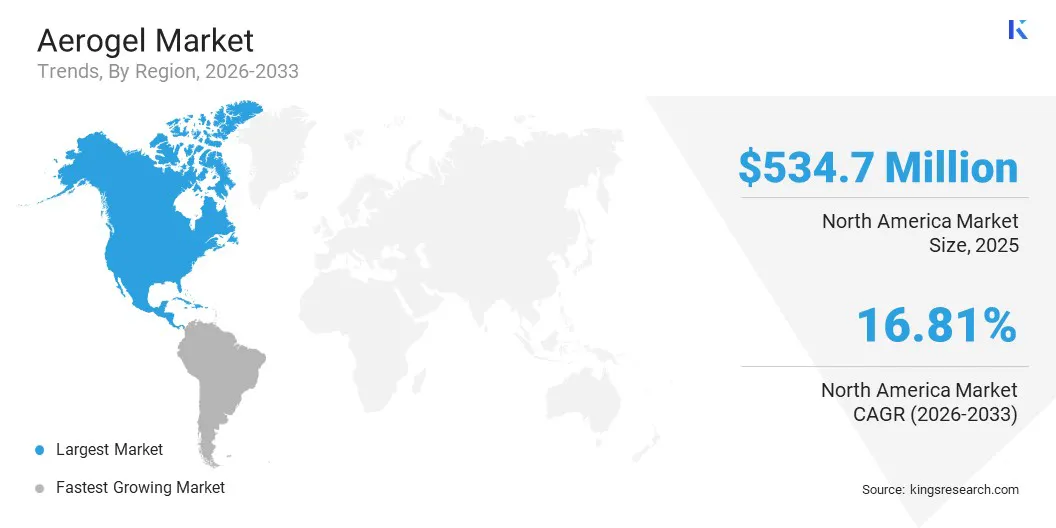
The North America aerogel market share stood at 43.80%, with a valuation of USD 534.7 million in 2025. Rising demand for energy-efficient insulation materials in the oil and gas sector, the expansion of the electric vehicle ecosystem, and increased adoption of high-performance materials in green building construction are propelling the demand for aerogel across the region. The presence of advanced manufacturing facilities in the U.S., which enable rapid technological innovation and automation, along with increasing investments in sectors such as electric vehicles, batteries, semiconductors, aerospace, and others, is creating new growth avenues for aerogel adoption.
South America is set to grow at the fastest CAGR of 22.81% over the forecast period. The presence of oil and gas exploration projects and extreme mining operations in countries such as Brazil and Chile is boosting demand for advanced heat-conducting materials, including aerogels. These properties are leading to increased adoption of aerogels as premium thermal insulators for deep-water pipelines, liquid natural gas (LNG) terminals, and heavy-duty industrial equipment.
The presence of extensive oil and gas resources further contributes to the demand for high-temperature-resistant insulation materials, including aerogel blankets. The application of aerogel in oil and gas processing machinery, including pipe protection, engine cylinder heads, skid compressors, and various onshore and offshore systems, is contributing significantly to market growth.
Key players operating in the aerogel market are focusing on strengthening product innovation and capacity expansion to enhance their market position. Aerogel manufacturers are investing in advanced production technologies and large-scale manufacturing facilities to improve product performance, operational efficiency, and supply capabilities.
Frequently Asked Questions

Faizy brings over four years of experience in market research and consulting, with a proven ability to support strategic engagements across diverse industries and business environments. His work focuses on understanding complex market structures, identifying emerging opportunities, and translating research findings into clear, commercially relevant insights. With strong analytical capabilities and a structured approach to problem-solving, he evaluates industry trends, competitive landscapes, customer dynamics, and evolving business models. His expertise encompasses market research, competitive intelligence, market sizing and forecasting, industry assessment, company benchmarking, and strategic analysis. Faizy combines technical proficiency with a strong research orientation, enabling him to interpret both qualitative and quantitative information effectively. He has contributed to projects that help organizations assess growth potential, strengthen market positioning, and evaluate strategic priorities. His adaptable approach allows him to work across sectors while maintaining a consistent focus on accuracy, relevance, and delivering insights that support informed decision-making for clients and stakeholders.
Habi is a seasoned research and consulting leader with renowned experience in guiding clients on strategic growth and transformation initiatives across global markets. He has led high-performing research teams that deliver actionable insights on market expansion, M&A strategies, opportunity assessment, new business development, and product launches. His project portfolio spans large petrochemical producers, electronic device manufacturers, lubricants companies, and other leading enterprises across diverse industrial and consumer sectors. He currently heads the research department at Kings Research, where he is responsible for setting the research agenda, mentoring analysts, and ensuring client-ready deliverables that support executive decision-making. With extensive experience in market intelligence, strategic research, and consulting, Habi brings a strong understanding of evolving industry dynamics, competitive landscapes, emerging opportunities, and business growth challenges. His expertise includes developing research frameworks, translating complex market data into actionable strategic recommendations, and working closely with senior stakeholders to address critical business questions. He has also contributed to building research capabilities, strengthening analytical methodologies, and driving a culture of quality and insight-led decision-making within research teams. His cross-industry exposure enables him to connect market trends with broader business implications and provide perspectives that help organizations identify opportunities, mitigate risks, and make informed strategic decisions.