
Inquire Now
Key Strategic Points
The green steel market involves the production, distribution, and commercialization of steel made using environmentally sustainable methods. This means minimizing or eliminating carbon emissions by using alternative energy sources like hydrogen, renewable electricity, or carbon capture technologies, as opposed to traditional coal-based processes. The market comprises products, technologies, services, and supply chains that are centered on reducing the environmental impact of steel production.
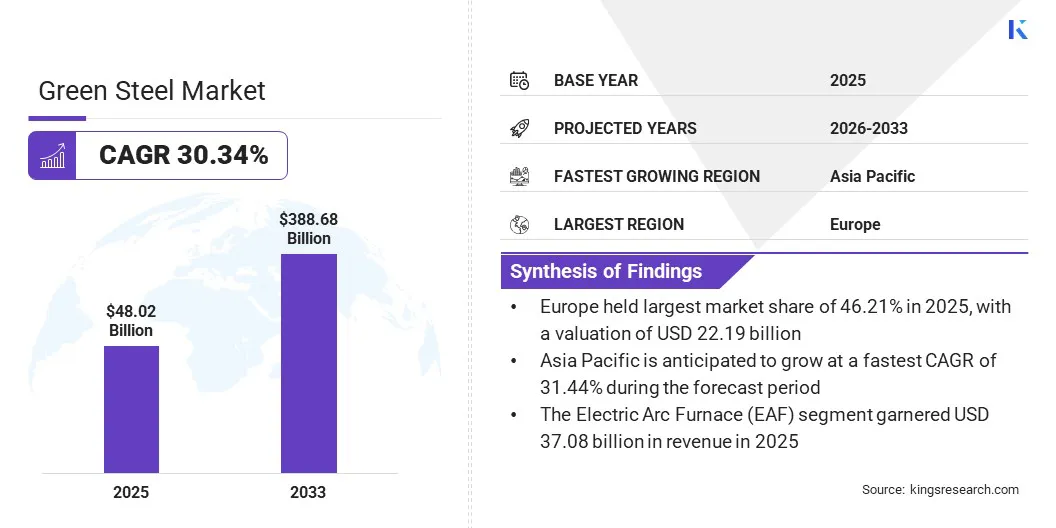
The global green steel market size was valued at USD 48.02 billion in 2025 and is projected to grow from USD 60.83 billion in 2026 to USD 388.68 billion by 2033, exhibiting a CAGR of 30.34% during the forecast period. The market is witnessing rapid growth, mainly driven by the increasing demand for environmentally responsible construction materials, sustainable automotive manufacturing, and cleaner industrial supply chains.
Major companies operating in the global green steel market are Nucor Corporation, ArcelorMittal, SSAB, Stegra AB, Tata Steel, NIPPON STEEL CORPORATION, Salzgitter AG, JFE Steel Corporation, voestalpine AG, JSW Group, LIBERTY Steel Group, Outokumpu, HBIS GROUP, SSG, and EMSTEEL.
Investments in renewable energy infrastructure, green hydrogen production, and next-generation steelmaking technologies are speeding up the commercialization of low-carbon steel production globally. Major steel producers are moving from pilot projects to commercial-scale deployments, and downstream industries are including green steel in their procurement plans to meet ESG commitments and regulatory requirements.
The growing focus on sustainability in the construction and automotive industries is propelling the demand for green steel. Builders, contractors, and infrastructure companies are seeking low-carbon materials to minimize the environmental impact of buildings and major projects, and to comply with ever-tightening environmental regulations.
Similarly, automotive manufacturers are under growing pressure to reduce emissions across their entire value chain. While the electrification process is addressing vehicle emissions, minimizing embedded carbon in manufacturing processes has become equally important. Green steel allows automakers to significantly reduce Scope 3 emissions while providing structural integrity, durability, and performance.
Green steel production, while environmentally beneficial, is considerably more expensive than conventional steelmaking. Hydrogen-based direct reduction, or electric arc furnaces (EAF) running on renewable energy, requires high capital costs, advanced infrastructure, and the availability of inexpensive renewable energy. The widespread availability and affordability of green hydrogen are also major hurdles, particularly in areas where infrastructure for its production is still at an early stage of development.
To overcome this challenge, industry leaders are investing in upgrading facilities or developing new production lines, increasing investments in research and development, forming strategic alliances, and advocating for supportive government policies and incentives. Production volumes are expected to grow, with costs expected to decrease over time as technology advances.
One of the major trends in the green steel industry is the fast-developing Hydrogen Direct Reduced Iron (H-DRI) with Electric Arc Furnace (EAF) technology, which substitutes coal with hydrogen in the reduction of iron, significantly reducing carbon emissions without sacrificing production efficiency benefits. The cost competitiveness of the hydrogen-based steelmaking route is expected to further improve as the price of renewable energy drops and green hydrogen production increases, thereby enabling broader commercial adoption.
Major steelmakers are heavily investing in pilot projects and scaling such technologies to achieve commercial viability. The push for Hydrogen DRI-EAF aligns with global decarbonization goals and is garnering heavy investments and strategic partnerships, setting higher standards for sustainable steelmaking.
|
Segmentation |
Details |
|
By Production Technology |
Electric Arc Furnace (EAF) (Scrap-Based/Renewable Power), Hydrogen-Based Direct Reduction (H-DRI), and Others |
|
By Energy Source |
Renewable Energy (Solar/Wind/Hydropower), Green Hydrogen, Sustainable Biomass, and Others |
|
By Product Form |
Flat Steel, Long Steel, Tubular Steel, and Specialty Steel |
|
By End User |
Building & Construction, Automotive & Transportation, Consumer Goods & Appliances, Energy & Power Infrastructure, Machinery & Industrial Equipment, Packaging, and Others |
|
By Region |
North America: U.S., Canada, Mexico |
|
Europe: France, UK, Spain, Germany, Italy, Russia, Rest of Europe |
|
|
Asia-Pacific: China, Japan, India, Australia, ASEAN, South Korea, Rest of Asia-Pacific |
|
|
Middle East & Africa: Turkey, U.A.E., Saudi Arabia, South Africa, Rest of Middle East & Africa |
|
|
South America: Brazil, Argentina, Rest of South America |
Based on region, the global green steel market has been classified into North America, Europe, Asia Pacific, Middle East & Africa, and South America.
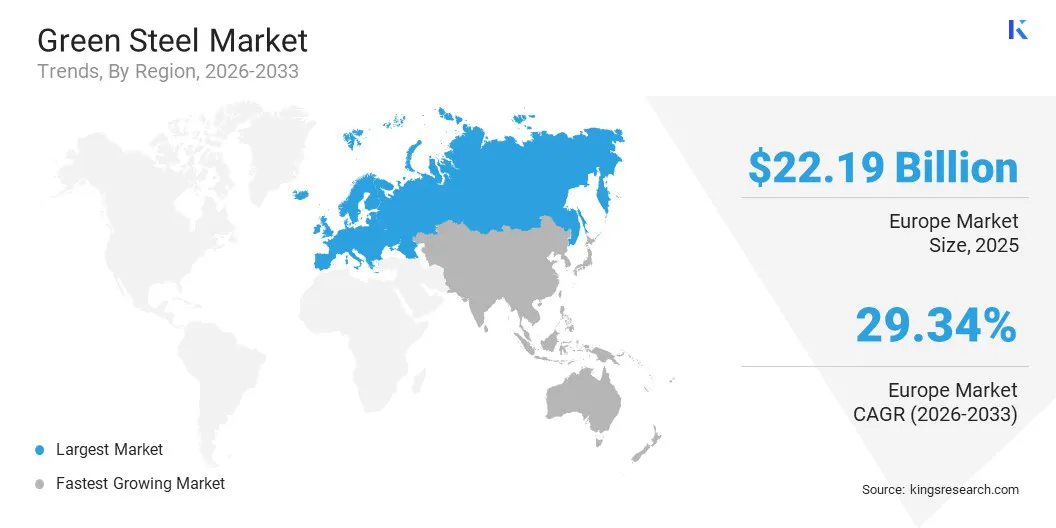
The Europe green steel market share stood at 46.21% in 2025, with a valuation of USD 22.19 billion. This leading position is supported by ambitious climate policies, strong carbon pricing mechanisms, and extensive investments in renewable energy and hydrogen infrastructure. The region has become a global hub for green steel innovation, with numerous large-scale projects under development across Sweden, Germany, and other European countries.
Regional market expansion is driven by robust demand from automotive manufacturers, construction companies, and industrial users. Commercialization is being accelerated by partnerships between steel producers, technology developers, and renewable energy companies.
The Asia-Pacific green steel market is set to grow at a CAGR of 31.44% over the forecast period. This expansion is propelled by rapid industrialization, rising environmental awareness, and government support for clean manufacturing technologies. Increasing investment in advanced steelmaking technologies and a strong emphasis on reducing environmental impact are driving the adoption of green steel. Regional governments are implementing supportive policies, incentives, and pilot initiatives to support the shift to low-carbon production.
The growth of end-use sectors such as construction, automotive, and infrastructure is also driving market growth as companies seek to meet sustainability targets and respond to consumer demand for greener products. Increased collaboration across the value chain is also fostering innovation and scale-up of green steel solutions in the region. The region’s strong manufacturing base and increasing demand for low-carbon industrial materials are expected to drive significant uptake of green steel solutions.
The global green steel market is highly competitive, with the presence of established steel manufacturers, new technology providers, renewable energy developers, and hydrogen infrastructure companies.
Key players are investing in R&D, strategic partnerships, and capacity expansion to gain leadership in the growing low-carbon steel sector. Companies are partnering with automotive manufacturers, construction companies, and energy suppliers to build integrated green steel value chains.
Competition is moving toward technology innovation, production efficiency, carbon reduction capabilities, renewable energy integration and access to green hydrogen resources. Strategic alliances and large investments are expected to continue to be important competitive differentiators as demand continues to grow.
Frequently Asked Questions

Aswathi holds cross-domain expertise, translating market trends and competitive intelligence into decision-ready insights. Her work helps clients interpret evolving market conditions and identify growth opportunities. She brings a focused, insight-led approach to research execution. She translates these findings into clear, prioritized action plans that align with client capabilities. Her research often includes scenario modeling to test growth strategies under varying economic conditions. She maintains a rigorous validation process, cross-checking primary and secondary sources to ensure reliability. Clients value her ability to synthesize noisy data into concise executive summaries that drive board-level discussions. Her sector-specific lens, combined with a pragmatic focus on execution, consistently delivers high-impact, commercially sound recommendations. Her structured yet flexible research frameworks adapt to client timelines without compromising depth. She is known for distilling complex trade-offs into straightforward, defensible positions that facilitate confident decision-making.
Habi is a seasoned research and consulting leader with renowned experience in guiding clients on strategic growth and transformation initiatives across global markets. He has led high-performing research teams that deliver actionable insights on market expansion, M&A strategies, opportunity assessment, new business development, and product launches. His project portfolio spans large petrochemical producers, electronic device manufacturers, lubricants companies, and other leading enterprises across diverse industrial and consumer sectors. He currently heads the research department at Kings Research, where he is responsible for setting the research agenda, mentoring analysts, and ensuring client-ready deliverables that support executive decision-making. With extensive experience in market intelligence, strategic research, and consulting, Habi brings a strong understanding of evolving industry dynamics, competitive landscapes, emerging opportunities, and business growth challenges. His expertise includes developing research frameworks, translating complex market data into actionable strategic recommendations, and working closely with senior stakeholders to address critical business questions. He has also contributed to building research capabilities, strengthening analytical methodologies, and driving a culture of quality and insight-led decision-making within research teams. His cross-industry exposure enables him to connect market trends with broader business implications and provide perspectives that help organizations identify opportunities, mitigate risks, and make informed strategic decisions.