Inquire Now
Key Strategic Points
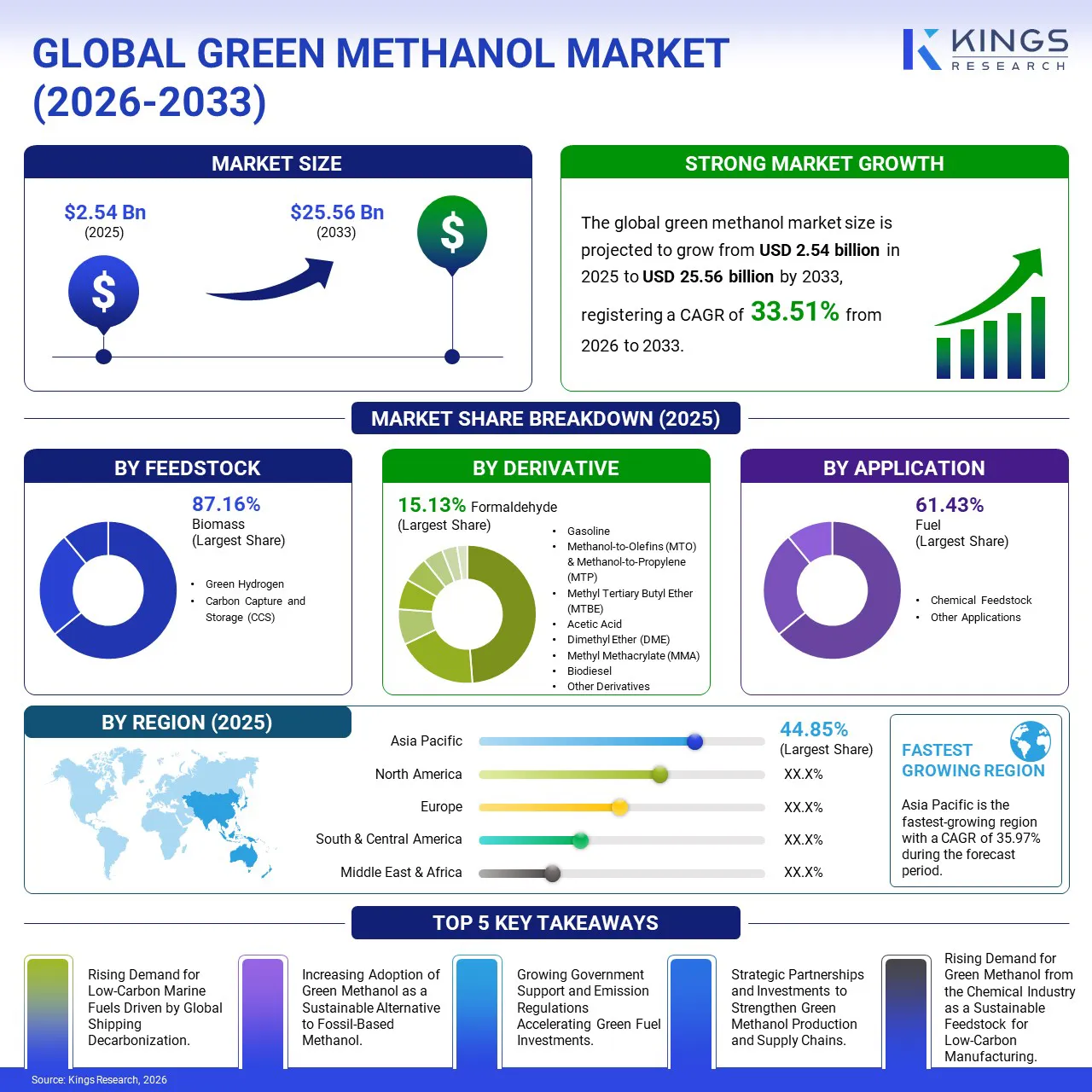
According to Kings Research, the global green methanol market size was USD 2.54 billion in 2025 and is projected to reach USD 25.56 billion by 2033, exhibiting a CAGR of 33.51% over the forecast period (2026-2033).
Market growth is mainly driven by the shipping industry's shift toward methanol-capable vessels, stricter greenhouse gas regulations for marine fuels in Europe and globally, and chemical producers' demand for lower-carbon feedstock for formaldehyde, olefins, and other derivatives. Government support for green hydrogen and biofuel projects, particularly in China and Europe, is helping convert announced capacity into operational plants, which is expected to support market expansion through 2033.
The market is transitioning from pilot-scale units and small biogas plants to commercial-scale facilities with annual production capacities reaching thousands of tons, thus creating significant opportunities for market expansion. Furthermore, the production of e-methanol using renewable energy, electrolyzers, and captured carbon dioxide is gaining momentum. Meanwhile, long-term supply agreements with shipping companies and chemical manufacturers are strengthening revenue visibility, facilitating project financing, and enabling producers to scale up production capacity, thereby supporting the overall growth of the green methanol market.
The shipping industry is a major end user for green methanol, with container lines, ferry operators, and car carrier owners ordering dual-fuel vessels that operate on methanol. Its liquid state at ambient temperature enables effective handling using modified existing bunkering equipment, and each vessel delivered creates a long-term demand for low-emission fuel.
In September 2026, the Global Methanol Alliance projected an increase in production capacity from 0.9 million tons to 6–12 million tons by 2031, driven by investments across marine fuels, aviation, road transport, and power generation. It further highlighted methanol as a well-established marine fuel, with more than 150 methanol-capable vessels in operation and over 290 on order that require certified bio-methanol and e-methanol to meet emission targets.
Moreover, national programs offering pilot plant funding, loans, and renewable fuel targets are reducing risks for first-of-a-kind projects. This support is particularly evident in China, where policies are directing renewable power, biomass, and hydrogen projects toward liquid fuels for shipping, chemicals, and exports.
In September 2025, China's National Energy Administration identified the first batch of nine green liquid fuel technology and industrialization pilot projects, including five for green methanol production. These projects can access policy and financing support, potentially accelerating construction and increasing Asia Pacific's share of global revenue.
Demand commitments from shipping companies and chemical buyers are growing faster than production capacity. Many announced projects have yet to reach a final investment decision, while others face long lead times for electrolyzers, biomass collection, and grid connections. Green methanol also costs several times more to produce than conventional methanol, limiting purchases beyond regulated or contracted demand.
According to an August 2025 Global Maritime Forum report, limited availability remains a key barrier to broader green methanol adoption, as it accounts for only a small fraction of total methanol supply. This gap is expected to sustain high prices in the near term and slow the conversion of vessel orders into actual fuel purchases.
Long-term fuel contracts and plant financing depend on clear carbon pricing and fuel standards. Delays in global regulation make it harder for shipowners to commit to multi-year purchases and for developers to secure financing, slowing capacity additions.
In October 2025, the International Maritime Organization agreed to adjourn the extraordinary session of its Marine Environment Protection Committee, which was considering the Net-Zero Framework, and reconvene after 12 months. Until a global framework is adopted, demand will depend largely on regional regulations and voluntary corporate targets, potentially delaying investment decisions for large projects.
Developers are combining biomass gasification with electrolytic hydrogen in single plants. Adding green hydrogen to biomass-derived syngas increases methanol output from the same feedstock, while shared infrastructure lowers production costs per ton. This approach supports larger plant capacities than standalone biomass or e-methanol routes.
In September 2026, Goldwind Science & Technology Co., Ltd. shipped the first batch of green methanol from its 1.45-million-ton-per-year biomass and green hydrogen project in Hinggan League, Inner Mongolia, according to Xinhua. The cargo was routed through Busan Port in South Korea for European buyers, highlighting the growing role of large-scale Chinese plants in international methanol trade.
Additionally, developers are building large complexes that produce multiple grades of low-carbon methanol at one site, combining electrolytic hydrogen with lower-cost production routes. Shared infrastructure spreads costs and offers buyers a choice of certified fuels, supporting the gradual adoption of e-methanol.
In October 2026, Transition Industries LLC signed an EPC agreement with Siemens Energy and Techint E&C for an approximately 210 MW electrolyzer facility at its Pacifico Mexinol project in Sinaloa, Mexico. The 6,130-metric-ton-per-day complex is planned to produce 175,000 tons of RFNBO e-methanol and 175,000 tons of recycled carbon fuel methanol annually, with operations targeted for 2030.
Moreover, port authorities that license methanol suppliers and develop storage and delivery infrastructure provide shipowners with greater fuel availability across major trade routes. Expanding bunkering networks also creates sales channels for producers and supports supply agreements tailored to individual ports.
In November 2025, the Maritime and Port Authority of Singapore announced three methanol bunkering licenses, valid from January 1, 2026, to December 31, 2030. These licenses support the development of methanol supply at a major bunkering hub and could create regular demand for green methanol.
|
Segmentation |
Details |
|
By Feedstock |
Biomass (Forestry & Agricultural Waste, Biogas from Landfill, Sewage, Municipal Solid Waste (MSW), and Black Liquor from Paper & Pulp Industry), Green Hydrogen, and Carbon Capture & Storage (CCS) |
|
By Derivative |
Gasoline, Methanol-to-Olefins (MTO) & Methanol-to-Propylene (MTP), Formaldehyde, Methyl Tertiary Butyl Ether (MTBE), Acetic Acid, Dimethyl Ether (DME), Methyl Methacrylate (MMA), Biodiesel, and Other Derivatives |
|
By Application |
Chemical Feedstock, Fuel, and Other Applications |
|
By Region |
North America: U.S., Canada, and Mexico |
|
Europe: France, UK, Spain, Germany, Italy, Russia, and Rest of Europe |
|
|
Asia Pacific: China, Japan, India, Australia, ASEAN, South Korea, and Rest of Asia Pacific |
|
|
Middle East & Africa: Turkey, U.A.E., Saudi Arabia, South Africa, and Rest of Middle East & Africa |
|
|
South & Central America: Brazil, Argentina, and Rest of South & Central America |
The biomass segment held the majority share of 87.16% in 2025, fueled by abundant availability of agricultural residues, forestry waste, and other organic feedstocks, along with established production technologies. Relatively lower feedstock costs, existing processing infrastructure, and growing demand for sustainable fuels further support its dominance.
The formaldehyde segment accounted for the largest share of 15.13% in 2025, supported by its use in resins for wood panels, insulation, and coatings. Growing demand from the building and construction, furniture, automotive, and material industries further drives green methanol consumption for formaldehyde production. Additionally, the shift towards sustainable chemical production encourages manufacturers to adopt bio-based methanol as a lower-carbon alternative to conventional fossil-based methanol.
The fuel segment accounted for the largest share of 61.43% in 2025, mainly due to the growing demand for low-carbon marine fuels and sustainable alternatives to conventional fossil fuels. Increasing adoption of green methanol in the shipping industry, supported by stringent emission regulations and decarbonization targets, further supports demand. Moreover, its compatibility with existing fuel infrastructure and methanol-powered vessels contributes to its leading share.
The global green methanol market is segmented into North America, Europe, Asia Pacific, Middle East & Africa, and South & Central America.
Asia Pacific
Asia Pacific held the largest share of 44.85% in 2025, with a valuation of USD 1.14 billion. China leads the region, with large biomass and e-methanol plants supported by renewable power in its northern provinces and national pilot programs. In June 2026, Carbon Recycling International, ehf. delivered and installed the world's largest e-methanol reactor for the Liaoyuan E-Methanol Project in Jilin Province, China. Its first phase is designed to produce approximately 170,000 tons of renewable methanol annually.
In Japan and South Korea, chemical companies and shipping lines are signing long-term supply contracts to secure green methanol for fleets and chemical plants. India's green hydrogen policies are supporting new e-methanol projects for exports and domestic bunkering, while Singapore is emerging as a regional fuel supply hub. These developments are expected to sustain Asia Pacific's position as the leading and fastest-growing market for green methanol.
North America
The North America green methanol market is projected to register a CAGR of 33.34% over the forecast period. The regional market benefits from an established conventional methanol industry, particularly along the U.S. Gulf Coast, where producers are developing low-carbon methanol for chemical and marine applications.
In March 2026, Methanex Corporation reported in its 2025 Management's Discussion and Analysis that interest in methanol as a marine fuel continues, with consumption influenced by regulations and fuel economics. In Canada, waste-to-fuel projects are developing renewable methanol for marine and chemical applications, while Mexico is witnessing the development of large planned complexes targeting certified fuel exports.
Europe
Europe accounted for a share of 33.18% in 2025, generating a valuation of USD 0.84 billion. Demand is supported by FuelEU Maritime, the EU Emissions Trading System, and renewable fuel targets that favor certified bio-methanol and e-methanol. These frameworks are encouraging production investments and strengthening demand across marine, chemical, and industrial applications.
In January 2026, European Energy A/S and Mitsui & Co., Ltd. secured a green financing bridge facility from Nordea and SMBC for Denmark's Kassø e-methanol facility. With an annual production capacity of up to 42,000 tons, the facility supplies A.P. Moller-Maersk, the LEGO Group, and Novo Nordisk. In May 2026, Liquid Wind AB submitted an environmental permit application for its EFÖvik eFuel facility in Örnsköldsvik, Sweden, which is planned to produce more than 100,000 tons of e-methanol annually using biogenic carbon dioxide. Similar projects in Sweden, Germany, and the Netherlands are expected to support regional market expansion.
Middle East and Africa
The Middle East and Africa accounted for a share of 4.12% in 2025. Abundant solar and wind resources, an established conventional methanol industry, and existing export infrastructure create favorable conditions for renewable methanol production targeting international marine and chemical markets.
The IEA's Global Hydrogen Review 2026, published in June 2026, reported that the Middle East accounts for close to 17% of global methanol production and that methanol prices increased by 60% between January and May 2026 following regional conflict. This volatility is encouraging buyers to diversify supply, creating opportunities for green methanol projects in the U.A.E., Saudi Arabia, Egypt, and Oman, particularly near the Suez Canal shipping route.
South and Central America
South and Central America accounted for 2.57% in 2025. Uruguay and Chile offer strong wind and solar resources, while Brazil's extensive biomass base supports the region's potential to develop e-methanol and bio-methanol facilities for export markets.
In February 2026, HIF Global LLC signed a heads of agreement with German eFuel One GmbH to supply about 100,000 tons of e-methanol annually from its planned Paysandú project in Uruguay, certified under EU RED III standards. Such export agreements are strengthening the region's position as a potential supplier of renewable methanol to international markets.
The green market comprises established methanol producers, renewable energy developers, technology licensors, and new companies focused only on e-fuels. Established producers such as Methanex Corporation and Proman AG contribute production, storage, and logistics assets, while developers such as European Energy A/S, Goldwind Science & Technology Co., Ltd., and HIF Global LLC bring access to renewable power and project development expertise.
Technology providers, including Johnson Matthey Plc, Topsoe A/S, and Carbon Recycling International ehf., license synthesis and gasification processes and collaborate with developers from the design stage. Competition is driven by production costs, certification under EU and international standards, long-term offtake agreements, and access to project financing.
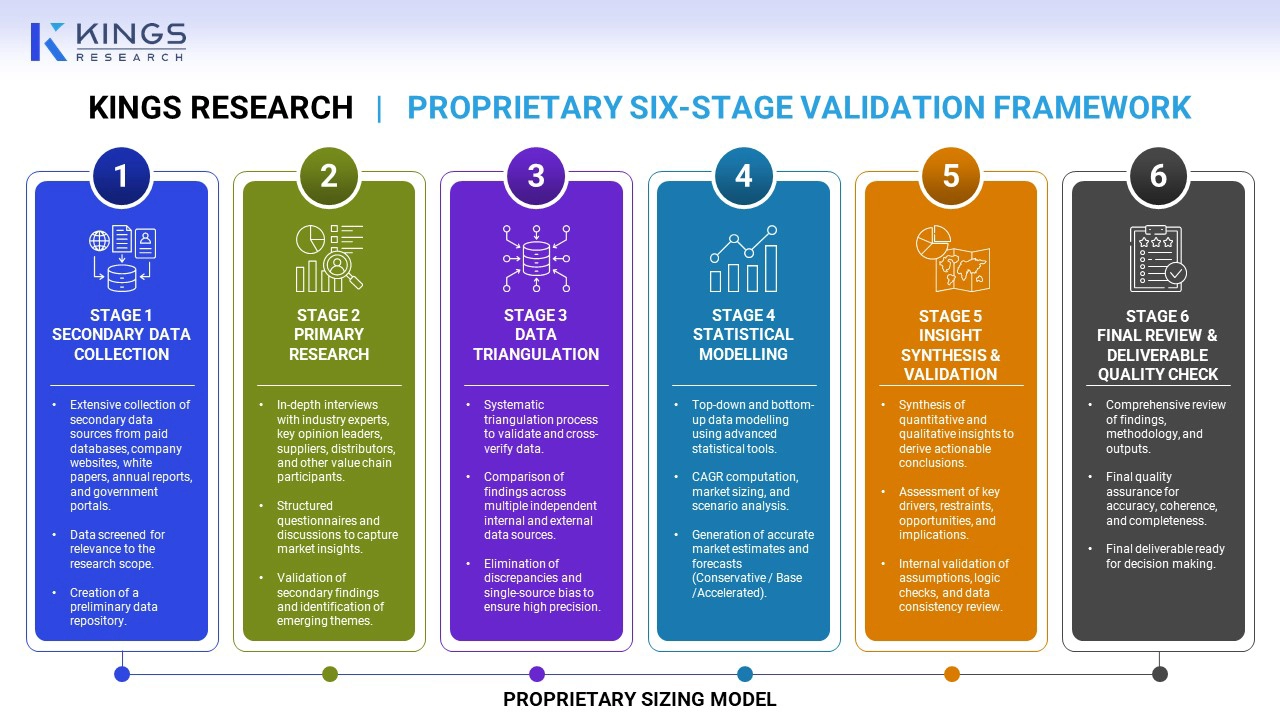
Our methodology triangulates insights from multiple independent and publicly available research databases and is further validated against regulatory filings and public company disclosures. All estimates are cross-verified; no single-source data is presented without validation.
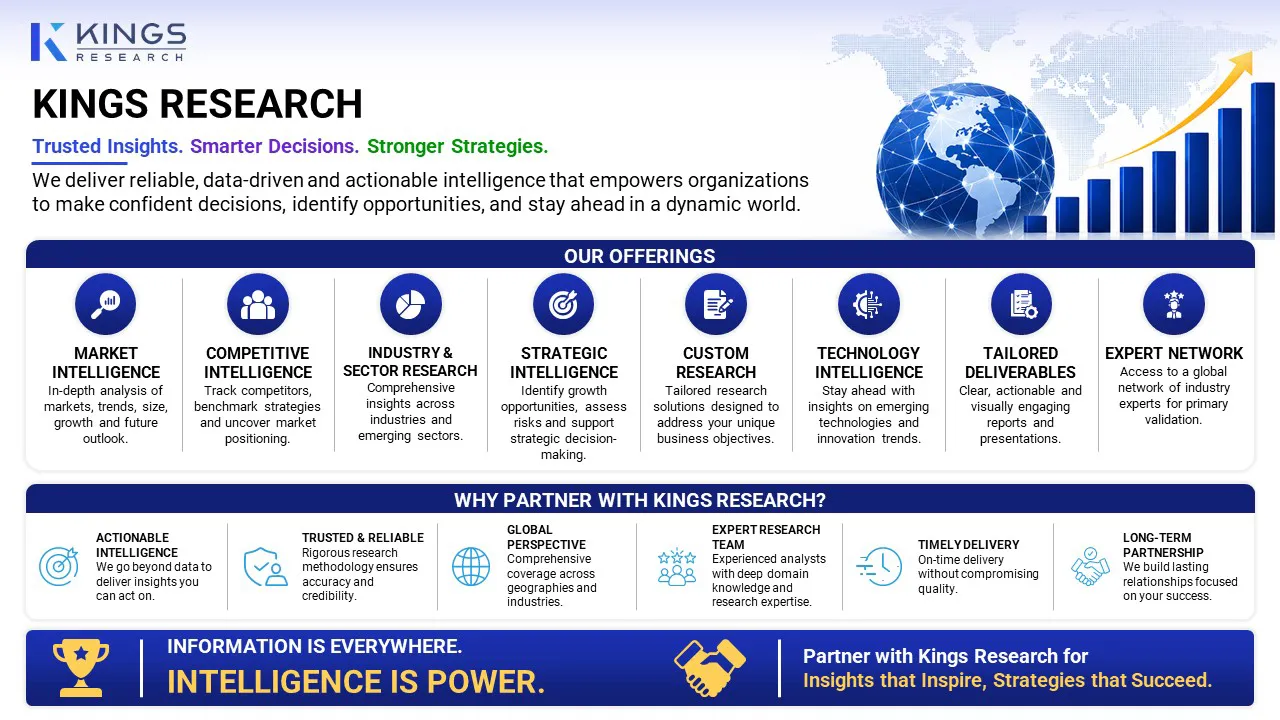
We deliver tailored, data-driven intelligence and strategic guidance to help organizations identify, evaluate, and capitalize on key market opportunities.
Frequently Asked Questions

Anurag Singh specializes in delivering actionable market intelligence across various domains such as ICT, IoT, Automotive & Transportation, Semiconductor & Electronics, Energy & Power, and Aerospace & Defence. With a background in Computer Science Engineering and extensive experience in market research, he brings a strong understanding of industry dynamics, emerging technologies, competitive landscapes, and evolving market opportunities. His expertise includes market sizing, forecasting, trend analysis, competitive benchmarking, and data-driven strategic insights. Anurag closely monitors technological advancements and shifting industry ecosystems to identify growth opportunities and emerging business trends. His research supports organizations in making informed strategic decisions, assessing market potential, understanding technology adoption, and navigating complex, rapidly evolving industries. Passionate about innovation and technology, he combines analytical expertise with a practical understanding of market developments to deliver meaningful insights that help businesses strengthen their strategies, identify new opportunities, and maintain a competitive edge in dynamic global markets.
With many years of consulting experience across global pharma, biotech, and MedTech markets, Minaz brings deep domain expertise, strategic clarity, and analytical rigor to every engagement. She has led 130+ consulting assignments spanning market entry, competitive landscaping, and portfolio prioritization, helping clients navigate complex, high-stakes decisions with confidence. Known for her ability to synthesize primary and secondary research into executive-ready recommendations, Minaz has built forecasting models and market sizing frameworks that have informed multi-million dollar investment decisions in oncology, diagnostics, and peptide therapeutics. Beyond her analytical strength, Minaz is a trusted client partner, translating complex datasets into clear, actionable insights for senior stakeholders. She currently leads a team of research analysts, driving business expansion, and shaping client engagement strategy.