
Inquire Now
Key Strategic Points
The textile recycling market refers to the industry and economic activities involved in the collection, processing, and repurposing of used or waste textiles. This market deals with the recycling of used clothing, fabrics, and other textile materials to be used as reusable fibers, new textile products, or raw materials for other industries. It seeks to minimize the environmental effects, conserve resources, and promote sustainable practices in the textile and apparel industries.
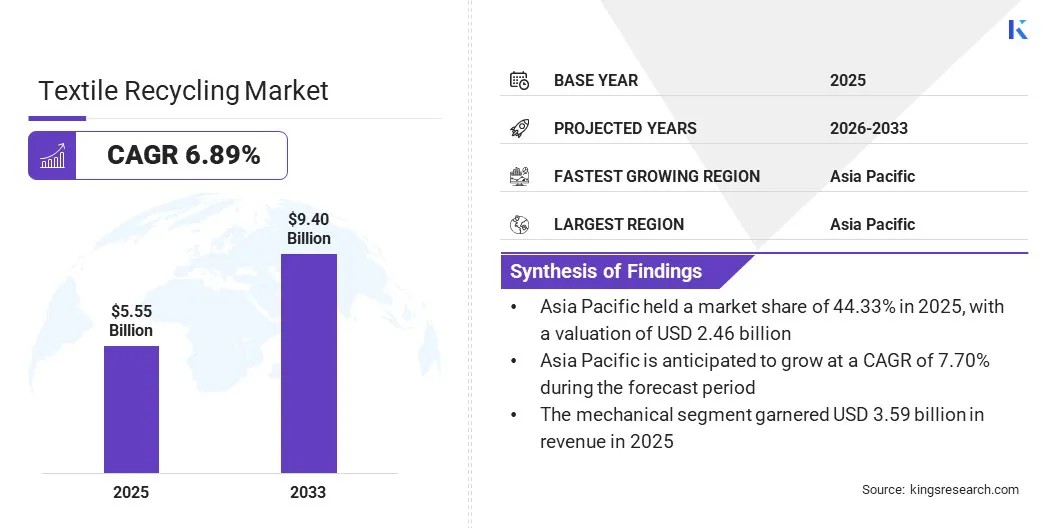
The global textile recycling market size was valued at USD 5.55 billion in 2025 and is projected to grow from USD 5.90 billion in 2026 to USD 9.40 billion by 2033, at a CAGR of 6.89% over the forecast period. This robust growth is driven by increasing environmental concerns, rising volumes of textile waste, and heightened regulatory focus on sustainable waste management practices.
Major companies operating in the global textile recycling industry are Lenzing AG, Liva by Birla Cellulose, UNIFI, Inc., Aquafil S.p.A., HYOSUNG, Infinited Fiber Company, Recover Textile Systems, S.L., Ambercycle, Inc., CARBIOS, Worn Again Technologies, CIRC, Loop Industries, Inc., Boer Group, Usha Yarns Ltd., and TEXAID.
Further, rising awareness among consumers and industries regarding the benefits of circular economy practices, as well as technology developments in recycling solutions, is driving market growth. As key players invest in innovative processes and strategic collaborations, the textile recycling market is poised for significant development, offering substantial opportunities for stakeholders across the value chain.
The textile recycling market is gaining traction due to the growing volumes of textile waste across the globe. The growth of fast fashion, population, and shifting consumer preferences has contributed to an unprecedented amount of discarded garments and fabrics. In March 2025, according to the United Nations Environment Programme (UNEP), 92 million tonnes of global textile waste was being generated each year.
This waste puts a strain on landfill space and also creates environmental pollution caused by microfibers and chemicals. Governments and organizations are increasing their efforts to regulate textile disposal and promote greenmarket textile recycling initiatives. The industry’s move toward sustainable waste management solutions is leading to higher investment in recycling technologies and new circular economy practices.
Much of the discarded clothing and fabrics are made of fabrics, fibers blended together, dyes, and finishing treatments, which are difficult and expensive to sort and process. The challenge is to integrate the recycling activities efficiently, as each material requires specialized handling and technologies to recover it effectively. Buttons, zippers, and embellishments further complicate the recycling process, as they are non-textile components. Thus, companies are investing in high-tech sorting technology, from AI-enabled systems to mechanized machines, to help identify and separate materials more precisely. Some are also working on chemical recycling processes that can break down mixed fibers to reusable raw materials, which add to the overall recycling costs.
Technological innovations are driving a transformative shift in the textile recycling industry, facilitating efficient and sustainable recycling processes. The collection, processing, and transformation of waste textiles into new materials are being done using innovations like automated sorting systems, AI-driven fiber identification, and advanced chemical recycling techniques. These technologies offer more accurate and faster sorting of various types of textiles, which is difficult due to fiber blends and impurities.
In addition, new recycling technologies can decompose complex fabrics into their constituents and enable the recycling of better-quality fibers. The industry is therefore heavily investing in research and development, using state-of-the-art solutions to increase resource recovery, reduce environmental impact, and promote the circular economy in textiles.
|
Segmentation |
Details |
|
By Material |
Cotton, Polyester, Wool, Polyamide, and Others |
|
By Source |
Apparel Waste, Home Furnishing Waste, and Other |
|
By Process Outlook |
Mechanical and Chemical |
|
By Region |
North America: U.S., Canada, Mexico |
|
Europe: France, UK, Spain, Germany, Italy, Russia, Rest of Europe |
|
|
Asia-Pacific: China, Japan, India, Australia, ASEAN, South Korea, Rest of Asia-Pacific |
|
|
Middle East & Africa: Turkey, U.A.E., Saudi Arabia, South Africa, Rest of Middle East & Africa |
|
|
South America: Brazil, Argentina, Rest of South America |
Based on region, the global market has been classified into North America, Europe, Asia Pacific, Middle East & Africa, and South America.
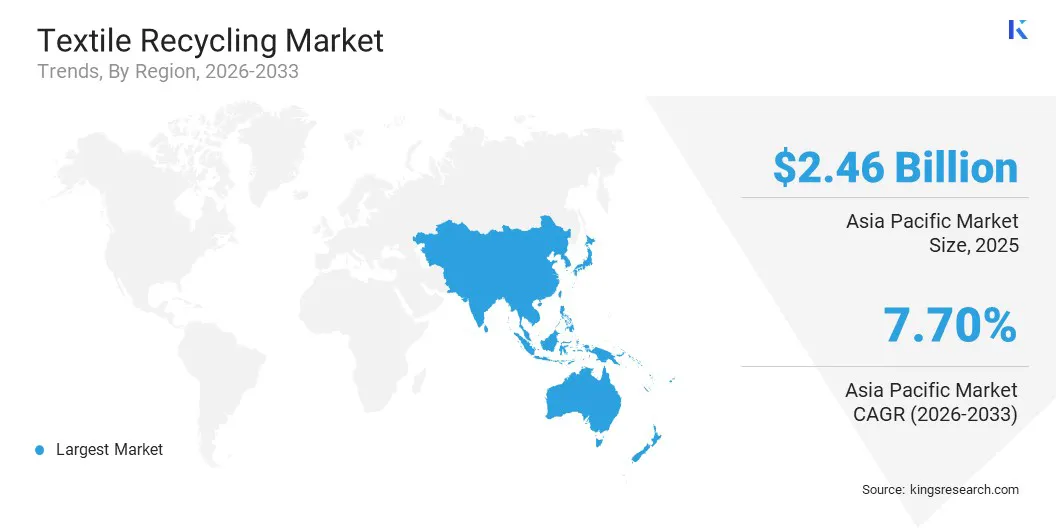
Asia Pacific textile recycling market share stood at 44.33% in 2025, valued at USD 2.46 billion. The region’s huge market share is attributed to its strong commitment towards sustainable practices, owing to a thriving textile manufacturing sector and growing consumer consciousness toward ecological issues. Recycling equipment and technology investments are improving waste collection, sorting, and processing efficiency. The market growth is also attributed to the rising trend of strategic partnerships for enhancing material recovery rates and supply chain optimization.
Moreover, the increasing focus on cost-effective recycling solutions and the development of innovative technologies for processing mixed-fiber waste are expected to drive market growth, with the region being a leader in the international textile recycling industry.
North America textile recycling market is set to grow at the fastest CAGR of 6.77% over the forecast period. The expansion of the market is being driven by a growing consumer awareness and demand for sustainable and eco-friendly products, coupled with a focus on corporate social responsibility by apparel brands and retailers. The growing number of textile collection programs and public-private partnerships are helping recycling services become more accessible, which is diverting textiles from landfills.
The market is also expanding owing to technological innovations that enable the application of sophisticated fiber blends and enhance the quality of recycled materials. Further, educational campaigns and incentive-based programs are leading individuals and organizations to participate in recycling activities, thus propelling the market’s sustained growth.
The textile recycling market is fragmented, with several established recycling companies, emerging startups, and large textile manufacturers entering the market. Key players are competing on recycling technology, processing capacity, geographical presence, and collaborations with apparel brands or municipalities. Market consolidation is also increasing, with larger companies buying startups to boost their recycling capabilities. Furthermore, there is a rising degree of collaboration between brands, recyclers, and other technology providers to improve resource recovery and chain integration. Leading companies continue to invest heavily in R&D for further streamlining of processes and quality of products.
Frequently Asked Questions

Aswathi holds cross-domain expertise, translating market trends and competitive intelligence into decision-ready insights. Her work helps clients interpret evolving market conditions and identify growth opportunities. She brings a focused, insight-led approach to research execution. She translates these findings into clear, prioritized action plans that align with client capabilities. Her research often includes scenario modeling to test growth strategies under varying economic conditions. She maintains a rigorous validation process, cross-checking primary and secondary sources to ensure reliability. Clients value her ability to synthesize noisy data into concise executive summaries that drive board-level discussions. Her sector-specific lens, combined with a pragmatic focus on execution, consistently delivers high-impact, commercially sound recommendations. Her structured yet flexible research frameworks adapt to client timelines without compromising depth. She is known for distilling complex trade-offs into straightforward, defensible positions that facilitate confident decision-making.
Habi is a seasoned research and consulting leader with renowned experience in guiding clients on strategic growth and transformation initiatives across global markets. He has led high-performing research teams that deliver actionable insights on market expansion, M&A strategies, opportunity assessment, new business development, and product launches. His project portfolio spans large petrochemical producers, electronic device manufacturers, lubricants companies, and other leading enterprises across diverse industrial and consumer sectors. He currently heads the research department at Kings Research, where he is responsible for setting the research agenda, mentoring analysts, and ensuring client-ready deliverables that support executive decision-making. With extensive experience in market intelligence, strategic research, and consulting, Habi brings a strong understanding of evolving industry dynamics, competitive landscapes, emerging opportunities, and business growth challenges. His expertise includes developing research frameworks, translating complex market data into actionable strategic recommendations, and working closely with senior stakeholders to address critical business questions. He has also contributed to building research capabilities, strengthening analytical methodologies, and driving a culture of quality and insight-led decision-making within research teams. His cross-industry exposure enables him to connect market trends with broader business implications and provide perspectives that help organizations identify opportunities, mitigate risks, and make informed strategic decisions.