

What is Aerogel?
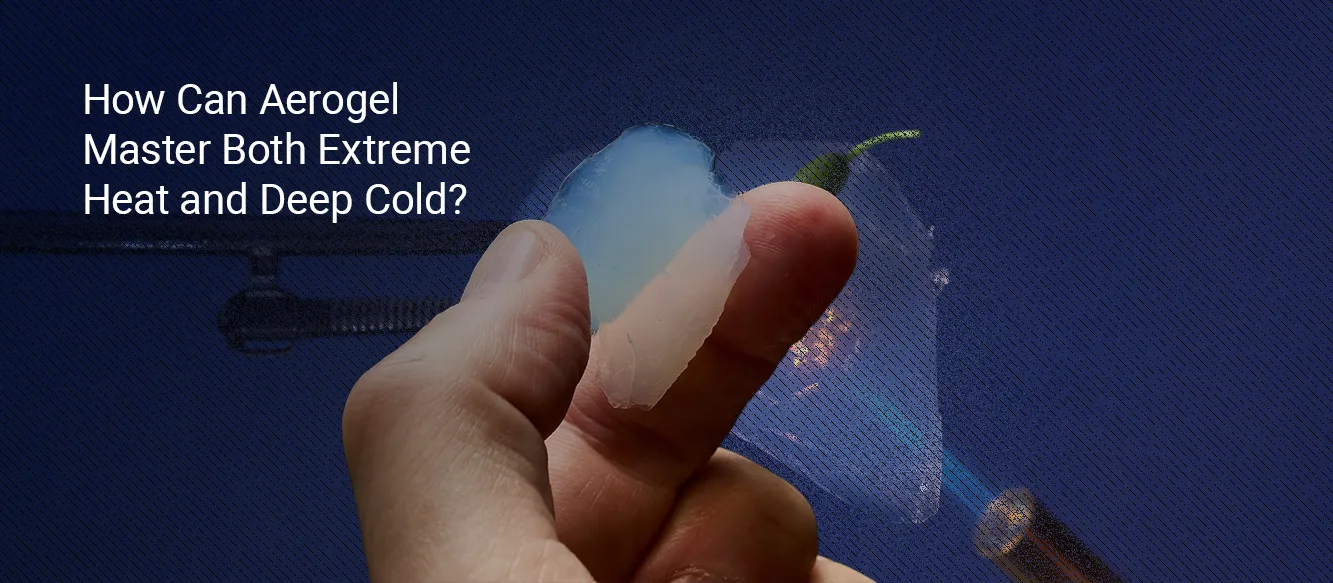
Aerogel is one of the lightest solid materials on Earth. It is created by taking a gel and replacing its liquid components with gas, leaving behind a dry, incredibly porous structure. Because it is mostly trapped air, aerogel acts as an ultimate thermal barrier, blocking heat transfer far better than traditional insulation like fiberglass or foam.
As per Kings Research, the global aerogel market was valued at USD 1,220.8 million in 2025 and is projected to grow from USD 1,417.4 million in 2026 to reach USD 4,646.5 million by 2033, representing a compound annual growth rate (CAGR) of 18.48% from 2026 to 2033. This commercial trajectory demonstrates an urgent industrial shift toward advanced material solutions capable of handling extreme thermal challenges across energy, processing, and transportation infrastructure.
Industrial facilities across the globe consume massive quantities of primary energy, yet substantial thermal volume dissipates into the surrounding ambient air. Data published by the U.S. Department of Energy (DOE) estimates that between 20% and 50% of total industrial energy input is discharged as waste heat in the form of hot exhaust gases, cooling water discharges, and thermal dissipation from hot equipment surfaces. According to statistics from the U.S. Energy Information Administration (EIA), the industrial sector accounts for approximately 33% of total U.S. energy consumption, consuming over 30 quadrillion British thermal units (Btu) annually.
Managing thermal energy across extreme temperature scales represents a foundational engineering priority. Industrial processing facilities require continuous thermal stability across temperature differentials spanning hundreds of degrees Celsius. From sub-zero liquefied natural gas (LNG) transfer systems operating at -162 degrees Celsius to high-temperature industrial cracking furnaces running above 600 degrees Celsius, effective thermal barrier systems directly dictate operational fuel efficiency, workplace safety, and asset reliability. Standard silica aerogel materials offer a high-performance alternative to legacy thermal barriers by providing low thermal conductivity within thin physical profiles.
What Makes Industrial Heat Management a Critical Engineering Challenge Today?
Industrial thermal control remains a difficult engineering discipline due to aggressive operating conditions, strict regulatory safety limits, and physical spatial constraints inside complex processing facilities. Processing plants, oil refineries, and chemical manufacturing complexes rely on continuous thermal fluid circulation. Thermal energy loss increases fuel consumption, elevates greenhouse gas emissions, and raises utility expenses. Mechanical insulation upgrades on industrial steam distribution systems provide major efficiency gains, with typical savings ranging from 3% to 13% of natural gas usage, proving that uninsulated or degraded thermal lines bleed significant energy into the environment.
Four primary systemic factors define this ongoing industrial engineering challenge:
- Uncontrolled Thermal Loss: Steam distribution piping, distillation columns, and chemical reactors release gigajoules of thermal energy continuously into surrounding ambient air. This thermal dissipation forces boilers and process heaters to burn additional natural gas or heavy fuel oil to sustain core process temperatures.
- Personnel Workplace Hazards: Industry standards, such as ASTM C1055, recommend that exposed surface temperatures stay below 60 degrees Celsius (140 degrees Fahrenheit) to prevent contact burn injuries among plant technicians. When legacy insulation breaks down, surface temperatures spike rapidly above safe human touch limits.
- Corrosion Under Insulation (CUI): Standard fibrous insulation blankets readily absorb atmospheric moisture and industrial liquids. Trapped liquid water held directly against outer metallic pipe surfaces initiates rapid electrochemical corrosion. CUI remains a primary driver of catastrophic pipe wall ruptures, hazardous fluid leaks, and unscheduled facility shutdowns.
- Spatial Limitations in Pipeline Racks: Offshore oil platforms, chemical plants, and refineries feature tightly clustered pipe racks with minimal physical clearance. Installing thick layers of legacy insulation remains physically impossible in restricted spaces, leaving high-temperature lines under-insulated.
How Does Aerogel Structure Enable Performance Across Extreme Temperatures?
Silica aerogel is a synthetic solid material made from a silica gel matrix in which specialized drying processes extract the internal liquid phase, leaving a solid nanostructure containing over 95% to 99.8% air porosity by volume. Depending on the formulation and manufacturer, such as those evaluated under industrial specifications like ASTM C1728, silica aerogels possess ultra-low bulk densities and nano-scale pore sizes that vary widely by product grade. Pore size diameters typically measure between 10 and 100 nanometers, with the average falling tightly between 20 and 40 nanometers. This nano-porous framework suppresses heat movement at the structural level.
Heat energy transfers through physical media via three distinct mechanisms: solid conduction, gas-phase conduction, and thermal radiation. Silica aerogel restricts heat transfer across all three pathways simultaneously:
-
Solid Conduction Suppression
The solid silica framework constitutes less than 5% of total material volume. Heat moving through the solid matrix must navigate a complex, highly tortuous chain of nanometer-scale silica clusters. This long conductive distance creates high thermal resistance, suppressing solid-state thermal transport.
-
Gas Convection Elimination (The Knudsen Effect)
At atmospheric pressure and room temperature, gas molecules in air have a mean free path of approximately 67 nanometers between collisions. The internal pore diameter of silica aerogel averages 20 to 40 nanometers. Because the pore boundaries are smaller than the mean free path of air, gas molecules collide with pore walls far more frequently than with other gas molecules. This behavior, known as the Knudsen Effect, prevents gas-phase conduction currents and dramatically restricts gas thermal conduction.
-
Radiant Infrared Attenuation
At elevated operating temperatures above 300 degrees Celsius, thermal radiation becomes the dominant mode of energy transfer. Integrating opacifiers such as carbon black, titania, or iron oxide into the aerogel composite absorbs and scatters infrared radiation, maintaining stable thermal resistance up to 650 degrees Celsius.
Through these combined structural mechanisms, silica aerogel achieves ambient thermal conductivity values between 0.015 and 0.020 W/(m·K), which is substantially lower than still, motionless air at 0.026 W/(m·K).
Why Do Conventional Insulation Materials Fail in Dual Extreme Conditions?
Traditional industrial thermal insulation materials were designed for narrow, specific temperature regimes. When subjected to severe thermal swings or moisture-laden outdoor environments, conventional materials exhibit structural degradation, water retention, or mechanical compaction.
- Fiberglass Insulation: Highly susceptible to liquid water accumulation. Wet fiberglass thermal conductivity increases from a dry value of 0.035 W/(m·K) to approach the conductivity of liquid water (approximately 0.60 W/(m·K)), representing an approximately 17-fold increase in thermal conductivity while accelerating CUI.
- Mineral Wool Insulation: Performs adequately at high temperatures, but requires thick physical dimensions to achieve target heat loss limits. Under continuous mechanical vibrations from pumps and compressors, mineral wool fibers settle, leaving uninsulated gaps along upper pipe surfaces.
- Polyurethane Foam: Delivers low initial thermal conductivity in refrigeration applications, but breaks down structurally at temperatures above 110 degrees Celsius and off-gases toxic compounds during fire exposure.
- Cellular Glass: Resists moisture ingress, but remains heavy, brittle, and prone to cracking under rapid thermal expansion and contraction cycles.
Technical Performance Comparison Table
|
Material Type |
Thermal Conductivity at 25°C (ASTM C177 / C518) [W/(m·K)] |
Bulk Density [kg/m³] |
Temperature Stability Range [°C] |
Relative Thickness Required for Equivalent Barrier |
Hydrophobic Water Repellency Rating |
Typical reference standard |
|
Silica Aerogel Blanket (High-Temperature Grade) |
0.015 - 0.020 |
100 - 220 |
0 to +650 |
1.0x (Baseline Reference) |
High (>99% Water Repellent) |
ASTM C1728 |
|
Silica Aerogel Blanket (Cryogenic Grade) |
0.015 - 0.020 |
100 - 220 |
-253 to +125 |
1.0x (Baseline Reference) |
High (>99% Water Repellent) |
ASTM C1728 |
|
Fiberglass Insulation |
0.032 - 0.040 |
30 - 100 |
-40 to +450 |
2.0x - 2.5x |
Low (Absorbs Moisture) |
ASTM C547 / C592 |
|
Mineral Wool |
0.035 - 0.044 |
40 - 160 |
-50 to +700 |
2.2x - 2.8x |
Low (Absorbs Moisture) |
ASTM C547 / C592 |
|
Polyurethane Foam |
0.022 - 0.028 |
30 - 60 |
-150 to +110 |
1.4x - 1.6x |
Moderate (Closed Cell) |
ASTM C1029 |
|
Cellular Glass |
0.040 - 0.050 |
110 - 160 |
-260 to +430 |
2.5x - 3.0x |
High (Vapor Impervious) |
ASTM C552 |
How Is Aerogel Addressing Thermal Runaway Risks in EV Battery Systems?
Electric vehicle (EV) safety engineering centers on preventing battery cell thermal runaway propagation. When an individual lithium-ion battery cell experiences an internal short circuit, overcharging, or physical puncture, internal temperatures escalate rapidly. Unchecked heat transfers to adjacent battery cells, triggering a cascading, irreversible fire across the entire battery pack.
Automotive engineers install thin silica aerogel sheets (1.0 mm to 2.0 mm thick) directly between individual pouch or prismatic cells. Aerogel sheets provide high fire resistance, low thermal conductivity, and structural integrity under mechanical compression loads. According to manufacturer testing and automotive design specifications, these thin silica aerogel barriers maintain adjacent cell temperatures below the critical 80 degrees Celsius decomposition threshold during localized thermal runaway incidents that can exceed 800 degrees Celsius. This performance satisfies international electric vehicle safety standards, including the United Nations Global Technical Regulation (GTR) No. 20 and the UNECE R100 standard for battery safety.
How Does Aerogel Improve Efficiency in Cryogenic LNG and Industrial Storage Systems?
Liquefied natural gas (LNG) must be maintained at -162 degrees Celsius (-260 degrees Fahrenheit) during ocean transport and pipeline transfer to retain its liquid state. External heat leaking into cryogenic tanks causes liquid fuel to vaporize into Boil-Off Gas (BOG). Excessive BOG raises internal tank pressure, requiring flaring or energy-intensive re-liquefaction operations.
Global LNG trade has expanded significantly, with EIA data indicating that global trade volumes regularly increased by 5.4% to a record 56.3 billion cubic feet per day (Bcf/d) in 2025. This immense scale emphasizes the necessity for efficient cryogenic insulation systems. Conventional cryogenic insulation materials like cellular glass or polyurethane foam become brittle and crack under extreme thermal contraction stress. Advanced aerogel products, such as Aspen’s Cryogel Z, solve this by remaining flexible down to -253 degrees Celsius while incorporating an integral zero-permeance vapor retarder to block moisture entirely. To understand how these cryogenic demands are shaping the supply chain, you can review the detailed segment breakdown in the Kings Research aerogel market report.
What Role Does Aerogel Play in High-Temperature Aerospace and Industrial Applications?
Aerospace design requires advanced lightweight insulation materials capable of surviving severe thermal environments without adding parasite mass. The NASA Jet Propulsion Laboratory (JPL) pioneered silica aerogel deployment on interplanetary missions, including the Mars Pathfinder, Stardust comet sample collector, and Mars Exploration Rovers (Spirit and Opportunity).
In heavy industrial processing, high-temperature aerogel composite blankets opacified with carbon or titania are deployed on steam turbines, continuous casting units, and processing furnaces. High-temperature aerogel pipe retrofits maintain outer surface touch temperatures below 60 degrees Celsius while internal steam or process fluid temperatures exceed 550 degrees Celsius. Because aerogel blankets withstand continuous temperatures up to 650 degrees Celsius without sagging or crumbling, facilities can insulate tight pipe bends, valves, and complex flanges that were previously left uninsulated.
Installation, Dust Management, and Occupational Safety
While aerogel provides significant operational safety benefits regarding burn protection and fire resistance, contractors frequently note that cutting and installing flexible aerogel blankets generates substantial nuisance dust. Because the silica matrix is fundamentally dry and friable, mechanical abrasion during installation releases fine particulate matter into the air. To mitigate this, installers must follow standard industrial dust management practices. This includes utilizing proper personal protective equipment (PPE), such as fitted particulate respirators, work gloves, and safety goggles, alongside localized ventilation when cutting rolls on site.
How Do Cost vs Performance Trade-Offs Shape Aerogel Adoption Decisions?
Aerogel carries higher initial procurement costs per square meter compared to standard fiberglass or mineral wool. High upfront material costs stem from supercritical fluid extraction processes, where liquid solvent is extracted from silica gel under high pressures and elevated temperatures to preserve the delicate nanoporous structure.
Evaluating insulation purely on upfront material cost provides an incomplete financial picture. Looking at the total cost of ownership (TCO), an EiiF fact sheet covering industrial insulation case studies reports rapid paybacks ranging from a few months to 1–3 years through reduced energy consumption.
Aerogel insulation contributes to lifecycle savings by enabling thinner insulation profiles, which reduce transportation and storage requirements compared to traditional bulky materials. Its flexible blanket form also simplifies installation around complex geometries, lowering labor time during maintenance cycles.
Additionally, hydrophobic aerogel materials resist water absorption, helping mitigate corrosion under insulation (CUI), a major cause of industrial asset degradation, thereby improving long-term system reliability.
How Are Innovations in Manufacturing Improving Aerogel Scalability?
High production costs historically limited aerogel adoption to specialized niche applications. Chemical engineers, material scientists, and industrial developers are implementing new manufacturing techniques to scale production and lower unit costs:
- Ambient Pressure Drying (APD): This is no longer purely future technology. Cabot Corporation has already successfully commercialized an APD process to allow continuous production of aerogel under ambient conditions (producing materials like Lumira aerogel). Meanwhile, ongoing research supported by the National Science Foundation (NSF) and the U.S. DOE Industrial Technologies Office (as documented in recent federal manufacturing grant abstracts) focuses on expanding these ambient pressure techniques into flexible blanket manufacturing. By bypassing the high-pressure supercritical carbon dioxide extraction phase, APD lowers capital equipment construction costs for new manufacturing plants.
- Alternative Low-Cost Feedstocks: Rather than relying on expensive refined alkoxysilanes (such as TEOS or TMOS), newer synthesis pathways utilize low-cost industrial mineral byproducts, including fly ash, rice husk ash, and recycled silicate glass.
- Fiber-Reinforced Roll Composites: Mechanically integrating silica aerogel directly into non-woven fiberglass, PET, or carbon fiber mats yields flexible, roll-based insulation products. These composites resist mechanical wear, reduce dust generation, and allow standard industrial cutting tools during site installation.
Which Industries Are Driving the Next Wave of Aerogel Adoption?
Rising global energy prices, stringent decarbonization mandates, and strict safety regulations are accelerating aerogel adoption across key industrial sectors:
- Electric Vehicles: Driven by international vehicle safety standards requiring complete containment of battery cell thermal runaway fires. Aerogel blankets protect passenger cabins and structural battery enclosures.
- Oil, Gas, and Chemical Processing: Deepwater subsea pipelines, offshore production platforms, refinery steam grids, and cryogenic LNG export terminals deploy aerogel to prevent hydrate formation, wax deposition, and boil-off gas losses.
- Commercial and Industrial Building Construction: Space-constrained urban building retrofits utilize ultra-thin aerogel insulation boards and thermal plasters to satisfy zero-energy building mandates without reducing interior usable floor area.
- Aerospace and Defense: Spacecraft thermal shields, launch vehicle fairings, and military jet engine cowlings rely on ultra-light aerogel composites to protect critical avionics from extreme radiant thermal loads.
Industrial Material Selection Matrix
Selecting the appropriate thermal insulation material requires balancing operational temperature bounds, spatial limits, moisture risk, and financial capital availability.
Comprehensive Application Decision Table
|
Target Application Environment |
Primary Operational Thermal Risk |
Recommended Material Selection |
Primary Engineering Selection Factor |
Typical reference standard |
|
EV Battery Module Barrier |
Cell thermal runaway fire (>800°C) |
Ultra-thin Silica Aerogel Sheet |
Ultra-thin physical profile (1-2 mm) |
NREL / NASA |
|
Subsea Oil & Gas Flowline |
Hydrate and paraffin wax blockage |
Flexible Aerogel Composite Wrap |
High compressive resistance & low k-value |
U.S. DOE / Offshore Tech |
|
Cryogenic LNG Transfer Line |
Boil-off gas creation (-162°C) |
Cryogenic Aerogel Blanket |
Thermal contraction resistance & flexibility |
NASA Kennedy CTL |
|
Refinery Steam Distribution |
Energy dissipation & severe CUI (300°C) |
Removable Aerogel Jacket |
High water repellency & tight wrap fit |
U.S. DOE Industrial Tech |
|
Ambient HVAC Ductwork |
Moderate conductive heat loss (25°C-60°C) |
Fiberglass / Mineral Wool |
Low initial material procurement cost |
NIST / ASHRAE 90.1 |
What Strategic Role Will Aerogel Play in Future Thermal Engineering Systems?
Industrial thermal engineering is undergoing a transition away from bulky, short-lived insulation toward advanced, durable material systems capable of surviving extreme environments. While traditional fibrous materials remain suitable for low-severity, budget-constrained applications, they fail to meet modern energy efficiency, spatial, and durability standards across extreme temperature scales.
Silica aerogel offers an effective, scientifically validated solution to industrial waste heat loss, battery thermal runaway risks, and cryogenic fuel boil-off losses. Aligning with decarbonization frameworks such as the U.S. Department of Energy (DOE) Industrial Decarbonization Roadmap, which targets net-zero industrial greenhouse gas emissions by 2050, aerogel materials provide the thermal performance required to meet aggressive sustainability goals. As ambient pressure drying technology scales up and manufacturing unit costs drop, silica aerogel is positioned to become a standard baseline specification across global industrial thermal engineering systems.
To review detailed growth projections and industrial demand drivers through 2033, access the Global Aerogel Industry Report by Kings Research.
Frequently Asked Questions
Is aerogel better than fiberglass insulation?
Yes, when compared at equal thickness, silica aerogel delivers roughly two to two and a half times the thermal resistance of fiberglass. Aerogel is highly hydrophobic, preventing water accumulation and corrosion under insulation, whereas fiberglass absorbs moisture and loses thermal performance.
Can aerogel withstand extreme temperatures?
Silica aerogel composites operate reliably across broad temperature ranges, maintaining structural integrity from cryogenic levels (down to -253 degrees Celsius) up to continuous high-temperature operating conditions (650 degrees Celsius). Formulations containing infrared opacifiers manage high thermal exposures effectively.
Why is aerogel expensive?
Production costs stem from traditional supercritical extraction processes, which require high-pressure, high-temperature equipment to extract liquid solvent from the silica gel without collapsing its nanoporous matrix. Manufacturing innovations like ambient pressure drying are reducing unit costs.
Where is aerogel used in industry?
Aerogel is deployed to insulate high-temperature refinery steam lines, deepwater oil pipelines, cryogenic LNG transfer systems, electric vehicle battery safety barriers, aerospace heat shields, and energy-efficient building enclosures.
Is aerogel suitable for cryogenic insulation?
Yes, flexible aerogel blankets perform exceptionally well at sub-zero temperatures down to liquid nitrogen (-196 degrees Celsius) and liquid hydrogen (-253 degrees Celsius). Aerogel retains flexibility without cracking under severe thermal contraction.