Inquire Now
Key Strategic Points
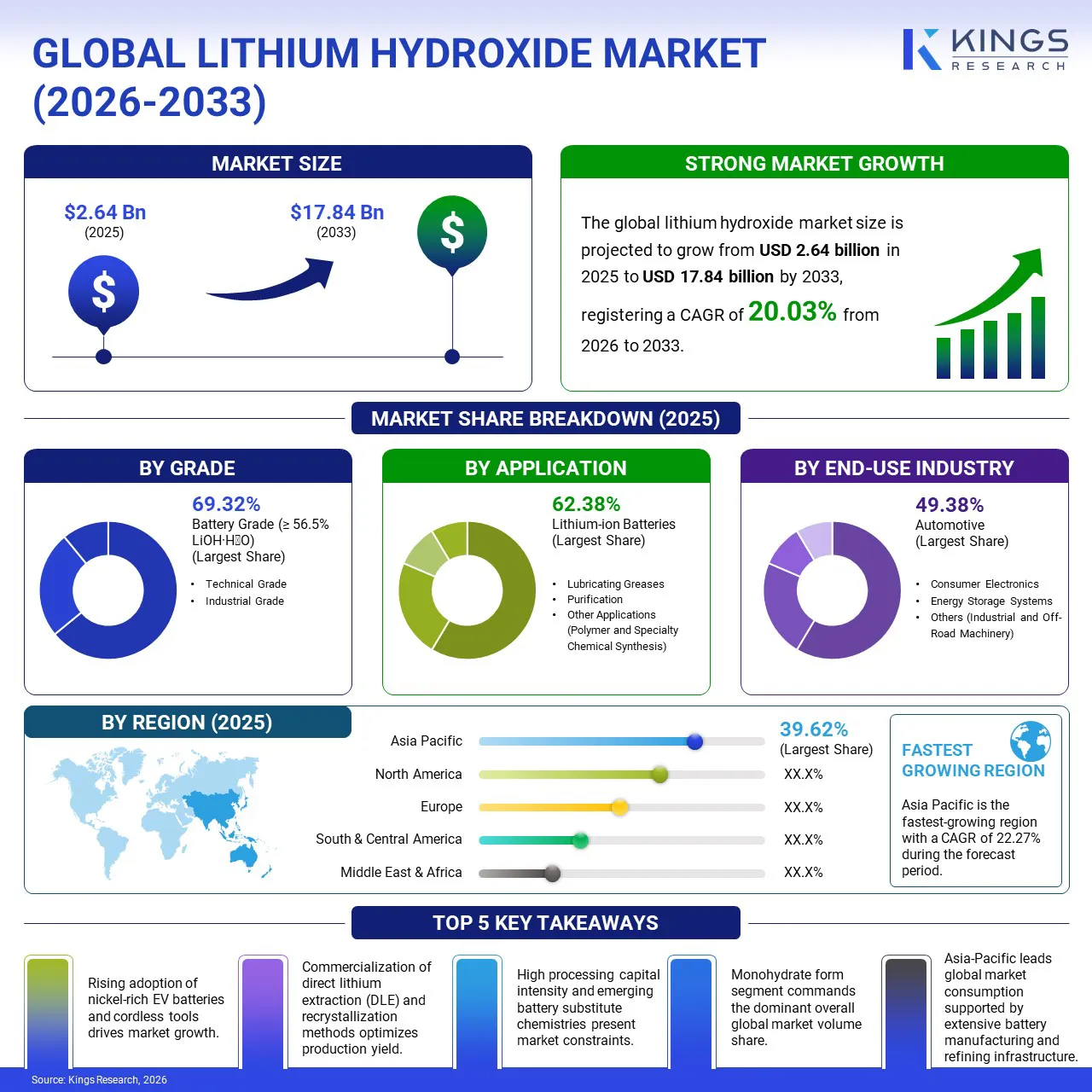
According to Kings Research, the global lithium hydroxide market size was USD 2.64 billion in 2025 and is projected to reach USD 17.84 billion by 2033, exhibiting a CAGR of 20.03% over the forecast period (2026-2033).
Market growth is primarily driven by rising demand for lithium hydroxide in nickel-rich cathode materials used in electric vehicle (EV) batteries, expanding lithium-ion battery manufacturing, and increasing deployment of battery energy storage systems (BESS). Investments in domestic lithium conversion and refining capacity, particularly across North America and Europe, are strengthening regional supply chains and supporting market expansion. Additionally, advancements in lithium extraction, processing, and recycling technologies are expected to improve battery-grade lithium hydroxide availability and support long-term growth.
The market encompasses the global production and sale of lithium hydroxide in monohydrate (LiOH·H₂O) and anhydrous forms across battery, technical, and industrial grades. Market valuation is based on producers' realized revenues from lithium hydroxide sales and excludes lithium carbonate, lithium chloride, lithium metal, and upstream lithium-bearing resources such as spodumene and brine.
The evolution of EV battery manufacturing, rising demand for battery-grade materials, and investments in regional lithium refining capacity are encouraging producers to adopt cost-efficient lithium conversion technologies, integrated supply chains, and recycled lithium feedstock processing. These developments aim to improve production economics and ensure consistent product quality. Alongside growing demand from automotive and energy storage applications, they are expected to create new growth opportunities throughout the forecast period.
The global transition to clean energy and electric mobility is creating demand for lithium hydroxide, particularly due to its use in lithium-ion batteries with nickel-rich cathode chemistries. The electrochemical properties of lithium hydroxide further position it as a preferred choice for battery manufacturers prioritizing higher energy density, longer battery life, and improved vehicle performance.
According to the International Energy Agency (IEA), EVs accounted for more than 70% of global lithium-ion battery deployment in 2025, with light‑duty vehicles representing over 85% of total EV battery deployment. China accounted for 60% of global EV battery deployment, while the European Union represented approximately 15% in 2025, highlighting their significant contributions to downstream lithium hydroxide demand.
Rising EV production and the expansion of grid-scale storage are increasing cathode material production, leading to an increase in demand for lithium hydroxide. In August 2026, Sociedad Química y Minera de Chile S.A. announced plans to convert its lithium hydroxide plant in Chile into a dual-purpose facility. The plan is intended to produce either lithium carbonate or lithium hydroxide, with operations anticipated to commence by mid-2027.
Lithium hydroxide production involves significant capital and operating expenditure due to energy-intensive downstream conversion, chemical reagent consumption, and pre-treatment requirements. Conversion infrastructure accounts for 25–40% of total installed capital costs in integrated lithium production facilities. Moreover, energy consumption in integrated DLE operations, ranging from 15 to 45 MWh per tonne of LCE, adds substantially to production costs. These factors increase the cost of producing battery-grade lithium hydroxide and may affect the commercial viability of lithium projects.
Additionally, purity challenges arising from trace impurities, including calcium, magnesium, sodium, iron, and sulfate, can affect cathode stability, battery performance, and cycle life. Achieving consistent battery-grade purity (typically ≥56.5% LiOH content) requires rigorous purification, precise process control, and effective crystallization, as variations in impurity levels can result in product rejection and downstream manufacturing disruptions.
To address these challenges, market players are advancing lithium extraction and refining technologies to enhance lithium hydroxide purity, production efficiency, and product quality consistency. In September 2026, American Battery Technology Company (ABTC) announced plans to develop proprietary extraction and refining technologies at its Tonopah Flats project in Nevada (U.S.). With a planned full-build-out capacity of 30,000 tons per annum, the facility aims to produce high-purity lithium hydroxide monohydrate from claystone resources.
Government support for domestic lithium refining is gaining momentum through funding initiatives targeted at accelerating commercial-scale capacity and strengthening regional battery material supply chains. These investments support battery-grade lithium hydroxide production facilities, reduce import dependence, and improve the availability of locally processed lithium for battery manufacturers.
In June 2026, American Battery Technology Company (ABTC) secured the reinstatement of its USD 115 million U.S. Department of Energy (DOE) grant to develop a commercial-scale lithium refinery in Nevada (U.S.). The project's first phase is expected to produce 5,000 tons per annum of battery-grade lithium hydroxide, strengthening domestic lithium processing capacity and battery material supply chains in the US.
In December 2025, AMG Lithium GmbH received funding from the German Federal Ministry for Economic Affairs and Energy for its lithium hydroxide refinery in Bitterfeld (Germany). The company plans to process technical-grade lithium salts and recycled lithium into battery-grade lithium hydroxide, creating additional supply opportunities for European battery cathode manufacturers.
Additionally, the use of recycled lithium hydroxide feedstock in battery manufacturing is gaining traction through advances in lithium recovery technologies. In July 2025, Cylib and Syensqo successfully produced high-purity, battery-grade lithium hydroxide from spent EV batteries. Their collaborative process combines hydrometallurgical processing and solvent extraction to recover lithium from different battery chemistries, including NMC and LFP, supporting sustainable lithium supply and Europe's circular battery value chain.
In December 2025, LevertonHELM Limited and Jedro Lithium announced plans to collaborate on producing lithium hydroxide monohydrate at Jedro Lithium's refinery in Croatia, using recycled lithium carbonate and lithium sulfate as primary feedstocks.
|
Segmentation |
Details |
|
|
By Grade |
Battery Grade (≥ 56.5% LiOH·H₂O), Technical Grade, and Industrial Grade |
|
|
By Form |
Monohydrate and Anhydrous |
|
|
By Application |
Lithium-ion Batteries, Lubricating Greases, Purification, and Others |
|
|
By End-Use Industry |
Automotive, Consumer Electronics, Energy Storage Systems, and Others |
|
|
By Region |
North America |
U.S., Canada, and Mexico |
|
Europe |
France, UK, Spain, Germany, Italy, Russia, and Rest of Europe |
|
|
Asia Pacific |
China, Japan, India, Australia, ASEAN, South Korea, and Rest of Asia Pacific |
|
|
Middle East and Africa |
Turkey, U.A.E., Saudi Arabia, South Africa, and Rest of Middle East & Africa |
|
|
South and Central America |
Brazil, Argentina, and Rest of South & Central America |
|
The battery grade (≥ 56.5% LiOH·H₂O) segment held the largest share of 69.32% in 2025. Its dominance is attributed to the high-purity requirements of lithium-ion battery manufacturing, particularly for high-nickel cathodes used in EV batteries. Rising demand for high-energy-density batteries and improved battery performance further support its growth.
The monohydrate segment held the majority share of 64.18% in 2025, as LiOH·H₂O is the standard commercial form supplied to cathode producers. Its high stability, ease of handling, and suitability for industrial applications, particularly lithium-ion battery manufacturing, support its dominance.
The lithium-ion batteries segment is anticipated to grow at the fastest CAGR of 22.11% over the forecast period. This growth is driven by rising electric vehicle adoption, increasing demand for high-energy-density batteries, and expanding investments in battery manufacturing capacity. The growing deployment of energy storage systems is further expected to accelerate lithium hydroxide consumption in lithium-ion battery production between 2026 and 2033.
The global lithium hydroxide market is segmented into North America, Europe, Asia Pacific, Middle East & Africa, and South & Central America.
Asia Pacific
Asia Pacific dominated the market in 2025, accounting for a share of 39.62%, valued at USD 1.05 billion. The regional market is projected to reach USD 8.24 billion by 2033, registering the fastest CAGR of 22.27% from 2026 to 2033.
The region's notable share is attributed to the high cathode production and lithium conversion capacities across China, South Korea, Japan, and Australia, which are major producers and consumers of lithium hydroxide.
According to the Commonwealth Scientific and Industrial Research Organisation (CSIRO), Australia produces approximately 47% of the world's spodumene, with nearly 400 kilotons mined annually. A major portion is shipped to China, which accounts for more than two-thirds of the global lithium refining capacity.
Moreover, the combined share of battery electric vehicle (BEV) and plug-in hybrid electric vehicle (PHEV) sales in total vehicle sales is forecast to increase from 20% in 2024 to 35% by 2030 and 60% by 2040, according to the International Lithium Association. Growing demand for larger EV battery packs is further driving lithium consumption. China is expected to retain 45% market share by 2040, thereby creating new growth opportunities for regional market expansion.
North America
North America held a share of 17.84% in 2025, supported by rising demand for lithium-ion batteries used in electric vehicles (EVs) and battery energy storage systems (BESS). Efforts to develop domestic lithium refining and battery supply chains in the U.S., reduce dependence on imported lithium chemicals, and strengthen supply chain security are contributing significantly to regional market growth.
Regional lithium demand is further supported by expanding domestic cathode active material (CAM) manufacturing capacity, which increases first-use lithium demand. New EV model introductions and growing consumer interest in battery-powered transportation are further strengthening demand. Additionally, the expansion of battery energy storage systems (BESS), particularly in California and Texas, is creating opportunities for lithium consumption as investments in renewable energy integration and grid stabilization accelerate.
Market participants are increasingly investing in domestic lithium conversion and refining facilities to strengthen supply chain resilience, meet battery manufacturers' sourcing requirements, and improve eligibility for applicable government incentives. In Canada, new lithium conversion capacity in Québec is being developed to supply North American cathode manufacturers, while Mexico's expanding automotive and battery assembly industries are expected to support regional battery supply chain growth.
Europe, Middle East & Africa and South & Central America
Europe is witnessing growing demand for lithium hydroxide, driven by expanding battery manufacturing capabilities, domestic lithium supply chain investments, and rising EV adoption. Battery gigafactories and cathode production facilities across Germany, France, and Central Europe are creating demand for battery-grade lithium hydroxide. Meanwhile, investments in refining facilities in Germany, Finland, and the UK are strengthening regional production capabilities and reducing import dependence.
In the Middle East & Africa, government-led industrial diversification initiatives in Saudi Arabia and the UAE are encouraging investments in battery materials and chemical processing. Emerging spodumene mining activities across Africa are further creating opportunities for future lithium conversion and processing.
Meanwhile, South & Central America benefits from abundant lithium brine resources in Chile and Argentina, where producers are expanding processing capabilities and increasing production flexibility to meet evolving market demand. Additionally, rising spodumene production in Brazil is expected to strengthen regional feedstock availability and support lithium hydroxide supply chain development.
The global market is characterized by strategic investments, acquisitions, and partnerships focused on expanding production capacity and strengthening mine-to-refinery integration. Companies across Europe, North America, and Australia are advancing projects to secure feedstock and strengthen their positions in the battery-grade lithium supply chain. These initiatives focus on capacity expansion, operational integration, and geographic diversification to meet rising demand from lithium-ion battery manufacturers and strengthen competitive positioning.
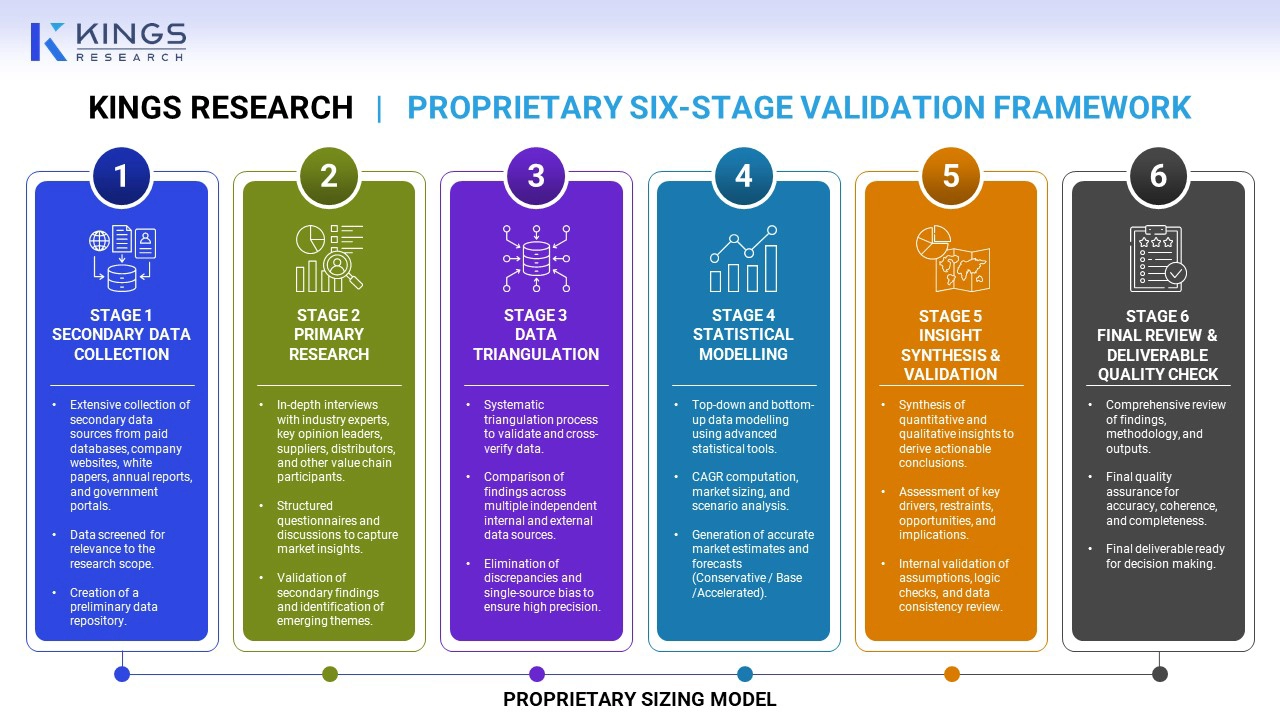
Our methodology triangulates insights from multiple independent and publicly available research databases, which are further validated against regulatory filings and public company disclosures. All estimates are cross-verified; no single-source data is presented without validation.
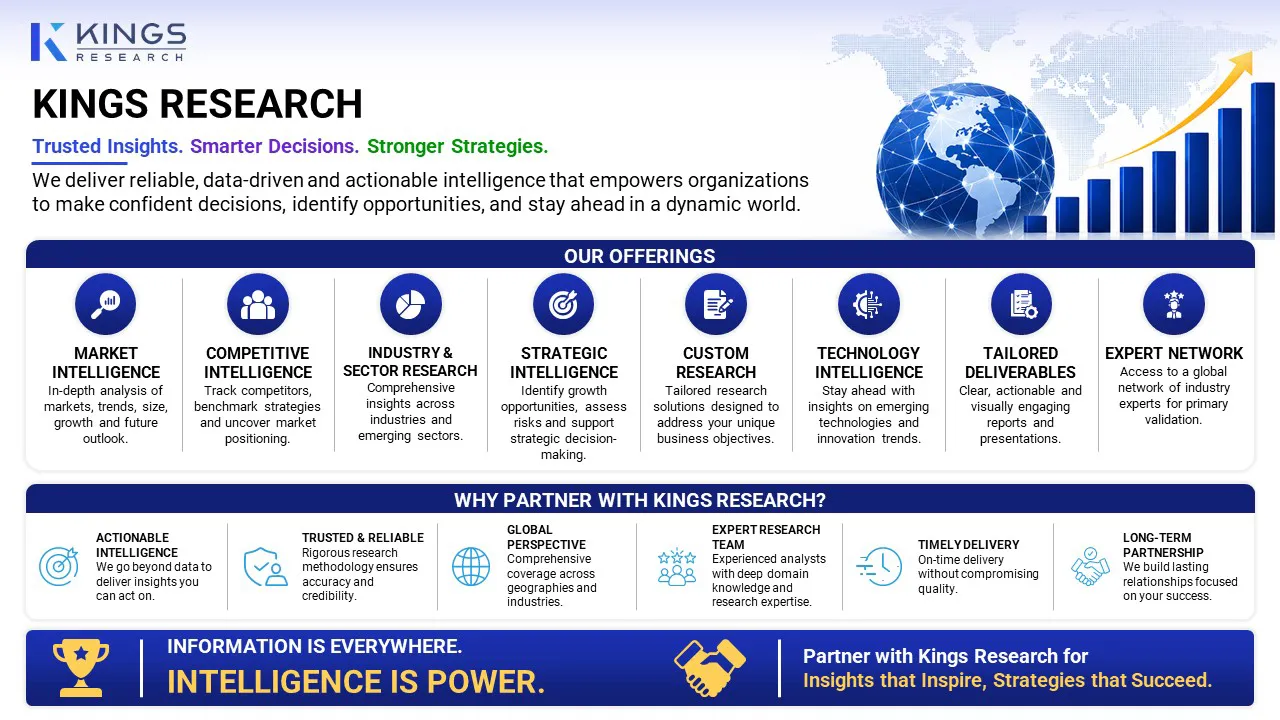
We deliver tailored, data-driven intelligence and strategic guidance to help organizations identify, evaluate, and capitalize on key market opportunities.
Frequently Asked Questions

Faizy brings over four years of experience in market research and consulting, with a proven ability to support strategic engagements across diverse industries and business environments. His work focuses on understanding complex market structures, identifying emerging opportunities, and translating research findings into clear, commercially relevant insights. With strong analytical capabilities and a structured approach to problem-solving, he evaluates industry trends, competitive landscapes, customer dynamics, and evolving business models. His expertise encompasses market research, competitive intelligence, market sizing and forecasting, industry assessment, company benchmarking, and strategic analysis. Faizy combines technical proficiency with a strong research orientation, enabling him to interpret both qualitative and quantitative information effectively. He has contributed to projects that help organizations assess growth potential, strengthen market positioning, and evaluate strategic priorities. His adaptable approach allows him to work across sectors while maintaining a consistent focus on accuracy, relevance, and delivering insights that support informed decision-making for clients and stakeholders.
With many years of consulting experience across global pharma, biotech, and MedTech markets, Minaz brings deep domain expertise, strategic clarity, and analytical rigor to every engagement. She has led 130+ consulting assignments spanning market entry, competitive landscaping, and portfolio prioritization, helping clients navigate complex, high-stakes decisions with confidence. Known for her ability to synthesize primary and secondary research into executive-ready recommendations, Minaz has built forecasting models and market sizing frameworks that have informed multi-million dollar investment decisions in oncology, diagnostics, and peptide therapeutics. Beyond her analytical strength, Minaz is a trusted client partner, translating complex datasets into clear, actionable insights for senior stakeholders. She currently leads a team of research analysts, driving business expansion, and shaping client engagement strategy.