
Inquire Now
Key Strategic Points
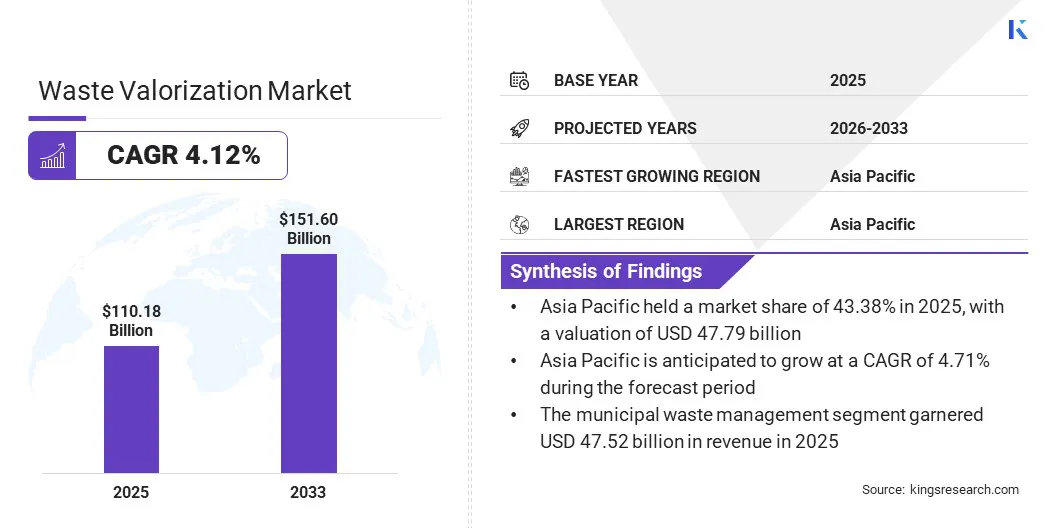
The global waste valorization market size was valued at USD 110.18 billion in 2025 and is projected to reach USD 151.60 billion by 2033, exhibiting a CAGR of 4.12% during the forecast period. This steady growth is fueled by increasing waste generation, heightened environmental awareness, and supportive government policies promoting resource recovery.
Major companies operating in the global waste valorization industry are Veolia, Republic Services, Remondis SE & Co. KG, Darling Ingredients, SUEZ, Umicore, Sims Limited, Kanadevia Corporation, FCC Environment, Stericycle, Inc., Reworld, Renewi plc, LanzaTech, and TERRACYCLE, INC.
Advancements in waste-to-energy and recycling technologies are enabling more efficient waste conversion into valuable products. As sustainability and circular economy initiatives gain momentum worldwide, the demand for innovative waste valorization solutions is expected to rise further.
The increasing volume of municipal solid waste (MSW) worldwide is a major driver of the waste valorization industry, creating a strong demand for technologies that recover energy and valuable materials from waste streams. According to the World Bank, global MSW generation is projected to rise from 2.2 billion tons in 2020 to 3.9 billion tons by 2050. Rapid urbanization, industrialization, and population growth are contributing to higher waste generation, placing pressure on conventional disposal methods such as landfilling. The waste burden is encouraging governments and industries to adopt waste valorization solutions that promote resource recovery, reduce landfill dependency, and support circular economy initiatives.
Many valorization technologies require clean and well-separated waste streams to maximize resource recovery and operational efficiency. However, limited source segregation, contamination of recyclable materials, and varying waste collection practices across countries reduce the quality of feedstock available for processing. According to the United Nations Environment Programme, approximately 2.7 billion people lack access to adequate solid waste collection services, resulting in inefficient waste management and lower recovery rates.
To address these issues, companies are investing in advanced sorting technologies, including AI-powered and sensor-based systems, to improve the purity of feedstock streams. Additionally, many firms are working with municipalities to launch educational campaigns that promote better waste segregation practices at the household and commercial levels.
The expansion of organic waste-to-energy projects is emerging as a key trend in the global market, driven by the growing adoption of anaerobic digestion and biogas technologies to convert organic waste into renewable energy. Governments and industries are investing in such projects to reduce methane emissions, improve waste management, and support decarbonization goals.
According to the U.S. Environmental Protection Agency (EPA), the U.S. had 400 operational manure-based anaerobic digestion systems as of June 2024, with 73 additional projects under construction or being upgraded to upgrade biogas to renewable natural gas (RNG). This significant resource potential is accelerating investments in organic waste-to-energy infrastructure and reinforcing the role of waste valorization in the global transition toward a circular and low-carbon economy.
|
Segmentation |
Details |
|
By Waste Type |
Biomass Waste, Plastic Waste, Chemical Waste, Metal Waste, and Others |
|
By Valorization Technology |
Biological conversion, Thermal conversion, Chemical conversion, Mechanical/material recovery, and Hybrid or integrated routes |
|
By Output Product |
Bioenergy, Biofuels, Chemicals & Biochemicals, Fertilizers & Soil Amendments, Recycled Materials, Animal Feed & Protein, and Others |
|
By End User |
Municipal waste management, Power and utilities, Agriculture, Food and beverage, Chemical and materials, Pulp and paper, Oil and gas/refining, and Others |
|
By Region |
North America: U.S., Canada, Mexico |
|
Europe: France, UK, Spain, Germany, Italy, Russia, Rest of Europe |
|
|
Asia-Pacific: China, Japan, India, Australia, ASEAN, South Korea, Rest of Asia-Pacific |
|
|
Middle East & Africa: Turkey, U.A.E., Saudi Arabia, South Africa, Rest of Middle East & Africa |
|
|
South America: Brazil, Argentina, Rest of South America |
Based on region, the global waste valorization market has been classified into North America, Europe, Asia Pacific, Middle East & Africa, and South America.
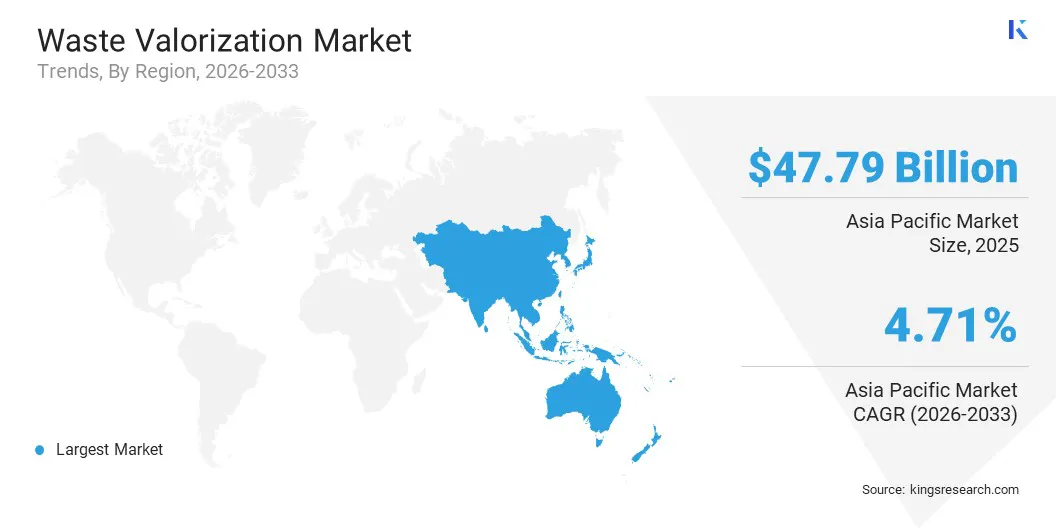
Asia Pacific waste valorization market share stood at 43.38% in 2025, valued at USD 47.79 billion. This dominance is driven by urbanization, industrialization, and municipal solid waste generation across regions. Governments are strengthening waste management regulations and promoting circular economy initiatives to reduce landfill dependency and improve resource recovery. Rising investments in recycling infrastructure, waste-to-energy facilities, and organic waste treatment plants are further supporting market expansion.
In October 2023, research published in the National Center for Biotechnology Information (NCBI) in Heliyon revealed that Asia is the largest waste-producing continent, generating over 800 million tonnes of waste per year. Continuous infrastructure development and supportive government policies are expected to maintain the region's market leadership.
North America Waste valorization market is set to grow at a CAGR of 3.97% over the forecast period. The region is witnessing investments in advanced recycling technologies, anaerobic digestion, renewable natural gas (RNG) production, and waste-to-energy infrastructure.
Growing corporate sustainability commitments and circular economy strategies are encouraging industries to recover valuable materials and energy from waste streams. Additionally, supportive regulatory frameworks and initiatives promoting landfill diversion and greenhouse gas emission reduction are accelerating technology adoption. Ongoing technological advancements and infrastructure modernization are expected to sustain the region's high growth rate.
The global waste valorization industry is moderately fragmented, with competition driven by technological innovation, strategic partnerships, and the expansion of waste processing infrastructure. Market players are focusing on developing advanced waste valorization technologies, including anaerobic digestion, gasification, pyrolysis, chemical recycling, and automated material recovery systems, to improve resource recovery efficiency and minimize environmental impact.
Companies are also investing in capacity expansion, digitalization, and process optimization to strengthen their market presence and address the growing demand for sustainable waste management solutions. Additionally, collaborations with municipalities, industrial waste generators, and technology providers are becoming prevalent to ensure a consistent feedstock supply and enhance operational capabilities. The growing emphasis on circular economy initiatives and decarbonization targets continues to heighten competition across the global waste valorization market.
Frequently Asked Questions

Aswathi holds cross-domain expertise, translating market trends and competitive intelligence into decision-ready insights. Her work helps clients interpret evolving market conditions and identify growth opportunities. She brings a focused, insight-led approach to research execution. She translates these findings into clear, prioritized action plans that align with client capabilities. Her research often includes scenario modeling to test growth strategies under varying economic conditions. She maintains a rigorous validation process, cross-checking primary and secondary sources to ensure reliability. Clients value her ability to synthesize noisy data into concise executive summaries that drive board-level discussions. Her sector-specific lens, combined with a pragmatic focus on execution, consistently delivers high-impact, commercially sound recommendations. Her structured yet flexible research frameworks adapt to client timelines without compromising depth. She is known for distilling complex trade-offs into straightforward, defensible positions that facilitate confident decision-making.
Habi is a seasoned research and consulting leader with renowned experience in guiding clients on strategic growth and transformation initiatives across global markets. He has led high-performing research teams that deliver actionable insights on market expansion, M&A strategies, opportunity assessment, new business development, and product launches. His project portfolio spans large petrochemical producers, electronic device manufacturers, lubricants companies, and other leading enterprises across diverse industrial and consumer sectors. He currently heads the research department at Kings Research, where he is responsible for setting the research agenda, mentoring analysts, and ensuring client-ready deliverables that support executive decision-making. With extensive experience in market intelligence, strategic research, and consulting, Habi brings a strong understanding of evolving industry dynamics, competitive landscapes, emerging opportunities, and business growth challenges. His expertise includes developing research frameworks, translating complex market data into actionable strategic recommendations, and working closely with senior stakeholders to address critical business questions. He has also contributed to building research capabilities, strengthening analytical methodologies, and driving a culture of quality and insight-led decision-making within research teams. His cross-industry exposure enables him to connect market trends with broader business implications and provide perspectives that help organizations identify opportunities, mitigate risks, and make informed strategic decisions.