
Inquire Now
Key Strategic Points
The phosphoric acid market involves the production, marketing, and distribution of phosphoric acid and its derivatives, which are vital chemicals used in various industries. These products are essential for fertilizer manufacturing, food and beverage processing, water treatment, and more as they provide nutrients, aid in food processing, and support chemical production. The market offers a variety of grades and formulations, including food-grade and industrial-grade phosphoric acid, tailored for agriculture, food processing, water treatment, and industrial applications.
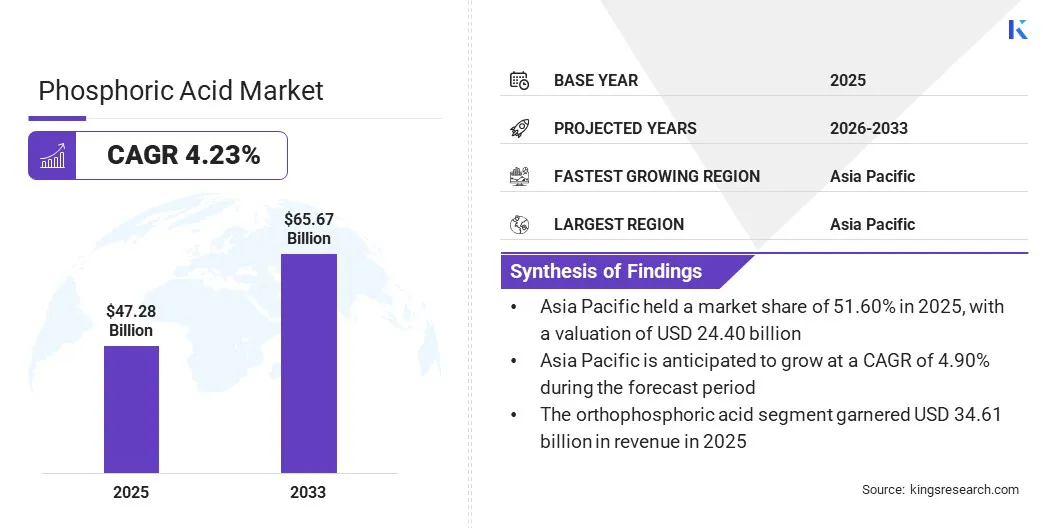
The global phosphoric acid market size was valued at USD 47.28 billion in 2025 and is projected to grow from USD 49.13 billion in 2026 to USD 65.67 billion by 2033, exhibiting a CAGR of 4.23% during the forecast period. This growth is primarily driven by rising demand for phosphate-based fertilizers to support global food production and modern agricultural practices. Moreover, increased consumption in food processing, water treatment, and the electronics industry is boosting market growth.
Major companies operating in the global phosphoric acid industry include OCP S.A., Nutrien, Hubei Xingfa Chemicals Group Co., Ltd., Yuntianhua Group Co., Ltd., Wengfu & Zijin Chemical Industry Co., Ltd., Jordan Phosphate Mines Company, PLC, ICL Group, Prayon, JIANGSU CHENGXING PHOSPH-CHEMICALS CO., LTD., Aditya Birla Management Corporation Pvt. Ltd., Coromandel International Ltd., IFFCO, PhosAgro Group, Innophos, and Solvay.
Manufacturers are investing in advanced production technologies and sustainable practices to enhance efficiency and minimize environmental impact. Industry leaders are also forming strategic partnerships and expanding capacity to meet evolving consumer needs and regulatory standards. The emergence of new applications, such as energy storage and battery manufacturing, is further enhancing the market’s growth prospects and attracting investment in innovative phosphoric acid solutions.
The rising demand for phosphate fertilizers in agriculture is a key driver of the phosphoric acid market. With the continuing growth of the world’s population, there is increasing pressure on agricultural production to ensure food security. Phosphoric acid is a critical raw material for manufacturing phosphate-based fertilizers, which play an essential role in improving soil fertility and crop yields. Modern farming practices depend on these fertilizers to replenish nutrients and support intensive cultivation.
Additionally, the shift toward high-efficiency fertilizers and the expansion of agricultural activities in developing regions further boost demand for phosphoric acid. This sustained need for phosphate fertilizers directly influences the growth and dynamics of the global market.
Supply chain disruptions are a major hindrance to the phosphoric acid market. Geopolitical tensions, trade restrictions, transport bottlenecks, and shortages of raw materials can all have an impact on the stable supply of phosphate rock and other major inputs. These interruptions can lead to production delays, higher costs, and uncertainty for both manufacturers and end-users. The vulnerabilities of supply chains are exposed by international disruptions such as wars or pandemics, resulting in intensified challenges in maintaining consistent production and meeting consumer demand. To address this issue, companies are diversifying their supplier base and investing in local sourcing strategies. Many are also building logistics networks and implementing advanced supply chain management technologies to improve resilience.
The market of phosphoric acid is witnessing a dynamic trend toward sustainability and closed-loop recycling. Increasing environmental regulations and growing demand for sustainable practices from stakeholders are prompting phosphoric acid manufacturers to embrace eco-friendly production methods. This includes implementing closed-loop recycling systems that recycle or reuse waste by-products, like phosphogypsum instead of discarding them.
Companies are exploring innovative ways to source raw materials and enhance process efficiency to minimize emissions and waste. These initiatives are reducing the environmental footprint, operating costs, and improving the efficiency of resource utilization. This trend is expected to enhance the environmental performance of the industry and to contribute to the development of long-term stability in the market.
|
Segmentation |
Details |
|
By Type |
Orthophosphoric Acid, Polyphosphoric Acid, Metaphosphoric Acid, and Others |
|
By Grade |
Food-Grade, Industrial Grade, Pharmaceutical Grade, and Others |
|
By End Use |
Agriculture, Electronics and Semiconductors, Food and Beverage, Industrial, and Pharmaceuticals |
|
By Region |
North America: U.S., Canada, Mexico |
|
Europe: France, UK, Spain, Germany, Italy, Russia, Rest of Europe |
|
|
Asia-Pacific: China, Japan, India, Australia, ASEAN, South Korea, Rest of Asia-Pacific |
|
|
Middle East & Africa: Turkey, U.A.E., Saudi Arabia, South Africa, Rest of Middle East & Africa |
|
|
South America: Brazil, Argentina, Rest of South America |
Based on region, the global market has been classified into North America, Europe, Asia Pacific, Middle East & Africa, and South America.
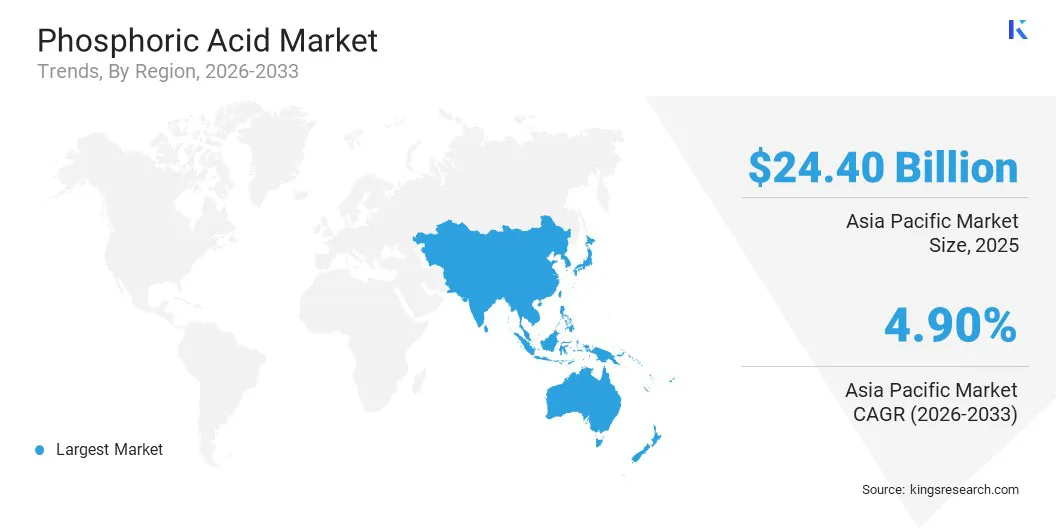
Asia Pacific phosphoric acid market share stood at 51.60% and was valued at USD 24.40 billion in 2025. The region’s vast agricultural base and increasing demand from multiple industrial sectors are factors driving the market. The growing demand for fertilizers and their usage in food processing and water treatment plants are further expected to fuel the market share.
Furthermore, the existence of well-established manufacturing units and ongoing investments in production technologies improve supply capabilities. The region is also experiencing a transition toward sustainable and efficient manufacturing practices. These factors strengthen Asia Pacific’s position in the global market and are projected to sustain momentum in the coming years.
The South America phosphoric acid market is set to grow at a CAGR of 4.30% over the forecast period. This growth is driven by increasing investment in agricultural modernization and the rising adoption of advanced farming practices across the region. The growing demand for food production and a shift toward high-efficiency fertilizers are driving the product demand.
The expansion of the food and beverage processing, water treatment, and other industrial sectors in the region is fueling the market growth. Strategic alliances between local manufacturers and global companies are strengthening the production capacities and distribution channels. Consequently, South America is emerging as an attractive market with substantial opportunities for both local and global phosphoric acid suppliers.
The phosphoric acid market is characterized by a large number of regional players and a few large multinational players. Key players are focusing on increasing their production, strategic alliances, and mergers and acquisitions to strengthen their market position. Process technology development and sustainability initiatives are becoming key competitive advantages.
Vertical integration helps companies to get economic benefits by controlling raw material supply and acid production, which helps in ensuring a reliable supply chain. The market is highly competitive in terms of pricing and quality, with ongoing efforts to meet the changing environmental regulations. As part of their strategy, many companies regularly analyze the phosphoric acid prices to benchmark against competitors and identify optimal pricing structures. Local players focus on addressing the regional demand, while global players leverage large distribution networks and a diverse product portfolio for better market visibility.
Frequently Asked Questions

Aswathi holds cross-domain expertise, translating market trends and competitive intelligence into decision-ready insights. Her work helps clients interpret evolving market conditions and identify growth opportunities. She brings a focused, insight-led approach to research execution. She translates these findings into clear, prioritized action plans that align with client capabilities. Her research often includes scenario modeling to test growth strategies under varying economic conditions. She maintains a rigorous validation process, cross-checking primary and secondary sources to ensure reliability. Clients value her ability to synthesize noisy data into concise executive summaries that drive board-level discussions. Her sector-specific lens, combined with a pragmatic focus on execution, consistently delivers high-impact, commercially sound recommendations. Her structured yet flexible research frameworks adapt to client timelines without compromising depth. She is known for distilling complex trade-offs into straightforward, defensible positions that facilitate confident decision-making.
Habi is a seasoned research and consulting leader with renowned experience in guiding clients on strategic growth and transformation initiatives across global markets. He has led high-performing research teams that deliver actionable insights on market expansion, M&A strategies, opportunity assessment, new business development, and product launches. His project portfolio spans large petrochemical producers, electronic device manufacturers, lubricants companies, and other leading enterprises across diverse industrial and consumer sectors. He currently heads the research department at Kings Research, where he is responsible for setting the research agenda, mentoring analysts, and ensuring client-ready deliverables that support executive decision-making. With extensive experience in market intelligence, strategic research, and consulting, Habi brings a strong understanding of evolving industry dynamics, competitive landscapes, emerging opportunities, and business growth challenges. His expertise includes developing research frameworks, translating complex market data into actionable strategic recommendations, and working closely with senior stakeholders to address critical business questions. He has also contributed to building research capabilities, strengthening analytical methodologies, and driving a culture of quality and insight-led decision-making within research teams. His cross-industry exposure enables him to connect market trends with broader business implications and provide perspectives that help organizations identify opportunities, mitigate risks, and make informed strategic decisions.