
Inquire Now
Key Strategic Points
According to Kings Research, the global adhesives and sealants market size is projected to grow from USD 80.40 billion in 2025 to USD 122.42 billion by 2033, registering a CAGR of 5.4% from 2026 to 2033.
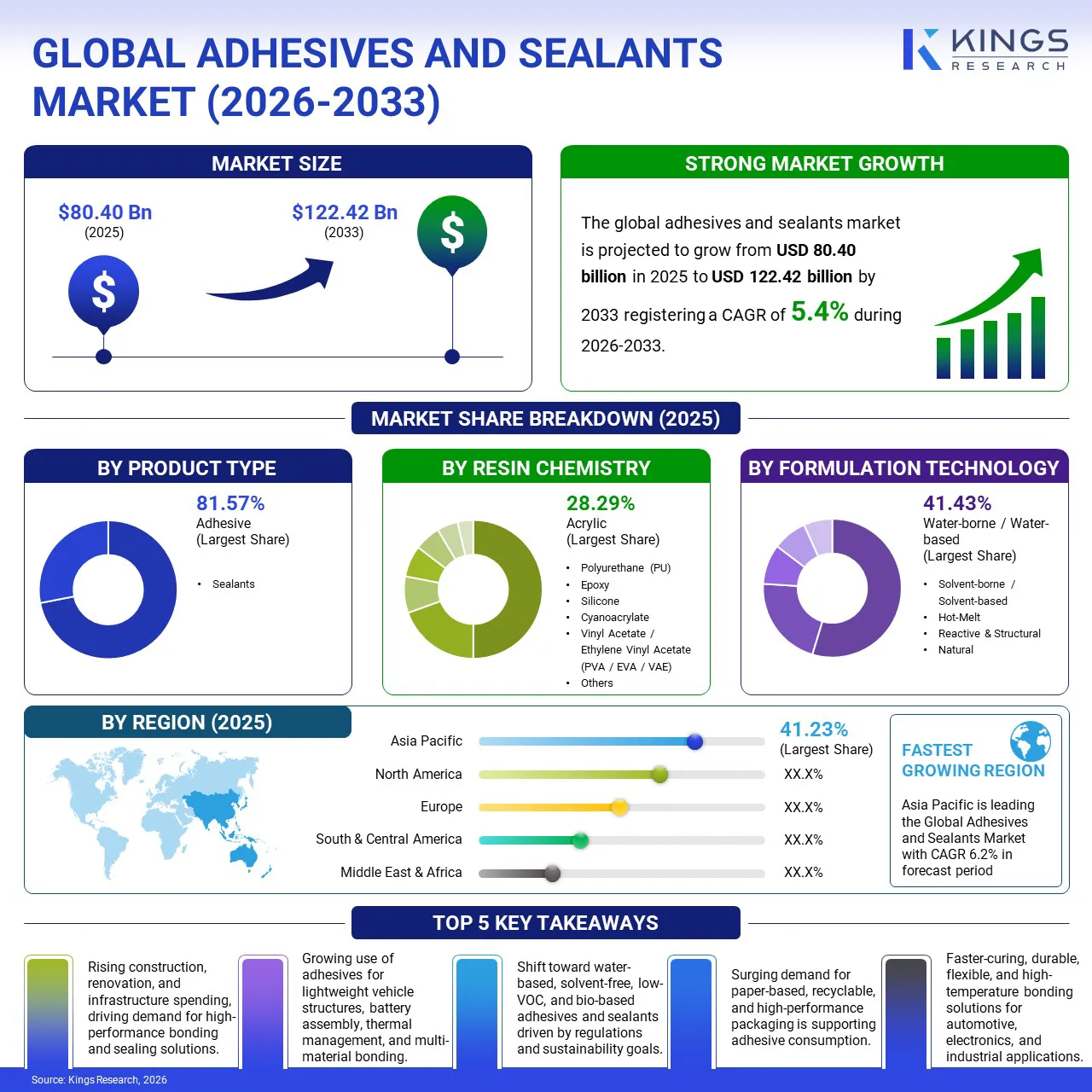
The global market is evolving from a commodity-driven industry toward a specialty materials segment, as advanced bonding solutions increasingly replace mechanical fasteners, welding, and riveting across automotive, construction, packaging, and electronics. Vehicle electrification and lightweighting are further supporting growth, creating a strong demand for structural and thermally conductive adhesives in EV battery and body assembly. Meanwhile, sustainability goals and stricter regulations are accelerating the adoption of water-based, bio-based, and low-VOC formulations.
Rapid urbanization, infrastructure development, and industrialization across emerging economies are driving the market expansion. Their seamless bonding property drives preference over conventional joining methods, supporting applications across industrial, consumer goods, and building and construction sectors. Additionally, reduced production costs from replacing welding and soldering, improved strength compared with mechanical fasteners, and reduced environmental impact create growth opportunities.
For instance, the transition toward electric vehicles is fueling demand for structural adhesives to bond battery cells, modules, and pack enclosures. Automotive manufacturers are adopting thermally adhesive sealants that dissipate heat effectively and prevent thermal runaway in high-voltage battery systems.
Key Insight: Rapid industrialization, urbanization, and the shift toward lightweight, electrified vehicles are expanding adhesives and sealants' adoption across manufacturing and construction.
Adhesive and sealant formulations remain heavily dependent on petrochemical-derived resins, including epoxy, polyurethane, and acrylic monomers, which are exposed to crude oil and naphtha price swings and freight disruptions.
Crude oil is a key feedstock for a diverse range of construction products, making fluctuations in oil prices a significant factor in downstream product costs. Current geopolitical tensions driven by the escalating Middle East conflict and disruptions in the Strait of Hormuz are leading to refinery disruptions and supply restrictions.
According to the U.S. Energy Information Administration (EIA), Brent crude oil prices averaged USD 69/b in 2025 and USD 87/b in 2026, while the gasoline retail prices surged from USD 3.10 per gallon to USD 3.78 per gallon. The price rise in feedstock elements is reflected in final production costs for petrochemical-derived resins used in adhesives and sealants, contributing to pricing adjustments across regional markets.
To address these challenges, market players are adopting price adjustments across their product lines to offset higher petrochemical raw material costs. Companies are also leveraging diversified supply networks, securing materials in advance, and qualifying alternatives to maintain supply continuity and customer service.
Key Insight: Feedstock volatility and rising chemical-safety compliance costs are simultaneously compressing margins, pushing manufacturers toward feedstock diversification and accelerated reformulation towards bio-based chemistries.
Adoption of water-based adhesives and sealants is rapidly gaining traction as an alternative to traditional synthetic adhesives due to their environmental friendliness, sustainability, and cost-effectiveness. The widespread adoption is further supported by the efforts to reduce dependence on petroleum resources as feedstock materials. The high versatility, high biodegradability, and low volatile organic compound (VOC) emissions position them as a sustainable option for end-use industries seeking to reduce their carbon footprint.
Moreover, the growing adoption of bio-based adhesives is further transforming market dynamics. Market players are innovating adhesive formulations and exploring chemistries for synthesising polymeric materials from bio-based, renewable resources.
Key Insight: Water-based and bio-based adhesives are gaining traction as companies seek lower VOCs, reduced petroleum dependence, and more sustainable solutions, with recent product launches showing growing adoption across multiple industries.
|
Segmentation |
Details |
|
|
By Product Type |
Adhesives, Sealants |
|
|
By Resin Chemistry |
Polyurethane (PU), Epoxy, Acrylic, Silicone, Cyanoacrylate, Vinyl Acetate / Ethylene Vinyl Acetate (PVA / EVA / VAE), Others |
|
|
By Formulation Technology |
Water-borne / Water-based, Solvent-borne / Solvent-based, Hot-Melt, Reactive & Structural, Natural |
|
|
By End-User Industry |
Paper, Packaging & Printing, Building & Construction, Automotive & Transportation, Electrical & Electronics, Woodworking, Joinery & Furniture, Healthcare & Medical, Others |
|
|
By Region |
North America |
U.S., Canada, Mexico |
|
Europe |
France, UK, Spain, Germany, Italy, Russia, Rest of Europe |
|
|
Asia-Pacific |
China, Japan, India, Australia, ASEAN, South Korea, Rest of Asia-Pacific |
|
|
Middle East and Africa |
Turkey, U.A.E., Saudi Arabia, South Africa, Rest of Middle East & Africa |
|
|
South and Central America |
Brazil, Argentina, Rest of South and Central America |
|
The silicone segment is anticipated to register the fastest CAGR of 6.5% over the forecast interval (2026-2033). Its high flexibility, durability, temperature and weather resistance, and strong adhesion are boosting adoption across automotive, electronics, lighting, and medical device manufacturing sectors.
The paper, packaging & printing segment accounted for the highest share of 29.93% in 2025. The high share is driven by the growing use of adhesives in paper manufacturing and packaging for high-speed production, strong bonding, and product integrity across cartons, labels, corrugated boards, and flexible packaging. Sustainability and automation are further creating a strong demand for water-based, hot-melt, low-VOC, and bio-based adhesive solutions that enhance recyclability, efficiency, and compliance.
The global adhesives and sealants market is moderately consolidated, characterized by diversified global specialty chemicals majors alongside pure-play adhesive specialists. Competitive intensity is increasingly defined by strategic mergers and acquisitions aimed at portfolio expansion and broader reach across underpenetrated markets.
Key Insight: Competitive differentiation is shifting toward technology-driven service delivery through mergers and acquisition activities, increasingly targeted at closing capability gaps in mission-critical and specialized adhesive and sealant applications.
Based on region, the global adhesives and sealants market has been segmented into North America, Europe, Asia Pacific, the Middle East and Africa, and South and Central America.
Asia Pacific emerged as the largest and fastest-growing market for adhesives and sealants. The regional market accounted for a share of 41.23% in 2025 and is projected to grow at a CAGR of 6.2% over the forecast period (2026-2033). This growth is driven by rapid industrialization, expanding automotive and construction sectors, and increasing packaging demands across countries such as China, India, Japan, South Korea, and Southeast Asian countries.
The region's expanding manufacturing base, urbanization, and infrastructure development continue to support consumption of adhesives & sealants across diverse end-use industries. Market players are expanding their operations across the Asia Pacific to strengthen regional presence and improve supply-chain efficiency.
Key Insight: Asia Pacific’s large manufacturing base, rapid industrialization, and infrastructure growth continue to drive adhesives and sealants demand, with market players expanding production, distribution, and technical capabilities across key countries.
Adhesives and sealants sit at the intersection of chemical safety, workplace exposure, and food-contact regulation, with the EU and U.S. advancing key compliance requirements that influence formulation strategies across the industry.
Key Insight: Increasing regulatory and standards requirements across chemical safety, emissions, and product labeling are tightening compliance expectations for adhesives and sealants, driving manufacturers toward safer formulations, greater transparency, and stronger testing and documentation capabilities.
Capital deployment in the global adhesives and sealants market is increasingly focused on strategic mergers, acquisitions, strategic partnerships, and capacity expansion. Companies are prioritizing specialty, medical, and higher-value adhesive applications to strengthen their positions in high-growth segments. Investments are also shifting upstream toward renewable and lower-carbon feedstock capacity, fueled by demand for more sustainable adhesive formulations.
Strategic M&A activity increasingly targets portfolio diversification and access to higher-growth specialty applications.
Raw material suppliers are also investing in renewable and low-carbon feedstock production capacity to help downstream adhesive formulators meet their decarbonization and VOC-reduction commitments.
Key Insight: Investments are concentrated around M&A-led expansion into specialty and medical adhesives and capacity expansion for renewable and lower-carbon feedstocks, reflecting the industry’s shift toward higher-value applications and more sustainable raw-material supply chains.
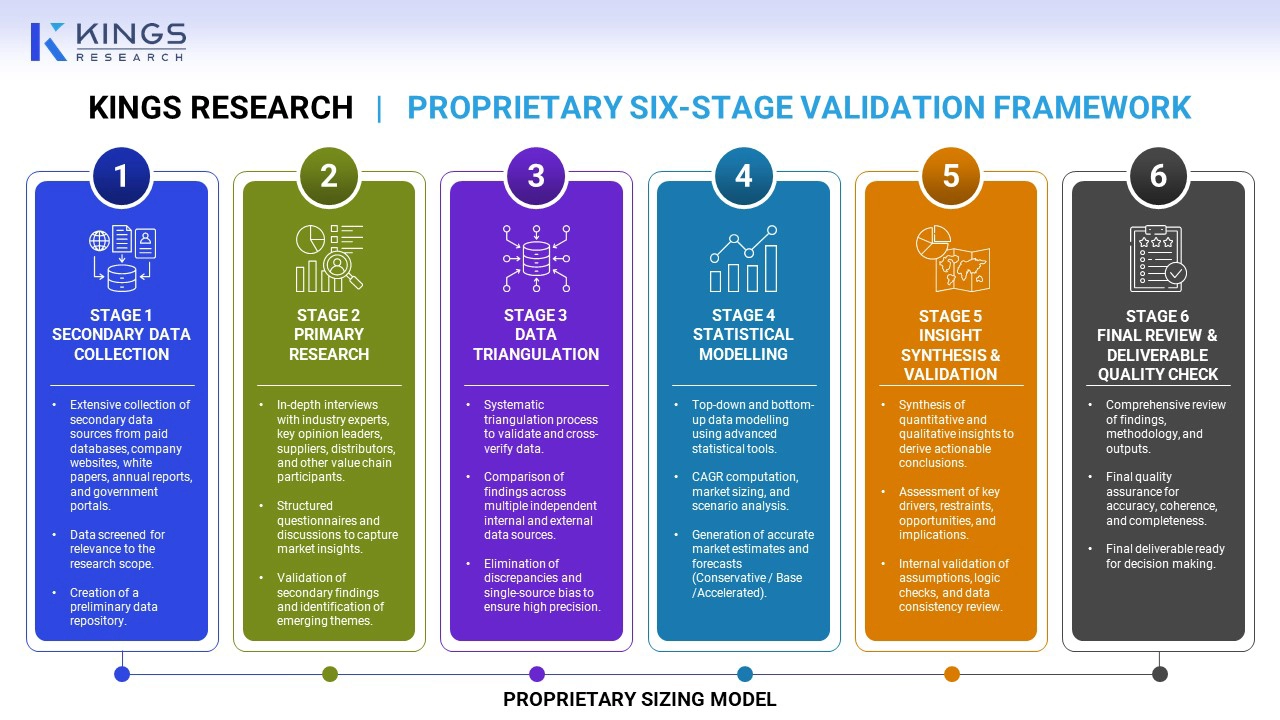
Our methodology triangulates insights from multiple independent and publicly available research databases, which is further validated against regulatory filings and public company disclosures. All estimates are cross-verified; no single-source data is presented without validation.
Our custom offerings deliver tailored, data-driven intelligence and strategic guidance to help organizations identify, evaluate, and capitalize on key market opportunities.
Frequently Asked Questions

Faizy brings over four years of experience in market research and consulting, with a proven ability to support strategic engagements across diverse industries and business environments. His work focuses on understanding complex market structures, identifying emerging opportunities, and translating research findings into clear, commercially relevant insights. With strong analytical capabilities and a structured approach to problem-solving, he evaluates industry trends, competitive landscapes, customer dynamics, and evolving business models. His expertise encompasses market research, competitive intelligence, market sizing and forecasting, industry assessment, company benchmarking, and strategic analysis. Faizy combines technical proficiency with a strong research orientation, enabling him to interpret both qualitative and quantitative information effectively. He has contributed to projects that help organizations assess growth potential, strengthen market positioning, and evaluate strategic priorities. His adaptable approach allows him to work across sectors while maintaining a consistent focus on accuracy, relevance, and delivering insights that support informed decision-making for clients and stakeholders.
Habi is a seasoned research and consulting leader with renowned experience in guiding clients on strategic growth and transformation initiatives across global markets. He has led high-performing research teams that deliver actionable insights on market expansion, M&A strategies, opportunity assessment, new business development, and product launches. His project portfolio spans large petrochemical producers, electronic device manufacturers, lubricants companies, and other leading enterprises across diverse industrial and consumer sectors. He currently heads the research department at Kings Research, where he is responsible for setting the research agenda, mentoring analysts, and ensuring client-ready deliverables that support executive decision-making. With extensive experience in market intelligence, strategic research, and consulting, Habi brings a strong understanding of evolving industry dynamics, competitive landscapes, emerging opportunities, and business growth challenges. His expertise includes developing research frameworks, translating complex market data into actionable strategic recommendations, and working closely with senior stakeholders to address critical business questions. He has also contributed to building research capabilities, strengthening analytical methodologies, and driving a culture of quality and insight-led decision-making within research teams. His cross-industry exposure enables him to connect market trends with broader business implications and provide perspectives that help organizations identify opportunities, mitigate risks, and make informed strategic decisions.