It’s been 8 months since the start of the U.S.-Iran conflict. The Strait of Hormuz has essentially been closed for most of this period. The implications of the closure have spread beyond oil trade and substantially changed how supply chains across multiple industries operate. The war is not just being fought between Iran and the U.S.; it is also being fought across economies as they manage their supply chains and try to keep key industries functional.
Understanding how this disruption is evolving and what the global economy will look like after its resolution will be crucial for all industries. Higher fuel prices, shortages of fertilizers, disrupted chemical production, and increased shipping costs are apparent issues. The real story lies in how the supply side and demand side have changed to adapt to this Strait closure. Analysts at Kings Research have tracked the event through its timeline and estimated how industries are changing and reacting to accommodate the issues caused by this event.
Before we get into which industries have been impacted, understanding the role of the Strait of Hormuz in the global economy is important.
Why is the Strait of Hormuz Essential for the Global Economy?
The Strait of Hormuz connects the Persian Gulf with the Gulf of Oman and the Arabian Sea. Its narrowest point is approximately 21 nautical miles wide, leaving limited navigable channels for commercial shipping. The majority of oil produced in the Gulf passes through the Strait for export to global markets. Qatar, Kuwait, Bahrain, Iraq, and Iran depend heavily on this Strait for their exports. The United Arab Emirates and Saudi Arabia have alternate export infrastructure, but it is not sufficient to replace the volumes that normally pass through the Strait.
With Gulf countries accounting for nearly one-third of global crude oil production, the closure of the Strait of Hormuz has placed the global energy industry under significant pressure. This is not just a logistical problem but also a supply chain nightmare for multiple industries. The interconnected nature of industrial commodities has also affected businesses and industries that do not directly depend on or trade in Gulf-origin commodities.
Here’s a global heatmap of regions that have been affected the most by the disruptions in the Strait of Hormuz.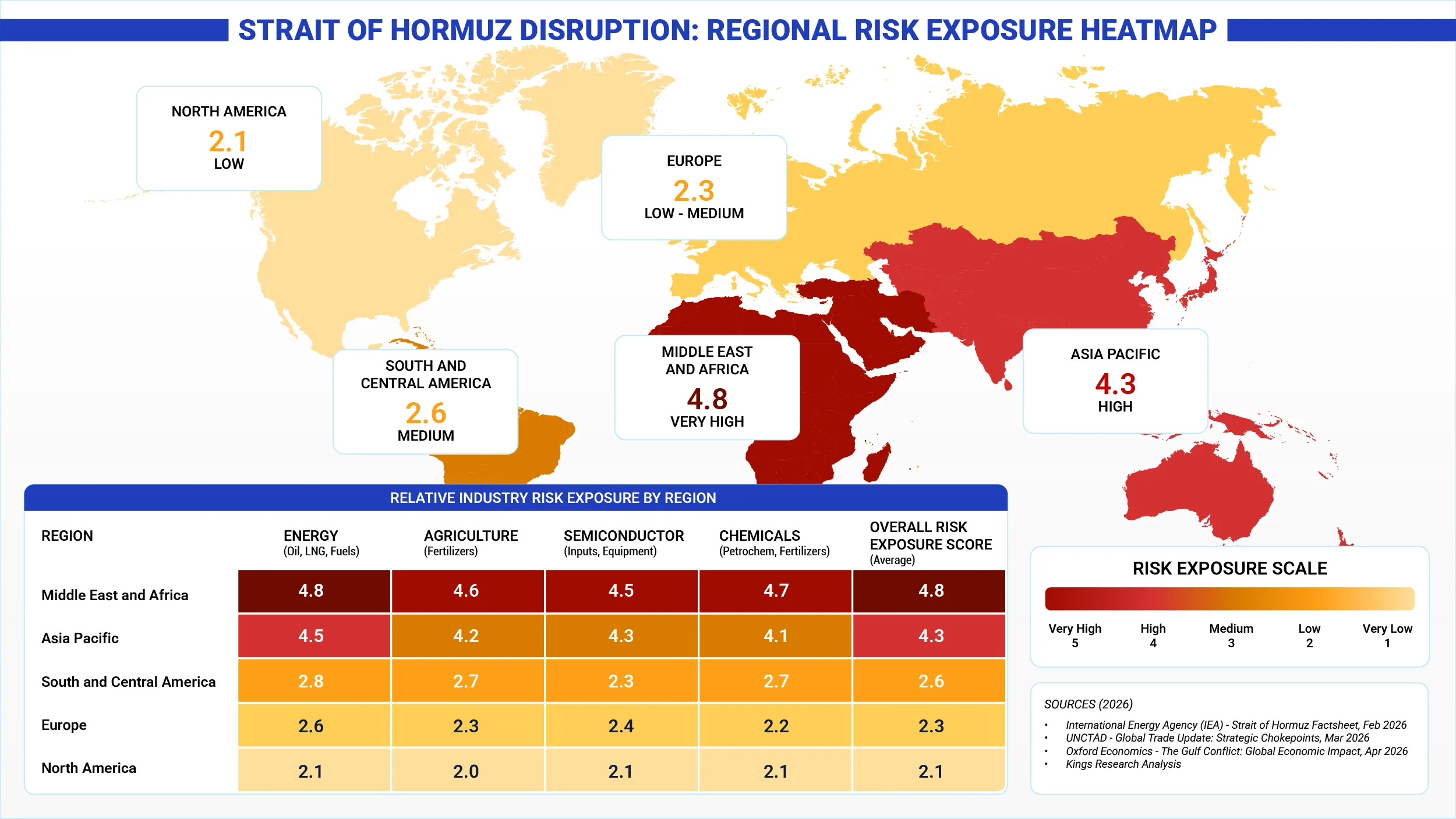
Note: Scores are qualitative, relative assessments based on multi-factor analysis including import dependence, infrastructure constraints, geopolitical conditions, industrial sensitivity, and trade exposure.
The Middle East and Africa region, where the conflict is taking place, is at the obvious highest risk. Following closely, Asia-Pacific has also taken a major hit due to the closure of the Strait. Pakistan, India, Bangladesh, Japan, China, Taiwan, Singapore, and Thailand are among the countries that have faced the most difficulty due to the crisis.
North America, Europe, and South and Central America have lower risk exposure to this disruption. Manufacturers and businesses in these regions may have opportunities to fill in the gaps created by decreased supply from Gulf countries.
For investors and businesses, regional exposure should be assessed alongside industry concentration, supplier dependencies, and recovery timelines. Lower regional scores do not eliminate indirect exposure through commodity prices, freight costs, or downstream supply chains. Similarly, higher-risk regions may present opportunities for infrastructure investment, alternative sourcing, and supply-chain diversification.
Which Industries Are Most Affected by the Strait of Hormuz Closure?
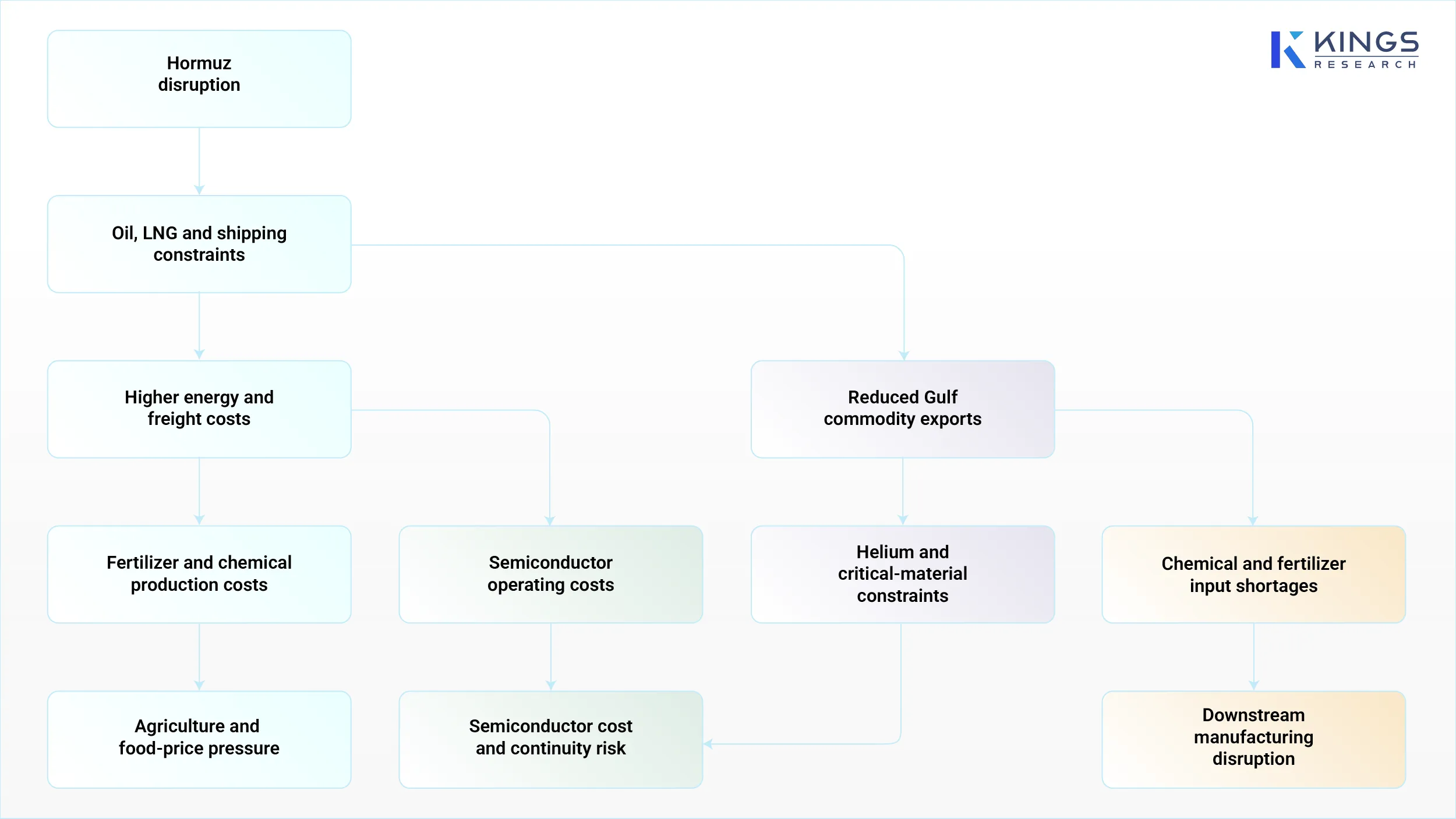
Energy, agriculture, logistics, chemicals, automotive, semiconductor, and electronics are some major industries that have been affected most by the closure of the Strait of Hormuz.
Energy: Supply Recovery and Export Infrastructure Determine Market Stability
With a direct impact on around one-third of global crude oil supply, the energy industry has been affected the most due to the Strait closure. With prolonged disruptions to oil and LNG supply chains, implications for energy production and utilization are profound across multiple parts of the world.
Impact: The energy industry across the Asian continent has been hit the hardest. Around 80% of the oil and 90% of the LNG transported through the Strait were destined for Asian countries in the pre-conflict era. As the conflict has continued for eight months, energy supply chains have come under significant pressure as national reserves decline. Higher procurement costs have directly affected end users and widened the supply-demand gap.
Limited alternative routes for transportation of oil and LNG make the situation worse. Even if the Strait opened fully to its pre-war capacity tomorrow, the energy industry is expected to require 6 to 8 months to return to normal operating conditions. Evaluation of available export capacity, operational recovery, inventory levels, and realized prices would be crucial in determining the recovery of the energy industry going forward.
In October 2026, QatarEnergy signed a deal with Cheniere Energy to buy 4 million metric tons of LNG per year through 2054. The deal is a testament to how the global energy markets are changing due to the Strait of Hormuz crisis, as Qatar was the second-largest exporter of LNG in 2025 before the war started. The attack on Qatar's Ras Laffan production facility has crippled its capacity and reduced shipments significantly in the last 8 months. Qatar’s energy minister, Saad Sherida Al-Kaabi, has stated that it will take around three years to repair the damage at Ras Laffan.
Want a closer look at how the energy industry has changed due to the conflict? Connect with analysts at Kings Research to obtain a deeper customized analysis of the event’s impact on your business, region, or industry.
Agriculture: Fertilizer Availability Is Becoming a Structural Supply Concern
At the start of the conflict, the fertilizer industry was hit with a price-shock issue. After 8 months, the overall fertilizer industry has shown signs of improvement and absorbed the initial price shock. According to data from UN Trade and Development (UNCTAD), increases in natural gas prices directly affect the prices of certain nitrogenous fertilizers.
Impact: Nitrogen and urea fertilizer markets have been largely normalized as compared to where they were at the initial stages of the conflict back in March and April 2026. However, this does not mean that risks have been averted; the fertilizer supply chain is expected to remain at risk until the conflict has a clear resolution. Alternative exporters, including China and the U.S., have helped compensate for reduced Gulf shipments. But the adjustment has been uneven: phosphate fertilizer prices remained approximately 25%–30% above pre-conflict levels, and sulfur prices had more than doubled over the preceding six months.
For agricultural businesses, the implications include input-cost uncertainty, procurement delays, and potential changes in fertilizer application. Tracking different fertilizer categories remains essential to get a clear picture of how the Strait of Hormuz closure has impacted the demand as well as supply sides associated with the fertilizer industry.
Chemicals: Feedstock Availability Is Reshaping Regional Competitiveness
Since crude oil is a major feedstock for chemical and petrochemical production, disruptions to its supply have had far-reaching implications across the chemical production pipeline. Reduced Gulf exports resulted in higher feedstock costs and uneven recovery across production facilities. Naphtha, methanol, polyethylene, sulfur, helium, and glycols are some of the most affected chemical commodities due to the conflict.
Impact: Feedstock buyers have shifted their focus toward alternative suppliers from North American or other Asian producers. This transition is not easy because it involves higher transportation costs, longer qualification processes, and diminished regional cost advantages. The feedstock supply chain and chemical industry are expected to recover quickly after the Strait returns to pre-war operating conditions. However, the recovery is not expected to happen in weeks but to take the course of months.
Proper replacement planning, plant utilization, and sourcing diversification are emerging as top priorities in companies operating in this sector. The implications differ across different companies; the major negative impact has been observed for Gulf-dependent manufacturers.
Dual sourcing has emerged as a popular trend in the chemical industry in response to the war disruptions. Gulf feedstock producers and suppliers are expected to retain their customer base largely due to their competitive pricing and established production scale. Domestic and regional feedstock suppliers are estimated to capture around 20% of demand, which is up from negligible levels before the Strait of Hormuz crisis.
Semiconductor: Specialty Materials and Energy Security Are Critical Exposure Points
The semiconductor shortage was already a bottleneck for the electronics industry, and the closure of the Strait of Hormuz has exacerbated the disruption. The use of helium, sulfur-related industrial inputs, specialty gases, and petrochemical-derived materials in the semiconductor industry exposes it directly to the conflict between the U.S. and Iran.
Impact: Qatar being the second-largest helium supplier and not being able to supply at its full capacity has surely slowed down the semiconductor industry. Apart from this, the critical and specialty material supply chains that are concentrated in the MEA region have also hurt the already worse semiconductor shortage situation.
The impact on this industry is not just on the production line but on the fundamental energy supply infrastructure backing it. LNG-dependent electricity systems in certain Asian economies such as Taiwan indirectly expose the semiconductor industry to the Strait closure. In addition, strict material specifications and consistent delivery are also negatively impacted. Replacements to combat the conflict-induced changes might be commercially available, but translating them into production scale is another challenge.
Careful management of sourcing, energy, and distribution should emerge as a top priority for semiconductor companies till the conflict between the U.S. and Iran is resolved.
The conflict and Strait disruption have had profound implications for industries and economies beyond comprehension. If you are looking for a specific analysis or need an assessment of how this conflict can reshape the future of your business and investing goals, connect with Kings Research to get a detailed report tailored for you or your business.
If Not Strait, Where Is the World Going?
The hustle and immediate efforts of economies and businesses to find alternative routes for Strait of Hormuz vessel traffic have ramped up significantly as the conflict is being stretched out. With multiple industries and economies at stake, the solution should have arrived easily, right?
The answer to finding alternative routes to the Strait of Hormuz is not as straightforward as we wish it were. The Strait of Hormuz has no alternative route capable of replacing its normal export capacity. Saudi Arabia’s East-West Pipeline and the UAE’s Abu Dhabi Crude Oil Pipeline provide partial alternatives for crude exports, but their combined capacity remains insufficient to compensate for prolonged disruption.
Saudi Arabia’s 1,200-km East–West Pipeline connects eastern oil-producing regions with Yanbu on the Red Sea. It became a critical export route during the disruption, moving approximately 4–5 mb/d. However, it was shut down on September 11, 2026, following multiple drone attacks on pumping stations. The pipeline has been restarted in a phased manner since September 22, 2026.
The UAE’s Abu Dhabi Crude Oil Pipeline connects Habshan with Fujairah, bypassing Hormuz. The IEA estimates its current capacity at approximately 1.8 mb/d, which is around 0.7 mb/d more than the original capacity of the line, designated as 1.5 mb/d.
Although alternatives for crude oil supply exist, the marine shipping and LNG export industries have much bigger problems that no alternative routes are solving. So, to sum it up, existing bypass routes can ease some pressure, but limited capacity, infrastructure attacks, and maritime security risks prevent them from replacing Hormuz.
Where Does the World Stand After 8 Months?
The Strait of Hormuz disruption has exposed the cost of global supply-chain concentration. Eight months in, businesses face not only commodity-price volatility but also longer recovery timelines, constrained logistics, and uneven industrial normalization. Not every industry is expected to recover and bounce back to pre-war levels at the same pace. The reopening of the Strait does not guarantee that businesses will return to normal operations. The conflict’s outcome remains uncertain, and this uncertainty is expected to last until negotiations and talks within concerned countries reach an agreed-upon conclusion.
How Can Businesses Keep Up with the Evolving Strait of Hormuz Crisis?
Securing supply, protecting margins, keeping track of the changing geopolitical landscape, and improving operational flexibility will be at the core of businesses looking to mitigate this crisis. Here are some key pointers that could help businesses minimize the adverse impact of the Strait of Hormuz closure:
- Diversification of supply chain
- Upgrade to data-driven logistics
- Strengthen institutional ties and improve collaboration
- Protection of working capital
- Retaining profit margins
- Proper risk evaluation of exposure to the Strait of Hormuz
Analysts at Kings Research are closely monitoring the developing U.S.-Iran crisis. Looking to turn geopolitical uncertainty into strategic clarity? Looking beyond the immediate disruption? Building a strategy to overcome the issues that this crisis created? Connect with us to get answers to these questions and any additional questions you may have to gain a granular understanding of the market landscape.