
Inquire Now
Key Strategic Points
A crystalline solar PV backsheet is a protective layer found at the rear end of photovoltaic modules. It provides mechanical strength, electrical insulation, and environmental protection to solar cells. The backsheet provides protection against moisture ingress and UV degradation, ensuring the long-term performance and reliability of crystalline silicon modules in residential, commercial, and utility-scale solar power installations.
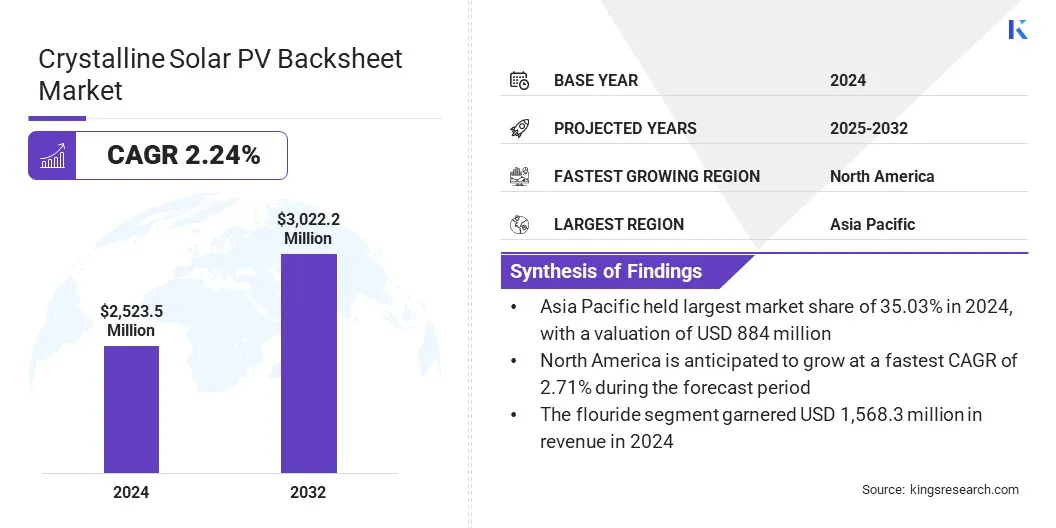
The global crystalline solar PV backsheet market size was valued at USD 2,523.5 million in 2024 and is projected to grow from USD 2,575.7 million in 2025 to USD 3,022.2 million by 2032, exhibiting a CAGR of 2.24% over the forecast period. This growth is driven by advancements in multi-layer backsheet structures enhancing UV resistance, insulation, and durability. These designs, often combining polymer films and coatings, improve thermal stability and module longevity.
Major companies operating in the crystalline solar PV backsheet market are DuPont, Targray, Krempel GmbH, 3M, Arkema, COVEME s.p.a., Cybrid Technologies Inc., DUNMORE, Endurans Solar, RenewSys India Pvt. Ltd., Navitas-Alpha Renewables Private Limited, Goldi Solar, Inc., Silfab Solar Inc., VIKRAM SOLAR LTD., and TOYO ALUMINIUM K.K.
The rising adoption of bifacial and half-cut cell modules is fueling market expansion. These advanced module architectures require backsheets with enhanced reflectivity, superior thermal management, and high dielectric strength. Manufacturers are developing specialized materials that maintain stability under variable irradiance and temperature conditions, enabling consistent power output.
Consequently, demand for high-performance multilayer backsheets compatible with next-generation crystalline modules is growing across large-scale and rooftop solar installations globally.
Governments and private entities are funding large-scale photovoltaic infrastructure to meet renewable energy targets boosting demand for durable and efficient backsheet materials that improve module longevity and performance. Increasing capacity across Asia-Pacific, Europe, and North America is strengthening backsheet production, supporting the supply of high-quality materials for crystalline module manufacturing.
Volatility in raw material prices and supply chain constraints are primarily hindering the expansion of the crystalline solar PV backsheet market. Frequent fluctuations in polymer and resin costs disrupt manufacturing operations and impact profit margins. Limited supplier availability and logistical disruptions further constrain production efficiency across the industry.
To address this, manufacturers are focusing on local sourcing networks, optimizing inventory management, and adopting long-term supplier partnerships to stabilize procurement and ensure a consistent supply of backsheet materials.
The rising focus on circular economy initiatives is reshaping the market by creating demand for eco-friendly, recyclable materials and innovative manufacturing processes. Manufacturers are developing backsheets with recyclable polymers and sustainable coatings that facilitate end-of-life recycling, reducing waste and environmental impact.
This trend is promoting R&D investments, collaboration with recycling firms, and adoption of sustainable production practices, particularly in regions with stringent environmental regulations. As a result, companies that embrace circular economy principles are gaining a competitive advantage by appealing to environmentally conscious buyers and aligning with evolving global sustainability standards.
|
Segmentation |
Details |
|
By Material |
Fluoride, Non-Fluoride |
|
By Thickness |
Less than 100 Micrometer, 100 to 500 Micrometer, Above 500 Micrometer |
|
By Product |
TPT-Primed, TPE, PET, PVDF, PEN, Others |
|
By Application |
Residential, Commercial, Utility |
|
By Region |
North America: U.S., Canada, Mexico |
|
Europe: France, UK, Spain, Germany, Italy, Russia, Rest of Europe |
|
|
Asia-Pacific: China, Japan, India, Australia, ASEAN, South Korea, Rest of Asia-Pacific |
|
|
Middle East & Africa: Turkey, U.A.E., Saudi Arabia, South Africa, Rest of Middle East & Africa |
|
|
South America: Brazil, Argentina, Rest of South America |
The global crystalline solar PV backsheet market has been classified into North America, Europe, Asia Pacific, Middle East & Africa, and South America, on the basis of region.
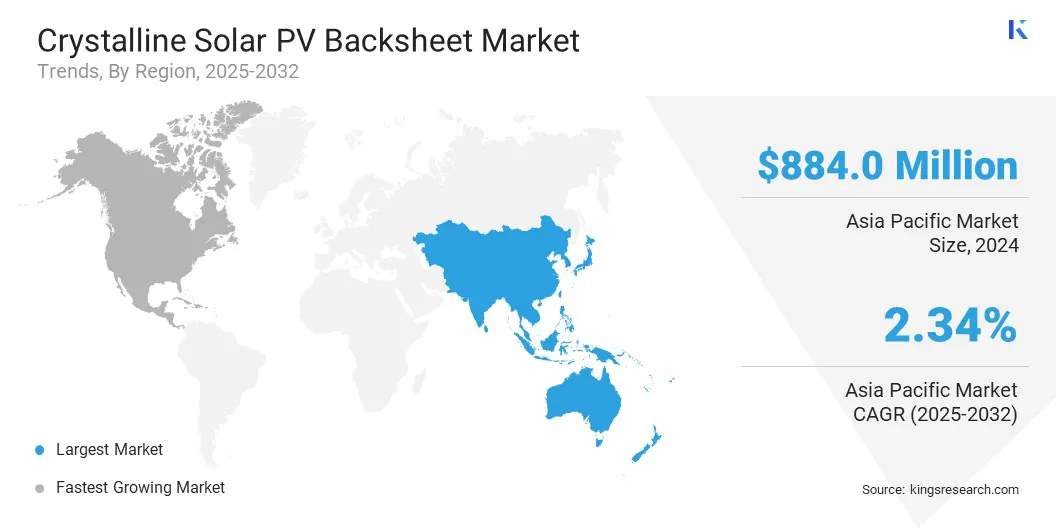
The Asia Pacific crystalline solar PV backsheet Market stood at 35.03% in 2024, valued at USD 884.0 million. This dominance is attributed to the large-scale solar capacity additions and rapid module manufacturing expansion. Strong demand from residential and utility-scale projects has boosted the supply base for backsheet materials.
Increasing production of high-efficiency crystalline modules has accelerated the use of advanced multilayer and non-fluorinated backsheets. Growing partnerships among material suppliers and module producers are also reinforcing regional manufacturing competitiveness.
The North America crystalline solar PV backsheet market is set to grow at a CAGR of 2.71% over the forecast period. This growth is due to the expanding commercial and utility-scale solar deployments and a rising focus on product durability and energy yield optimization.
Demand for high-performance backsheet materials offering long-term reliability is increasing, pushing manufacturers to develop weather-resistant and recyclable backsheets that align with industry standards. Ongoing investment in R&D and product standardization continues to shape market advancement across the region.
Key players operating in the crystalline solar PV backsheet industry are focusing on capacity expansion, vertical integration, and material innovation to strengthen their market presence. Companies are investing in advanced coating technologies and multilayer film development to improve product quality. Strategic partnerships with module manufacturers help ensure consistent supply and product compatibility.
Firms are prioritizing automation, process optimization, and regional manufacturing to improve cost efficiency. Continuous R&D efforts are directed toward non-fluorinated formulations and sustainable material sourcing to align with evolving industry standards and regulatory frameworks.
Frequently Asked Questions

Antriksh is an experienced analyst specializing in cross-domain research across diverse industries. With a strong foundation in data analysis and statistical interpretation, he delivers insightful market reports that guide strategic decision-making. Antriksh excels in conducting primary research, with a focus on identifying trends and understanding consumer behavior. Thriving in dynamic and high-pressure environments, he combines analytical expertise with a commitment to delivering impactful outcomes. Beyond his professional pursuits, Antriksh's passion for travel fuels his curiosity and broadens his perspectives, enriching his ability to uncover unique insights that enhance his research capabilities. He is equally adept at synthesizing quantitative findings with qualitative context, which allows him to present holistic viewpoints to clients. His disciplined work ethic and intellectual agility make him a trusted partner in navigating market uncertainties. He consistently seeks out new methodologies to refine his analytical toolkit, and his ability to communicate complex insights clearly ensures stakeholders act confidently on his recommendations.

Ganapathy Subramaniam Suresh
With over a decade of research leadership across global markets, Ganapathy brings sharp judgment, strategic clarity, and deep industry expertise. Known for precision and an unwavering commitment to quality, he guides teams and clients with insights that consistently drive impactful business outcomes.



.webp&w=128&q=75&dpl=dpl_CJzjB6WVUAT19Reax6v8xwinTPW6)