
Inquire Now
Key Strategic Points
The biomass energy market covers the production and utilization of fuels derived from various feedstocks, including wood and wood processing waste, agricultural crops and waste materials, as well as biogenic materials in municipal solid waste. The energy source is regarded as renewable in nature as it is constantly replenished, thereby serving as a sustainable alternative to fossil fuels like coal and petroleum. This energy is further utilized in electricity generation, heating, and cooking applications, and also serves as a potential fuel for transportation.
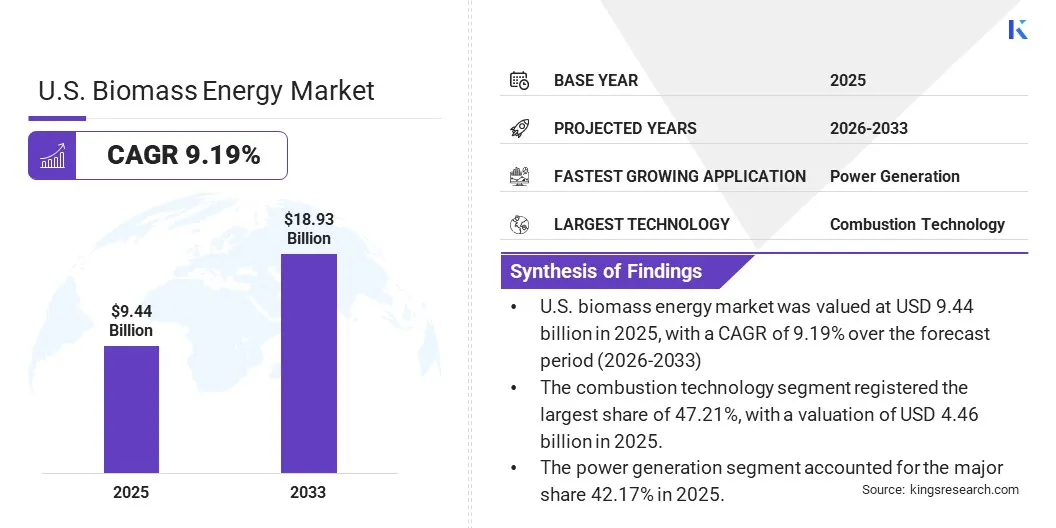
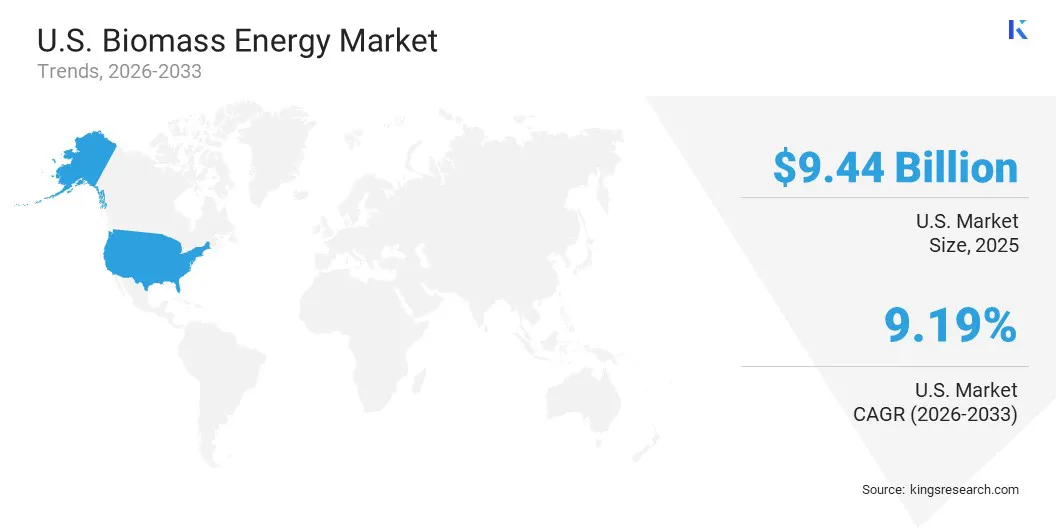
The U.S. biomass energy market size was valued at USD 9.44 billion in 2025 and is projected to reach USD 18.93 billion by 2033, representing a CAGR of 9.19% over the forecast period. This growth is driven by the rising renewable energy demand arising from diverse end-use verticals across the U.S. Additionally, government initiatives support the adoption of sustainable energy sources to achieve net-zero emissions by 2050, further creating growth avenues for market development.
Key players operating in the biomass energy market include Ameresco, Babcock & Wilcox Enterprises, Inc., Dominion Energy, Drax Group, DTE Energy, ENGIE, Enviva, General Electric Company, Mitsubishi Heavy Industries, Ltd., NextEra Energy Resources, Ørsted, RWE, Suez, Sumitomo Corporation, and Veolia.
Industry players are capitalizing on the adoption of innovative technologies to boost the production of different forms of biomass energy into sustainable fuels, thus reducing dependency on conventional fossil fuels for energy requirements.
The utilization of MSW, comprising energy-rich materials such as paper, plastics, yard waste, and products made from wood, for energy generation is fueling market growth. Power generation from the overall U.S. biomass market accounted for 20.3 billion kWh in 2025, where waste from industrial and commercial sectors generated around 1.3 GW, thereby supporting the development of MSW biomass plants in the U.S.
According to the Energy Information Agency (EIA), for every 100 pounds of MSW generated in the U.S., approximately 85 pounds can be burned as fuel to generate electricity. Waste-to-energy plants further reduce 2,000 pounds of garbage to ash that weighs between 300 pounds and 600 pounds, thereby reducing the volume of waste by about 87%.
The U.S. electric power sector is expanding waste biomass generation capacity from 2.6 GW in 2025 to 2.8 GW in 2027, with the share of biomass-fired output anticipated to reach 20 billion kWh in 2026 and 2027. This signifies relatively stable growth for biomass energy in the U.S., driven primarily by efficiency improvements and waste-to-energy optimization.
The energy conversion process involved in burning wood pellets or municipal solid waste (MSW) in incineration plants acts as a significant contributor to environmental pollution. The process releases 50% more greenhouse gas emissions compared to coal for the same amount of energy produced.
Pollutant by-products arising from incomplete combustion (PIC), including volatile organic compounds (VOC) and particulate matter (PM) such as biomass char, soot, and tars, affect air quality and impact health. Moreover, gaseous pollutants such as NOX and SOX, as well as emissions from waste wood contaminated with heavy metals and organic chlorine compounds, emit harmful air pollutants, degrading the environment.
Additionally, the low cost and negligible environmental pollution associated with renewable energy sources, including solar and wind, further restrain market development avenues. According to the U.S. Energy Information Administration (EIA), biomass energy accounted for to a 1.98% share in renewable energy generation in 2025, which is estimated to drop to 1.79% in 2026. In 2025, the shares of wind and solar combined account for nearly one-fifth of total U.S. electrical generation, generating 15.7% more electricity than coal and 8.7% more than nuclear power
To address this challenge, market players are adopting carbon capture and utilization (CCUS) technologies integrated with biomass power generation to reduce net emissions and improve environmental efficiency.
Sustainable aviation fuel (SAF) is produced using non-petroleum feedstocks, including agricultural residue, woody biomass, and municipal waste, which are converted into energy-dense hydrocarbons. The U.S. Department of Energy (DOE) reports a tripling of SAF production using biomass feedstocks, including corn grain, oil seeds, agricultural residues, forestry residues, wood mill waste, municipal solid waste streams, and wet wastes (manures, wastewater treatment sludge), reaching more than 1 billion tons per year, and producing an estimated 60 billion gallons of liquid biofuels.
The U.S. EPA further reported an increase in the consumption of SAF from 15.84 million gallons in 2022 to 24.5 million gallons in 2023, indicating rising demand for environmentally safe aviation fuel alternatives.
Additionally, a federal target has been set by the U.S. Sustainable Aviation Fuel (SAF) Grand Challenge to produce 3 billion gallons of SAF per year by 2030, with a long-term capacity scale-up of up to 35 billion gallons by 2050 to address 100% of domestic aviation fuel demand. This further contributes to the development of the U.S. biomass energy market.
|
Segmentation |
Details |
|
By Feedstock |
Wood and Forestry Residues, Agricultural Residues, Municipal Solid Waste, Animal Waste and Manure, Energy Crops, Others |
|
By Technology |
Combustion, Anaerobic Digestion, Gasification, Pyrolysis, Others |
|
By Application |
Power Generation, Biofuel Production, Combined Heat and Power (CHP), Heat Generation, Others |
|
By Country |
U.S. |
The rising demand for biomass energy in the U.S. is attributable to its robust renewable energy landscape addressing the energy demands arising from industrial, commercial, and residential end-use sectors. The country is emphasizing achieving net-zero emissions by 2050, aimed at strengthening international leadership in renewable energy through biomass energy adoption.
The U.S. utilized approximately 342 million tons of biomass, in 2024 including corn grain for ethanol and wood/wood waste for heat and power, to address nearly 5% of annual energy demand. The production estimates of biomass are anticipated to triple according to the U.S. Department of Energy (DOE), and this increase is estimated to support the production of low greenhouse gas liquid fuels using biomass resources, including energy crops. The expanded supply is anticipated to address over 100% of projected U.S. aviation fuel demand through sustainable aviation fuel (SAF), thus leading to a significant reduction in greenhouse gas emissions from the aviation and transportation sector.
Key players operating in the biomass energy market are focusing on strategic collaborations, partnerships, and technological innovation to improve operational efficiency and expand market share. These players are further emphasizing capacity expansion and sustainable sourcing practices to ensure a stable supply of high-quality biomass feedstock for renewable energy production.
Frequently Asked Questions

Faizy brings over four years of experience in market research and consulting, with a proven ability to support strategic engagements across diverse industries and business environments. His work focuses on understanding complex market structures, identifying emerging opportunities, and translating research findings into clear, commercially relevant insights. With strong analytical capabilities and a structured approach to problem-solving, he evaluates industry trends, competitive landscapes, customer dynamics, and evolving business models. His expertise encompasses market research, competitive intelligence, market sizing and forecasting, industry assessment, company benchmarking, and strategic analysis. Faizy combines technical proficiency with a strong research orientation, enabling him to interpret both qualitative and quantitative information effectively. He has contributed to projects that help organizations assess growth potential, strengthen market positioning, and evaluate strategic priorities. His adaptable approach allows him to work across sectors while maintaining a consistent focus on accuracy, relevance, and delivering insights that support informed decision-making for clients and stakeholders.
Habi is a seasoned research and consulting leader with renowned experience in guiding clients on strategic growth and transformation initiatives across global markets. He has led high-performing research teams that deliver actionable insights on market expansion, M&A strategies, opportunity assessment, new business development, and product launches. His project portfolio spans large petrochemical producers, electronic device manufacturers, lubricants companies, and other leading enterprises across diverse industrial and consumer sectors. He currently heads the research department at Kings Research, where he is responsible for setting the research agenda, mentoring analysts, and ensuring client-ready deliverables that support executive decision-making. With extensive experience in market intelligence, strategic research, and consulting, Habi brings a strong understanding of evolving industry dynamics, competitive landscapes, emerging opportunities, and business growth challenges. His expertise includes developing research frameworks, translating complex market data into actionable strategic recommendations, and working closely with senior stakeholders to address critical business questions. He has also contributed to building research capabilities, strengthening analytical methodologies, and driving a culture of quality and insight-led decision-making within research teams. His cross-industry exposure enables him to connect market trends with broader business implications and provide perspectives that help organizations identify opportunities, mitigate risks, and make informed strategic decisions.