
Inquire Now
Key Strategic Points
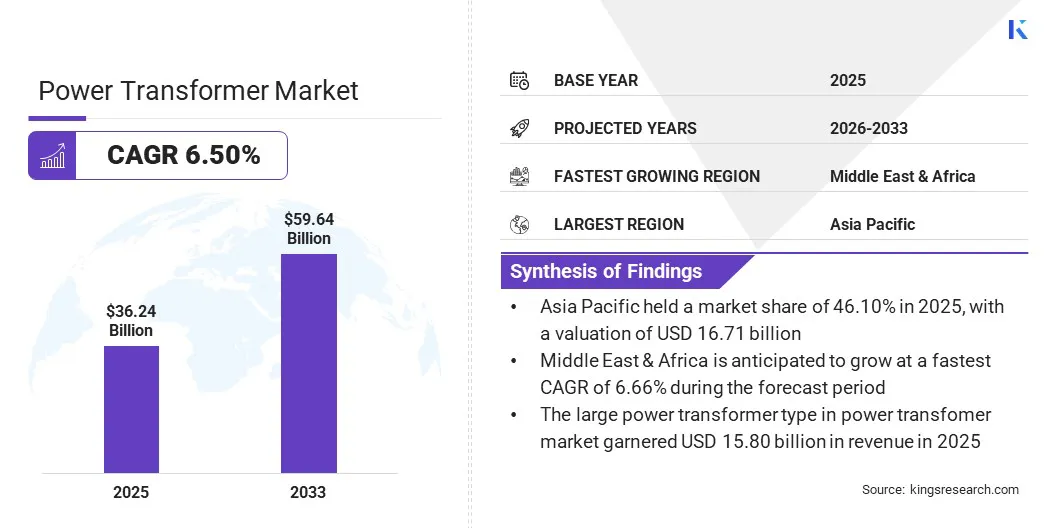
According to Kings Research, the global power transformer market size was valued at USD 36.24 billion in 2025 and is projected to reach USD 59.64 billion by 2033, growing at a CAGR of 6.5% from 2026 to 2033. The market comprises the manufacturing, assembly, and commercialization of high-voltage transformers used for transmission and substation applications. Power transformers are used to step up or step down voltage across power grids, industrial facilities, renewable energy projects, data centers, and other infrastructure.
The market is being driven by the growing need for reliable electricity transmission, grid modernization, renewable energy integration, electrification, and expansion of high-voltage transmission networks. The rapid development of hyperscale data centers is also creating substantial demand, as large computing facilities require significant electricity and multiple transformer installations across their power distribution systems.
Major companies operating in the global power transformer market include Hitachi Energy Ltd., Siemens AG, General Electric Company, Schneider Electric, Mitsubishi Electric Power Products, Inc., Toshiba International Corporation, HD Hyundai, TBEA Co., Ltd., WEG, Hyosung Heavy Industries, Fuji Electric Co., Ltd., LS Electric Co., Ltd., CG Power and Industrial Solutions Ltd., SBG SMIT, and CHINT Group.
The rapid expansion of AI compute infrastructure is transforming global energy demand. The expansion of hyperscale AI data centers to support large language models, autonomous systems, and high-performance computing (HPC) is leading to a surge in electricity consumption. This, in turn, requires the installation of power transformers, which handle grid interconnection, voltage regulation, and load balancing, thereby increasing their widespread applicability across power systems for data centers.
According to the International Energy Agency (IEA), China and the U.S. are estimated to be the most significant regions for data center electricity consumption, accounting for nearly 80% of global growth by 2030. The consumption is anticipated to increase by around 240 TWh (up 130%) in the U.S., compared to the 2024 level. In China, it increases by around 175 TWH (up 170%), and 45 TWh (up 70%) in Europe.
Fluctuations in raw material availability and supply chain disruptions negatively impact the power transformer market by creating an inconsistent supply base. Rising geopolitical tensions, trade tariffs (One Big Beautiful Bill (OBBBA) in the U.S.), and material shortages affect export dynamics, leading to increased production costs for transformer manufacturers.
Additionally, the shortage of grain-oriented electrical steel (GOES), which represents 20% of the transformer cost, followed by rising lead times, is leading to a supply chain crisis in the U.S. power sector.
For instance, the production capability of GOES is limited to Cleveland-Cliffs (U.S.), which constrains supply flexibility and impacts transformer production timelines amid growing demand from grid modernization and electrification initiatives. This is expanding average lead times for power transformers and specialized units up to 60 months for North America and Europe and 12 months for Asia-Pacific, causing a significant backlog of power transformer orders. This further contributes to higher project expenses and hinders market development.
To address the challenge, stakeholders are moving to amorphous core transformers, which use non-crystalline metal alloys and reduce no-load losses by 70–80%, leading to a lower carbon footprint.
The adoption of digitalization and cybersecurity measures in power systems is emerging as a notable trend in the market. The demand for smart and digitally enabled power transformers featuring real-time monitoring, remote diagnostics, and secure communication within modern grid architectures is transforming the market.
Integration of power transformers into digital substations and connected control environments is viewed as data-rich components within broader cyber-physical systems. Cyberattacks on the grid impact power transformers, causing incorrect readings, operational disruptions, equipment damage, or large-scale power outages. The malfunction results in forced, constant turning on/off, which creates an artificial demand for power. This causes the power transformers to trip, leading to blackouts.
To mitigate these operational disruptions, power transformer units are installed with sensors, condition monitoring systems, and communication interfaces. These interfaces enable predictive maintenance, improve operational efficiency, and provide robust cybersecurity, providing defense against unauthorized access, data manipulation, and communication-based attacks.
The energy infrastructure of Poland witnessed a failed cyberattack targeted in January 2026, which disrupted communication links between renewable energy installations and power distribution operators.
|
Segmentation |
Details |
|
By Type |
Small Power Transformers (10 MVA-30 MVA), Medium Power Transformers (30 MVA-100 MVA), Large Power Transformers (Above 100 MVA) |
|
By Cooling |
Oil-Cooled, Air-Cooled |
|
By Phase |
Single-Phase, Three-Phase |
|
By End Use |
Utilities, Industrial, Data Centers |
|
By Region |
North America: U.S., Canada, Mexico |
|
Europe: France, UK, Spain, Germany, Italy, Russia, Rest of Europe |
|
|
Asia-Pacific: China, Japan, India, Australia, ASEAN, South Korea, Rest of Asia-Pacific |
|
|
Middle East & Africa: Turkey, U.A.E., Saudi Arabia, South Africa, Rest of Middle East & Africa |
|
|
South America: Brazil, Argentina, Rest of South America |
Based on type, the market is categorized into small power transformers (10 MVA–30 MVA), medium power transformers (30 MVA–100 MVA), and large power transformers (above 100 MVA).
According to Kings Research, the large power transformer segment accounted for 43.60% of the market in 2025, valued at USD 15.80 billion, and is projected to grow at a CAGR of 6.67% from 2026 to 2033.
The segment's growth is supported by increasing investment in transmission infrastructure, grid modernization, renewable energy projects, data centers, industrial manufacturing facilities, and electric-vehicle infrastructure. Large transformers are particularly important for high-voltage transmission networks and large-scale power-generation projects.
Based on cooling, the market is classified into oil-cooled and air-cooled transformers.
The oil-cooled segment was valued at USD 31.64 billion in 2025 and is projected to grow at a CAGR of 6.50% from 2026 to 2033.
Oil-cooled transformers are widely used because transformer oil provides effective thermal management and dielectric insulation while supporting reliable operation under high electrical loads. Their durability and suitability for high-capacity transmission and distribution applications continue to support their widespread adoption.
Based on phase, the market is segmented into single-phase and three-phase transformers.
The three-phase segment accounted for 83.30% of the market in 2025, valued at USD 30.19 billion.
Three-phase transformers are widely deployed for industrial loads, utility transmission and distribution, and large-scale electricity networks. Their ability to efficiently handle high power loads makes them particularly suitable for long-distance electricity transmission and industrial applications.
Based on end use, the market is divided into utilities, industrial, and data centers. The utilities segment accounted for 67.30% of the market in 2025, valued at USD 24.39 billion.
The segment's dominance is attributed to the essential role of power transformers in electricity transmission and distribution networks. Utilities use transformers to step up voltage for long-distance transmission, reducing energy losses, and subsequently step down voltage for safe distribution to industrial, commercial, and residential consumers.
Increasing electricity consumption, aging grid infrastructure, electrification of transportation, renewable energy integration, and the expansion of large-load commercial facilities are expected to sustain demand from utilities.
Based on region, the global market has been segmented into North America, Europe, Asia-Pacific, the Middle East and Africa, and South & Central America.
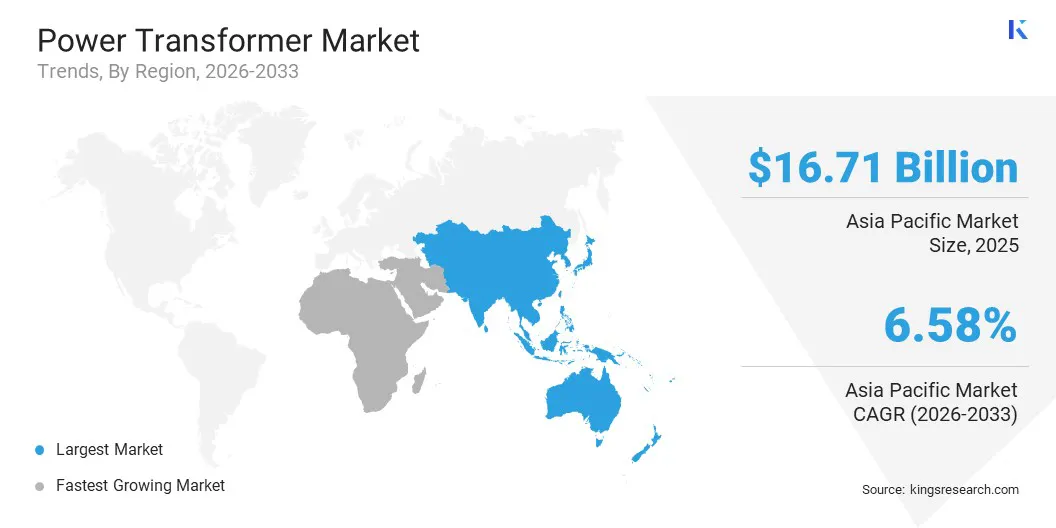 Asia-Pacific captured the highest market share of 46.10% in 2025. The high share is attributed to the rapid industrialization and an increased focus on clean energy initiatives. China and Southeast Asian countries act as major drivers for this growth due to their fast-growing industrial landscape and large populations, which create high demand for electricity to support their vast grid infrastructures.
For instance, China has made provisions to strengthen its position as the global leader in renewable energy, accounting for 60% of the global capacity expansion by 2030, according to the International Energy Agency (IEA). The country has doubled its utility-scale solar and wind power capacity, in line with the government target of 1,200 gigawatts (GW) by 2030, driving demand for power transformers in the region.
Additionally, the rising demand from Europe and the U.S. for Chinese-manufactured power transformers further drives the market expansion. The demand is attributable to the upgrading of aging power grids, increasing clean energy power generation, and expansion of computing infrastructure, including data centers.
The Middle East power transformer market is anticipated to grow at the fastest CAGR of 6.66%, reaching USD 6.48 billion by 2033. The rise in renewable capacity additions (solar and wind) and smart city developments across the UAE and Saudi Arabia, with projects like Masdar City, NEOM, Red Sea Project, and Sultan Haitham City, drives the demand for clean energy and environmentally responsible urban planning. This fuels the demand for power transformers capable of handling varying load demands.
The surge in the data center industry, driven by digital transformation, widespread adoption of cloud services, and strategic investments in artificial intelligence (AI), further increases the demand for power transformers in the region.
North America is witnessing increasing demand for power transformers as electricity consumption rises and utilities expand and modernize transmission infrastructure. In the U.S., growing data center and industrial electricity demand is creating additional pressure on grid capacity, while transformer supply constraints are encouraging investment in domestic manufacturing. Europe is prioritizing grid expansion and modernization to accommodate renewable-energy integration and electrification, with the European Commission estimating substantial investment requirements for transmission and distribution networks through 2040. South & Central America is supported by rising renewable-energy investment and transmission expansion, particularly in Brazil, while regional grid reliability and interconnection requirements are creating further opportunities for transformer deployment.
Key players operating in the power transformer market, such as Hitachi Energy, ABB, Siemens Energy, Schneider Electric, Fuji Electric, and others, are strengthening innovation and efficiency through strategic collaborations and acquisitions. Market players are entering into strategic collaborations and acquisitions to expand their portfolio, capture a wider market share, and address the long lead times for power transformers.
How We Gather This Information
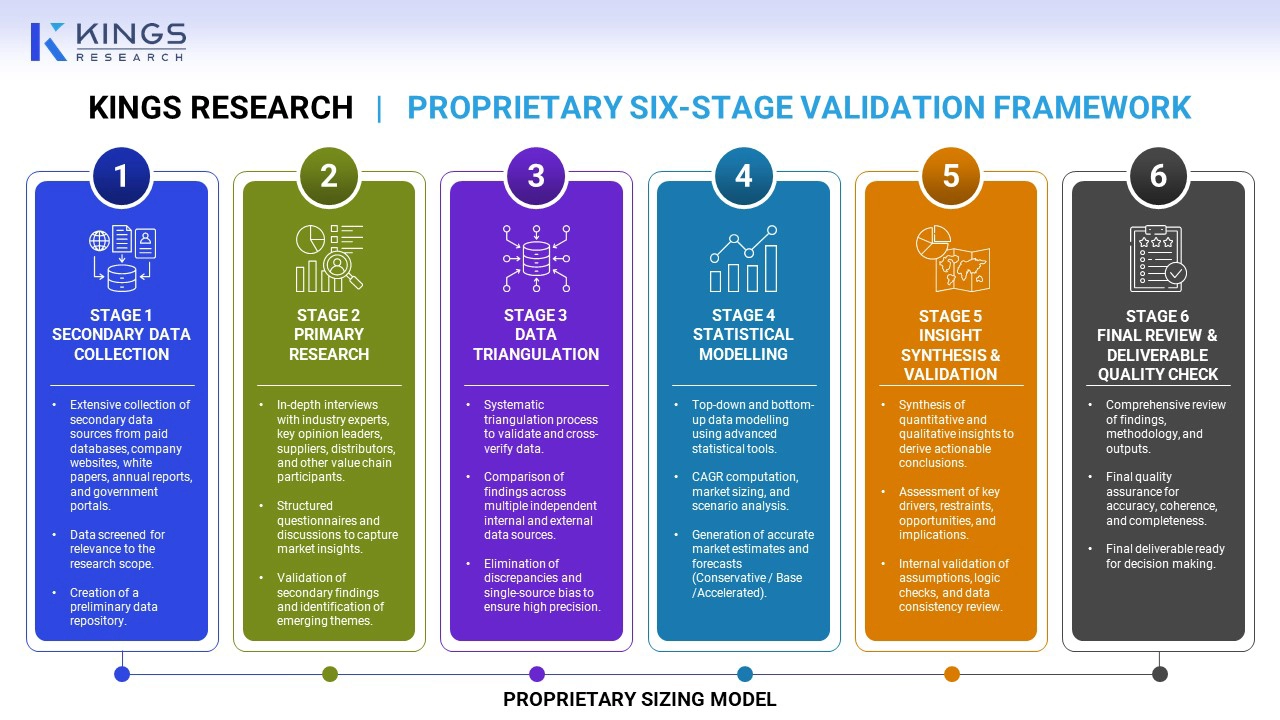
Our methodology triangulates insights from multiple independent and publicly available research databases and is further validated against regulatory filings and public company disclosures. All estimates are cross-verified; no single-source data is presented without validation.
Our custom offerings deliver tailored, data-driven intelligence and strategic guidance to help organizations identify, evaluate, and capitalize on key market opportunities.
Frequently Asked Questions

Faizy brings over four years of experience in market research and consulting, with a proven ability to support strategic engagements across diverse industries and business environments. His work focuses on understanding complex market structures, identifying emerging opportunities, and translating research findings into clear, commercially relevant insights. With strong analytical capabilities and a structured approach to problem-solving, he evaluates industry trends, competitive landscapes, customer dynamics, and evolving business models. His expertise encompasses market research, competitive intelligence, market sizing and forecasting, industry assessment, company benchmarking, and strategic analysis. Faizy combines technical proficiency with a strong research orientation, enabling him to interpret both qualitative and quantitative information effectively. He has contributed to projects that help organizations assess growth potential, strengthen market positioning, and evaluate strategic priorities. His adaptable approach allows him to work across sectors while maintaining a consistent focus on accuracy, relevance, and delivering insights that support informed decision-making for clients and stakeholders.
Habi is a seasoned research and consulting leader with renowned experience in guiding clients on strategic growth and transformation initiatives across global markets. He has led high-performing research teams that deliver actionable insights on market expansion, M&A strategies, opportunity assessment, new business development, and product launches. His project portfolio spans large petrochemical producers, electronic device manufacturers, lubricants companies, and other leading enterprises across diverse industrial and consumer sectors. He currently heads the research department at Kings Research, where he is responsible for setting the research agenda, mentoring analysts, and ensuring client-ready deliverables that support executive decision-making. With extensive experience in market intelligence, strategic research, and consulting, Habi brings a strong understanding of evolving industry dynamics, competitive landscapes, emerging opportunities, and business growth challenges. His expertise includes developing research frameworks, translating complex market data into actionable strategic recommendations, and working closely with senior stakeholders to address critical business questions. He has also contributed to building research capabilities, strengthening analytical methodologies, and driving a culture of quality and insight-led decision-making within research teams. His cross-industry exposure enables him to connect market trends with broader business implications and provide perspectives that help organizations identify opportunities, mitigate risks, and make informed strategic decisions.