
Inquire Now
Key strategic points
A blowout preventer (BOP) is a safety system that seals, controls, and monitors oil and gas wells to prevent blowouts and ensure operational safety. The market encompasses the manufacturing, distribution, and servicing of ram-type and annular BOP systems, control systems, and related components that are used in onshore and offshore drilling activities.
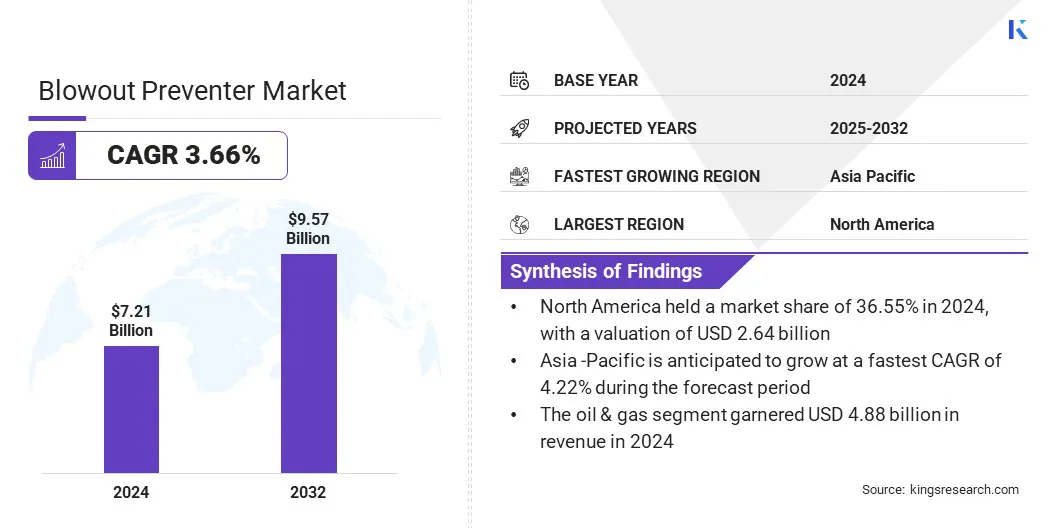
The global blowout preventer market size was valued at USD 7.21 billion in 2024 and is projected to grow from USD 7.44 billion in 2025 to USD 9.57 billion by 2032, exhibiting a CAGR of 3.66% over the forecast period.
Market growth is driven by rising global demand for oil and gas, which is encouraging expanded exploration and production activities. Increasing exploration activities in deepwater and ultra‑deepwater fields are further boosting the demand for advanced blowout preventer systems to ensure efficient and reliable drilling operations.
Major companies operating in the blowout preventer market are Schlumberger Limited, Baker Hughes Company, NOV, Weatherford, TechnipFMC plc, Halliburton Energy Services, Inc, Control Flow, Inc, BOP Products, LLC, WOM Inc, Kerui Oil & Gas, CANSCO Control Technology Inc, Satyam Oilfield Equipments and Services, Oceaneering International, Inc, AXON Pressure Products, Inc, and UZTEL S.A.
The rising upstream oil and gas costs are accelerating the adoption of advanced blowout preventer systems to improve drilling efficiency and ensure operational safety. Additionally, growing emphasis by operators on reducing downtime and preventing costly incidents is driving investments in reliable well control solutions, thereby supporting the growth of the market.
Rising Global Demand for Oil and Gas
A key factor propelling the growth of the blowout preventer market is the rising global demand for oil and gas, which is encouraging increased drilling and exploration activities worldwide.
Growing energy needs, driven by economic growth and industrial expansion are prompting operators to expand offshore and onshore production. This is leading to higher adoption of blowout preventers to ensure well control, operational safety, and regulatory compliance for onshore and offshore drilling projects.
High Initial Costs of Advanced BOP Systems
A key challenge impeding the growth of the blowout preventer market is the high initial cost of advanced BOP systems. These systems incorporate complex hydraulic mechanisms and digital control technologies that significantly increase capital expenditure. These high upfront costs create entry barriers and slow the broader adoption of advanced BOP solutions.
To address this challenge, market players are offering flexible financing options, leasing models, and service-based contracts, as well as investing in research and development to reduce manufacturing costs and improve operational efficiency. These strategies aim to make advanced BOP systems more accessible to oil and gas operators, particularly in emerging regions.
Introduction of Next-Generation Blowout Preventer (BOP) Technologies
A key trend shaping the blowout preventer market is the introduction of next-generation BOP technologies. Manufacturers are launching innovations such as automated locking mechanisms, boltless bonnet designs, and higher pressure-rated BOPs that improve operational efficiency, safety, and reliability in well control operations.
These advancements reduce maintenance time, minimize downtime, and help operators comply with safety regulations during complex offshore and onshore drilling projects.
|
Segmentation |
Details |
|
By Type |
Ram Blowout Preventer, Annular Blowout Preventer, Hybrid Blowout Preventer |
|
By Application |
Onshore, Offshore |
|
By End-Use Industry |
Oil & Gas, Geothermal, Mining |
|
By Region |
North America: U.S., Canada, Mexico |
|
Europe: France, UK, Spain, Germany, Italy, Russia, Rest of Europe |
|
|
Asia-Pacific: China, Japan, India, Australia, ASEAN, South Korea, Rest of Asia-Pacific |
|
|
Middle East & Africa: Turkey, U.A.E., Saudi Arabia, South Africa, Rest of Middle East & Africa |
|
|
South America: Brazil, Argentina, Rest of South America |
Based on region, the market has been classified into North America, Europe, Asia Pacific, Middle East & Africa, and South America.
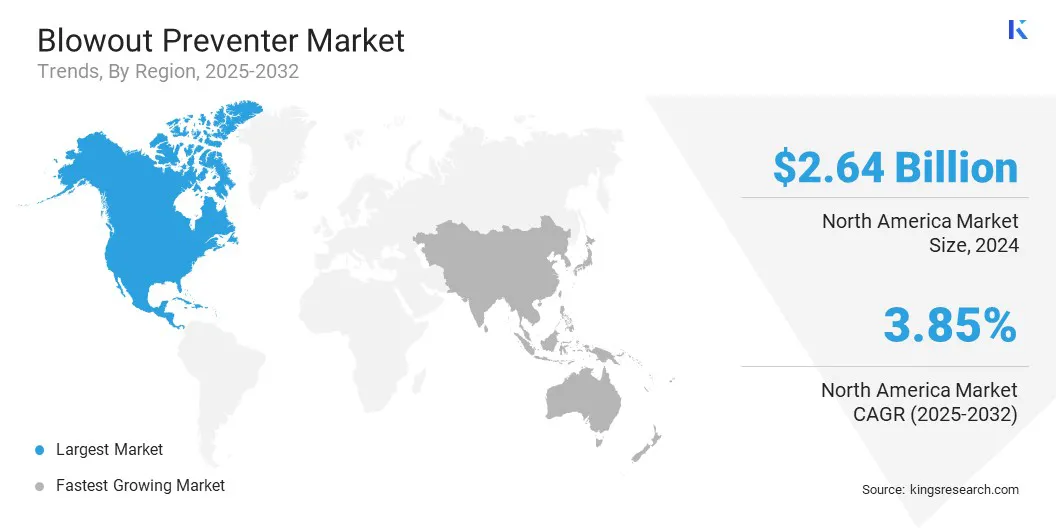
North America blowout preventer market share stood at 36.55% in 2024 in the global market, valued at USD 2.64 billion. This dominance is driven by rising demand for oil and gas, which is encouraging exploration and production activities across onshore and offshore fields in this region. Expanding investments by major energy companies in deepwater drilling are driving the need for advanced blowout preventer systems that ensure operational safety and compliance.
Stringent safety regulations by the U.S. Bureau of Safety and Environmental Enforcement (BSEE) and Canada’s National Energy Board are compelling operators to adopt robust well control solutions. Moreover, regional players are pursuing strategic fleet expansions to strengthen capabilities and meet the growing demand for safe and efficient drilling operations across region.
Asia Pacific is set to grow at a robust CAGR of 4.22% over the forecast period. This growth is due to the region’s rapid expansion in offshore oil and gas exploration activities. Growing energy demand from emerging economies, including China, India, and Southeast Asian nations is prompting large‑scale drilling activities.
Government initiatives such as China’s 14th Five‑Year Plan for energy development, India’s Hydrocarbon Exploration and Licensing Policy (HELP) to strengthen energy security and investments in offshore infrastructure are further fueling demand for advanced blowout preventer systems. Moreover, regional players are innovating in BOP design to improve efficiency, safety, and operational reliability, thereby fueling market growth.
Major players in the blowout preventer industry are focusing on advancing product design and manufacturing to enhance safety, reliability, and efficiency in well control operations. They are investing in research and development to introduce innovative technologies such as automated locking systems and boltless bonnet designs that reduce maintenance time and improve operational performance.
Companies are expanding their service capabilities and geographical presence by forming strategic partnerships and acquisitions to strengthen their market position and meet growing demand for advanced well control solutions. Additionally, market players are enhancing their portfolios with advanced data analytics and hydraulic completion solutions to provide integrated well intervention services.
Frequently Asked Questions

Swati is a committed research analyst with a passion for optimizing systems and processes across industries, specializing in healthcare but also bringing valuable expertise to sectors such as consumer goods, life sciences, and more. Her cross-domain research approach allows her to generate clear, actionable reports that inform strategic decisions in a variety of fields. Swati is committed to staying ahead of evolving trends, leveraging her broad understanding of different sectors to provide insights that are relevant to a range of industries. In her personal time, she enjoys music and spending quality time with her family, which inspires her creativity and enriches her professional approach. Her systematic methodology ensures that every report is both thorough and practical. Swati's ability to bridge regulatory frameworks with market realities gives her recommendations a distinct edge. She collaborates seamlessly with cross-functional teams, distilling complex data into straightforward narratives. Her proactive monitoring of policy and technological shifts keeps her analysis forward-looking.

With over a decade of research leadership across global markets, Ganapathy brings sharp judgment, strategic clarity, and deep industry expertise. Known for precision and an unwavering commitment to quality, he guides teams and clients with insights that consistently drive impactful business outcomes.