
Inquire Now
Key strategic points
The oil refining market involves transforming crude oil into various refined petroleum products such as gasoline, diesel, jet fuel, heating oil, and petrochemicals. This market includes the activities of oil refineries, as well as the technologies, processes, and infrastructure deployed to refine the crude oil. It also entails the supply chain operations involved in the distribution and sale of these refined products.
The market is a crucial element in meeting global energy needs, supporting transportation, manufacturing, and heating industries, and responding to changing environmental regulations and technological advancements.
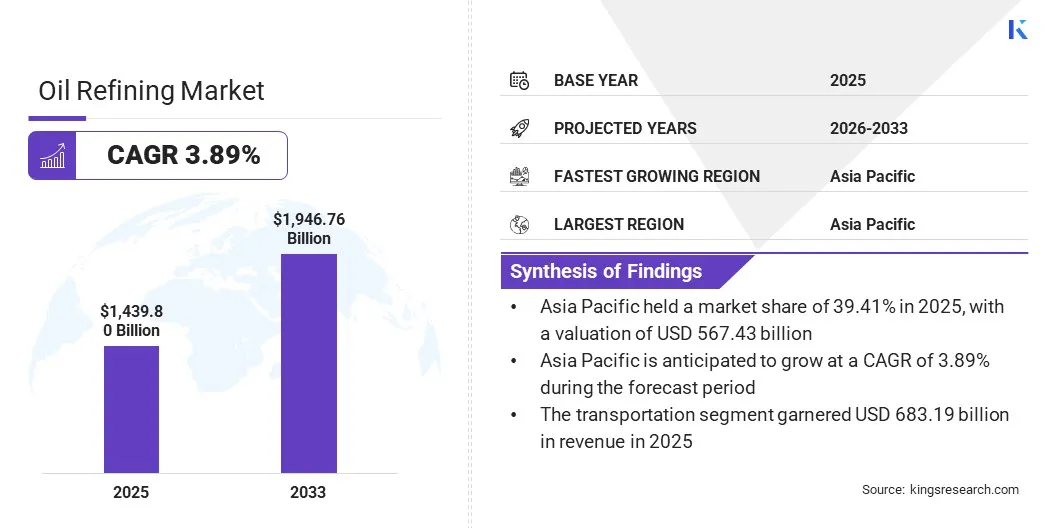
The global oil refining market size was valued at USD 1,439.80 billion in 2025 and is projected to grow from USD 1,490.39 billion in 2026 to USD 1,946.76 billion by 2033, exhibiting a CAGR of 3.89% during the forecast period. This growth is driven by rising energy demand, growing use of transportation and industrial fuels, continuous industrialization, and expanding infrastructure in emerging economies.
Major companies operating in the global oil refining industry are China Petrochemical Corporation (SINOPEC), Exxon Mobil Corporation, Saudi Arabian Oil Co., Valero, China National Petroleum Corporation (CNPC), Marathon Petroleum Corporation, ROSNEFT, Shell, BP, Indian Oil Corporation Ltd, Chevron Corporation, Reliance Industries Limited, TotalEnergies, Phillips 66 Company, and Petrobras.
Moreover, the shift toward petrochemical integration and smarter barrels increases the value of products and the overall efficiency of the refinery. Investments in advanced refining technologies, digitalization, and the production of cleaner fuels to meet stringent environmental regulations are further shaping the market’s positive outlook.
The increasing demand for transportation and industrial fuel is emerging as a key driving factor. As global populations grow and economic development accelerates, especially in emerging markets, the need for fuels such as gasoline, diesel, jet fuel, and marine fuels continues to increase. Rising consumption in the automotive, aviation, and shipping sectors is driven by urbanization, infrastructure building, and increased mobility.
At the same time, industrial development increases the demand for heating oils and other refined products that are essential for production and electricity generation. This high demand encourages refineries to expand capacity, increase efficiency, and implement new and improved processing technologies. As a result, the oil refining market experiences ongoing investment and innovation to meet the world’s evolving energy needs.
Crude oil price volatility and geopolitical risks present significant challenges to market expansion. Refineries depend on crude oil as the key feedstock; hence, any sudden fluctuation in the price of crude oil can be disastrous for operating costs, profitability, and overall business stability. Geopolitical factors like conflicts, sanctions, or changes in production policies among key oil-producing countries usually cause price volatility, leading to uncertainty in supply chains and market dynamics.
These external factors complicate refiners’ ability to plan investments, manage inventories, and predict financial performance. To mitigate these obstacles, refineries can diversify their crude sourcing strategies and invest in advanced risk management tools. Increased operational flexibility and scenario planning also enable companies to quickly adapt to market disruptions and remain resilient.
A significant trend shaping the oil refining market is the increasing interconnection of refinery processes with petrochemical manufacturing, also known as petrochemical integration, and the pursuit of smarter barrels. With the growth in the demand for traditional fuels leveling off, there is a strong emphasis by refiners on maximizing the production of high-value chemical feedstocks such as ethylene, propylene, and aromatics.
This change includes redesigning refineries to manufacture more petrochemicals with the help of sophisticated process technologies and versatile production processes.
The smarter barrel strategy focuses on deriving the best value out of every barrel of crude oil by focusing on the products that have higher margins and future market relevance. This trend increases the profitability, supports diversification, and allows refineries to adapt more easily to changing energy markets and customer demands.
|
Segmentation |
Details |
|
By Products |
Diesel/Gasoil, Fuel Oil, Gasoline, Kerosene (Jet Fuel), LPG, Naphtha, and Others |
|
By Application |
Transportation, Aviation, Electricity, Petrochemical, Residential & Commercial, and Others |
|
By Region |
North America: U.S., Canada, Mexico |
|
Europe: France, UK, Spain, Germany, Italy, Russia, Rest of Europe |
|
|
Asia-Pacific: China, Japan, India, Australia, ASEAN, South Korea, Rest of Asia-Pacific |
|
|
Middle East & Africa: Turkey, U.A.E., Saudi Arabia, South Africa, Rest of Middle East & Africa |
|
|
South America: Brazil, Argentina, Rest of South America |
Based on region, the global market has been classified into North America, Europe, Asia Pacific, Middle East & Africa, and South America.
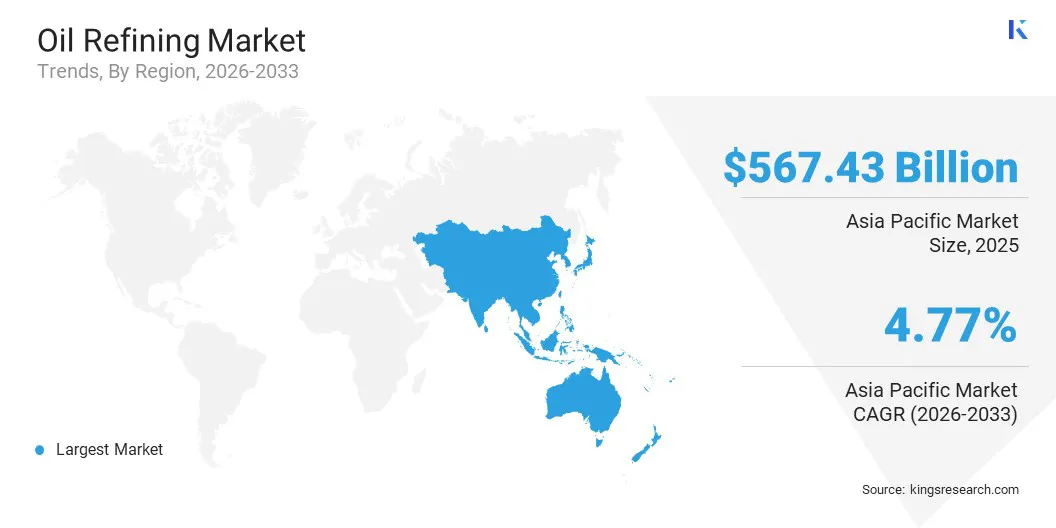
Asia-Pacific oil refining market share stood at 39.41% in 2025, valued at USD 567.43 billion. This dominant position can be attributed to a high rate of industrialization, urbanization, and increased energy use in the large economies in China, India, and Southeast Asian nations. The high economic development in the region has contributed to a high demand for refined products such as gasoline, diesel, and petrochemicals to support expansions of capacity and modernization of refining facilities.
Moreover, the competitiveness of the region has been enhanced by government policies that encourage local production and strategic investments in advanced refining technologies and environmental improvements. The regional market continues to grow due to the expansion of the automotive and transportation industries, along with infrastructure development projects. As a result, Asia-Pacific remains a key hub for oil refining globally, attracting significant investment and innovation.
The North America oil refining market is set to grow at a CAGR of 4.12% over the forecast period due to the continuous expansion of oil refinery infrastructure and an increasing emphasis on the production of cleaner fuels to comply with strict environmental policies. The region has a strong supply of domestic crude oil and a high level of technology, which allows refiners to optimize their activities and enhance margins.
Shifting consumer preferences towards low-sulfur fuels and biofuel blending are prompting refiners to invest in process innovation and modernization. Moreover, the discovery of shale oil resources has increased the flexibility of feedstock, which facilitates stable and cost-effective production. The market is also growing due to strategic partnerships, digital transformation, and investments in energy efficiency.
The oil refining market is characterized by intense competition, with barriers to entry being quite high due to significant capital requirements, advanced technological expertise, and strict adherence to regulatory standards. Firms are competing in terms of refining capacity, operational efficiency, product diversification, and their capacity to manufacture cleaner and higher-value fuels in compliance with environmental regulations. The industry is experiencing increased investment in advanced process technologies, automation, and digital solutions to enhance efficiency and reduce emissions.
Strategic activities such as mergers, acquisitions, and long-term supply agreements are prevalent as firms aim to optimize operations and strengthen market positions. Differentiation through innovation, sustainability programs, and responsiveness to regulatory changes is also critical, and a concentration on cost-optimization and value-added products contributes to continued profitability in a competitive and dynamic market.
Frequently Asked Questions

Aswathi holds cross-domain expertise, translating market trends and competitive intelligence into decision-ready insights. Her work helps clients interpret evolving market conditions and identify growth opportunities. She brings a focused, insight-led approach to research execution. She translates these findings into clear, prioritized action plans that align with client capabilities. Her research often includes scenario modeling to test growth strategies under varying economic conditions. She maintains a rigorous validation process, cross-checking primary and secondary sources to ensure reliability. Clients value her ability to synthesize noisy data into concise executive summaries that drive board-level discussions. Her sector-specific lens, combined with a pragmatic focus on execution, consistently delivers high-impact, commercially sound recommendations. Her structured yet flexible research frameworks adapt to client timelines without compromising depth. She is known for distilling complex trade-offs into straightforward, defensible positions that facilitate confident decision-making.

With over a decade of research leadership across global markets, Ganapathy brings sharp judgment, strategic clarity, and deep industry expertise. Known for precision and an unwavering commitment to quality, he guides teams and clients with insights that consistently drive impactful business outcomes.