


Aviation remains one of the hardest sectors to decarbonize. Long-haul flights require high-energy-density fuels that current electric or hydrogen systems cannot consistently deliver at scale. The sector continues to depend on liquid fuels for operational reliability and global connectivity.
Sustainable aviation fuel (SAF) has emerged as one of the most practical near-term solutions for reducing lifecycle greenhouse gas emissions. According to the International Civil Aviation Organization, SAF can reduce lifecycle emissions by up to 80% compared to conventional jet fuel, depending on the feedstock and production pathway.
Biomass is increasingly recognized as one of the most scalable and commercially viable feedstocks for SAF production. Governments, airlines, and fuel producers are accelerating investments in biomass-based pathways due to their compatibility with existing infrastructure and supply chains. The U.S. Department of Energy SAF Grand Challenge targets producing 3 billion gallons of SAF annually by 2030 and 35 billion gallons by 2050, signaling strong policy alignment with bio-based fuels.
Biomass also supports broader economic and environmental objectives. It enables waste utilization, strengthens energy security by reducing dependence on fossil fuel imports, and aligns with circular economy principles. Feedstocks such as agricultural residues, forestry waste, and municipal solid waste are already integrated into existing industrial systems, making scale-up more feasible.
Market Snapshot
|
Metric |
Value |
|
USD 9.44 Billion |
|
|
Forecast Market Size (2033) |
USD 18.93 Billion |
|
CAGR |
9.19% |
|
Largest Feedstock Segment |
Wood & Forestry Residues |
|
Fastest Growing Opportunity |
Sustainable Aviation Fuel |
Why Sustainable Aviation Fuel Has Become a Strategic Priority
The aviation industry is under increasing pressure to align with global decarbonization targets while maintaining operational efficiency and growth. Unlike other sectors, aviation has limited alternatives to liquid fuels due to strict energy density, safety, and performance requirements. This constraint has positioned sustainable aviation fuel (SAF) as a central pillar in aviation’s decarbonization strategy.
Global frameworks are reinforcing this transition. The Carbon Offsetting and Reduction Scheme for International Aviation (CORSIA), introduced by the International Civil Aviation Organization (ICAO), requires airlines to offset growth in emissions from international flights. At the same time, several countries are introducing SAF blending mandates and long-term decarbonization roadmaps. These regulatory measures are shifting SAF from a voluntary initiative to a compliance-driven requirement.
Airlines are also setting independent net-zero targets, often aiming for carbon neutrality by 2050. Major carriers are entering long-term offtake agreements with SAF producers to secure future fuel supply. These agreements reflect a structural shift in fuel procurement strategies, where sustainability considerations are integrated into long-term planning rather than treated as a short-term adjustment.
Government incentives are accelerating this transition. Policy mechanisms such as the Renewable Fuel Standard (RFS), federal tax credits, and production incentives are improving the commercial viability of SAF.
Rising demand for low-carbon aviation is further strengthening SAF adoption. Corporate travel policies, investor expectations, and environmental, social, and governance (ESG) frameworks are driving airlines to reduce their carbon footprint. SAF provides an immediate and scalable pathway to achieve measurable emissions reductions without requiring changes to aircraft fleets or airport infrastructure.
SAF is expected to remain the primary decarbonization pathway for long-haul aviation. Electric and hydrogen-powered aircraft are under development, but their commercial deployment at scale remains limited by technological and infrastructure constraints. In contrast, SAF can be blended with conventional jet fuel and used within existing systems, making it the most practical solution for near- to medium-term decarbonization.
As a result, SAF is transitioning from an alternative fuel option to a strategic necessity. Its role is expanding across regulatory compliance, corporate sustainability strategies, and long-term fuel security planning. This shift is driving increased investment, innovation, and collaboration across the aviation and energy sectors.
What is Sustainable Aviation Fuel (SAF)?
Sustainable aviation fuel is a renewable jet fuel produced from non-fossil feedstocks such as biomass, waste oils, and agricultural residues. It is chemically similar to conventional jet fuel and can be blended for use in existing aircraft, enabling lower lifecycle greenhouse gas emissions without infrastructure changes.
Why Biomass is Emerging as the Preferred SAF Feedstock
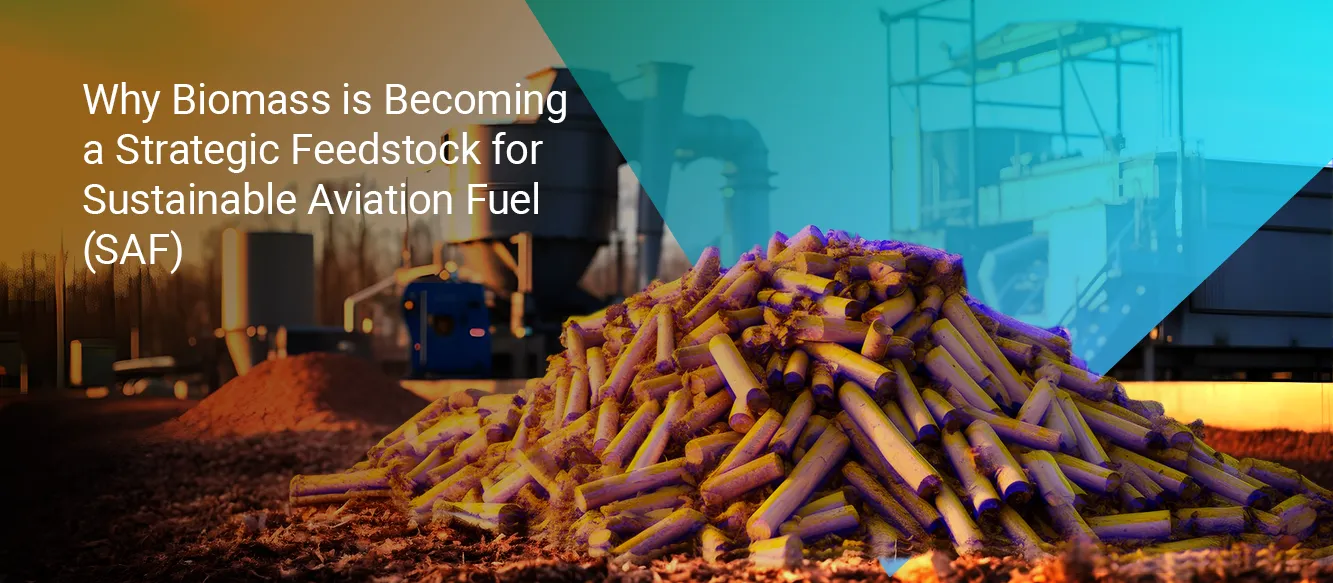
Biomass is gaining strategic importance as a feedstock for sustainable aviation fuel because it meets three critical requirements at scale: availability, compatibility, and sustainability. As SAF demand accelerates, stakeholders are prioritizing feedstocks that can support long-term production without creating supply constraints or infrastructure disruptions.
One of the primary advantages of biomass is its widespread availability. Agricultural residues, forestry waste, municipal solid waste, and animal waste are generated continuously across regions. The U.S. Department of Energy’s Billion-Ton assessments show that the United States has the potential to add over 400 million tons of biomass annually, bringing the total available biomass to more than 1 billion tons.
Biomass also benefits from existing supply chains. Collection and transportation systems are already established within agriculture, forestry, and waste management sectors. This reduces the need for new infrastructure and enables faster commercialization compared to alternative feedstocks that require dedicated systems.
Feedstock diversity further strengthens its position. Biomass includes a wide range of inputs, from residues to energy crops, allowing flexible sourcing based on regional availability. This reduces supply risk and supports consistent production across different geographies.
From a sustainability perspective, biomass aligns with circular economy principles. Many feedstocks are derived from waste streams that would otherwise contribute to emissions or landfill accumulation. Converting these materials into SAF improves resource efficiency and reduces lifecycle greenhouse gas emissions compared to conventional jet fuel. Biomass also supports energy security by enabling domestic fuel production. Countries can leverage local resources to reduce dependence on imported fossil fuels and improve supply resilience.
Compared to other SAF feedstocks, biomass presents fewer scalability constraints. Waste oils face limited supply, while synthetic fuels require significant infrastructure development. Biomass, in contrast, is already available at scale and compatible with multiple conversion pathways, making it a practical option for near-term expansion.
As SAF demand continues to rise, securing reliable and scalable feedstocks will remain critical. Biomass meets these requirements effectively, positioning it as a preferred feedstock for sustainable aviation fuel production.
Biomass Feedstock Comparison Table
|
Feedstock |
Availability |
Typical SAF Pathway |
Sustainability Benefits |
|
Agricultural Residues |
High |
Gasification, ATJ |
Utilizes waste, reduces open-field burning |
|
Forestry Waste |
High |
Fischer-Tropsch |
Reduces wildfire risk, improves forest management |
|
Municipal Solid Waste |
Moderate |
Gasification |
Diverts waste from landfills |
|
Energy Crops |
Moderate |
HEFA, ATJ |
Dedicated renewable feedstock with controlled supply |
|
Animal Waste |
Moderate |
Anaerobic digestion |
Captures methane emissions and reduces pollution |
How Biomass is Converted into Sustainable Aviation Fuel
Biomass conversion into SAF involves multiple industrial pathways. Each pathway is designed to process specific feedstocks and produce fuel that meets aviation-grade specifications. The process is defined by three stages: feedstock preparation, conversion, and fuel upgrading.
The U.S. Department of Energy notes that approved SAF pathways can deliver significant lifecycle emissions reductions while remaining compatible with existing jet engines.
At a high level, biomass such as agricultural residues, forestry waste, and used oils is first processed into intermediate forms. These intermediates are then refined into hydrocarbons that closely match conventional jet fuel.
Conversion Pathways Table
|
Pathway |
Process |
Typical Feedstock |
|
HEFA (Hydroprocessed Esters and Fatty Acids) |
Oils are hydrogenated and refined into jet fuel |
Used cooking oil, animal fats |
|
Gasification + Fischer-Tropsch |
Biomass is converted into syngas, then into liquid fuel |
Agricultural and forestry residues |
|
Alcohol-to-Jet (ATJ) |
Alcohols converted into jet-range hydrocarbons |
Ethanol, biomass-derived alcohols |
|
Pyrolysis |
Biomass thermally decomposed into bio-oil, then upgraded |
Wood waste, crop residues |
How the Process Works Across Pathways
Each pathway differs in chemistry, but the core process remains consistent. Biomass is first collected and pre-treated to remove moisture and impurities. This step ensures stable conversion and improves efficiency.
In thermochemical routes such as gasification, biomass is exposed to high temperatures with limited oxygen. This produces synthesis gas, which is then converted into liquid hydrocarbons through catalytic processes. In biochemical pathways, biomass is fermented into alcohols before undergoing catalytic upgrading. The final stage focuses on refining and blending. The produced fuel is treated to meet aviation standards and blended with conventional jet fuel. Current approvals typically allow blending ratios of up to 50%, depending on the pathway.
According to the DOE Bioenergy Technologies Office, improving conversion efficiency and reducing processing costs remain critical for scaling these technologies.
Why Conversion Technology Matters
Conversion pathways directly influence cost, scalability, and emissions performance. HEFA remains the most commercially mature route due to established supply chains for waste oils. However, its scalability is limited by feedstock availability.
Thermochemical pathways such as Fischer-Tropsch offer higher scalability potential because they utilize abundant biomass residues. Similarly, Alcohol-to-Jet processes benefit from existing ethanol infrastructure, particularly in regions with strong biofuel ecosystems.
As technology advances, the industry is shifting toward pathways that balance feedstock flexibility, cost efficiency, and large-scale production potential. These factors will determine how quickly biomass-based SAF can move from pilot projects to mainstream aviation fuel supply.
Business Advantages of Biomass-Based SAF
Biomass-based SAF offers measurable operational and financial advantages. These benefits are driving adoption across airlines, fuel producers, and policymakers. The value extends beyond emissions reduction to supply security and regulatory alignment.
100% SAF can reduce lifecycle greenhouse gas emissions by up to 94% compared to conventional jet fuel, depending on feedstock and pathway. Other publications, such as those from Resources for the Future, highlight that scaling up biofuels production can strengthen rural economies and reduce dependence on imported fuels.
Key Business Advantages Table
|
Advantage |
Strategic Impact |
|
Carbon reduction potential |
Up to 94% lifecycle emissions reduction (DOE) |
|
Feedstock availability |
Agricultural and forestry residues widely accessible (USDA) |
|
Energy security |
Reduces reliance on crude oil imports |
|
Policy incentives |
Tax credits and SAF mandates improving ROI |
|
Infrastructure compatibility |
Works with existing aircraft and fuel systems |
Where Biomass-Based SAF is Creating the Greatest Opportunities
Biomass-based SAF deployment is accelerating in regions with strong policy backing and feedstock availability. The U.S. leads in structured scaling efforts supported by federal programs. The USDA continues to fund feedstock development and rural bioenergy supply chains, strengthening upstream availability.
Opportunity Areas Table
|
Opportunity Area |
Growth Driver |
|
United States |
Strong federal funding and SAF Grand Challenge targets |
|
Europe |
Policy mandates under aviation decarbonization frameworks |
|
Asia-Pacific |
Rising aviation demand and energy diversification goals |
|
Rural economies |
Biomass supply chain expansion supported by USDA |
|
Waste-to-fuel projects |
Municipal and agricultural waste utilization |
The Challenges of Scaling Biomass-Based SAF
Despite strong momentum, scaling biomass-based SAF involves structural and economic challenges. These barriers are shaping investment decisions and deployment timelines. The IEA Bioenergy notes that feedstock logistics, conversion costs, and infrastructure scaling remain key constraints to commercialization. It also emphasizes the need to expand sustainable biomass supply without impacting food systems or the balance of land use.
Download the U.S. Biomass Energy Market Report
Explore in-depth insights into biomass feedstock trends, sustainable aviation fuel (SAF) production pathways, market forecasts, policy developments, and emerging investment opportunities shaping the U.S. biomass energy market.
Key Challenges Table
|
Challenge |
Impact on Scaling |
|
Feedstock logistics |
Collection, storage, and transport complexity |
|
High production cost |
SAF remains costlier than fossil jet fuel |
|
Limited refining capacity |
Infrastructure still developing |
|
Land use concerns |
Balancing fuel vs food production |
|
Policy uncertainty |
Long-term incentives still evolving |
Policy is Accelerating Biomass-Based SAF Development
Policy frameworks are shaping the commercial viability of biomass-based SAF. Governments are aligning climate targets with fuel transition strategies, creating a structured demand environment for SAF adoption. The focus has shifted from pilot support to market creation and long-term scale-up.
In the U.S., policy is designed to reduce cost barriers and accelerate private investment. The U.S. Department of the Treasury's IRS introduced a dedicated SAF tax credit ranging from USD 1.25 to USD 1.75 per gallon, depending on lifecycle emissions performance. This directly links financial incentives to improvements in carbon intensity, encouraging the use of low-emission biomass feedstocks.
In parallel, the U.S. Department of Energy is funding demonstration and commercialization projects to bridge the gap between pilot-scale technologies and industrial deployment.
How Policy is Structuring the SAF Market
Policy support is not limited to subsidies. It is creating a multi-layered ecosystem that reduces risk across the value chain. Federal and state programs are aligning feedstock production, fuel conversion, and airline adoption under a common framework.
The U.S. Department of Agriculture is supporting biomass supply chains through programs that fund feedstock cultivation, collection, and processing infrastructure. This ensures consistent availability of raw materials for SAF production.
On the demand side, federal agencies are integrating SAF into procurement strategies. Government-backed offtake agreements are improving revenue visibility for producers, which is critical for financing large-scale facilities.
Policy Impact on Investment and Scaling
Policy clarity is reducing uncertainty for investors. Long-term tax credits and funding programs are improving project bankability. This is leading to increased participation from energy companies, aviation stakeholders, and infrastructure developers.
At the same time, sustainability criteria embedded in policies are shaping feedstock selection. Incentives favor pathways that deliver greater emissions reductions, thereby accelerating the shift toward waste-based and residue-derived biomass.
Why Policy Support Matters for Biomass
Biomass-based SAF depends on coordinated development across agriculture, energy, and aviation sectors. Policy frameworks are enabling this integration by aligning incentives across all three domains.
As a result, biomass is moving from a supplementary feedstock to a policy-backed priority, supported by structured incentives, funding mechanisms, and long-term decarbonization mandates.
The Future of Biomass in Sustainable Aviation Fuel
Biomass is expected to remain central to SAF production over the next decade. Advanced feedstocks, including algae and engineered biomass, are expanding the resource base.
Bio-refineries are evolving into integrated production hubs. Carbon capture technologies such as BECCS are being integrated to further reduce lifecycle emissions. The International Energy Agency highlights that bioenergy with carbon capture can deliver negative emissions under certain conditions. AI-driven supply chain optimization is improving feedstock sourcing and logistics. These developments support long-term scalability and cost efficiency. Biomass is likely to remain a dominant SAF feedstock through 2035 due to its availability, policy support, and compatibility with existing fuel systems.
What This Means for Stakeholders Across the Value Chain
Biomass-based SAF is moving beyond early-stage momentum and entering a phase where execution determines impact. The direction is clear. The next phase depends on how effectively stakeholders align operations, investment, and supply chains.
For fuel producers, the focus is shifting toward process efficiency and feedstock flexibility. Technologies that can handle diverse biomass inputs will reduce supply risk and improve margins. For airlines, long-term procurement strategies will become central to managing both cost exposure and emissions targets.
What emerges is a clear industry shift. Biomass-based SAF is not defined only by environmental value. It is increasingly tied to energy diversification, supply resilience, and long-term cost stability. The companies that move early to secure feedstock, invest in scalable technologies, and align with policy frameworks will be better positioned as SAF demand accelerates. The opportunity is not limited to fuel production. It extends across logistics, agriculture, refining, and aviation operations.
In this transition, biomass is emerging as a strategic enabler of aviation decarbonization, supported by real assets, existing supply chains, and growing institutional backing.
Bottom Line
Biomass is evolving from a renewable energy source into a strategic industrial feedstock. Its role in sustainable aviation fuel production is expanding due to its scalability, availability, and compatibility with existing infrastructure.
SAF represents one of the most significant long-term growth opportunities for biomass utilization. Governments, airlines, and fuel producers are investing across the value chain to accelerate deployment.
Long-term success will depend on sustainable feedstock sourcing, continued technological advancement, and supportive policy frameworks.
Frequently Asked Questions
What is Sustainable Aviation Fuel?
Sustainable aviation fuel (SAF) is an alternative to conventional jet fuel produced from renewable or waste-based resources. It is designed to operate within existing aircraft engines and fueling infrastructure while delivering significantly lower lifecycle greenhouse gas emissions than fossil-derived aviation fuel.
Why is biomass used to produce SAF?
Biomass is widely used because it is renewable, widely available, and compatible with multiple fuel conversion technologies. It includes waste streams that would otherwise remain underutilized. The U.S. Department of Energy identifies biomass as a key pathway for producing low-carbon fuels due to its ability to reduce lifecycle emissions and support domestic energy supply.
Which biomass feedstocks are used for aviation fuel?
Common feedstocks include agricultural residues such as corn stover and wheat straw, forestry residues, used cooking oil, animal fats, and municipal solid waste. These feedstocks are preferred because they do not directly compete with the food supply and are available at scale across multiple regions.
How is biomass converted into jet fuel?
Biomass is converted into SAF through several established pathways. These include hydroprocessed esters and fatty acids (HEFA), gasification followed by Fischer–Tropsch synthesis, and alcohol-to-jet conversion. Each pathway transforms raw biomass into a refined fuel that meets aviation-grade specifications.
What’s Next?
Download the U.S. Biomass Energy Market Report to explore feedstock trends, SAF production technologies, investment opportunities, regulatory developments, and future market forecasts shaping the biomass energy industry. Or speak with a renewable energy market analyst to evaluate strategic opportunities in biomass-based SAF.