Inquire Now
Key Strategic Points
The sodium-ion battery market involves the production of sodium-ion-based battery systems that use sodium ions as the primary charge carriers. The market is gaining prominence due to the low cost of the technology and the fast-charging capabilities of the batteries. This, in turn, makes these batteries suitable across a diverse array of end-use domains, ranging from automotive and consumer electronics to large grid-scale energy storage systems.
The market includes multiple battery chemistries and configurations such as sodium-sulfur, sodium-nickel chloride (ZEBRA), and other emerging sodium-based technologies, available in various formats including cylindrical, prismatic, pouch, and other specialized designs. These batteries utilize different electrolyte systems, thus offering varied energy densities, cycle life, safety, cost efficiency, and thermal stability to support emerging applications across diverse end-use verticals.
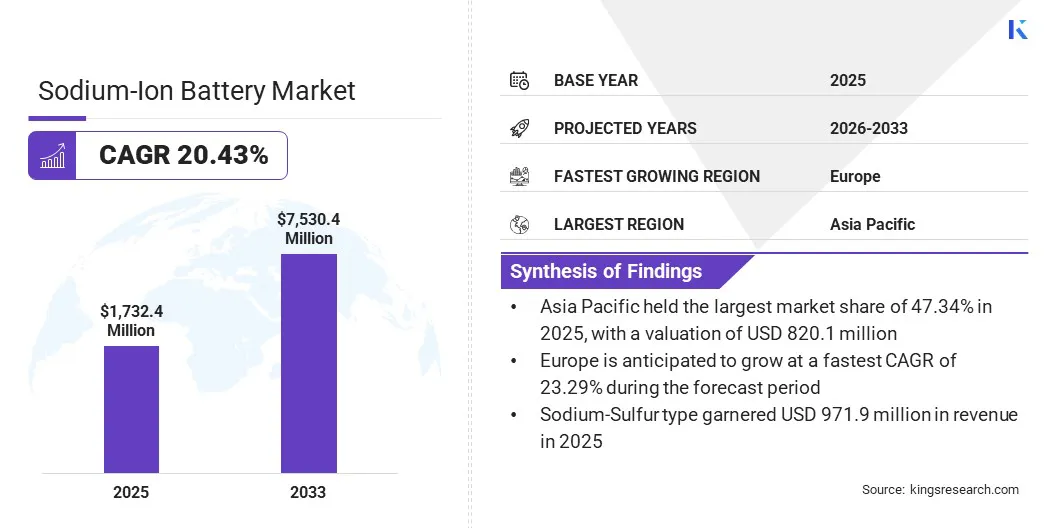
The global sodium-ion battery market size was valued at USD 1732.40 million in 2025 and is projected to reach USD 7530.44 million by 2033, representing a CAGR of 20.43% over the forecast period. This notable growth is driven by the rising demand for low-cost, environmentally friendly battery chemistries for deployment across large-scale grid energy storage systems and automotive end-use sectors. Additionally, the ability of sodium-ion batteries to reach 90% charge capacity in approximately 12 minutes, along with their stable performance at temperatures ranging from -40°C to 80°C, makes them a prime choice for addressing energy storage needs in colder climates.
Major companies operating in the global sodium-ion battery industry include CATL, Faradion, HiNa Battery Technology Co., Ltd., Natron Energy, TIAMAT SAS, BYD Co., Ltd., Indi Energy, VEKEN, Rechargion Energy Private Limited, AMTE Power, Pylon Technologies Co., Ltd., Samsung SDI, LG Chem, ProLogium Technology CO., Ltd., and TOSHIBA CORPORATION.
Businesses across diverse end-user industries such as automotive, stationary energy storage, and industrial power are adopting sodium-ion batteries (SIBs) to capitalize on their superior safety, low-temperature performance, and cost-effectiveness. The market is witnessing a strategic transition to the adoption of sodium-ion batteries due to their low cost and rapid charging capabilities, particularly for entry-level electric vehicles and large-scale renewable energy firming. Additionally, the high cost and volatile supply of critical battery minerals such as lithium further fuel the shift toward abundant metal sodium-based battery chemistries.
Sodium-ion batteries utilize sodium carbonate as the primary raw material, which is over 1,000 times more abundant than lithium and up to 500 times less expensive to process. According to the U.S. Geological Survey (USGS), the global reserves of sodium are estimated at 47 billion tons, compared to 150 million tons for lithium as of 2025.
Moreover, the stability in sodium carbonate prices, which are estimated at around USD 300 per ton compared to USD 13,000 - USD 80,000 per ton for lithium, reduces the exposure of sodium-ion battery production to geopolitical supply shocks. This provides an overall lower cost on a kilogram basis to sodium-ion batteries compared to lithium-based chemistries, acting as a major driving factor.
The lower energy density of sodium-ion batteries compared to lithium-ion alternatives limits their performance and adoption. With around 175 Wh/kg, they offer shorter driving ranges (up to 350 km) versus 400–600 km for lithium-ion batteries, making them less suitable for long-range applications like electric vehicles. Additionally, dependence on minerals such as nickel and manganese, which face supply chain constraints, further restricts large-scale deployment.
To address this, industry players are advancing battery chemistries and material innovations to improve energy density and overall performance. Efforts focus on enhancing electrode materials, optimizing cell design, and improving thermal stability to boost efficiency and reliability. These developments are expected to narrow the performance gap with lithium-ion batteries while retaining the cost and resource advantages of sodium-ion technology.
Advancements in cathode materials, particularly the adoption of Prussian blue analogues (PBAs), are emerging as a notable market trend. PBAs offer three-dimensional ion diffusion channels that enable fast-charging capabilities, minimize structural strain during cycling, and their low-cost, iron-based chemistry leads to a significant reduction in reliance on cobalt- and nickel-based cathodes.
Moreover, PBAs such as iron hexacyanoferrate (FeHCF) and copper hexacyanoferrate (CuHCF) exhibit high specific capacity, good cycling stability, strong structural stability, high voltage, and relatively simple synthesis processes. This makes PBAs a commercially attractive cathode option for sodium-ion batteries, offering potentially 20-30% lower production costs and fast charging capabilities compared to lithium-ion batteries. This, in turn, creates potential growth opportunities for sodium-ion batteries.
|
Segmentation |
Details |
|
By Type |
Sodium-Salt (ZEBRA), Sodium-Sulfur, Sodium-Nickel Chloride |
|
By Format |
Cylindrical, Prismatic, Pouch, Others |
|
By Electrolyte |
Aqueous, Non-Aqueous |
|
By End Use |
Automotive, Energy Storage, Consumer Electronics, Telecommunications, Industrial, Others |
|
By Region |
North America: U.S., Canada, Mexico |
|
Europe: France, UK, Spain, Germany, Italy, Russia, Rest of Europe |
|
|
Asia-Pacific: China, Japan, India, Australia, ASEAN, South Korea, Rest of Asia-Pacific |
|
|
Middle East & Africa: Turkey, U.A.E., Saudi Arabia, South Africa, Rest of Middle East & Africa |
|
|
South America: Brazil, Argentina, Rest of South America |
Based on region, the global sodium-ion battery market is segmented into North America, Europe, Asia Pacific, Middle East and Africa, and South America.
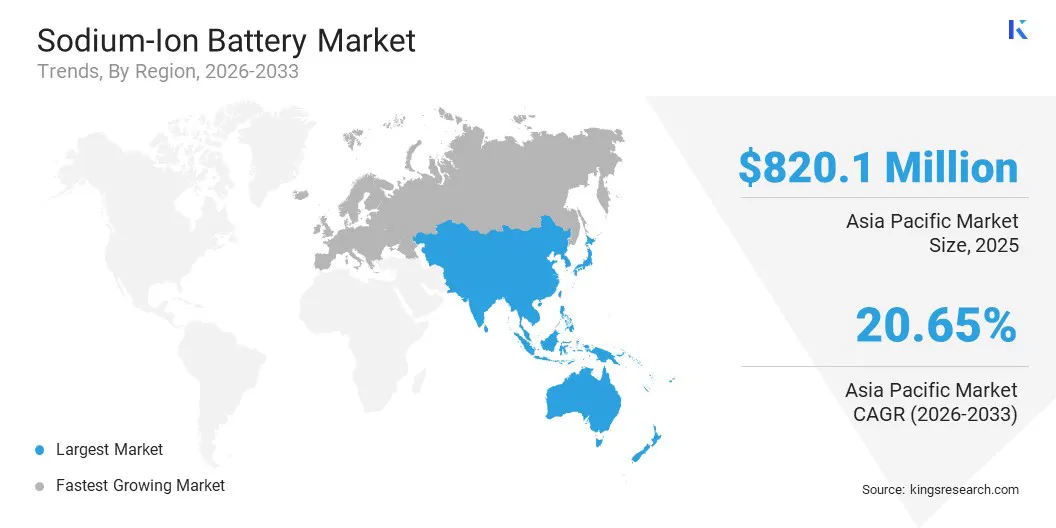
The Asia-Pacific sodium-ion battery market captured a majority share of 47.34% and was valued at USD 820.1 million in 2025. This expansion is primarily driven by accelerated renewable energy deployment and grid storage expansion due to rising electrification needs, along with the extensive adoption of electric vehicles across fast-growing economies such as China, South Korea, India, and Southeast Asia. Additionally, the booming industrial and commercial infrastructure, along with an extensive technological research landscape across China, Japan, South Korea, and Southeast Asian economies, supports regional market growth.
The Europe sodium-ion battery market is set to register the fastest CAGR of 23.29% over the forecast period. This rapid growth is primarily propelled by increasing awareness regarding the social and environmental impacts of extracting and refining critical battery minerals, including lithium, gallium, boron, and tungsten. The concentration of lithium, nickel, and cobalt reserves in a few countries, particularly China, which accounts for nearly 70% of the global lithium refining capacity, exposes Europe to geopolitical and trade disruptions and subjects it to intense competition.
Sodium-based batteries are gaining prominence in Europe owing to their ability to counter battery supply chain challenges and reduce Europe’s reliance on Chinese-sourced battery raw materials and technologies.
Key players in the sodium-ion battery market are conducting extensive research to improve electrode performance, refine electrolyte formulations, enhance battery energy density, and scale up pilot manufacturing to address the growing demand for scalable energy storage systems in renewable energy, grid integration, and electric mobility, thereby reducing dependence on critical raw materials.
Additionally, market players are prioritizing strategic technical collaboration with established players to drive the transition to sodium-ion battery cell technology and electrode design, while advancing commercialization opportunities in next-generation energy storage and high-performance systems.
Frequently Asked Questions

Faizy brings over four years of experience in market research and consulting, with a proven ability to support strategic engagements across diverse industries and business environments. His work focuses on understanding complex market structures, identifying emerging opportunities, and translating research findings into clear, commercially relevant insights. With strong analytical capabilities and a structured approach to problem-solving, he evaluates industry trends, competitive landscapes, customer dynamics, and evolving business models. His expertise encompasses market research, competitive intelligence, market sizing and forecasting, industry assessment, company benchmarking, and strategic analysis. Faizy combines technical proficiency with a strong research orientation, enabling him to interpret both qualitative and quantitative information effectively. He has contributed to projects that help organizations assess growth potential, strengthen market positioning, and evaluate strategic priorities. His adaptable approach allows him to work across sectors while maintaining a consistent focus on accuracy, relevance, and delivering insights that support informed decision-making for clients and stakeholders.
Habi is a seasoned research and consulting leader with renowned experience in guiding clients on strategic growth and transformation initiatives across global markets. He has led high-performing research teams that deliver actionable insights on market expansion, M&A strategies, opportunity assessment, new business development, and product launches. His project portfolio spans large petrochemical producers, electronic device manufacturers, lubricants companies, and other leading enterprises across diverse industrial and consumer sectors. He currently heads the research department at Kings Research, where he is responsible for setting the research agenda, mentoring analysts, and ensuring client-ready deliverables that support executive decision-making. With extensive experience in market intelligence, strategic research, and consulting, Habi brings a strong understanding of evolving industry dynamics, competitive landscapes, emerging opportunities, and business growth challenges. His expertise includes developing research frameworks, translating complex market data into actionable strategic recommendations, and working closely with senior stakeholders to address critical business questions. He has also contributed to building research capabilities, strengthening analytical methodologies, and driving a culture of quality and insight-led decision-making within research teams. His cross-industry exposure enables him to connect market trends with broader business implications and provide perspectives that help organizations identify opportunities, mitigate risks, and make informed strategic decisions.