


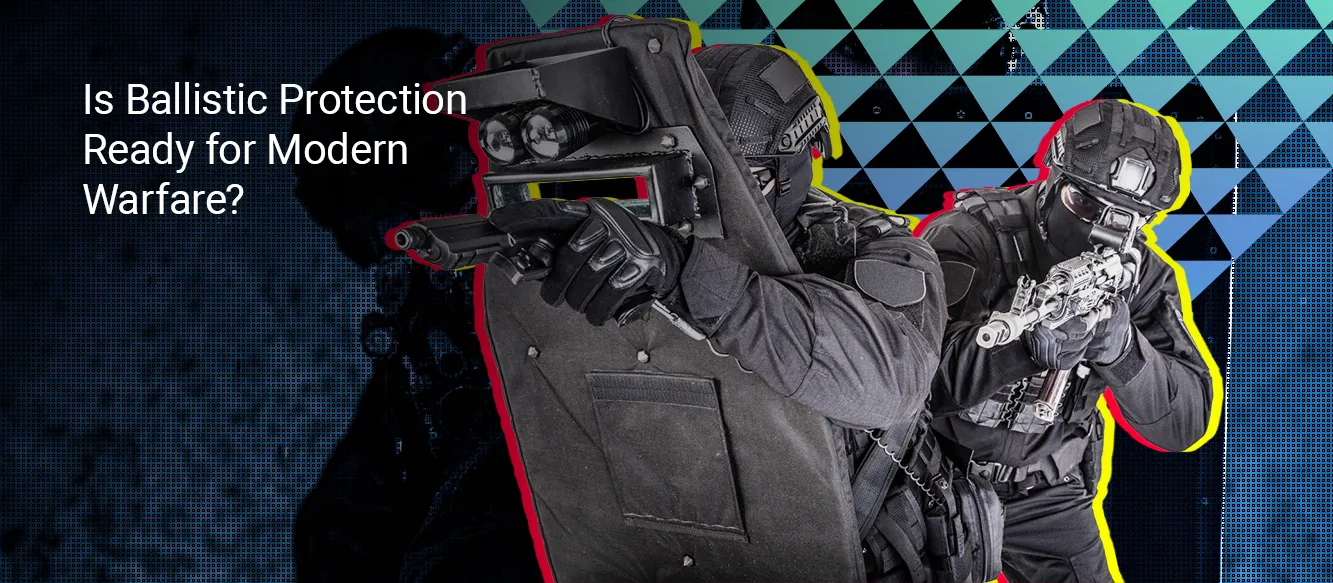
From USD 12.06 billion in 2025, the global ballistic protection market is projected to reach USD 19.73 billion by 2033, recording a CAGR of 4.7% between 2026 and 2033, according to Kings Research. This growth reflects a fundamental shift in battlefield realities. Conventional bullet resistance proves insufficient as a standalone design objective today. Modern warfighters face multidirectional fragmentation, advanced rifle threats, explosive hazards, and drone-enabled battlefield environments.
These dynamic hazards force engineers to confront a central tension: delivering greater survivability while ensuring lower weight and higher mobility. Overloaded operators experience severe fatigue, reducing overall physical effectiveness and tactical awareness. Consequently, the industry is racing to develop multi-threat armor capable of handling complex environments. Protective equipment keeps pace with modern warfare largely through a paradigm shift toward lightweight, modular, and standards-driven systems.
What Is Ballistic Protection?
At its core, ballistic protection refers to specialized materials and engineered systems designed to stop or mitigate the impact of incoming projectiles and explosive fragmentation, shielding the wearer from lethal trauma. Understanding this baseline is crucial for examining how modern armor adapts to increasingly complex battlefield hazards.
How Are Emerging Battlefield Threats Expanding the Protection Challenge?
Threats on the modern battlefield extend far beyond traditional handgun calibers. Adversaries deploy advanced rifle systems, subjecting personnel to high-velocity armor-piercing projectiles. Simultaneously, artillery fire and improvised explosive devices generate lethal, high-speed fragmentation across wide blast radii. Furthermore, drone-enabled weapons add an overhead hazard, altering the trajectory of incoming projectiles and requiring defense mechanisms beyond the standard torso plates. Drones drop munitions vertically, often bypassing front and back plates entirely. This overhead angle exposes the neck and collarbone to localized blast pressure. A single protection rating fails to address every operational scenario.
Recognizing this complexity, the U.S. National Institute of Justice updated its framework to reflect current realities. NIJ 0123.00 introduces revised rifle-related test threats, establishing RF2 as an intermediate rifle protection level. This standard acknowledges that legacy classifications omit critical intermediate hazards deployed in modern theaters. As threats diversify, protective equipment must scale accordingly, addressing multidirectional hazards while maintaining operational viability for the end user.
Why Is Multi-Threat Armor Becoming Essential?
Multi-threat armor is a protective system designed to address multiple hazards simultaneously, such as ballistic, stab, spike, or fragmentation dangers. The engineering challenge involves combining these distinct protection functions while controlling weight, thickness, flexibility, and wearability. A system capable of stopping a rifle round remains vulnerable to a spike or stab attack if it lacks specialized layered architectures. Combining these defensive capabilities creates immense design complexity. Adding layers to defeat spikes or blast fragments increases bulk, directly threatening wearability. Wearability remains critical; rigid or overly thick vests limit a user's range of motion and accelerate thermal strain.
To resolve this dilemma, developers use modular armor. Modular systems allow operators to add or remove specific plates and soft inserts based on immediate mission requirements. An ASTM guide for planning and managing a body armor program addresses multi-threat and combination armor among the various types of equipment an agency may manage. By adopting modular architectures, defense forces ensure personnel remain adequately shielded against localized hazards without carrying unnecessary bulk during low-risk patrols.
Can Armor Become Lighter Without Sacrificing Protection?
Weight operates as a critical performance variable in protective equipment design. A direct relationship exists between armor weight, user mobility, fatigue, and operational endurance. According to a September 2025 assessment published by the Army University Press, U.S. Army doctrine dictates that a soldier's fighting load should not exceed 30 percent of their body weight, roughly 55 pounds for an average 170-pound soldier. The same doctrine states that the approach load should ideally not exceed 45 percent of a soldier's body weight, or approximately 84 pounds for that same soldier. However, modern operational data indicates that real-world approach loads for a standard nine-person rifle squad frequently exceed 1,061 pounds, meaning individuals are hauling an average of nearly 118 pounds in the field. Hauling this mass in austere environments severely degrades physical performance and situational awareness.
Reducing weight is essential, and the military is aggressively pursuing advanced materials to alleviate this burden. For example, in 2017, the U.S. Army noted that its four-piece Torso and Extremity Protection (TEP) system, which includes the Modular Scalable Vest (MSV), achieves a five-pound weight reduction compared to the older IOTV. In February 2024, the U.S. Army Program Executive Office (PEO) Soldier began fielding the Next-Generation Integrated Head Protection System (NG-IHPS) to the 82nd Airborne Division. According to the Army Head Protection Team, the NG-IHPS delivers world-leading rifle threat protection while reducing the weight required to previously reach this protection level by 40 percent. This massive technological leap underscores the priority placed on minimizing physical strain without compromising survivability.
Soft armor, made from flexible woven fabrics, provides lightweight defense against handguns and fragmentation. Hard armor, utilizing rigid plates, stops high-velocity rifle rounds but adds substantial weight. Lightweight composite architectures attempt to bridge this gap. Engineers focus on areal density, which measures the mass of the material per unit area, to optimize protection efficiency. Lower areal density values mean a lighter plate for the exact same stopping capability. Recent research in materials science demonstrates continued efforts to optimize UHMWPE and metal-hybrid structures for superior resistance while preserving lightweight characteristics.
Illustrative Example: Protection-Versus-Weight Trade-Off
Disclaimer: This is a hypothetical armor configuration and excludes actual product specifications.
- Legacy Configuration: Steel plate (Level RF1 equivalent) plus aramid backing. Areal density: 8.5 lbs per square foot. Total plate weight: 7.2 lbs.
- Advanced Configuration: Ceramic strike face plus UHMWPE backing. Areal density: 5.5 lbs per square foot. Total plate weight: 4.7 lbs.
- Result: The advanced composite achieves a roughly 35% weight reduction while defeating identical threats, significantly extending the operator's physical endurance limits.
Which Materials Are Winning the Race for Next-Generation Armor?
The push for lower areal density relies entirely on advanced ballistic materials. Aramid fibers, originally introduced decades ago, remain a foundational element for soft vests. However, Ultra-High-Molecular-Weight Polyethylene (UHMWPE) dominates the current high-performance segment. UHMWPE offers superior tensile strength and significantly lower weight than legacy aramid configurations. A 2025 peer-reviewed study evaluating handgun rounds found that a hybrid combination of Kevlar on the front and UHMWPE on the back offers superior ballistic performance, enhancing energy absorption and reducing residual velocities compared to using either material on its own.
For hard plates, ceramic materials such as silicon carbide and boron carbide provide the necessary hardness to shatter incoming projectiles. When a projectile strikes a ceramic plate, the extreme hardness blunts the bullet tip and shatters the core. The kinetic energy dissipates outward radially. Because pure ceramics are brittle, manufacturers develop ceramic-polymer composites and hybrid layered structures. Research published in 2025 examined material arrangement in multilayer composite systems, utilizing silicon carbide, UHMWPE, and metal interlayers to maximize energy absorption and penetration resistance. Careful thickness optimization ensures the strike face shatters the bullet while the polymer backing catches the fragments, preventing blunt force trauma.
Why Is Armor Coverage Expanding Beyond the Torso?
Traditional vests prioritize the vital organs in the chest and back. However, modern fragmentation and close-quarter engagements reveal critical coverage gaps. Shrapnel and drone-dropped munitions frequently cause catastrophic injuries to unprotected extremities. Consequently, developers are expanding coverage to include neck and shoulder protection, groin and upper-leg coverage, as well as enhanced facial and head protection.
Expanding the protective area introduces severe trade-offs involving mobility, heat retention, and weight. A fully encapsulated suit restricts movement and accelerates heat exhaustion. To balance these factors, designers focus heavily on ergonomic requirements. Systems must articulate seamlessly with human joints and accommodate different body types. On the testing side, the U.S. National Institute of Justice's updated 0101.07 standard introduces a more simplified, monolithic clay applique, replacing the earlier ASTM E3086 procedure. This ensures panels are fully filled in with clay before mounting, providing a better substrate to ballistically test nonplanar armor and better supporting armors designed for female wearers during testing.
How Are New Ballistic Standards Changing Product Development?
Procurement agencies demand verified metrics before fielding new equipment. The testing landscape recently shifted with the introduction of NIJ 0123.00 and NIJ 0101.07. NIJ 0123.00 specifies the ballistic protection levels and associated test threats identified as posing a life-threatening safety hazard to U.S. law enforcement officers, formally separating protection tiers from equipment-specific performance standards. By decoupling the threat levels from the test methods found in NIJ 0101.07, regulators can update threat profiles rapidly as new hazards emerge without overhauling the entire testing protocol. Given the large number of vests currently in use, the NIJ Compliance Testing Program anticipated maintaining the older 0101.06 Compliant Products List through at least the end of 2029 so manufacturers and agencies can transition to armor that meets the new standard.
The updated framework replaces old numerical tiers with clearer categories and specific test threats:
|
NIJ 0123.00 Category |
Test Threats Covered |
|
NIJ HG1 |
Standard handgun velocities |
|
NIJ HG2 |
Higher-velocity pistol rounds |
|
NIJ RF1 |
7.62x51mm M80 Ball NATO FMJ, 7.62x39mm MSC (mild steel core) Ball, and 5.56mm M193 |
|
NIJ RF2 |
All RF1 threats plus the 5.56mm M855 intermediate rifle round |
|
NIJ RF3 |
30.06 M2 AP |
HG1 focuses on standard handgun velocities, whereas HG2 addresses higher-velocity pistol rounds. RF1 targets the 7.62x51mm NATO, 7.62x39mm mild steel core, and 5.56mm M193 rounds. RF2 is a new intermediate rifle protection level that includes all the threats at the RF1 level plus an additional threat, the 5.56mm M855. RF3 handles true armor-piercing rifle munitions.
These classifications dictate testing, certification, and compliance protocols, forcing manufacturers to engineer products precisely tailored to modern, empirical hazard data.
What Is the Procurement Problem Behind Advanced Ballistic Protection?
Advanced equipment only matters if defense organizations can acquire it at scale. Procurement agencies constantly weigh performance versus cost. Government purchasing volumes highlight the immense scale of these requirements. The U.S. Department of Justice Office of Justice Programs reports that its Bulletproof Vest Partnership program has distributed USD 624 million in federal funds to over 13,000 jurisdictions, enabling the purchase of more than 1.6 million body armor vests since 1999, as verified by May 2026 data. This USD 624 million investment underscores the financial commitment required to outfit civilian law enforcement alone.
Conversely, budget constraints highlight how tight per-person spending can be in other contexts. The U.S. Department of Defense FY 2025 Counter-ISIS Train and Equip Fund budget request allocates USD 1.2 million specifically for Personal Protective Equipment, outfitting 3,500 personnel in Iraq's Counter Terrorism Service, averaging roughly USD 343 per operator for body armor, helmets, etc.
Internationally, regulatory standards dictate these large-scale acquisitions; prominent frameworks guiding global procurement include NATO STANAG, Germany's VPAM, and the UK's HOSDB/CAST alongside U.S. NIJ and ASTM requirements. High-end ceramic composites offer exceptional survivability but cost significantly more than basic steel plates. Buyers must navigate rigorous certification and qualification requirements, ensuring every delivered batch matches the original test samples. Product consistency is mandatory; a single weak plate risks lives. Furthermore, production scalability and lead times present massive hurdles. Rapid scaling strains production lines and raw material reserves. Decision-makers also evaluate domestic versus international sourcing. Relying on foreign materials introduces strategic vulnerabilities during geopolitical disputes. Governments establish long-term defense procurement agreements, guaranteeing continuous demand to keep domestic production lines active. Buyers require validated field performance before authorizing large-scale acquisitions.
To explore the commercial dynamics driving these procurement strategies, view the Ballistic Protection Market report for detailed supplier assessments.
Can the Ballistic Protection Supply Chain Keep Pace With Demand?
Procurement strategies rely entirely on a resilient manufacturing base. The ballistic protection supply chain faces severe bottlenecks regarding raw materials. Aramid fiber availability, UHMWPE supply, and access to ceramic precursors dictate global production limits. Currently, supplier concentration remains high, with a few chemical giants producing the majority of base polymers. Regional production imbalances leave allied forces vulnerable to shipping disruptions.
To counter this, governments push for dual sourcing and localization, forcing manufacturers to build facilities closer to the end user. Defense industrial capacity is a primary focus for international coalitions shaping defense technology trends. NATO's updated Defence Production Action Plan emphasizes increased manufacturing, multinational procurement, industry collaboration, and the resilience and security of supply chains. NATO Allies committed to investing 5% of Gross Domestic Product in defense by 2035, driving capital into production expansion. Suppliers must prove they can reliably deliver high-volume orders under crisis conditions, making supply chain resilience highly critical alongside the ballistic capabilities of the armor itself.
What Will Define the Next Generation of Ballistic Protection?
The next era of survivability equipment relies on a synthesis of several core capabilities. Multi-threat protection capabilities will merge with extreme weight efficiency. This efficiency enables broader coverage, protecting extremities previously left exposed. Every product will need to be certification-ready against frameworks like NIJ 0123.00. Finally, manufacturing resilience ensures these advanced systems actually reach the personnel who require them.
These core factors will increasingly determine product differentiation among global defense contractors and dictate body armor technologies. Future ballistic protection will be evaluated as an integrated performance system, judged by its holistic contribution to operator survivability, endurance, and combat effectiveness.
Frequently Asked Questions
What is multi-threat armor?
Multi-threat armor is a protective system designed to address multiple hazards simultaneously, such as ballistic, stab, spike, or fragmentation threats. Its engineering challenge is combining these protection functions while controlling weight, thickness, flexibility, and wearability. Certification requirements depend on the specific protection claims and applicable standards.
Why is ballistic protection becoming lighter?
Ballistic protection is becoming lighter because military and law enforcement users require greater mobility alongside high protection. Advanced aramid fibers, UHMWPE, ceramics, and hybrid composites improve protection efficiency relative to conventional materials. According to a 2017 army.mil article, the U.S. Army's four-piece Torso and Extremity Protection (TEP) system, which includes the Modular Scalable Vest, achieves a five-pound weight reduction compared to the older IOTV, demonstrating this industry-wide priority.
What materials are used in advanced ballistic armor?
Advanced systems utilize aramid fibers for flexible defense, Ultra-High-Molecular-Weight Polyethylene (UHMWPE) for lightweight rigidity, and specialized ceramics like silicon carbide. Manufacturers frequently combine these into hybrid composites to maximize energy absorption while keeping the overall mass extremely low.
How do emerging threats affect body armor design?
Emerging hazards like overhead drone munitions and improvised explosives introduce multidirectional fragmentation. This forces designers to move beyond flat torso plates and engineer modular attachments for the neck, shoulders, and groin, balancing the need for expanded coverage against the risk of operator fatigue.
How does areal density impact ballistic equipment?
Areal density measures the mass of a protective material per unit of area. Lower areal density allows a vest or plate to provide a specific level of defense while carrying less physical mass, directly enhancing a user's physical endurance and agility in the field.
What role does localization play in the armor supply chain?
Localization involves building manufacturing facilities closer to the deployment regions. It secures the supply of critical precursors like UHMWPE and ceramics against international shipping disruptions, ensuring defense forces receive a continuous flow of protective equipment during global crises.
To examine the long-term forecasts and regional supply chain data shaping this sector, view the Ballistic Protection Market report or request a customized research and procurement opportunity assessment.