

As per Kings Research, the U.S. underwater robotics market size was valued at USD 1.96 billion in 2025 and is expected to hit USD 5.41 billion by 2033, exhibiting a compound annual growth rate (CAGR) of 13.56% between 2026 and 2033. Cutting the physical tether is what fundamentally changes the economics of this market, as the true financial savings come from eliminating the need for large surface support ships. Self-steering capabilities, of which artificial intelligence is the newest part, are what make working without a tether trustworthy enough for operators to buy. The integration of advanced subsea systems allows automated vehicles to execute complex tasks ranging from deepwater oil rig inspections to sensitive military surveillance missions. By deploying untethered, self-steering equipment, operators achieve high precision while bypassing the immense risks associated with human commercial diving.
The marine automation sector is experiencing rapid growth, fueled primarily by the continuous demands of deepwater oil and gas extraction and expansive national defense requirements, with offshore wind emerging as a massive future opportunity. Operators across the U.S. rely on advanced machines to gather high-resolution data in extreme depths, overcoming the limitations of traditional vessel-based surveying.
What Is Underwater Robotics?
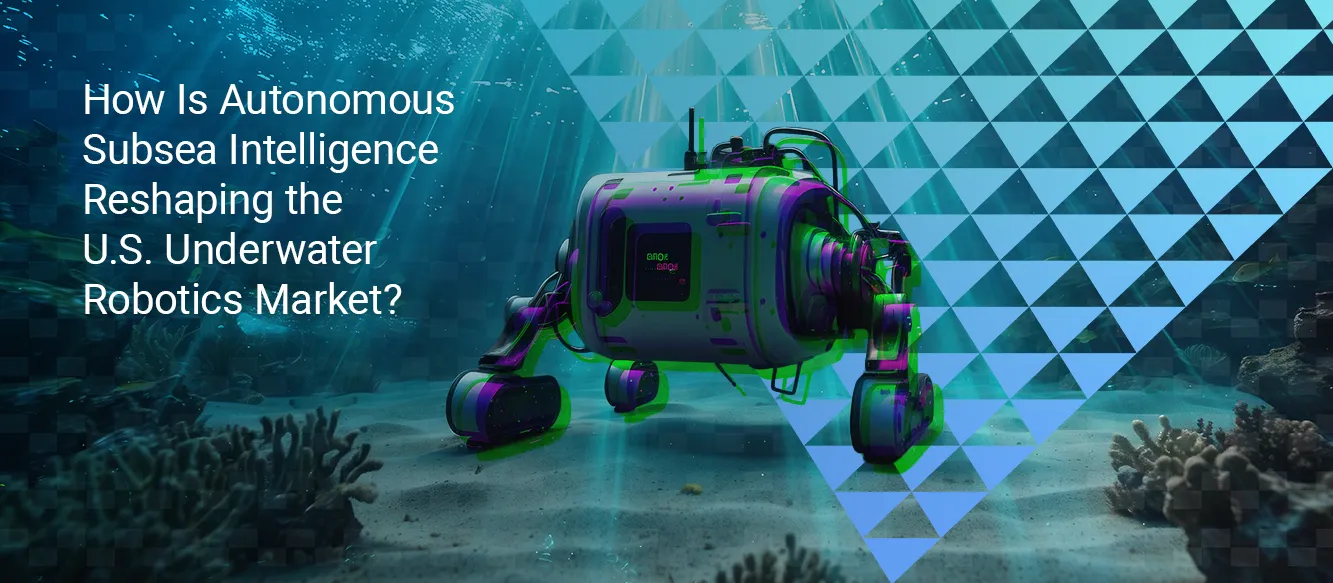
Underwater robotics refers to the specialized field of engineering focused on developing, programming, and deploying machines capable of operating autonomously or semi-autonomously beneath the ocean surface. These advanced systems replace human divers in hazardous environments, offering a much safer alternative for executing complex marine tasks. The equipment generally includes remotely operated vehicles (ROVs), autonomous underwater vehicles (AUVs), and versatile hybrid platforms. Each machine carries a sophisticated payload of sensors, cameras, and mechanical arms tailored to specific mission parameters.
Modern subsea robots analyze acoustic data, capture high-definition video, and manipulate heavy infrastructure with pinpoint accuracy. Federal agencies, energy producers, and scientific institutions utilize these systems to explore uncharted territories, monitor aquatic health, and maintain critical energy pipelines. The continuous development of marine machines provides an efficient approach to managing the massive aquatic territories under United States jurisdiction. These platforms are built with pressure-resistant materials like titanium and specialized syntactic foam, allowing them to withstand the crushing forces found at the bottom of the ocean. The integration of edge computing allows these vehicles to act on what they sense without waiting on a surface round trip, which the low bandwidth of acoustic links would otherwise make impossible.
What Is the Strategic Scope of the U.S. Underwater Robotics Industry?
The strategic scope of this sector encompasses a robust ecosystem of hardware manufacturers, software developers, marine service providers, and institutional end users. This value chain delivers highly specialized tools designed to withstand the corrosive conditions of the deep ocean. The ecosystem functions through tight collaboration between sensor manufacturers who build the acoustic payloads, software engineers who design the navigation algorithms, and the maritime operators who deploy the vessels.
What Technologies Define This Ecosystem?
The industry relies on a broader family of unmanned underwater vehicles (UUVs), which branch primarily into ROVs and AUVs, alongside uncrewed surface vessels (USVs) that serve as their surface equivalent. Within the subsea domain, these systems operate across three primary categories.
Remotely Operated Vehicles (ROVs): These systems represent tethered architectures connected directly to a surface ship. The physical umbilical cable supplies continuous electrical power and facilitates real-time data transfer, allowing human pilots to manually control the vehicle from a surface control room. These heavy-duty machines are essential for underwater construction, complex mechanical repairs, and continuous live video broadcasting. They typically feature heavy manipulator arms capable of turning subsea valves and connecting hydraulic lines. Notable exemplars include Oceaneering International's Magnum Plus ROV.
Autonomous Underwater Vehicles (AUVs): These systems operate entirely free from physical tethers. Relying on onboard battery arrays, AUVs execute pre-programmed or dynamically calculated missions independently. They excel at mapping large areas of the seafloor, gathering environmental data, and conducting wide-area surveillance. Equipped with inertial navigation systems and Doppler velocity logs, they calculate their exact position independently of GPS signals. Notable exemplars include the REMUS series by Huntington Ingalls Industries (HII), such as the REMUS 620, which delivers a battery endurance of up to 110 hours.
Hybrid Systems: Bridging the gap between the first two categories, hybrid platforms combine the strengths of both architectures. They navigate autonomously over long distances to reach a target site, then switch to a remotely controlled mode via a thin fiber-optic micro-tether or acoustic modem for delicate intervention tasks, providing high operational flexibility. Notable exemplars of this hybrid approach include Nauticus Robotics of Webster, Texas, and its Aquanaut vehicle; as the company states, "Aquanaut is an AUV until you need an ROV.
|
Feature |
ROV (Remotely Operated Vehicle) |
AUV (Autonomous Underwater Vehicle) |
Hybrid System |
|
Control Type |
Manual human control via umbilical tether |
Pre-programmed or AI-driven navigation |
Switchable between autonomous and remote |
|
Autonomy |
Low (requires continuous pilot input) |
High (operates independently) |
Variable (adapts to mission requirements) |
|
Operational Cost |
High (demands large surface support vessels) |
Low (deploys from small boats or shorelines) |
Medium (optimizes vessel time based on task) |
|
Primary Applications |
Heavy construction, complex repairs, live video |
Seabed mapping, large area surveillance |
Surveying followed by physical intervention |
|
Power & Endurance |
Continuous while tethered to surface power |
Limited (constrained by onboard batteries) |
Moderate (combines efficiency with charging) |
|
Key Specification (Exemplar) |
10,000-foot depth rating (Oceaneering Magnum Plus) |
Up to 110-hour battery life (HII REMUS 620) |
3,000-meter depth rating (Nauticus Aquanaut) |
Why Is Untethered Self-Steering Redefining Subsea Operations?
Cutting the tether is what truly changes the economics of subsea operations, because the primary cost is the support ship, not the pilot. Self-steering, with AI as its newest and most advanced component, is what makes working without a tether trustworthy enough to buy. Artificial intelligence allows marine machines to evaluate complex sensor data locally, granting them the ability to navigate dynamic ocean currents and avoid dangerous obstacles independently. By enabling reliable, independent navigation, this technology removes the requirement for a continuous human pilot, lowering operational overhead significantly.
How Do AI Systems Enable Independent Underwater Missions?
Advanced machine learning algorithms process massive volumes of acoustic data from multibeam echosounders and synthetic aperture sonar instantaneously. This immediate data processing enables the vehicle to identify structural anomalies on the seafloor, such as pipeline fractures or metal fatigue, independently of human analysts reviewing the footage later. Simultaneous Localization and Mapping algorithms empower these vehicles to navigate accurately through environments completely lacking GPS signals. By continuously mapping the surrounding terrain and calculating their exact position relative to those features, autonomous platforms maintain high navigational accuracy over missions lasting several days.
Federal organizations heavily support these advancements to expand marine observations. As documented in NSF-funded research (2024), a team at the Minnesota Interactive Robotics and Vision Laboratory is developing advanced autonomous underwater vehicles powered by artificial intelligence to collect vast oceanographic data, with testing executed on a dedicated AUV platform called MeCO. The implementation of edge computing on these platforms enables them to make rapid navigational decisions, vastly improving mission success rates. These smart systems independently adjust their thrusters to counteract deep ocean currents, keeping the vehicle accurately aligned with its target trajectory.
How Does Offshore Energy Infrastructure Sustain Long-Term Demand?
The offshore oil and gas sector provides a massive, continuous revenue stream for marine automation companies. Extracting energy resources from deepwater reserves requires operating in incredibly harsh conditions, facing high pressure, corrosive saltwater, and strong subsurface currents. Human divers face severe depth limits and immense physical risks, making robotics the highly preferred solution for deepwater maintenance.
Why Are Subsea Inspections Increasing Across U.S. Offshore Assets?
Maintaining the structural integrity of this sprawling infrastructure requires frequent inspection, repair, and maintenance operations. Older platforms demand rigorous fatigue analysis and continuous corrosion monitoring to prevent catastrophic environmental failures. Subsea robots equipped with cathodic protection sensors and ultrasonic thickness gauges routinely scan these aging jackets and pipelines. Operators deploy automated vehicles for these inspections to reduce the reliance on human commercial divers, thereby significantly enhancing workplace safety and minimizing costly production shutdowns.
Statistics published by the U.S. Energy Information Administration indicate that oil and natural gas production in the Federal Offshore Gulf of Mexico accounted for about 15 percent of total U.S. crude oil production in 2022. Thousands of platforms operate in these waters at depths up to 6,000 feet, with a select few platforms operating in depths exceeding 10,000 feet. The continuous requirement for accurate structural data across these thousands of offshore platforms ensures a steady, lucrative avenue for underwater equipment manufacturers. Federal safety rules enforced by the Bureau of Safety and Environmental Enforcement (BSEE) require periodic structural inspections, driving an ongoing operational need for remote inspection systems.
What Makes Defense Investments a Core Growth Engine?
Underwater autonomy is viewed as a critical component of modern naval strategy. Federal funding heavily prioritizes the development of unmanned underwater vehicles to expand maritime domain awareness and enhance national security protocols. The military requires systems that can operate quietly and persistently without risking human lives in contested waters.
How Are Autonomous Systems Enhancing Maritime Security Capabilities?
Naval modernization programs require assets capable of executing clandestine surveillance, mine countermeasures, and anti-submarine warfare. Autonomous platforms offer strategic advantages by operating covertly in hostile territories. These platforms carry diverse payloads, deploying remote sensors and gathering intelligence over extended timeframes. The consistent flow of federal defense contracts provides essential capital for research and development, pushing the boundaries of what these marine machines can achieve.
Publicly available budget documents show the Department of Defense requested USD 143.2 billion for research, development, test, and evaluation (RDT&E) in FY2025, which includes extensive funding for advanced unmanned systems and maritime security technologies. This extensive financial backing ensures that defense contractors can continue developing highly sophisticated autonomous submarines capable of operating independently for months at a time, without active human intervention. These extra-large unmanned underwater vehicles represent the pinnacle of current maritime engineering, offering unprecedented range and payload capacity for critical naval operations. For example, as announced in May 2024, the Manta Ray prototype uncrewed underwater vehicle (UUV) built by performer Northrop Grumman completed full-scale, in-water testing off the coast of Southern California in February and March 2024.
How Is Offshore Wind Development Expanding Robotics Use Cases?
The transition toward renewable energy introduces a rapidly expanding frontier for offshore energy infrastructure technologies. Offshore wind farms require extensive subsea engineering, from initial site assessments to continuous operational maintenance throughout the lifespan of the turbines.
What Role Do Robotics Play in Offshore Wind Infrastructure Management?
A 2022 federal target outlined in a September 2022 fact sheet from the U.S. Department of the Interior aimed to deploy 30 GW of offshore wind energy by 2030. This immense scale of construction demands massive fleets of robotic vehicles. During the pre-construction phase, autonomous vehicles map the seabed to identify optimal locations for turbine foundations and inter-array cables, scanning the area for hazards like unexploded ordnance.
Once operational, tethered and autonomous machines perform continuous cable monitoring, ensuring the electrical transmission lines remain properly buried and protected from anchor strikes or natural scouring. Furthermore, environmental compliance regulations require wind farm operators to monitor local marine habitats. Robots equipped with high-resolution cameras and bioacoustic sensors fulfill these regulatory mandates efficiently, tracking marine life behavior and ensuring that construction activities minimize disruption to local ecosystems. The investments required for offshore wind projects already approved and under construction fuel the expansion of the marine automation sector, creating a massive parallel demand alongside the traditional oil and gas industry.
What Technological Advancements Are Improving System Efficiency?
Beyond software algorithms, physical engineering advancements continuously elevate the performance of subsea machines. Manufacturers focus heavily on optimizing power consumption, enhancing maneuverability, and ensuring modular flexibility to maximize the utility of every launched vehicle.
Why Is Electric Propulsion Becoming the Preferred Standard?
Historically, heavy-duty machines relied on hydraulic power systems to drive their thrusters and manipulator arms. While powerful, hydraulic systems present risks of fluid leaks, require substantial maintenance, and suffer from inefficiencies at extreme depths. Modern engineering strongly favors electric propulsion. Electric thrusters offer precise control, quieter operation, and much higher energy efficiency.
Federal marine-energy research has pushed in the same direction: in November 2020, ARPA-E’s SHARKS program committed USD 35 million across 11 projects to develop economically competitive hydrokinetic turbines for tidal and river currents, creating underwater power-generation infrastructure that also requires inspection by underwater vehicles. Furthermore, modular system architectures allow operators to swap out sensor payloads or battery packs rapidly while out at sea. This modularity ensures a single vehicle chassis can execute a wide variety of missions simply by attaching different specialized modules. A vehicle might map the seafloor with a multibeam sonar on Monday, and then swap modules to collect water chemistry samples on Tuesday. These engineering upgrades allow companies to maximize their return on investment by deploying one versatile machine for multiple distinct tasks.
What Operational Barriers Are Limiting Wider Adoption?
Despite rapid technological progress, the industry faces substantial logistical and financial hurdles. High initial capital expenditures, limited communication bandwidth underwater, and a severe shortage of skilled operators create boundaries for smaller enterprises looking to adopt these systems.
How Are Companies Addressing High Capital and Operational Costs?
Underwater acoustic communication remains inherently slow and constrained by physical laws, limiting the amount of real-time data an autonomous vehicle can transmit back to the surface. Radio waves fail to penetrate water effectively, forcing reliance on acoustic modems that transmit data at extremely low bit rates. Furthermore, purchasing commercial-grade subsea robots requires millions of dollars in upfront capital.
Operating a global-class academic research vessel typically costs $30,000–$60,000 per day, according to a 2026 marine-compliance industry guide. To bypass these high maritime costs, many stakeholders adopt Robotics as a Service models. Rather than purchasing the hardware, operators lease the equipment and the accompanying data analytics platforms on a project-by-project basis. This approach democratizes access to high-end marine technology. Below is a detailed numerical breakdown demonstrating the financial advantage of deploying an autonomous vehicle rather than a traditional vessel-supported tethered system.
Illustrative model: The figures below are indicative inputs chosen to show the shape of the cost difference, not survey data.
Worked Example: Pipeline Inspection Cost Analysis
Mission Parameters: 100-kilometer subsea pipeline inspection in the Gulf of Mexico requiring continuous video recording and ultrasonic thickness measurements.
Traditional ROV Deployment
- Daily Vessel & Crew Cost: $50,000 per day
- Inspection Speed: 10 kilometers per day
- Total Mission Duration: 10 days
- Total Operational Cost: $500,000
Autonomous AUV Deployment
- Daily Vehicle & Boat Cost: $15,000 per day
- Inspection Speed: 25 kilometers per day
- Total Mission Duration: 4 days
- Total Operational Cost: $60,000
Financial Outcome: Deploying the AUV yields $440,000 in direct operational savings alongside a 60 percent reduction in mission duration. This massive efficiency gain explains the aggressive industry shift toward autonomous inspection paradigms.
How Is the Competitive Landscape Evolving Across Key Players?
The sector thrives on fierce competition and strategic collaboration among aerospace giants, specialized marine technology firms, and agile software startups. Consolidation remains a major theme as large defense contractors acquire smaller, highly specialized robotics firms.
Which Companies Are Driving Technological Advancements?
Major U.S. hardware manufacturers are driving technological advancements through verifiable, real-world deployments. For example, Boeing delivered the first Orca Extra Large Unmanned Undersea Vehicle (XLUUV) to the U.S. Navy in December 2023. Huntington Ingalls Industries (HII) continues to expand its widely used AUV lineup, having unveiled the REMUS 620 medium-class vehicle in November 2022. Oceaneering International secured a multi-million-dollar contract from the Department of Defense in October 2024 to build a Freedom AUV and establish an onshore remote operations center for the Navy. Additionally, in October 2025, Anduril Industries announced the opening of its factory to manufacture the Ghost Shark Extra Large Autonomous Underwater Vehicle.
Recent industry developments highlight a trend of cross-sector partnerships. Hardware manufacturers collaborate with cloud computing providers to ensure the massive volumes of sonar data collected during missions are processed and visualized seamlessly for the end client. As highlighted in our autonomous underwater vehicle market analysis, strategic positioning currently favors companies offering comprehensive data solutions rather than just raw hardware sales. Clients demand a fully processed 3D map of the seafloor, rather than just the raw acoustic logs. Industry players regularly publish press releases detailing successful autonomous missions and groundbreaking sensor integrations, demonstrating their commitment to pushing the boundaries of marine automation. This competitive drive forces continuous upgrades in battery chemistry, sensor resolution, and software reliability, ensuring end users receive highly sophisticated equipment.
What New Application Areas Are Expanding Beyond Energy and Defense?
While offshore oil and military applications historically funded robotic development, the technology currently scales across diverse scientific and commercial domains. The falling costs of microprocessors and improved battery densities allow smaller organizations to access these previously exclusive tools.
How Are Scientific Institutions Leveraging Underwater Robotics?
Federal science organizations rely heavily on autonomous marine systems to chart unknown aquatic territories. These expeditions discover new marine species, locate historical shipwrecks, and map geological fault lines. According to NOAA Ocean Exploration's 2025 annual report, its ship and robotic operations mapped 131,222 square miles (about 339,864 square kilometers) of seafloor in 2025. This massive data collection effort supports its mission of exploring the unknown ocean and unlocking its potential through scientific discovery, technological advancements, and open data delivery.
Commercial aquaculture also represents a rapidly growing sector. Large-scale fish farming operations deploy underwater robots to inspect netting for tears, monitor fish health through behavioral analysis cameras, and automate feeding processes. Environmental agencies utilize specialized autonomous platforms to track the dispersion of microplastics, measure ocean acidification levels, and monitor the health of fragile coral reef ecosystems. These robots can swim through delicate coral formations, minimizing the risk of physical damage, capturing pristine ecological data for conservationists.
What Is the Long-Term Outlook for Autonomous Subsea Systems?
The trajectory of this industry points toward full operational independence, anchored fundamentally by the massive, ongoing requirements of the offshore oil and gas and defense sectors, while simultaneously preparing to support the future build-out of offshore wind. As battery densities improve and artificial intelligence grows more sophisticated to ensure these untethered systems remain highly reliable, future subsea robots will execute missions lasting several months, docking at submerged charging stations to upload data and replenish their power reserves entirely underwater.
How Will AI and Modular Systems Shape Future Deployment Models?
The integration of swarm robotics presents a fascinating future deployment model. Instead of relying on a single, expensive vehicle, operators will deploy fleets of smaller, highly coordinated micro autonomous vehicles. These swarms will communicate acoustically, distributing tasks among themselves to map vast areas of the ocean floor in a fraction of the time currently required. The shift toward scalable, modular, and highly intelligent systems supports a robust future for marine automation, expanding humanity's ability to monitor and protect the global oceans.
Subsea System Selection Guide
|
Application Requirement |
Recommended System |
Operational Advantage |
|
Heavy physical intervention, construction, or real-time mechanical manipulation |
➔ Select ROV |
Ensures continuous power and direct human control for delicate mechanical tasks. |
|
Wide area surveying, seabed mapping, or extended intelligence gathering |
➔ Select AUV |
Provides untethered freedom, faster travel speeds, and automated data collection. |
|
Initial wide-area scanning followed by targeted physical sampling |
➔ Select Hybrid System |
Delivers high versatility, transitioning from autonomous survey to tethered intervention. |
Operational Architecture: Tethered vs. Autonomous Models
|
ROV Architecture (Tethered) |
AUV Architecture (Autonomous) |
|
Surface: Large Support Vessel |
Surface/Shore: Small Boat or Shoreline |
|
Connection: Umbilical Tether (High Bandwidth Power & Data) |
Connection: Acoustic Comms (Low Bandwidth Data) |
|
Subsea Unit: ROV |
Subsea Unit: AUV |
|
• Continuous live video feed |
• Onboard battery power |
|
• Human-in-the-loop control |
• AI-driven navigation algorithms |
|
• Heavy manipulation arms |
• Local sensor data storage |
Explore comprehensive insights into technological advancements, operational trends, and growth drivers shaping this space between 2026 and 2033. For a detailed analysis, including forecasts and competitive landscape, access the full report here: U.S. Underwater Robotics Market Report
Frequently Asked Questions
What are underwater robots used for?
Marine professionals utilize these robots for structural inspections, deep-sea mapping, scientific exploration, military surveillance, and maintaining offshore energy platforms.
How do AUVs differ from ROVs?
AUVs operate without physical tethers using onboard batteries and pre-programmed or AI-driven navigation, whereas ROVs remain connected to a surface ship via a cable for direct human control and continuous power supply.
Why is AI important in subsea robotics?
Artificial intelligence is the newest enabler of self-steering, which makes working without a tether trustworthy enough to execute. Because the primary expense of subsea operations is chartering the large surface support ship rather than the pilot, AI allows vehicles to safely navigate and process data independently, completely transforming the economics of the mission by removing the need for the ship. AUVs run pre-planned or adaptively planned missions without a pilot on the link, while tethered ROVs remain the essential tool for physical work.
What industries use underwater robotics?
The primary sectors include offshore oil and gas, national defense, renewable offshore wind energy, commercial aquaculture, and federal scientific research.
What limits adoption in the U.S.?
High initial equipment costs, a severe shortage of skilled operators, and the physical limitations of underwater acoustic communication present boundaries for broader industry integration.