

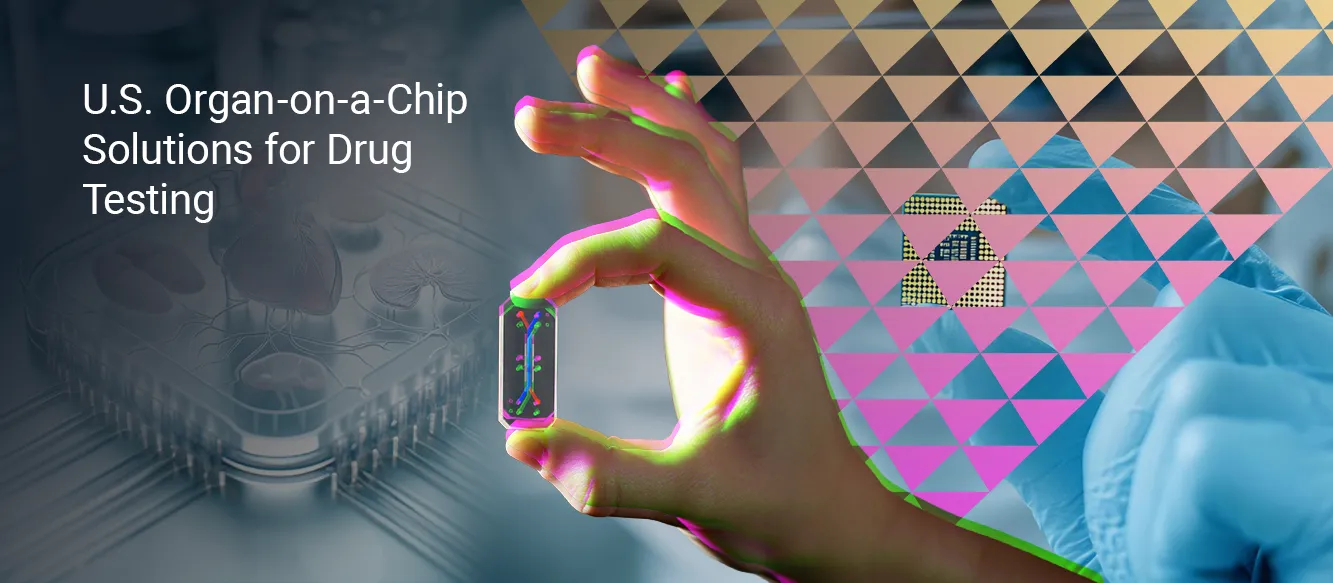
Organ-on-a-chip platforms represent bioengineered microfluidic devices lined with living human cells that replicate physiological tissue architecture, tissue-fluid interfaces, mechanical forces, and vascular perfusion. These microphysiological systems provide human-relevant preclinical models designed to evaluate substance safety, pharmacokinetics, and mechanism of action prior to clinical evaluation. Despite impressive scientific advancements, a distinct gap remains between technological availability and routine adoption within pharmaceutical research and development workflows.
Kings Research forecasts the U.S. organ-on-a-chip market to reach USD 869.1 million by 2033, up from USD 215.37 million in 2026, reflecting a 24.34% CAGR. The market was valued at USD 172.9 million in 2025. This commercial expansion reflects mounting momentum across the drug discovery sector. However, transitioning these devices into routine testing infrastructure requires overcoming technical, operational, and regulatory hurdles.
Regulatory momentum has accelerated significantly. As detailed in the FDA's Roadmap to Reducing Animal Testing in Preclinical Safety Studies, the FDA Modernization Act 2.0, passed in late 2022, explicitly authorized the use of non-animal alternatives to support an investigational new drug (IND) application and allowed the removal of the animal study requirement for biosimilar biologics license applications. Furthermore, in March 2026, the U.S. Food and Drug Administration (FDA) issued draft guidance establishing clear expectations for validating New Approach Methodologies (NAMs), including organ-on-a-chip platforms, for regulatory applications. Additionally, public investments support this transition. Despite these advances, factors such as standardization, inter-laboratory reproducibility, assay scalability, and data integration dictate whether pharmaceutical entities can adopt these platforms regularly.
What Does "Standard Tool" Actually Mean for Pharmaceutical R&D?
Defining a "standard tool" in pharmaceutical R&D requires evaluating operational and regulatory parameters rather than basic microfluidic engineering achievement. Commercial availability of a microfluidic device alone fails to constitute a standardized drug development tool suitable for critical decision-making.
Currently, the overall success rate of clinical trials is 7.9 percent. Approximately 80 percent of clinical trials fail to meet their initial enrollment goals and timelines, causing a loss of as much as USD 8 million in revenue per day for drug discovery companies. Furthermore, according to the FDA's Roadmap, over 90 percent of drugs that appear safe and effective in animals do not go on to receive FDA approval in humans, predominantly due to safety and/or efficacy issues. This staggering attrition rate underscores why establishing truly standardized, predictive platforms is vital for the pharmaceutical landscape.
For a platform to achieve standard status in drug evaluation, it must satisfy precise operational requirements:
- Repeatable Performance: Assays must execute with high technical precision, exhibiting minimal coefficient of variation across repeat runs within the same laboratory.
- Defined Standard Operating Procedures (SOPs): Fully documented protocols covering cell sourcing, extracellular matrix (ECM) coating, microfluidic priming, and assay readouts.
- Consistent Data Generation: Outputs must yield quantifiable metrics that directly inform drug safety or efficacy decisions.
- Inter-Laboratory Reproducibility: Independent laboratories testing identical reference compounds under standardized conditions must achieve concordant results.
- Workflow Compatibility: Compatibility with existing laboratory automation, fluidic handlers, plate readers, and high-content imaging systems.
- Regulatory Usability: Data packages generated by the platform must align with data formatting and validation criteria required by regulatory authorities.
- Predictable Cost and Throughput: Cost structures and plate capacities must support routine screening absent operational bottlenecks.
Can Regulatory Validation Give Pharmaceutical Companies Confidence in Organ-on-a-Chip Data?
Regulatory acceptance serves as a primary foundation for widespread adoption in drug development. The FDA March 2026 draft guidance outlines four fundamental validation principles for NAMs:
- Context of Use (COU): A clear statement defining the precise scope, application, and decision-making boundary of the assay.
- Human Biological Relevance: Refers to the relationship between the information generated from the NAM and how that information could impact the assessment of the drug.
- Technical Characterization: Documenting platform specifications, fluid dynamics, shear stress, material absorption properties, analytical limits, and assay precision.
- Fit for Purpose: Providing empirical evidence that the assay performance matches the rigorous requirements of the specified regulatory decision.
A vital distinction exists between demonstrating biological capability and establishing regulatory suitability. Demonstrating that a chip replicates human microvascular perfusion proves scientific feasibility; proving that data generated by that chip can reliably support an Investigational New Drug (IND) safety submission establishes regulatory fit-for-purpose viability.
Why Will Reproducibility Matter More Than Biological Complexity?
In preclinical research, model consistency supersedes anatomical complexity. Highly complex multicellular biochips provide limited commercial value if batch-to-batch variation hinders data replication across different testing cycles. An analysis of clinical trials registered as closed in 2011 showed that 19 percent of clinical trials were terminated due to insufficient numbers of participants, highlighting why reliable in vitro models are essential.
Sources of variability in microphysiological assay systems include:
- Cell Source and Passage Variation: Donor-to-donor genetic heterogeneity in primary human cells or batch variations in induced pluripotent stem cell (iPSC) derived lineages.
- Extracellular Matrix (ECM) Integrity: Variations in natural ECM proteins impacting cell attachment and differentiation.
- Device Fabrication and Microfluidics: Micro-scale dimensional tolerances in polymer molding, channel surface roughness, and microfluidic flow rate fluctuations.
- Assay Readout Precision: Divergence in fluorescent dye uptake, mass spectrometry background signal, or biomarker extraction efficiency.
Pamies and colleagues (2024) in Stem Cell Reports set out fit-for-purpose quality-management criteria for microphysiological systems, noting that standardizing cell sourcing and manufacturing tolerances remains imperative for broad industrial implementation.
How Can Standardized Data Make Results Comparable Across Laboratories?
Data standardization and interoperability are essential to ensure that outputs generated on disparate platforms yield comparable results across international research sites. Robust data architecture is required to ensure these outputs are properly organized and analyzed for reproducibility across independent sites. International standard bodies are advancing formal guidelines to address this requirement.
International standards currently under development include:
- ISO/CD 25591: Focuses on digital twins and computational modeling for microphysiological systems, establishing metadata structures, data provenance, and computational interoperability rules.
- ISO/CD 25693: Outlines the general development process for organ-on-a-chip systems intended for substance evaluation, defining quality management and data reporting protocols.
Implementing Findable, Accessible, Interoperable, and Reusable (FAIR) data principles ensures that raw sensor outputs, microfluidic parameters, and biomarker concentrations can be independently audited, compared, and integrated into global pharmaceutical safety databases.
What Must Change Before Organ-on-a-Chip Can Operate at Pharmaceutical Scale?
Transitioning from low-throughput academic studies to high-throughput pharmaceutical pipelines requires extensive operational modification. While scientific laboratories often run individual microfluidic chips manually, pharmaceutical screeners demand automated, multi-channel parallel execution. Large-scale compound screening necessitates equally robust physical testing systems. Automation bridges the gap between limited prototype studies and expansive industrial utility.
Operational requirements for scale-up include:
- Parallel Testing: Microtiter plate-compatible footprints enabling simultaneous evaluation of compound libraries.
- Automated Fluid Handling: Robotic liquid handling integration for continuous media replenishment, compound dosing, and waste removal.
- Automated Imaging & Sensing: High-content automated microscopy and non-destructive real-time analytical readouts.
- Sterile Interconnects: Closed-loop microfluidic connections to eliminate biological contamination risk during extended culture periods.
Integrating embedded biosensors, automated sampling manifolds, and quantitative readouts is vital for transitioning microphysiological models toward translational and regulatory environments.
Where Do AI and Biosensors Fit Into the Next Generation of Organ-on-a-Chip Platforms?
Modern microphysiological devices are incorporating real-time biosensing and artificial intelligence to extract multidimensional functional data without destroying cellular architecture. Advanced systems require computational modeling to analyze this immense biological complexity. These digital representations allow scientists to extrapolate localized tissue reactions into systemic human physiological predictions.
Key technological convergence areas include:
- Real-Time Biosensing: Transepithelial electrical resistance (TEER) sensors to track tissue barrier integrity, electrode arrays for electrophysiology, and optical biosensors for dissolved oxygen and metabolic flux.
- Automated Image Analysis: Deep learning algorithms to process high-content cellular images, quantify morphology changes, and track cell viability continuously.
- Multi-Omics Data Integration: Coupling microfluidic effluent sampling with transcriptomics, proteomics, and metabolomics to map deep mechanisms of action pathways.
- Digital Twin Modeling: Integrating empirical chip measurements with quantitative systems pharmacology (QSP) models to predict human organ responses computationally.
Which Drug-Development Decisions Are Best Suited to Organ-on-a-Chip Today?
Adoption in pharmaceutical R&D is proceeding through targeted contexts of use where traditional models exhibit documented predictive limitations. Cardiotoxicity due to drug-induced arrhythmias is a principal cause for new drug failure. Rather than replacing entire preclinical workflows immediately, microphysiological platforms address specific decision nodes.
|
Drug Development Decision |
Potential Role of Organ-on-a-Chip Platforms |
Primary Value Proposition |
|
Toxicity Assessment |
Human-relevant response evaluation for organ-specific liabilities. |
Detects human-specific toxicities missed by conventional animal models. |
|
ADME / PK Studies |
Evaluating gut absorption, hepatic metabolism, tissue transport, and drug clearance rates. |
Provides human metabolic clearance data early in compound optimization phases. |
|
Efficacy Screening |
Evaluating translational targets within complex, human-relevant disease models. |
Translational target validation in complex, multicellular human disease contexts. |
|
Mechanism Studies |
Cellular and tissue-level functional pathway analysis under continuous fluidic flow. |
Elucidates precise cellular injury pathways and molecular target engagement. |
|
Drug Combination Testing |
Multifactor response assessment across complex cell combinations. |
Evaluates synergistic efficacy and toxicity profiles across therapeutic regimens. |
|
Patient-Specific Research |
Donor- or iPSC-derived models targeting specific genetic backgrounds or rare disease phenotypes. |
Enables stratification of responder populations prior to clinical trial enrollment. |
Why Will Pharmaceutical Companies Need Evidence Beyond Academic Demonstrations?
Commercial adoption requires robust business and operational proof. Academic proof of concept publications demonstrate scientific feasibility, but pharmaceutical companies require systematic evidence demonstrating return on investment and workflow reliability.
Essential adoption requirements include:
- Benchmarking Against Reference Datasets: Rigorous evaluation using blind sets of known toxic and safe drugs with established clinical outcomes.
- Multi-Site Replication Studies: Cross-validation studies conducted across multiple pharma laboratories and Contract Research Organizations (CROs) to verify platform robustness.
- Cost-Benefit Quantification: Evidence demonstrating that early chip-based toxicity detection reduces costly late-stage candidate attrition.
- CRO Integration: Availability of validated assays through established CRO providers, enabling pharma companies to outsource testing without building internal infrastructure.
How Could NIH and Public-Private Programs Accelerate Standardization?
Standardization challenges require broader ecosystem coordination. Federal initiatives in the U.S. provide centralized infrastructure designed to establish shared methodologies. The NIH’s March 2026 Complement-ARIE awards represent a vital public commitment, allocating over USD 150 million toward building human-based research infrastructure. The funding marks the first awards under the Complement-ARIE program, an initiative to develop, implement, and standardize lab- or computer-based methods. Research teams across the U.S. will lead projects designed to produce more predictive models of human disease.
Key elements include:
- Technology Development Centers (TDCs): Advancing specialized human-based platforms for specific disease areas, such as cardiac, neurological, and rare disorders.
- NAMs Data Hub and Coordinating Center (NDHCC): Establishing infrastructure for data sharing, metadata standardization, and cross-platform comparisons.
- Validation and Qualification Network (VQN): Partnering with the Foundation for the National Institutes of Health to engage industry and regulatory experts in preparing reliable platforms for formal regulatory clearance.
These structural public investments foster an ecosystem pipeline: shared standards lead to open data repositories, supporting independent validation, driving regulatory confidence, and encouraging industrial implementation.
What Would a Mature U.S. Organ-on-a-Chip Ecosystem Look Like?
Achieving routine status requires progressing through defined operational maturity stages. The maturity framework below highlights the progression from early prototype research to widespread regulatory use.
|
Maturity Stage |
Technical & Operational Characteristics |
Regulatory & Pharma Integration Status |
|
Stage 1: Academic Prototypes |
Custom microfluidic devices, manual cell seeding, single donor cell sourcing, exploratory readouts. |
Exploratory academic research; minimal industrial or regulatory integration. |
|
Stage 2: Commercial Platforms |
Commercially manufactured chips, standardized consumables, defined vendor SOPs. |
Internal pharmaceutical evaluation; used primarily as exploratory secondary screens. |
|
Stage 3: Validated COU Tools |
Assays benchmarked with reference compounds, high technical precision, established limits of detection. |
Accepted by regulators for specific COU submissions; pilot CRO service offerings. |
|
Stage 4: Integrated Workflows |
High-throughput automation compatibility, ISO data standards compliance, automated fluidic handling. |
Routine deployment in pharma lead optimization; formal inclusion in IND safety portfolios. |
|
Stage 5: Standard Preclinical Tools |
Global multi-site reproducibility, harmonized quality standards, computational digital twin integration. |
Fully recognized routine testing tools supporting global regulatory approvals. |
Barriers to Organ-on-a-Chip Adoption in Pharmaceutical Research
The key technical, operational, and regulatory barriers governing platform adoption are summarized below:
|
Barrier |
Why It Matters for Industrial Adoption |
|
Validation |
Determines whether generated data possess sufficient scientific credibility to support regulatory submissions. |
|
Reproducibility |
Ensures consistent results across experimental runs, cell batches, and independent laboratory sites. |
|
Standardization |
Establishes unified device specifications, cell characterizations, and analytical measurement protocols. |
|
Scalability |
Dictates whether platforms can match the throughput requirements of high-volume compound screening. |
|
Data Interoperability |
Allows experimental readouts to transfer seamlessly across analytical software and global databases. |
|
Cost and Expertise |
Determines the operational feasibility of adopting complex microfluidic systems over legacy assays. |
|
Material Absorption |
Hydrophobic small drug molecules can easily bind to and be absorbed by silicone elastomers (like PDMS) used in chips, which skews pharmacokinetic and toxicity data. |
|
Cell Supply and Cost |
Acquiring reliable, ethically sourced primary human cells or high-quality iPSCs in sufficient quantities remains a logistical and financial bottleneck for routine testing. |
Frequently Asked Questions
What is an organ-on-a-chip used for?
An organ-on-a-chip is a microfluidic cell culture device designed to mimic human organ physiology, tissue architecture, and microenvironmental forces. It is used in pharmaceutical R&D to evaluate drug efficacy, toxicity, tissue transport, and metabolic responses under physiological fluid flow.
Are organ-on-a-chip systems approved by the FDA?
The FDA avoids issuing blanket approvals for testing platforms. Instead, the FDA evaluates whether a specific assay is validated for a defined Context of Use (COU) within a regulatory submission. While the agency's March 2026 draft guidance provides general validation considerations for New Approach Methodologies (NAMs) used in drug development, the FDA notes that the guidance does not address specific methodologies or drug discovery applications, and the FDA continues to review data from NAMs on a case-by-case basis when the methodology demonstrates reliability and scientific validity for a clearly defined use.
What are microphysiological systems?
Microphysiological systems (MPS) are bioengineered 3D cell culture models, including microfluidic organ chips and tissue systems, that emulate living human organ functional units, cellular interactions, and physiological fluid dynamics.
Can organ-on-a-chip replace animal testing?
Organ-on-a-chip platforms offer human-relevant alternatives that can reduce or refine animal reliance in specific testing contexts. However, regulatory agencies emphasize that many complex systemic evaluations still require ongoing research before full replacement across all preclinical stages is feasible.
How accurate are organ-on-a-chip models?
Accuracy depends on the specific organ model, cell source quality, and intended Context of Use. For instance, a Human Liver-Chip recently evaluated in a validation study correctly identified 87% of hepatotoxic drugs that caused liver injury in patients, according to the FDA's Roadmap to Reducing Animal Testing in Preclinical Safety Studies. Separately, this platform was evaluated and accepted into an FDA pilot program.
What is the difference between organ-on-a-chip and organoids?
Organoids are self-organizing 3D cellular clusters derived from stem cells that mimic anatomical structures. Organ-on-a-chip platforms integrate continuous fluidic flow, mechanical strain, and microchannel architecture, providing controlled physical microenvironments alongside cellular tissue structures.
What Will Ultimately Determine Standardization?
Transitioning microphysiological systems into routine tools for U.S. drug development requires addressing five central requirements: establishing regulatory confidence, ensuring inter-laboratory reproducibility, implementing standardized data frameworks, building scalable automated workflows, and demonstrating clear pharmaceutical decision-making value.
As the commercial sector advances, the evolution of the U.S. Organ-on-a-Chip Market will depend on moving beyond early technological proof-of-concept demonstrations toward validated, highly repeatable, and decision-ready testing platforms.
Gain Deeper Market Intelligence
For a deeper assessment of U.S. organ-on-a-chip adoption, segmentation, competitive activity, and growth outlook, explore the full U.S. Organ-on-a-Chip Market report published by Kings Research.