

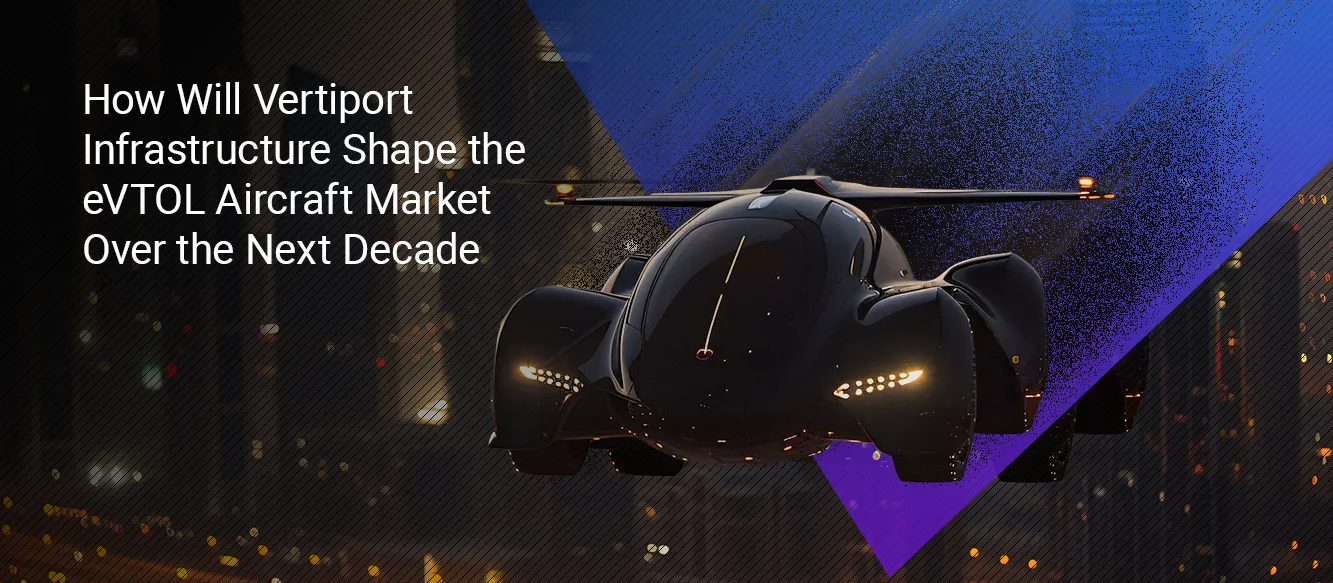
As per Kings Research, the global eVTOL aircraft market is forecasted to reach USD 20.14 billion in 2030 and a further USD 110.64 billion by 2035, registering a CAGR of 41.32% over the forecast period (2031 to 2035). While electric vertical takeoff and landing vehicles capture significant public attention, ground facilities ultimately dictate the scaling speed of this industry. Lacking adequate landing sites, charging systems, and airspace integration, flight operations remain permanently grounded. Vertiport facilities dictate deployment pace, scalability, and investment strategies globally.
What is an eVTOL Aircraft?
Before examining these critical ground facilities, understanding the vehicles themselves provides essential context. Electric Vertical Takeoff and Landing vehicles represent a distinct aviation category combining helicopter agility with airplane efficiency. These advanced aerial machines utilize electric propulsion systems to lift off vertically, hover, and transition into forward cruise flight. The Federal Aviation Administration officially classifies them under the powered lift category. According to a May 2026 United States Government Accountability Office report, the FAA is currently evaluating 23 electric propulsion certification projects out of 16,788 overall projects received since 2018.
However, aircraft certification is rapidly advancing to where ground infrastructure, rather than vehicle approval, becomes the primary binding constraint. As of mid-2026, Joby Aviation is advancing through Stage 4 testing and analysis toward Type Inspection Authorization (TIA), while Archer Aviation became the first to close Phase 3 of the FAA's four-phase type certification process. Although no U.S. eVTOL developer holds a final type certificate yet, issuance is approaching, making operational vertiports the immediate priority for commercial launch.
These vehicles eliminate the heavy emissions associated with traditional combustion engines. Instead, they rely on high-capacity lithium battery packs driving multiple electric rotors. The FAA finalized Special Federal Aviation Regulation (SFAR) No. 120 under 14 CFR Part 194 in October 2024, establishing strict pilot certification and operational rules for this hybrid class. While the vehicles themselves represent a massive leap in aerospace engineering, their success relies entirely on the physical ground grid supporting them.
What Defines Infrastructure Readiness in the eVTOL Aircraft Market?
Core components of the eVTOL ecosystem include physical landing areas, high-capacity electrical charging systems, digital booking software, and local grid upgrades. The difference between aircraft innovation and infrastructure readiness is stark. Vehicle design focuses exclusively on flight capabilities, whereas ground readiness ensures these vehicles possess sufficient power, secure landing spots, and approved flight paths. The Federal Aviation Administration specifically incorporates Advanced Air Mobility into its Aerospace Forecast FY 2026 to 2046 to support federal budget and planning needs. Several AAM Original Equipment Manufacturers, including Joby Aviation, Archer Aviation, and Beta Technologies, are planning to launch commercial operations in the 2026–2027 timeframe.
Projected to reach USD 20.14 billion by 2030 and USD 110.64 billion by 2035, the sector depends heavily on these foundational facilities. A fleet of electric vehicles provides zero value if the required landing pads lack sufficient power reserves. True readiness means every single layer of the advanced air mobility ecosystem functions in perfect unison. Developers must align physical real estate acquisition with massive utility grid enhancements simultaneously.
How Do Vertiports Function as Operational Hubs Rather Than Landing Zones?
Traditional helipads serve as simple concrete squares. In contrast, advanced air mobility hubs function as highly orchestrated operational centers. Passenger flow, turnaround time, and scheduling systems dictate daily profitability. Operators must process travelers quickly to maintain high flight frequencies. Facilities require designated waiting lounges, automated security scanning areas, and strict passenger weigh-in stations to ensure strict load balancing before takeoff.
Integration with digital booking and fleet management creates a seamless experience. The software coordinates arrivals, departures, and battery charging schedules simultaneously, bypassing any delays on the pad. The entire facility operates much like a high-speed rail terminal. Passengers arrive, scan digital tickets, clear automated security gates, and board their assigned vehicle within minutes. This rapid turnaround time ensures the expensive real estate generates maximum daily revenue.
Why Is Vertiport Location Strategy Critical for Commercial Viability?
Strategic placement determines passenger volume and revenue. Developers primarily evaluate two frameworks. The airport-city placement model connects large international airports with downtown financial districts, capturing premium business travelers willing to pay higher fares for speed. Corporate executives value every minute saved, making these direct routes incredibly profitable for early operators.
The intra-city placement model links various points within a single metropolitan area. Both frameworks rely heavily on high demand density and precise route optimization. Operators position pads strictly where ground transport delays are worst, ensuring passengers see immediate value in paying for aerial transit. A UAM Geomatics study referenced by the U.S. Government Accountability Office projects that the cumulative cost of vertiport construction and renovation could exceed $4.5 billion by 2045 across 38 large metropolitan areas.
The following table breaks down the capital requirements and use cases for different facility types:
|
Infrastructure Type |
Cost Range |
Deployment Time |
Scalability |
Use Case |
|
Vertiports |
$5M to $15M |
2 to 4 Years |
High |
High volume urban hubs |
|
Helipads (retrofit) |
$500K to $2M |
6 to 12 Months |
Low |
Early pilot flights |
|
Airport hubs |
$10M to $25M |
3 to 5 Years |
Medium |
City to airport transit |
|
Rooftop pads |
$2M to $8M |
1 to 3 Years |
Medium |
Corporate charters |
Understanding these physical layouts leads directly into the next major hurdle: securing enough electricity to power them.
How Are Energy Infrastructure and Charging Systems Limiting Scale?
Power demands represent a massive hurdle for developers. A single facility requires immense electricity to keep fleets operational. Battery and charging limitations restrict operational efficiency. Fast charging versus battery swap models present distinct challenges for facility engineers. Fast charging models drain massive current from the local grid rapidly, demanding heavy-duty cabling and advanced thermal management to keep batteries cool. Battery swap models bypass the grid surge but require expansive physical storage space and robotic swapping arms.
Grid dependency forces facility owners to invest in localized renewable integration to prevent blackouts and stabilize flight schedules. Upgrading older utility grids to handle megawatt-scale power surges requires years of planning and extensive municipal cooperation. Operators frequently install massive solar canopies and localized battery storage systems directly onsite to store cheap energy during off-peak hours, deploying it rapidly when vehicles land. Without these heavy power upgrades, fleet operators face severe delays in daily flight schedules.
Download the full Advanced Air Mobility report for deep data insights
What Role Does Air Traffic Integration Play in Infrastructure Planning?
Airspace management integrates physical ground pads into the sky. Facilities require robust air traffic management and unmanned aircraft system traffic management software. Controlled versus autonomous airspace coordination ensures safe scaling across busy cities. Ground radar and communication towers must communicate flawlessly with approaching vehicles.
Overlooking this integration severely delays safety certification and restricts daily flight volumes. Automated systems will eventually guide vehicles from the pad to the designated flight corridor safely. Early pilot operations will rely heavily on human air traffic controllers, but long-term scaling strictly requires AI-driven digital routing systems to prevent mid-air conflicts. These software platforms continuously calculate optimal flight paths, adjusting for unexpected weather anomalies and temporary flight restrictions instantly.
How Are Regulatory Frameworks Influencing Infrastructure Rollout Timelines?
Policy directly dictates deployment speed. The Federal Aviation Administration and the European Union Aviation Safety Agency maintain strict approval pathways for vertiports. Both agencies focus heavily on structural integrity, battery fire safety, and flight corridor clearances. Safety teams demand rigorous testing of fire suppression systems specifically designed to handle high-voltage lithium battery incidents.
U.S. pilot programs enabling early operations across states set a precedent for phased deployment. Clear regulations allow developers to secure municipal zoning permits faster. Lacking clear rules, projects face years of delays in local city councils. Investors demand regulatory certainty before committing millions of dollars to pour concrete and install heavy electrical hardware. Standardized guidelines empower local municipalities to approve construction permits swiftly, accelerating the entire industry.
What Investment Models Are Emerging Around Vertiport Development?
Financial systems blend public and private capital to cover high development costs. The U.S. Government Accountability Office reported that publicly disclosed worldwide investment in the Advanced Air Mobility sector grew from $180 million in 2019 to $5.8 billion in 2021. Infrastructure-as-a-service models are gaining immense traction. Instead of owning the physical pad, vehicle operators lease landing rights from dedicated real estate firms.
Partnerships between Original Equipment Manufacturers and infrastructure firms help distribute the massive capital expenditure. Public-private partnerships allow cities to co-fund these facilities, securing long-term transit upgrades while sharing the financial burden with private investors. Real estate developers currently integrate landing pads into the blueprints of new commercial skyscrapers, treating aerial transit access as a premium amenity for future corporate tenants.
To understand the financial viability of these localized hubs, consider the following economic breakdown for an early market operator:
Worked Example: Operator Break-Even Timeline
- Cost of vertiport: $10,000,000
- Daily flights: 100 flights
- Passengers per flight: 4 passengers
- Ticket price: $150
- Operating margin per ticket: $50
- Daily profit: 100 flights × 4 passengers × $50 margin = $20,000
- Annual profit (assuming 350 operational days): $7,000,000
- Break-even timeline for operator: 1.4 years ($10,000,000 / $7,000,000)
How Does Urban Congestion Translate into Infrastructure Demand?
Traffic gridlock serves as the primary catalyst for aerial mobility. Ground transport creates severe delays, pushing commuters toward alternative transit. Airport connectivity use cases highlight extreme time savings, bypassing highway bottlenecks entirely. eVTOL enables point-to-point mobility and reduces travel time, proving that severe ground congestion directly guarantees high ticket demand.
European Union Aviation Safety Agency studies on UAM social acceptance highlight that noise levels represent the second leading public concern after safety. Additionally, a representative EASA survey featuring over 9,000 respondents from 18 European countries revealed that three out of four European citizens favor an environmental label for aviation, demonstrating that operators must maintain strict environmental standards to gain full public backing. Passengers remain desperate to reclaim hours lost to daily highway commutes, creating a highly motivated customer base for aerial operators. Emergency medical transport also benefits immensely, bypassing crowded city streets to deliver critical care patients directly to hospital rooftops.
What Regional Infrastructure Strategies Are Emerging Globally?
Different regions adopt distinct strategies for deployment, tailoring their approach to local economic conditions and urban layouts.
- North America: Early pilot deployments drive the current expansion. Federal agencies spearhead corridor mapping across major states. Private companies partner with existing parking garage operators to retrofit urban spaces into active flight hubs.
- Asia Pacific: High-density urban infrastructure remains the primary focus. The Asia Pacific region is projected to hold a 34.21% share by 2030, driven by immense populations in megacities requiring immediate relief from ground gridlock.
- Middle East and Africa: Government-led infrastructure acceleration funds luxury travel routes. Data shows a projected CAGR of 45.03% in this specific region, highlighting rapid, state-backed expansion designed to attract global tourism and showcase technological advancement.
What Are the Key Barriers to Scaling Vertiport Networks?
Developers face severe operational barriers before launching daily flights. Land use and zoning restrictions force facilities into complex municipal approval cycles. Noise and community acceptance remain major hurdles, as residents resist low-flying vehicles near residential zones. Operators must prove their vehicles operate well below the decibel levels of traditional helicopters to win community support.
High capital expenditure prevents rapid scaling. Individual infrastructure projects could cost between $500,000 and upwards of $10 million apiece, depending on specific electrification requirements and real estate values. These astronomical costs force companies to carefully select only the most profitable routes, delaying expansion into smaller suburban zones. Upgrading existing structures requires heavy structural reinforcement to support the combined weight of the aircraft and the heavy charging equipment.
How Are Companies Building Integrated Infrastructure Ecosystems?
Firms abandon isolated projects in favor of broad ecosystems. OEM and infrastructure collaborations ensure that physical pads perfectly match vehicle specifications. Companies build end-to-end mobility ecosystem developments, bundling vehicle sales with charging hardware and digital booking software.
Recent industry press releases highlight major vehicle creators securing exclusive landing rights at busy international airports. This strategy guarantees a locked-in customer base and stabilizes early revenue streams. By controlling the entire passenger journey, from the digital ticket purchase to the final landing, these integrated companies capture maximum value while ensuring consistent safety standards across the entire flight experience.
What Will the Next Decade Look Like for Infrastructure in the eVTOL Aircraft Market?
Predictive trends indicate highly automated facilities dominating the landscape. Autonomous vertiports will rely on advanced software rather than human dispatchers to guide arrivals and manage passenger boarding. AI-driven traffic systems will precisely manage heavy vehicle volume in tight airspaces, calculating optimal flight paths in real time to avoid weather anomalies and other aircraft.
Smart city integration represents the ultimate goal, linking aerial hubs directly with subway stations and electric car chargers. This seamless web of transit options ensures aerial mobility becomes a daily utility for the general public. Municipalities will view these facilities as essential public transit nodes, seamlessly blending aerial routes with existing ground-based public transportation networks.
Frequently Asked Questions
How many vertiports are needed for urban deployment?
A standard metropolitan area requires between 10 and 20 connected pads to create a viable, profitable flight web capable of serving thousands of daily commuters.
What is the cost of building a vertiport?
Constructing a new, purpose-built vertiport hub typically costs between $5 million and $15 million depending on electrification requirements and real estate values, whereas retrofitting existing helipads for early operations ranges between $500,000 and $2 million.
Are vertiports different from helipads?
Yes. Modern pads include megawatt-scale electric charging hardware and advanced digital traffic management software, whereas traditional helipads provide a simple concrete landing square.
How is eVTOL charging managed?
Facilities utilize high-capacity grid connections or localized battery storage to deliver rapid charging during brief passenger turnaround windows, ensuring vehicles remain operational throughout peak hours.
What regulations govern vertiports?
Agencies like the FAA and EASA manage strict safety rules covering structural limits, battery fire suppression, and safe flight corridors, while local city councils manage specific zoning permits.
What is a vertiport in the eVTOL aircraft market?
A vertiport is a dedicated physical facility designed specifically for electric vertical takeoff and landing vehicles. These hubs provide landing pads, high-capacity electrical charging systems, passenger boarding terminals, and digital fleet management software to support safe, high-frequency aerial mobility operations within urban environments.
Why is infrastructure critical for the eVTOL aircraft market?
Physical facilities dictate the scaling speed of the entire aerial mobility industry. Lacking megawatt-scale charging stations and approved landing zones, advanced electric vehicles remain indefinitely grounded. Ground systems bridge the gap between aircraft manufacturing and actual daily passenger operations, directly controlling revenue generation and route viability.
What are the components of eVTOL infrastructure?
- Physical landing and takeoff pads
- Megawatt-scale electrical charging stations
- Passenger screening and boarding terminals
- Unmanned aircraft traffic management software
- Localized battery storage systems
- Maintenance and repair bays
Download the full report to access exclusive financial projections: https://www.kingsresearch.com/report/evtol-aircraft-market-3121