
Inquire Now
Key Strategic Points
According to Kings Research, the global ballistic protection market size is projected to grow from USD 12.06 billion in 2025 to USD 19.73 billion by 2033, registering a CAGR of 4.7% from 2026 to 2033. The ballistic protection market ecosystem comprises protective equipment designed to safeguard military personnel, law enforcement officers, and security forces from ballistic threats, including bullets, shrapnel, and other high-impact projectiles. The market encompasses products such as body armor & wearables, armor kits & panels, transparent armor, shields, barriers & enclosures used across defense, homeland security, and civilian applications. Rising defense modernization initiatives, increasing geopolitical tensions, and growing security concerns are fueling demand for next-generation ballistic protection solutions worldwide.
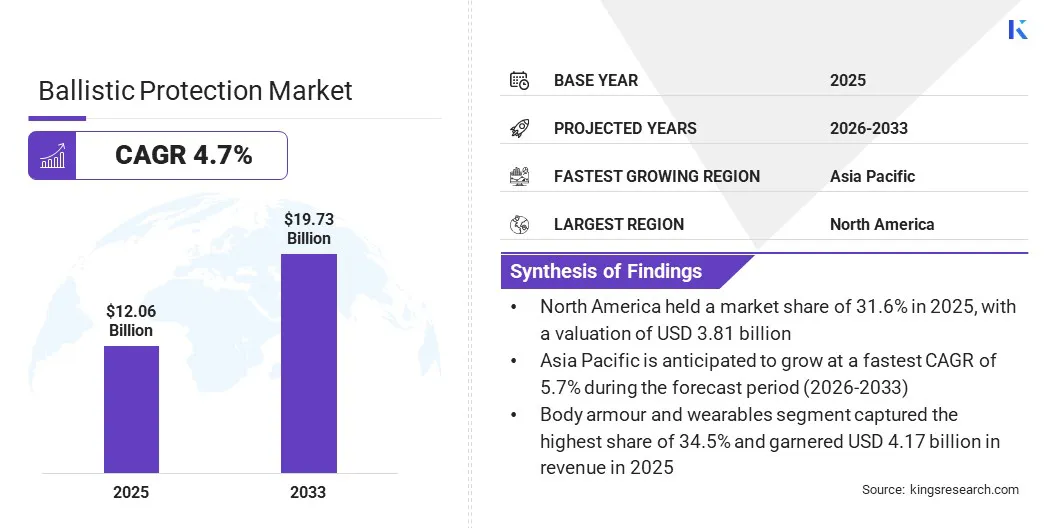
Key Insight: The ballistic protection market is shifting from a defense-only procurement category to a broader security and public safety investment class, a shift reflected in a growth rate that holds near 4.7% CAGR through 2033. This momentum signals that defense modernization, material innovation, and expanding law enforcement demand are structural tailwinds rather than a cyclical spike.
Body armor & wearables accounted for 34.54% share in 2025, supported by sustained defense modernization programs and rising demand from military and law enforcement agencies. Armor kits & panels are the fastest-growing segment, registering a growth rate of 5.4%, driven by increasing adoption in military vehicles and critical infrastructure protection.
|
Segmentation |
Details |
|
By Product Type |
Body Armor & Wearables, Armor Kits & Panels, Transparent Armor, Shields, Barriers & Enclosures, Others |
|
By Application |
Personnel, Land Vehicles, Aircraft, Naval & Maritime Platforms, Fixed Sites & Infrastructure |
|
By End User |
Military, Government & Law Enforcement |
|
By Region |
North America: U.S., Canada, Mexico |
|
Europe: France, UK, Spain, Germany, Italy, Russia, Rest of Europe |
|
|
Asia-Pacific: China, Japan, India, Australia, ASEAN, South Korea, Rest of Asia-Pacific |
|
|
Middle East & Africa: Turkey, U.A.E., Saudi Arabia, South Africa, Rest of Middle East & Africa |
|
|
South America: Brazil, Argentina, Rest of South America |
By application, personnel protection accounts for the largest market share of 41% in 2025, while land vehicles are anticipated to register the fastest growth rate due to evolving battlefield requirements and homeland security investments. Military organizations remain the primary end users, capturing the highest share of 82.52% with a valuation of USD 9.96 billion in 2025 owing to increased global defense spending, rising geopolitical tensions, and ongoing military modernization initiatives.
Expanding defense budgets, tightening safety standards, and increasing concerns over public safety and personal security are driving ballistic protection market growth. Rising geopolitical tensions across regions are prompting governments to accelerate modernization programs and expand protective equipment inventories for both regular and reserve forces.
Additionally, a surge in mass shootings, urban crime, and civil unrest during public protests has increased awareness of personal protection. According to RMA Armament, strong civilian demand in 2021 shifted its customer base from 80% law enforcement to a majority civilian segment. This trend has continued through 2025, driven by ongoing social instability, and has reinforced ballistic protection products as mainstream personal safety solutions beyond traditional military and law enforcement applications.
For instance, in January 2026, Logistik Unicorp received the Body Armor Innovation Award 2026 for its Women’s Armour System for enhanced fit, comfort, and protection, accommodating up to 99% of female body types. Similarly, in September 2025, NP Aerospace launched a new specialist body armor range for women at DSEI 2025. The product is designed to meet the distinct needs of women operating in high-risk environments.
Key Insight: The market growth trajectory is shifting from government-led procurement to multi-segment demand, strengthening market resilience through a balanced mix of defense, law enforcement, and civilian customers.
The ballistic protection market faces persistent supply chain challenges due to limited raw material availability and rising demand, creating procurement issues. Regulatory restrictions on cross-border trade are further increasing complexity, prompting companies to strengthen sourcing strategies. Additionally, trade tensions and tariffs are increasing costs by affecting the supply of key materials, including aramid fibers, UHMWPE, and ceramics, leading to supply uncertainties and higher compliance requirements.
For instance, under the broad U.S. Section 338 tariff measures effective August 19, 2026, Canadian exports of base metal armored safes and doors face a 50% tariff rate. Additionally, manufacturers producing finished ballistic armor or protective gear may face increased costs on key raw inputs, including nonwoven technical fibers used in soft body armor and cermet plates and tips used in hard armor plating.
To address this challenge, market players are diversifying their supplier base and expanding regional manufacturing capabilities to improve operational efficiency. These strategies enable companies to strengthen supply chain resilience, reduce dependency on single-source suppliers, and sustain their competitive positioning in the evolving global ballistic protection market.
For instance, in May 2025, Rheinmetall AG and Reliance Defence Ltd. entered into a strategic partnership to strengthen ammunition manufacturing and supply chains, thus enhancing raw material security, expanding production capacity, and supporting India's defense manufacturing and export ambitions. Moreover, in February 2025, NATO endorsed its updated Defense Production Action Plan to strengthen defense industrial capacity, expand production, and improve supply chain resilience across the Alliance. The plan emphasizes increased multinational procurement, stronger industry collaboration, protection of critical supply chains, and long-term investments to support military modernization and defense readiness.
Key Insight: Trade tensions and material shortages are accelerating a strategic shift toward localized sourcing and long-term supplier alliances, reducing exposure to volatile global defense supply chains.
Evolving threat environments are significantly influencing product development in the ballistic protection market. The rising prevalence of fragmentation protection in modern armor requirements, driven by drones, artillery, and explosive devices, is increasing demand for extended-coverage body armor systems.
Modern designs are expanding beyond traditional torso protection to include shoulders, neck, and groin areas. Additionally, the demand for protection against direct rifle fire in close combat scenarios is further reshaping market dynamics. This is fostering innovation in lightweight, high-performance ballistic systems that maintain protection while reducing weight and minimizing deformation.
For instance, in February 2026, Avon Protection launched the EXOSKIN-S2 high-performance CBRN protective suit for the military, first responders, and special forces. Similarly, in October 2025, Hessed Korea unveiled the X Frame adaptive body armor at Seoul ADEX 2025, offering multi-threat ballistic protection.
Additionally, in January 2025, Point Blank Enterprises, Inc. introduced Elite EXO, a next-generation soft body armor developed with DuPont Kevlar EXO and certified to NIJ standards, with dedicated male and female models. Similarly, in January 2025, Safariland introduced the SX HP Ballistic Panel and Hardwire 57 Ballistic Panel at SHOT Show 2025. The panels offer lighter, thinner body armor with enhanced ergonomic fit for both male and female models.
Key Insight: Evolving combat dynamics are positioning ballistic protection as a mobility-driven technology domain, where weight reduction and expanded body coverage define product differentiation.
The global ballistic protection market remains moderately fragmented, with competition distributed among specialized armor manufacturers and advanced materials companies. Market leadership varies by product segment and geography, while ongoing investments in lightweight materials, manufacturing expansion, and strategic acquisitions are strengthening the position of leading players without significantly increasing market concentration. Moreover, strategic acquisitions and long-term defense procurement agreements enable companies to broaden product portfolios, enhance technological capabilities, and secure recurring revenue from military and law enforcement customers.
For instance, in October 2025, Cadre Holdings acquired TYR Tactical for USD 175 million to expand its portfolio of mission-critical protective equipment for military and law enforcement. The acquisition strengthens Cadre’s presence in hard armor, plate carriers, ballistic shields, and European defense markets while adding expertise in advanced materials and ergonomic body armor.
Similarly, in September 2025, Hardwire LLC and Leading Technology Composites, Inc. acquired a USD 6.5 million contract from the U.S. Army for the production of 72,179 Lightweight Small Arms Protective Inserts (LSAPI). Additionally, in April 2024, Team Wendy expanded its Cleveland operations by investing approximately USD 15 million to consolidate production from California and establish Cleveland as the company's Center of Excellence in Head Protection, introducing three new product lines.
Key Insight: Competitive differentiation is shifting beyond product performance, with companies leveraging acquisitions and production localization to improve supply reliability, accelerate innovation, and deepen strategic relationships with defense agencies worldwide.
North America accounted for the largest share of the global ballistic protection market, representing 31.56% of total revenue and reaching USD 3.81 billion in 2025. The region's dominance is primarily driven by the U.S., which allocated approximately USD 916 billion to defense spending in 2025, accounting for more than 40% of global defense expenditure. The country's established procurement frameworks, robust domestic manufacturing capabilities, and strong defense industrial base have positioned it as a key market for defense equipment and ballistic protection solutions. Furthermore, regional players are increasingly investing in domestic capacity expansion and supply chain localization to enhance production resilience, reduce lead times, and strengthen national defense readiness.
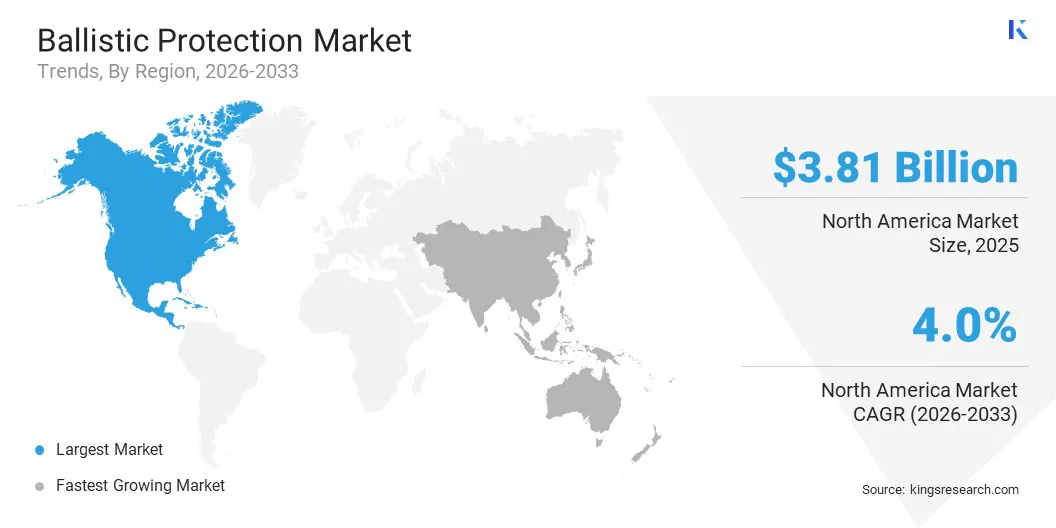
The Asia-Pacific ballistic protection market is estimated to register the fastest CAGR of 5.7% over the forecast period, driven by expanding regional defense budgets, rising domestic manufacturing investment, and growing homeland security procurement. In 2025, the regional defense spending reached approximately USD 573 billion, contributing significantly to the global defense expenditure of around USD 2.6 trillion. Countries such as China, India, and South Korea are leading production owing to strong manufacturing ecosystems and rising demand for advanced body armor, ballistic helmets, and vehicle protection systems in military and law enforcement sectors.
Key Insight: North America maintains leadership through technological leadership and established manufacturing, while Asia-Pacific is emerging as the primary growth engine, fueled by local production and military modernization.
The global ballistic protection market is governed by an evolving regulatory landscape that emphasizes performance, testing accuracy, and quality assurance. Regulatory standards set by international organizations like NIJ, ASTM International, NATO STANAG, VPAM, and HOSDB/CAST are prominent in the market. These standards promote harmonized testing methods, independent certification, and standardized labeling practices to ensure consistent product performance, reliability, and user safety. Compliance with these frameworks enables manufacturers to meet procurement requirements, enhance customer confidence, and support the adoption of high-quality ballistic protection solutions across military, law enforcement, and civilian applications.
Easing regulatory requirements are encouraging ballistic-protection product manufacturers to invest in advanced material technologies, standardized testing procedures, and compliance-focused product innovation to ensure consistent performance, facilitate procurement approvals, and enhance their market positioning.
Key Insight: Manufacturers that proactively align product development with upcoming NIJ and STANAG protocol revisions are better positioned to minimize requalification delays as standards continue to harmonize across allied nations.
Aramid fiber, UHMWPE, and ceramic precursor supply remain concentrated among a limited number of qualified suppliers, creating exposure to single-source risk during periods of elevated demand. In response, manufacturers are diversifying supplier relationships and, in select cases, localizing precursor and finished-armor production to reduce exposure to export restrictions and geopolitical disruption.
Key Insight: Resilience strategies are shifting from cost optimization toward dual-sourcing of critical raw materials and regional finishing capacity, acting as a buffer against export restriction risk and surge demand from modernization programs.
Future outlook strategic opportunities (2026 2033): Sustained defense modernization, growing law enforcement procurement, and continued material innovation are expected to support long-term growth through 2033. Near-term risks include raw material concentration, export policy uncertainty, and potential defense budget volatility linked to broader fiscal conditions. These risks can be mitigated through supply chain diversification and proactive engagement with evolving standards, rather than constraining long-term demand.
Key Insight: Investment opportunity sits at the intersection of three capabilities: qualified manufacturing scale, demonstrated field performance data, and readiness for evolving NIJ and STANAG standards. Manufacturers and investors aligned with these three vectors are best positioned to capture growth through the forecast period.
Kings Research offers customized research solutions tailored to clients' strategic and business requirements. Available customization options include:
Frequently Asked Questions

Faizy brings over four years of experience in market research and consulting, with a proven ability to support strategic engagements across diverse industries and business environments. His work focuses on understanding complex market structures, identifying emerging opportunities, and translating research findings into clear, commercially relevant insights. With strong analytical capabilities and a structured approach to problem-solving, he evaluates industry trends, competitive landscapes, customer dynamics, and evolving business models. His expertise encompasses market research, competitive intelligence, market sizing and forecasting, industry assessment, company benchmarking, and strategic analysis. Faizy combines technical proficiency with a strong research orientation, enabling him to interpret both qualitative and quantitative information effectively. He has contributed to projects that help organizations assess growth potential, strengthen market positioning, and evaluate strategic priorities. His adaptable approach allows him to work across sectors while maintaining a consistent focus on accuracy, relevance, and delivering insights that support informed decision-making for clients and stakeholders.
Habi is a seasoned research and consulting leader with renowned experience in guiding clients on strategic growth and transformation initiatives across global markets. He has led high-performing research teams that deliver actionable insights on market expansion, M&A strategies, opportunity assessment, new business development, and product launches. His project portfolio spans large petrochemical producers, electronic device manufacturers, lubricants companies, and other leading enterprises across diverse industrial and consumer sectors. He currently heads the research department at Kings Research, where he is responsible for setting the research agenda, mentoring analysts, and ensuring client-ready deliverables that support executive decision-making. With extensive experience in market intelligence, strategic research, and consulting, Habi brings a strong understanding of evolving industry dynamics, competitive landscapes, emerging opportunities, and business growth challenges. His expertise includes developing research frameworks, translating complex market data into actionable strategic recommendations, and working closely with senior stakeholders to address critical business questions. He has also contributed to building research capabilities, strengthening analytical methodologies, and driving a culture of quality and insight-led decision-making within research teams. His cross-industry exposure enables him to connect market trends with broader business implications and provide perspectives that help organizations identify opportunities, mitigate risks, and make informed strategic decisions.