
Inquire Now
Key Strategic Points
The LNG (Liquefied Natural Gas) bunkering market refers to the global industry engaged in the supply and distribution of LNG as a marine fuel for ships and vessels. It combines infrastructure development, logistics, and storage solutions with the growing demand for environmentally sustainable maritime operations. These services allow shipping companies to minimize emissions, comply with more stringent environmental regulations, and maximize fuel efficiency while optimizing operational costs.
The integration and analysis of extensive logistical and operational data allow LNG bunkering providers to enhance supply chain management, improve delivery efficiency, and tailor services to specific port and vessel requirements.
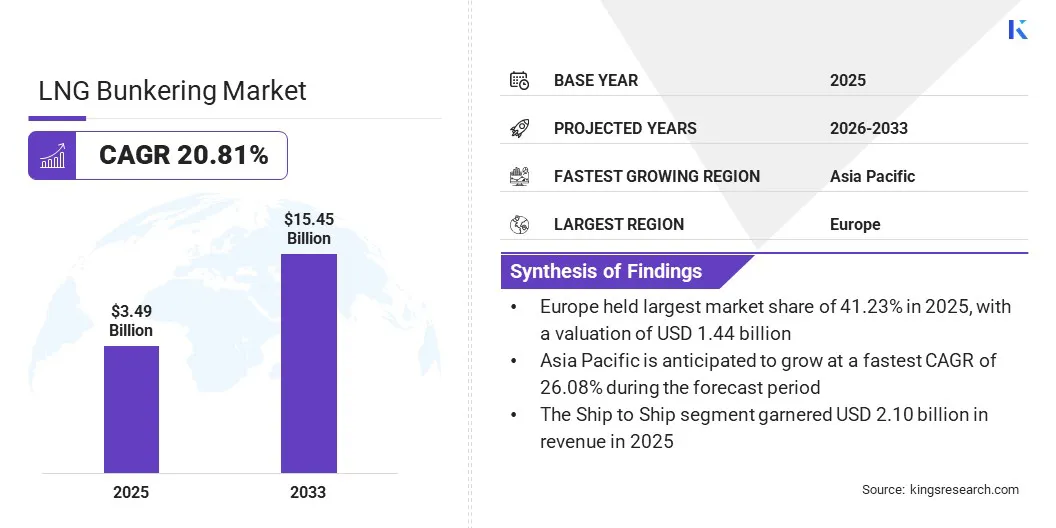
The global LNG bunkering market size was valued at USD 3.49 billion in 2025 and is projected to grow from USD 4.11 billion in 2026 to USD 15.45 billion by 2033, exhibiting a CAGR of 20.81% during the forecast period. This rapid expansion is fueled by stringent environmental regulations and the global shift toward cleaner marine fuel alternatives.
Major companies operating in the global LNG bunkering industry are Shell.com, TotalEnergies, Gasum Ltd, Exxon Mobil Corporation, ENGIE SA, Peninsula, Seaside LNG, KOREA LNG BUNKERING, Stabilis Solutions, Inc., Fluxys, Mitsui O.S.K Lines, Titan LNG, Petroliam Nasional Berhad (PETRONAS), Cryostar, and Crowley.
The increased implementation of LNG, along with emerging alternatives such as bio-LNG, is propelled by its low emissions profile, regulatory acceptance, and the need to decarbonize the shipping sector. Market growth is expected to gain further momentum in the coming years due to continued investment in infrastructure and advancements in technology.
The expansion of LNG bunkering infrastructure is an important driver of the development of the LNG bunkering market. The availability and reliability of supply are also increasing with the growing number of ports worldwide investing in specialized storage, distribution, and refueling activities. Such innovations reduce logistical problems and allow shipping companies to transition to the use of LNG as a marine fuel.
An established system of bunkering centers improves confidence in the supply of LNG and helps vessel operators to conduct their operations more efficiently and cost-effectively. This increased infrastructure is making LNG a viable and attractive option within the maritime sector, supporting the adoption of cleaner fuel options.
Limited port infrastructure is a major obstacle to the widespread adoption of LNG bunkering in the maritime industry. There are currently few ports in the world that have dedicated LNG bunkering stations, which creates significant geographic supply gaps. This limits the operational flexibility of LNG-powered vessels, particularly on shipping routes that lack access to suitable ports.
This leads to logistical problems and higher costs for shipping companies, particularly in terms of route planning and fuel stops. Infrastructure deficiencies also hinder the development of the industry, since investments in LNG-driven vessels are dependent on the availability of good bunkering facilities.
To address this challenge, stakeholders are investing more in the development and expansion of LNG infrastructure in major ports across the globe. Moreover, the establishment of global standards and safety measures can help accelerate the adoption of LNG bunkering systems while ensuring safe and efficient operations.
One of the key market trends is the incorporation of bio-LNG and synthetic LNG into existing supply chains. Bio-LNG, produced from renewable biomass, and synthetic LNG, derived from renewable electricity and captured carbon, can further reduce the carbon footprint of marine transport. With this integration, shipping companies can comply with an ever-growing number of strict environmental standards and be in line with the global decarbonization objectives.
The substitution or mixing of traditional LNG with bio-LNG and synthetic LNG provides a flexible route through which the industry can evolve into a carbon-neutral shipping industry. With the ongoing increase in demand for viable solutions, the production, certification, and supply of these alternative fuels are likely to influence the market.
|
Segmentation |
Details |
|
By Product Type |
Truck to Ship, Port to Ship, Ship to Ship, and Portable Tanks |
|
By Application |
Container Fleet, Tanker Fleet, Cargo Fleet, Ferries, Inland Vessels, and Others |
|
By Region |
North America: U.S., Canada, Mexico |
|
Europe: France, UK, Spain, Germany, Italy, Russia, Rest of Europe |
|
|
Asia-Pacific: China, Japan, India, Australia, ASEAN, South Korea, Rest of Asia-Pacific |
|
|
Middle East & Africa: Turkey, U.A.E., Saudi Arabia, South Africa, Rest of Middle East & Africa |
|
|
South America: Brazil, Argentina, Rest of South America |
Based on region, the global market has been classified into North America, Europe, Asia Pacific, Middle East & Africa, and South America.
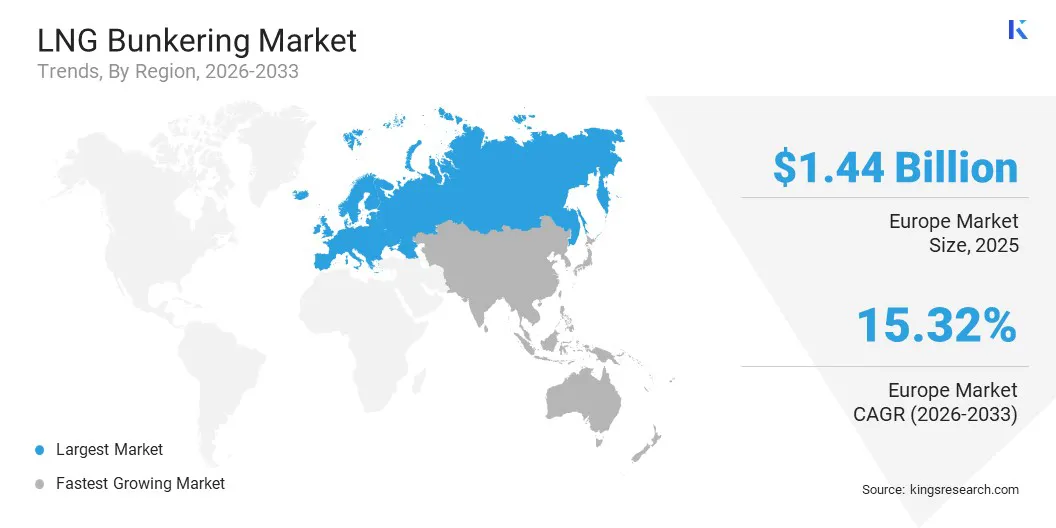
Europe LNG bunkering market share stood at 41.23% in 2025, valued at USD 1.44 billion. This leadership is facilitated by stringent regulatory standards and significant port infrastructure investments. The growth of bunkering infrastructure in major ports has made it more efficient to supply fuel to LNG-powered vessels, thereby boosting the use of LNG as a marine fuel.
The collaboration between government agencies, port authorities, and industrial stakeholders has simplified the working processes and increased the reliability of the supply chain. The incorporation of alternative fuels, including bio-LNG, is also underway, which indicates ongoing efforts to reduce emissions in maritime transportation. These factors are expected to sustain Europe’s leading position in the LNG bunkering industry over the forecast period.
The Asia Pacific LNG bunkering market is set to grow at a CAGR of 26.08% over the forecast period. This growth is propelled by the rising number of LNG-powered vessels, ongoing port infrastructure development, and regulatory efforts to reduce maritime emissions. Several countries are actively developing LNG bunkering hubs to support international shipping routes and regional trade.
The introduction of modern technologies and the development of non-routine refueling options are enhancing operational efficiency and supply reliability. Strategic partnerships between public and private sector entities are facilitating rapid market development. These efforts are transforming Asia Pacific into a high-growth market for LNG bunkering services, contributing to the increased usage of cleaner marine fuel in the region.
Both established energy providers and new entrants in the LNG bunkering market are investing in the development of strong infrastructure and the reliability of their services. Market players are also forming strategic alliances, adopting the latest state-of-the-art technologies, and enhancing operational efficiency to strengthen their competitive position.
The differentiation is being made more with innovative solutions, flexible service offerings, and a dedication to safety and sustainability. As the industry matures, competition is likely to increase, and further improvements in supply chain management, customer support, and the incorporation of alternative fuels within the LNG bunkering value chain are expected.
Frequently Asked Questions

Aswathi holds cross-domain expertise, translating market trends and competitive intelligence into decision-ready insights. Her work helps clients interpret evolving market conditions and identify growth opportunities. She brings a focused, insight-led approach to research execution. She translates these findings into clear, prioritized action plans that align with client capabilities. Her research often includes scenario modeling to test growth strategies under varying economic conditions. She maintains a rigorous validation process, cross-checking primary and secondary sources to ensure reliability. Clients value her ability to synthesize noisy data into concise executive summaries that drive board-level discussions. Her sector-specific lens, combined with a pragmatic focus on execution, consistently delivers high-impact, commercially sound recommendations. Her structured yet flexible research frameworks adapt to client timelines without compromising depth. She is known for distilling complex trade-offs into straightforward, defensible positions that facilitate confident decision-making.
Habi is a seasoned research and consulting leader with renowned experience in guiding clients on strategic growth and transformation initiatives across global markets. He has led high-performing research teams that deliver actionable insights on market expansion, M&A strategies, opportunity assessment, new business development, and product launches. His project portfolio spans large petrochemical producers, electronic device manufacturers, lubricants companies, and other leading enterprises across diverse industrial and consumer sectors. He currently heads the research department at Kings Research, where he is responsible for setting the research agenda, mentoring analysts, and ensuring client-ready deliverables that support executive decision-making. With extensive experience in market intelligence, strategic research, and consulting, Habi brings a strong understanding of evolving industry dynamics, competitive landscapes, emerging opportunities, and business growth challenges. His expertise includes developing research frameworks, translating complex market data into actionable strategic recommendations, and working closely with senior stakeholders to address critical business questions. He has also contributed to building research capabilities, strengthening analytical methodologies, and driving a culture of quality and insight-led decision-making within research teams. His cross-industry exposure enables him to connect market trends with broader business implications and provide perspectives that help organizations identify opportunities, mitigate risks, and make informed strategic decisions.