
Inquire Now
Key Strategic Points
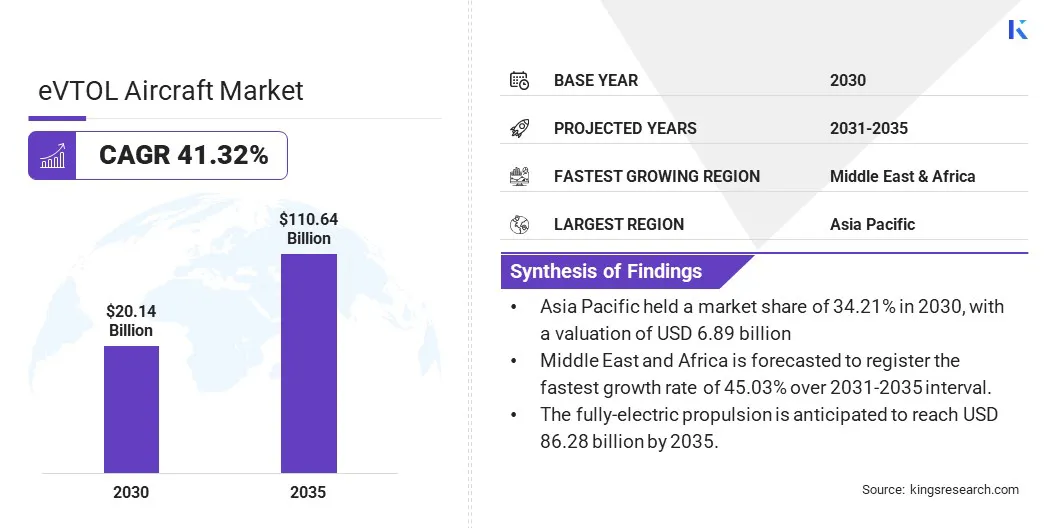
The global eVTOL aircraft market is forecasted to reach USD 20.14 billion in 2030 and a further USD 110.64 billion by 2035, registering a CAGR of 41.32% over the forecast period (2031 to 2035). The market is undergoing a transformative shift that is redefining urban mobility and public transportation. Market players are emphasizing the development and inclusion of faster, efficient, and sustainable aerial transportation alternatives into the mainstream mode of transportation. Major companies operating in the global eVTOL market, including Volocopter GmbH, Lilium, Joby Aero, Inc., Archer Aviation, Wisk Aero, Beta Technologies, and others, are entering strategic partnerships with technology providers and investment companies to expand market reach. Rising transportation congestion in metropolitan cities across the globe and increasing demand for faster and efficient transportation solutions are enabling transformation across industrial and aviation regulations across regions.
eVTOL aircraft offer significant advantages compared to conventional transport, as these are purpose-built to carry passengers. They are operated within regulated airspace under conventional aviation safety standards. The lower noise levels, reduced operating costs, and zero direct in-flight emissions are anticipated to contribute towards their market adoption over the forecast interval. Unlike unmanned drones or cargo-focused platforms, eVTOL design, certification, and operational concepts are fundamentally centered on the safe, reliable transport of passengers, particularly in dense urban and suburban environments. Their high demand is further favorable due to their on-demand, point-to-point air mobility as urban air taxis, airport-city connections, and short-range regional mobility. This, in turn, empowers users to bypass ground traffic congestion and reduce travel times within metropolitan areas, thereby boosting adoption.
eVTOLs require fast charging to maximize vehicle uptime and revenue generation. Hence, battery limitations to handle high power inputs without performance degradation restrain market growth. eVTOLs experience peak power output during takeoff and landing, which necessitates propulsion systems and batteries to handle the demand without overheating or suffering rapid wear. The short cruising times lead to frequent and intense power and thermal cycles, which require efficient power systems that deliver the peak power and dissipate heat effectively in parallel.
Challenges associated with lithium-ion batteries, including charging speed, thermal management, and the absence of charging stations in urban areas, further hinder adoption. This infrastructure challenge requires investment in grid upgrades and renewable energy integration to support sustainable and reliable charging. Additionally, high ambient temperatures across regions accelerate battery degradation and strain on propulsion systems during takeoff and landing. This results in engine operation at higher RPMs to generate the required lift, further stressing components, and potentially shortening their lifespan. To address the challenge, market players are exploring battery technologies offering higher energy densities and better thermal stability.
The adoption of eVTOL aircraft in medical emergency services, disaster response, tourism and sightseeing or cargo, and logistics is anticipated to create novel growth avenues for market. eVTOL aircraft are positioned to enhance emergency medical services (EMS) and mission-critical applications by enabling the deployment of paramedic-pilots to incident locations, particularly in areas where ground response times are prolonged. Their application in emergency services to complement existing ambulance and air ambulance networks further creates new opportunities for the market. The integration of eVTOL technology is expected to improve response efficiency, particularly in congested urban areas, remote regions, and disaster-affected locations, thus supporting the broader adoption of advanced air mobility solutions within public safety operations.
Additionally, the high operating cost, noise restrictions, and environmental concerns of traditional helicopter tours create potential growth avenues for the market. The silent panoramic flights above coastal regions, mountain ranges, urban skylines, or cultural landmarks and reduced noise profile enable sightseeing flights in areas where alternative aerial applications witness community opposition.
|
Segmentation |
Details |
|
By Platform Type |
Passenger eVTOL, Cargo eVTOL, Dual-use / Special mission eVTOL |
|
By Propulsion |
Fully electric, Hybrid electric |
|
By Range |
Up to 200 km, Above 200 km |
|
By Mode of Operation |
Piloted, Autonomous |
|
By Maximum Take-Off Weight (MTOW) |
Below 250 kg, 250–1,000 kg, 1,001–2,000 kg, Above 2,000 kg, |
|
By Application |
Air taxi / air metro / air shuttle, Cargo transport / last-mile delivery, Medical / EMS, Defense / surveillance / special mission, Others |
|
By Region |
North America: U.S., Canada, Mexico |
|
Europe: France, UK, Spain, Germany, Italy, Russia, Rest of Europe |
|
|
Asia-Pacific: China, Japan, India, Australia, ASEAN, South Korea, Rest of Asia-Pacific |
|
|
Middle East & Africa: Turkey, U.A.E., Saudi Arabia, South Africa, Rest of Middle East & Africa |
|
|
South America: Brazil, Argentina, Rest of South America |
Based on region, the global eVTOL aircraft market has been segmented into North America, Europe, Asia Pacific, Middle East and Africa, and South America.
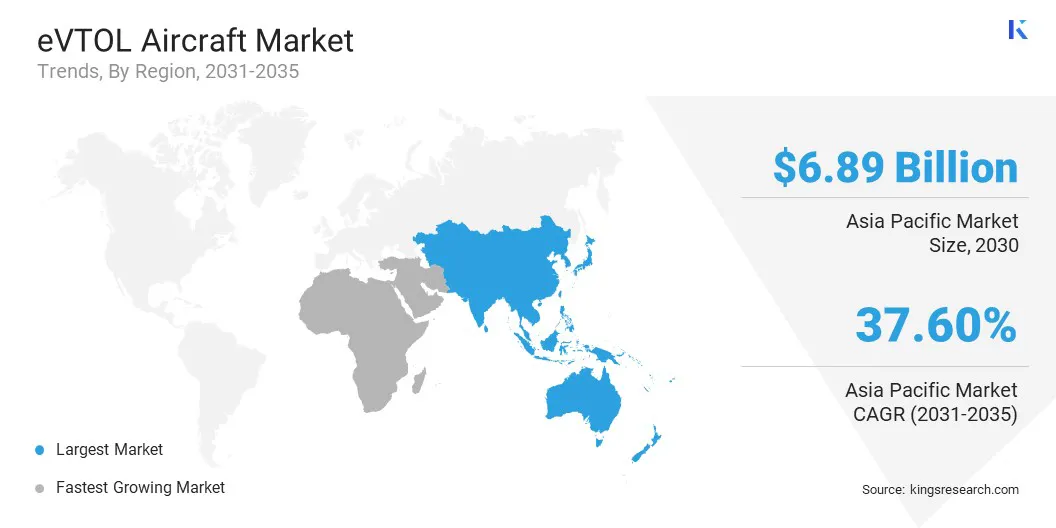
Asia Pacific is poised to capture the highest 34.21% market share in 2030. The high share is attributed to the demand for urban air mobility across densely populated megacities with limited ground transportation connectivity. The region is designated as a key hub for the development and commercialization of advanced air mobility (AAM) due to favorable government initiatives, expanding industry partnerships, and increasing investments in eVTOL technologies. Countries including Japan, South Korea, China, Singapore, India, Australia, and New Zealand are advancing air taxi services, regional mobility solutions, and supporting infrastructure such as vertiports and air traffic management systems.
The Middle East eVTOL aircraft market is anticipated to grow at the fastest CAGR of 45.03% over the forecast period (2031-2035). The region is likely to gain pace as a strategic hub for advanced air mobility (AAM) due to strong government support, favorable regulatory policies, and significant investments in eVTOL infrastructure and commercialization. Countries such as the UAE and Saudi Arabia are signing strategic partnership deals with leading eVTOL manufacturers, including Archer, Joby, EHang, and Eve Air Mobility, to develop air taxi ecosystems, pilot training programs, maintenance facilities, and vertiport infrastructure. These initiatives are positioning the region as one of the earliest markets for large-scale commercial eVTOL deployment, with significant potential to accelerate urban air mobility adoption.
The eVTOL aircraft market is undergoing transformative evolution driven by development programs across the regions. The market is attracting significant funding, technology, and regulatory engagement to reach commercialization. The industry is expected to undergo consolidation over the next decade owing to high certification costs, strict regulatory requirements, and the demand for large-scale investment in eVTOL development, manufacturing, and infrastructure.
Market players with strong cash positions, strategic partnerships, and clear paths to certification are anticipated to register steady growth in the competitive market. Prime differentiators comprising aircraft design philosophy such as multicopter versus tilt-rotor versus lift-plus-cruise, target market segments from urban air taxi to regional transport to cargo. While go-to-market strategy including owned fleet versus manufacturing for others are positioned to create growth avenues for players.
Frequently Asked Questions

Faizy brings over four years of experience in market research and consulting, with a proven ability to support strategic engagements across diverse industries and business environments. His work focuses on understanding complex market structures, identifying emerging opportunities, and translating research findings into clear, commercially relevant insights. With strong analytical capabilities and a structured approach to problem-solving, he evaluates industry trends, competitive landscapes, customer dynamics, and evolving business models. His expertise encompasses market research, competitive intelligence, market sizing and forecasting, industry assessment, company benchmarking, and strategic analysis. Faizy combines technical proficiency with a strong research orientation, enabling him to interpret both qualitative and quantitative information effectively. He has contributed to projects that help organizations assess growth potential, strengthen market positioning, and evaluate strategic priorities. His adaptable approach allows him to work across sectors while maintaining a consistent focus on accuracy, relevance, and delivering insights that support informed decision-making for clients and stakeholders.
Habi is a seasoned research and consulting leader with renowned experience in guiding clients on strategic growth and transformation initiatives across global markets. He has led high-performing research teams that deliver actionable insights on market expansion, M&A strategies, opportunity assessment, new business development, and product launches. His project portfolio spans large petrochemical producers, electronic device manufacturers, lubricants companies, and other leading enterprises across diverse industrial and consumer sectors. He currently heads the research department at Kings Research, where he is responsible for setting the research agenda, mentoring analysts, and ensuring client-ready deliverables that support executive decision-making. With extensive experience in market intelligence, strategic research, and consulting, Habi brings a strong understanding of evolving industry dynamics, competitive landscapes, emerging opportunities, and business growth challenges. His expertise includes developing research frameworks, translating complex market data into actionable strategic recommendations, and working closely with senior stakeholders to address critical business questions. He has also contributed to building research capabilities, strengthening analytical methodologies, and driving a culture of quality and insight-led decision-making within research teams. His cross-industry exposure enables him to connect market trends with broader business implications and provide perspectives that help organizations identify opportunities, mitigate risks, and make informed strategic decisions.