
Inquire Now
Key Strategic Points
The military drone market consists of products and services associated with unmanned aerial vehicles (UAVs) used in the military sector. The market comprises different types of drones such as fixed wing, rotary blade, and hybrid UAVs used for surveillance, reconnaissance, intelligence, target acquisition, and combat operations. It covers manufacturers, component suppliers, software developers, and service providers supporting defense organizations and government agencies.
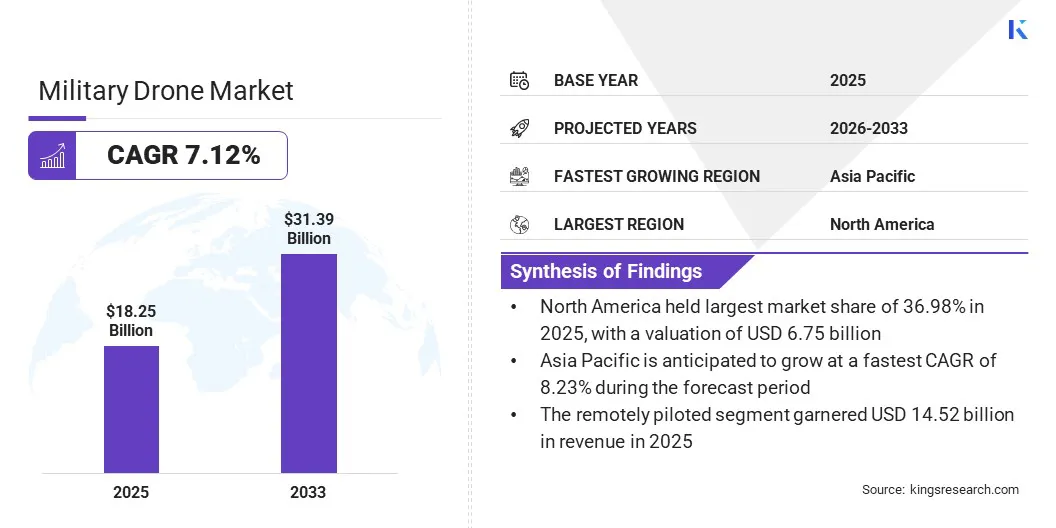
The global military drone market size was valued at USD 18.25 billion in 2025 and is projected to grow from USD 19.40 billion in 2026 to USD 31.39 billion by 2033, exhibiting a CAGR of 7.12% during the forecast period. This growth reflects the increasing adoption of unmanned aerial vehicles for defense applications across various regions.
Major companies operating in the global military drone industry are General Atomics, Northrop Grumman, Boeing, AeroVironment, Inc., Anduril Industries, Lockheed Martin Corporation, Shield AI, Skydio, Inc., Kratos, Teledyne FLIR Defense Inc., Israel Aerospace Industries., BAYKAR TECH, Thales, Elbit Systems Ltd., and Airbus.
The market is expanding owing to the increasing demand for advanced surveillance, intelligence, and reconnaissance solutions and ongoing investments in military modernization. Moreover, technological improvements and the use of artificial intelligence are making military drones more versatile and effective, thus contributing to the positive growth of the market.
The increasing need for improved intelligence, surveillance, and reconnaissance (ISR) capabilities is driving market growth. Accurate and timely intelligence is critical for decision-making, threat assessment, and situational awareness in military operations. The use of drone technology with sophisticated sensors, cameras, and data transmission systems can help armed forces perform persistent surveillance over large, inaccessible areas in demanding and hostile environments.
These drones are able to capture high-quality images, track enemy troop movements, and provide up-to-date situational updates without risking human lives. As threats become more sophisticated and militaries look for a tactical advantage, ISR-capable drones are becoming a key part of modern military strategy and investment.
One of the major concerns is its susceptibility to cyber-attacks and electronic warfare. The dependence on sophisticated communication networks, GPS signals, and data links in drone operations increases their exposure to vulnerabilities like drone hacking, signal jamming, and interception by adversaries. Such weaknesses can result in the loss of control, data breaches, or the compromise of sensitive mission intelligence.
To overcome these challenges, companies are investing heavily in cybersecurity solutions, including encrypted communications, anti-jamming technologies, and real-time threat detection systems. By incorporating advanced protection measures and regular security updates, manufacturers aim to safeguard military drones and ensure mission continuity in contested environments.
The integration of artificial intelligence (AI) into military drones is an industry-transforming trend that is changing the defense landscape. AI allows drones to function with increased autonomy, enabling them to navigate complex environments, identify targets, and carry out missions with less human intervention. By utilizing machine learning algorithms and real-time data analysis, military UAVs can adjust to changing battlefield conditions, detect threats, and coordinate actions in drone swarms to enhance effectiveness.
This transition increases operational speed and accuracy while reducing the cognitive burden on operators. Defense firms are continuously developing AI systems to create more intelligent, reliable, and efficient autonomous drones capable of performing effectively across diverse mission scenarios.
|
Segmentation |
Details |
|
By Type |
Fixed Wing, Rotary Blade, and Hybrid |
|
By Operation Mode |
Remotely Piloted, Partially Autonomous, and Fully Autonomous |
|
By Range |
Visual Line of Sight (VLOS), Extended Visual Line of Sight (EVLOS), and Beyond Visual Line of Sight (BVLOS) |
|
By Application |
Intelligence, Surveillance, Reconnaissance, and Targeting (ISRT), Combat Operations, Battle Damage Management, Logistics & Transportation, and Others |
|
By Weight |
<150 Kg, 150 - 1000 Kg, and >1000 Kg |
|
By Endurance |
Short-Endurance Drones (Up to 6 hours), Medium Endurance Drones(6-24 hours), Long Endurance(Over 24 hours) |
|
By End User |
Air Force, Army, Navy, and Others |
|
By Region |
North America: U.S., Canada, Mexico |
|
Europe: France, UK, Spain, Germany, Italy, Russia, Rest of Europe |
|
|
Asia-Pacific: China, Japan, India, Australia, ASEAN, South Korea, Rest of Asia-Pacific |
|
|
Middle East & Africa: Turkey, U.A.E., Saudi Arabia, South Africa, Rest of Middle East & Africa |
|
|
South America: Brazil, Argentina, Rest of South America |
Based on region, the global military drone market has been classified into North America, Europe, Asia Pacific, Middle East & Africa, and South America.
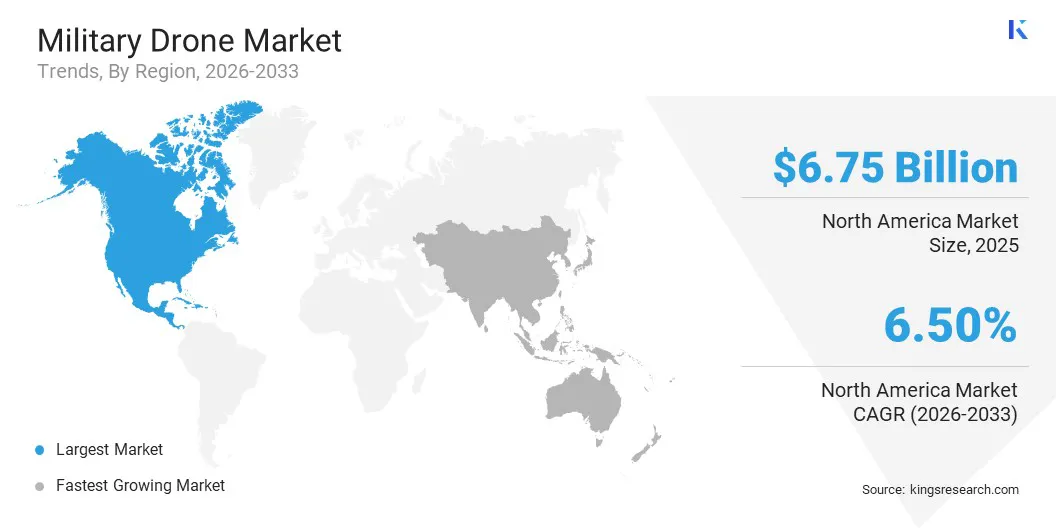
North America military drone market share stood at 36.98% in 2025, with a valuation of USD 6.75 billion. This dominance is reinforced by significant investments in defense procurement programs, rapid adoption of cutting-edge UAV technologies, and strong government support for modernization initiatives. Robust collaboration between defense agencies and private sector innovators accelerates the development of advanced drones tailored to various military missions.
Furthermore, North America’s established infrastructure for research, testing, and deployment enables swift integration of new capabilities into the armed forces. The presence of skilled personnel and an ongoing focus on training and simulation further bolsters the region’s leadership in military drone deployment and operational effectiveness.
The Asia-Pacific military drone market is set to grow at a CAGR of 8.23% over the forecast period, owing to increased demand for advanced defense technologies. Growing security concerns, territorial disputes, and the need for enhanced border surveillance are prompting countries to expand their UAV fleets. Several governments are working to develop in-country drone manufacturing capabilities and investing in local R&D to reduce dependence on foreign suppliers.
The regional market further benefits from a rapidly maturing technological landscape and the rise of local manufacturers offering low-cost solutions. Asia Pacific is an attractive market for the drone industry due to the increasing adoption of military capabilities, including the use of drones in reconnaissance, disaster management, and maritime security.
The military drone market is characterized by a dynamic mix of established defense firms and innovative technology companies. Industry leaders leverage advanced research and development to create sophisticated UAV platforms that address evolving military requirements. Meanwhile, specialized providers focus on emerging technologies such as artificial intelligence, autonomy, and miniaturization.
Collaborations, partnerships, and acquisitions are frequent as organizations aim to broaden their technological capabilities and market presence. This environment of intense competition fuels continuous advancements in drone performance, reliability, and adaptability, ensuring that military clients have access to cutting-edge solutions tailored to diverse operational scenarios.
Frequently Asked Questions

Aswathi holds cross-domain expertise, translating market trends and competitive intelligence into decision-ready insights. Her work helps clients interpret evolving market conditions and identify growth opportunities. She brings a focused, insight-led approach to research execution. She translates these findings into clear, prioritized action plans that align with client capabilities. Her research often includes scenario modeling to test growth strategies under varying economic conditions. She maintains a rigorous validation process, cross-checking primary and secondary sources to ensure reliability. Clients value her ability to synthesize noisy data into concise executive summaries that drive board-level discussions. Her sector-specific lens, combined with a pragmatic focus on execution, consistently delivers high-impact, commercially sound recommendations. Her structured yet flexible research frameworks adapt to client timelines without compromising depth. She is known for distilling complex trade-offs into straightforward, defensible positions that facilitate confident decision-making.
Habi is a seasoned research and consulting leader with renowned experience in guiding clients on strategic growth and transformation initiatives across global markets. He has led high-performing research teams that deliver actionable insights on market expansion, M&A strategies, opportunity assessment, new business development, and product launches. His project portfolio spans large petrochemical producers, electronic device manufacturers, lubricants companies, and other leading enterprises across diverse industrial and consumer sectors. He currently heads the research department at Kings Research, where he is responsible for setting the research agenda, mentoring analysts, and ensuring client-ready deliverables that support executive decision-making. With extensive experience in market intelligence, strategic research, and consulting, Habi brings a strong understanding of evolving industry dynamics, competitive landscapes, emerging opportunities, and business growth challenges. His expertise includes developing research frameworks, translating complex market data into actionable strategic recommendations, and working closely with senior stakeholders to address critical business questions. He has also contributed to building research capabilities, strengthening analytical methodologies, and driving a culture of quality and insight-led decision-making within research teams. His cross-industry exposure enables him to connect market trends with broader business implications and provide perspectives that help organizations identify opportunities, mitigate risks, and make informed strategic decisions.