
Inquire Now
Key Strategic Points
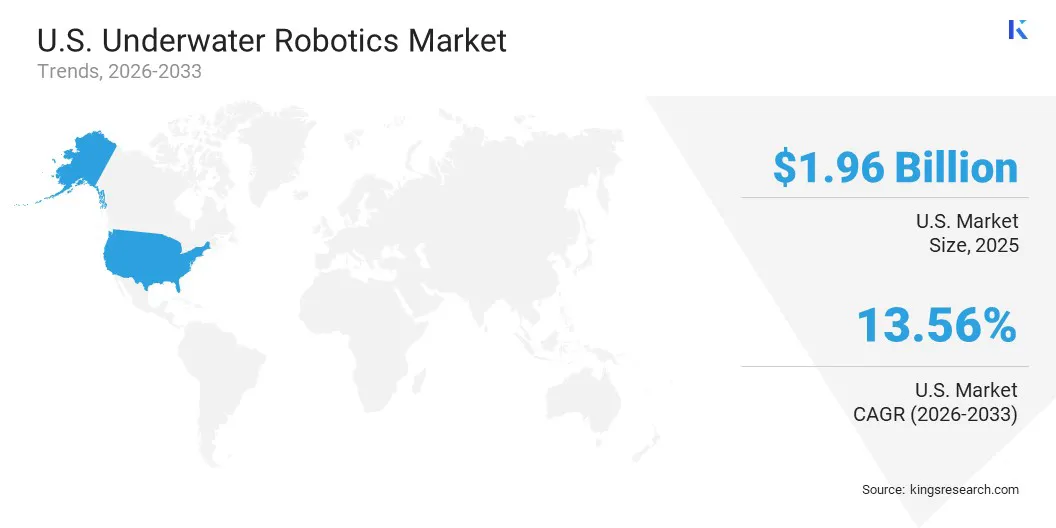
The U.S. underwater robotics industry size was valued at USD 1.96 billion in 2025 and is projected to reach USD 5.41 billion by 2033, exhibiting a CAGR of 13.56% during the forecast period. This growth is fueled by the increasing demand for subsea inspection, maintenance, and exploration in the offshore energy, defense, and scientific research sectors. Advancements in autonomous technologies and cost-efficient robotic platforms further support the growth.
Major companies operating in the U.S. underwater robotics market are General Dynamics Mission Systems, Inc, Boeing, HII (Huntington Ingalls Industries), Lockheed Martin Corporation, L3Harris Technologies, Inc., Oceaneering International, Inc., Teledyne, Anduril Industries, NAUTICUS ROBOTICS, Ocean Aero, Vatn Systems, VideoRay LLC, Blue Robotics Inc, Deep Ocean Engineering, Inc., and Terradepth.
Federal investments in maritime security, alongside rising initiatives in ocean exploration and environmental monitoring, are further accelerating market expansion. The introduction of next-generation remotely operated and autonomous vehicles is expected to transform operations in deepwater and harsh environments.
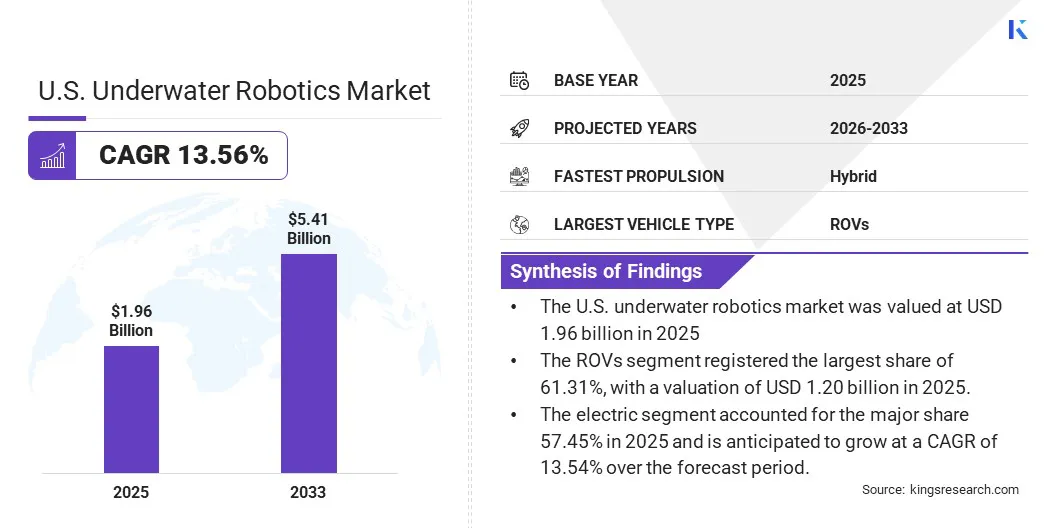
The offshore oil and gas industry is the primary driver of demand in the U.S. underwater robotics industry. Exploration in deeper and more remote subsea environments makes diving impractical and unsafe. ROVs and AUVs enable operators to conduct detailed inspections, maintenance, and repairs at depths and locations inaccessible or hazardous for humans, improving operational efficiency and safety.
This demand is reinforced by the extensive network of offshore platforms, with 3,728 active worldwide in 2025, including 1,641 in the Gulf of Mexico, according to the Cornell University database. All of these platforms require regular monitoring and maintenance. The ongoing pace of U.S. offshore drilling, combined with aging subsea infrastructure, ensures sustained and long-term demand for underwater robotics across major domestic oil and gas regions.
Purchasing advanced ROVs and AUVs requires significant investment in specialized support vessels, subsea docking infrastructure, skilled operators, and ongoing maintenance. Such substantial financial commitments are typically feasible only for major oil and gas companies, large defense contractors, and government-funded research institutions.
This effectively excludes mid-sized operators and nascent application segments such as aquaculture and environmental monitoring. Consequently, leading U.S. manufacturers are turning to modular and scalable system architectures, while rental and leasing models are gaining popularity as affordable alternatives to outright ownership. This, in turn, lowers the financial barrier to entry for new market entrants.
AI and autonomous advancements enable robots to control self-directed systems. These advancements are empowering the new generation of underwater robots that can adapt to unpredictable environments and execute complex tasks with minimal human intervention. As such, they can plan missions, take real-time decisions, avoid obstacles, and analyze data on their own. The technology is helping to reduce dependence on skilled operators and bandwidth-limited acoustic communication.
|
Segmentation |
Details |
|
By Vehicle Type |
ROVs and AUVs |
|
By Propulsion |
Electric, Hydraulic, and Hybrid |
|
By Application |
Inspection, Repair & Maintenance (IRM), Surveying & Mapping, Exploration & Resource Assessment, Surveillance & Security, Search & Recovery Operations, and Others |
|
By End User |
Offshore Energy, Defense & Security, Research & Academia, Aquaculture & Fisheries, Commercial Service Providers, Mining, and Others |
|
By Region |
U.S. |
The U.S. underwater robotics market includes a broad and growing range of application segments, reflecting the wide utility of ROVs, AUVs, and hybrid underwater systems across many industries. For example, the offshore oil and gas industry relies heavily on underwater robots to perform tasks such as pipeline inspection, wellhead monitoring, and subsea infrastructure maintenance at Gulf of Mexico facilities. At the same time, federal agencies such as NOAA and leading oceanographic research institutions deploy AUVs to map the deep sea, study biodiversity, and conduct climate research in U.S. waters.
The expansion of offshore wind energy along the U.S. East Coast is further broadening demand, with the U.S. Department of Energy reporting that the U.S. offshore wind project development and operational pipeline reached a potential generating capacity of 80,523 MW as of May 2024, a 53% increase from the previous year. This signifies the need for underwater robotic systems supporting cable inspection, foundation monitoring, and environmental assessment.
The U.S. underwater robotics market is characterized by a competitive landscape across ROV, AUV, and hybrid vehicle segments. It comprises established technology conglomerates, specialized subsea engineering firms, defense contractors, and emerging technology developers. Domestic players maintain a strong competitive edge, driven by robust defense procurement by the U.S. Navy and the Department of Defense, which continues to fund the development and deployment of advanced unmanned underwater systems for surveillance, mine countermeasures, and intelligence operations.
Strategic alliances with federal agencies, long-term service contracts with offshore energy operators, and joint development programs with leading oceanographic research institutions are driving competitive positioning in the U.S. underwater robotics market. At the same time, new entrants focused on miniaturized and affordable AUV platforms are gradually eroding the market dominance of incumbent leaders in commercial, defense, and scientific application segments.
Frequently Asked Questions

Aswathi holds cross-domain expertise, translating market trends and competitive intelligence into decision-ready insights. Her work helps clients interpret evolving market conditions and identify growth opportunities. She brings a focused, insight-led approach to research execution. She translates these findings into clear, prioritized action plans that align with client capabilities. Her research often includes scenario modeling to test growth strategies under varying economic conditions. She maintains a rigorous validation process, cross-checking primary and secondary sources to ensure reliability. Clients value her ability to synthesize noisy data into concise executive summaries that drive board-level discussions. Her sector-specific lens, combined with a pragmatic focus on execution, consistently delivers high-impact, commercially sound recommendations. Her structured yet flexible research frameworks adapt to client timelines without compromising depth. She is known for distilling complex trade-offs into straightforward, defensible positions that facilitate confident decision-making.
Habi is a seasoned research and consulting leader with renowned experience in guiding clients on strategic growth and transformation initiatives across global markets. He has led high-performing research teams that deliver actionable insights on market expansion, M&A strategies, opportunity assessment, new business development, and product launches. His project portfolio spans large petrochemical producers, electronic device manufacturers, lubricants companies, and other leading enterprises across diverse industrial and consumer sectors. He currently heads the research department at Kings Research, where he is responsible for setting the research agenda, mentoring analysts, and ensuring client-ready deliverables that support executive decision-making. With extensive experience in market intelligence, strategic research, and consulting, Habi brings a strong understanding of evolving industry dynamics, competitive landscapes, emerging opportunities, and business growth challenges. His expertise includes developing research frameworks, translating complex market data into actionable strategic recommendations, and working closely with senior stakeholders to address critical business questions. He has also contributed to building research capabilities, strengthening analytical methodologies, and driving a culture of quality and insight-led decision-making within research teams. His cross-industry exposure enables him to connect market trends with broader business implications and provide perspectives that help organizations identify opportunities, mitigate risks, and make informed strategic decisions.