
Inquire Now
Key Strategic Points
The market focuses on technologies that enable precise detection, tracking, and management of aircraft and ground movements within airport environments. Systems include surveillance radars, surface movement radars, precision approach radars, and weather radars that support safe navigation and operational continuity.
The market covers type, range, and applications required to maintain reliable air traffic control functions. Its scope extends to modernization programs, regulatory compliance, and performance enhancements across global airport infrastructure.
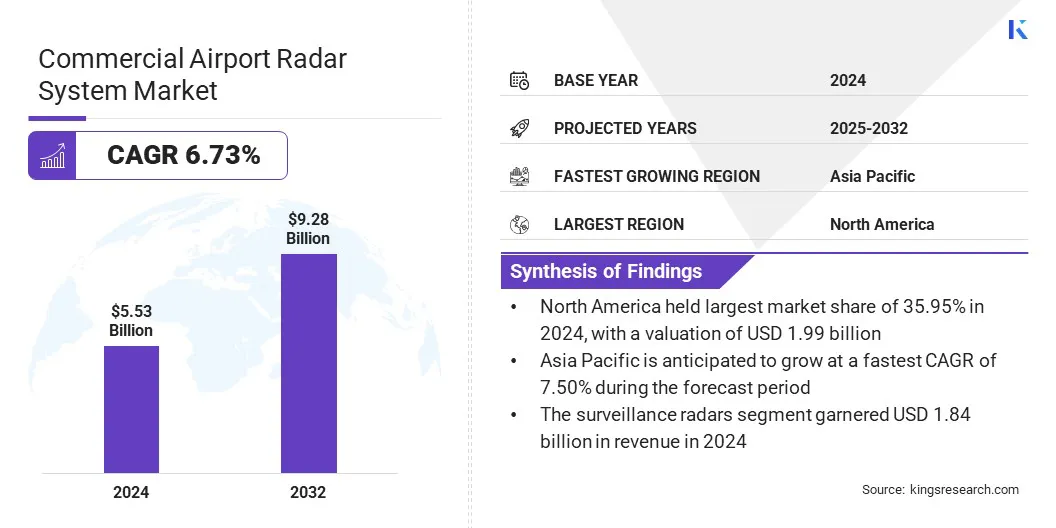
The global commercial airport radar system market size was valued at USD 5.53 billion in 2024 and is projected to grow from USD 5.88 billion in 2025 to USD 9.28 billion by 2032, exhibiting a CAGR of 6.73% during the forecast period.
This growth is driven by airports adopting AI-enhanced radar platforms to strengthen situational awareness and automate traffic assessment. AI optimizes radar data interpretation and improves operational response times, supporting safer and more efficient airport operations.
Major companies operating in the commercial airport radar system market are Thales, Indra Sistemas, S.A., Honeywell International Inc., Northrop Grumman, RTX Corporation, TERMA, Frequentis AG, BAE Systems, Leonardo S.p.A., NEC Corporation, Hensoldt AG, Detect Inc., Easat Radar Systems Limited, Vaisala, and Shoghi Communications Ltd.
Expansion of remote tower implementations using radar-based monitoring is driving modernization in airport operations by enabling centralized oversight of multiple airfields. Radar systems provide consistent surveillance accuracy, supporting remote decision-making, runway visibility assessment, and efficient traffic sequencing.
Growing demand for cost-effective tower operations is encouraging airports and air navigation service providers (ANSPs) to adopt radar-enabled remote configurations, which reduce staffing requirements while maintaining safety compliance.
Increasing investments by airport authorities and government aviation agencies in digital communication networks are enhancing radar data transmission reliability, positioning remote tower solutions as a scalable and efficient option for regional and low-traffic airports seeking to upgrade control capabilities.
Rising airport modernization initiatives are driving the adoption of advanced radar systems, as authorities upgrade aging infrastructure to manage increasing air traffic and meet stringent safety requirements. Modernization programs focus on enhancing surveillance coverage, real-time situational awareness, and response capabilities during adverse weather.
Operators are replacing legacy radars with digital, long-range, and high-resolution systems that integrate with broader air traffic management workflows. Moreover, increasing investments by airport authorities and government aviation agencies in performance reliability, regulatory compliance, and minimizing operational disruptions are further supporting the adoption of commercial airport radar systems.
High capital expenditure and complex integration requirements restrict rapid adoption of commercial airport radar systems, particularly in airports operating with constrained budgets or legacy infrastructure. Procurement involves significant investment in advanced sensors, installation, calibration, and long-term maintenance.
Integration with existing air traffic systems often demands customized configurations, extended deployment timelines, and specialized technical expertise. These factors increase overall project risk for operators and delay modernization initiatives, creating financial and operational barriers that influence procurement decisions across small and medium-sized airports.
To address this challenge, market players address these challenges by implementing phased deployment strategies, forming vendor partnerships that provide lifecycle support, adopting modular radar architectures, and leveraging government-backed funding mechanisms to manage costs and simplify system integration.
A key trend driving the commercial airport radar system market is the transition toward digitally enabled airport operations, which increases reliance on radar systems that integrate with analytics platforms, automation tools, and networked control architectures. Digital ecosystems allow continuous monitoring of airspace and ground movements, supporting faster decision-making and coordinated workflows.
Radar-derived data improves traffic prediction, runway incursion alerts, and weather-related risk assessments. With digital transformation, airports are increasingly adopting predictive analytics, AI-assisted decision-making, and integrated traffic management systems, which place higher demands on radar resolution, data throughput, and interoperability.
Modern radar systems must support real-time data sharing across multiple platforms, comply with emerging cybersecurity protocols, and enable scalable updates to accommodate evolving operational requirements. Additionally, the push toward autonomous ground vehicles and unmanned aerial systems at airports further emphasizes the need for advanced radar capabilities that provide precise situational awareness, minimize operational delays, and enhance overall safety standards.
|
Segmentation |
Details |
|
By Type |
Surveillance Radars, Surface Movement Radars, Precision Approach Radars, Weather Radars |
|
By Range |
Short-range, Medium-range, Long-range |
|
By Application |
Air traffic control, Surface movement monitoring, Precision approach & landing, Weather monitoring, Wind shear detection, Others |
|
By Region |
North America: U.S., Canada, Mexico |
|
Europe: France, UK, Spain, Germany, Italy, Russia, Rest of Europe |
|
|
Asia-Pacific: China, Japan, India, Australia, ASEAN, South Korea, Rest of Asia-Pacific |
|
|
Middle East & Africa: Turkey, U.A.E., Saudi Arabia, South Africa, Rest of Middle East & Africa |
|
|
South America: Brazil, Argentina, Rest of South America |
Based on region, the global commercial airport radar system market has been classified into North America, Europe, Asia Pacific, Middle East & Africa, and South America.
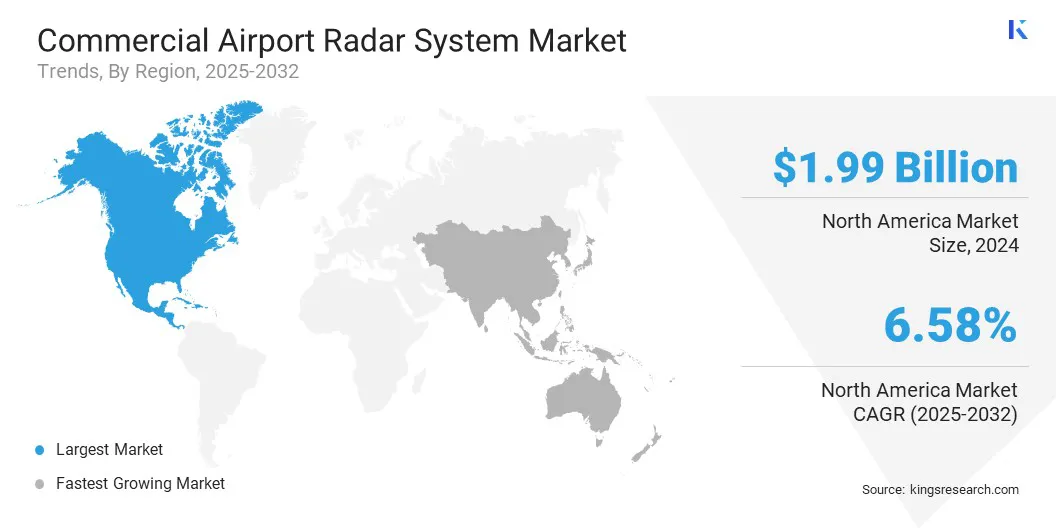
North America accounted for 35.95% of the commercial airport radar system market in 2024, reaching a valuation of USD 1.99 billion. This dominance is attributed to continuous upgrades across major airports seeking improved surveillance accuracy, enhanced surface movement monitoring, and higher operational reliability. Authorities are replacing legacy radar installations with advanced long-range and multi-sensor systems to manage increasing traffic density and evolving safety mandates.
Market growth in the region is driven by targeted investments from airport authorities and air navigation service providers in digital air traffic management platforms, radar system upgrades, and runway expansion projects. These stakeholders are allocating capital toward automated surveillance, surface movement monitoring, and integrated radar architectures to support rising traffic volumes, meet safety regulations, and sustain long-term infrastructure modernization programs.
Asia Pacific commercial airport radar system industry is projected to grow at a CAGR of 7.50% over the forecast period, driven by rapid airport expansion, increasing passenger throughput, and strengthening investment in aviation safety infrastructure. Rising air traffic in countries such as China, India, and Southeast Asian nations is fueling demand for advanced surveillance and air traffic management solutions.
Governments in this region are prioritizing the modernization of existing radar networks and deployment of multi-sensor systems to enhance operational efficiency and safety. Additionally, airport authorities and air navigation service providers across the region are adopting digital air traffic management platforms and automated radar solutions, enabling real-time data sharing and more informed operational decision-making.
National aviation regulators and government-backed airport operators are expanding regional connectivity and international airport development programs, which is driving higher procurement of advanced radar systems and accelerating technology upgrades.
Key players in the commercial airport radar system industry are focusing on enhancing product portfolios, improving radar precision, and strengthening system interoperability to sustain competitive positioning. Companies are investing in research programs aimed at boosting detection accuracy, weather resilience, and data processing speeds.
Key players are also emphasizing cybersecurity and modular system designs to address evolving airport modernization and automation requirements. Market participants are pursuing geographic expansion through strategic contracts, long-term service agreements, and establishing local support capabilities.
Frequently Asked Questions

Antriksh is an experienced analyst specializing in cross-domain research across diverse industries. With a strong foundation in data analysis and statistical interpretation, he delivers insightful market reports that guide strategic decision-making. Antriksh excels in conducting primary research, with a focus on identifying trends and understanding consumer behavior. Thriving in dynamic and high-pressure environments, he combines analytical expertise with a commitment to delivering impactful outcomes. Beyond his professional pursuits, Antriksh's passion for travel fuels his curiosity and broadens his perspectives, enriching his ability to uncover unique insights that enhance his research capabilities. He is equally adept at synthesizing quantitative findings with qualitative context, which allows him to present holistic viewpoints to clients. His disciplined work ethic and intellectual agility make him a trusted partner in navigating market uncertainties. He consistently seeks out new methodologies to refine his analytical toolkit, and his ability to communicate complex insights clearly ensures stakeholders act confidently on his recommendations.
Habi is a seasoned research and consulting leader with renowned experience in guiding clients on strategic growth and transformation initiatives across global markets. He has led high-performing research teams that deliver actionable insights on market expansion, M&A strategies, opportunity assessment, new business development, and product launches. His project portfolio spans large petrochemical producers, electronic device manufacturers, lubricants companies, and other leading enterprises across diverse industrial and consumer sectors. He currently heads the research department at Kings Research, where he is responsible for setting the research agenda, mentoring analysts, and ensuring client-ready deliverables that support executive decision-making. With extensive experience in market intelligence, strategic research, and consulting, Habi brings a strong understanding of evolving industry dynamics, competitive landscapes, emerging opportunities, and business growth challenges. His expertise includes developing research frameworks, translating complex market data into actionable strategic recommendations, and working closely with senior stakeholders to address critical business questions. He has also contributed to building research capabilities, strengthening analytical methodologies, and driving a culture of quality and insight-led decision-making within research teams. His cross-industry exposure enables him to connect market trends with broader business implications and provide perspectives that help organizations identify opportunities, mitigate risks, and make informed strategic decisions.



.webp&w=128&q=75&dpl=dpl_DPva2LrvfsBdTJm1XZj67UTrvMHL)
