

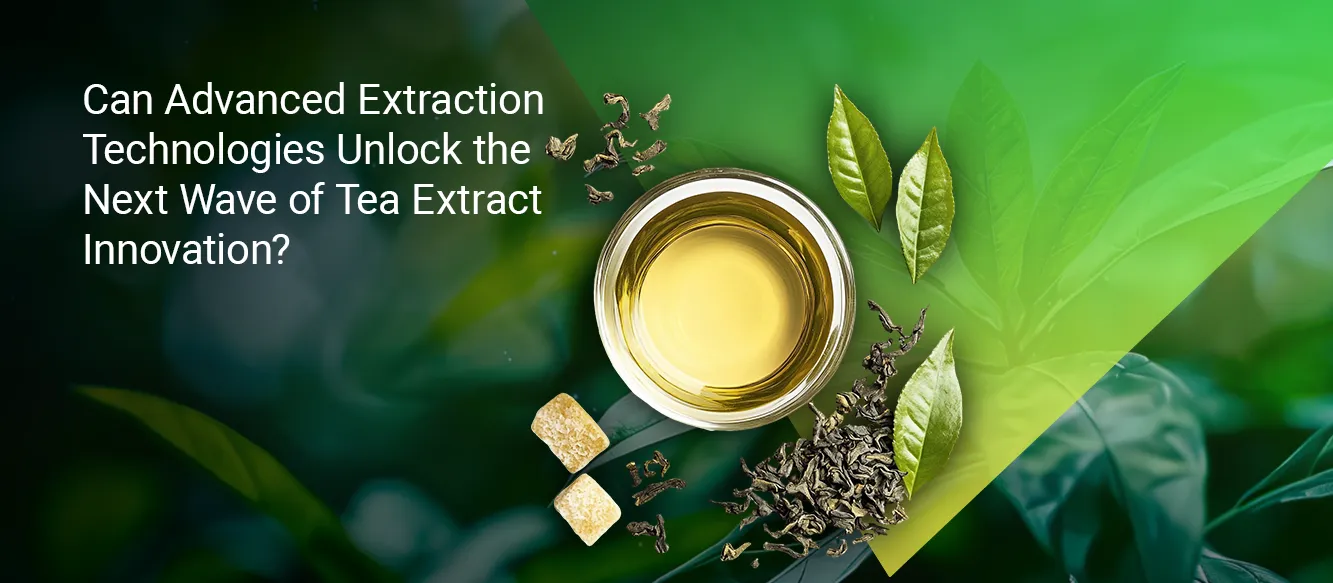
Advanced tea extraction systems are specialized engineering processes designed to improve recovery, selectivity, and structural preservation of bioactive compounds such as catechins, L-theanine, and total tea polyphenols. These systems incorporate ultrasound-assisted, microwave-assisted, pressurized-water, supercritical-fluid, high-pressure, and enzyme-assisted processing, providing efficient alternatives to traditional hot-water steeping or organic solvent steeping.
As per Kings Research, the global tea extract market was valued at USD 8.02 billion in 2025 and is projected to grow to USD 9.10 billion in 2026, reaching USD 16.16 billion by 2033, representing a CAGR of 8.55% over the forecast period. This expansion coincides with substantial global agricultural output. Global tea production reached 7.05 million metric tonnes in 2024. Concurrently, 2025 recorded an all-time high for India's export volume at 280.40 million kg, generating an export value of Rs 8,488.43 crore.
With substantial global leaf production, commercial attention is shifting from raw leaf volume toward high-value bioactives.
Why Is Tea Extract Innovation Moving Beyond Conventional Extraction?
Traditional extraction relies on prolonged thermal steeping in hot water or chemical solvent soaking using ethanol, methanol, or ethyl acetate. While these traditional systems remain widely deployed due to simple equipment requirements, they exhibit severe technical constraints.
Prolonged exposure to elevated temperatures triggers oxidation and thermal degradation of heat-sensitive polyphenols. Traditional hot-water extraction recovers broad groups of compounds, resulting in dark, bitter, and highly astringent liquid bases that require extensive downstream refining.
Solvent-based systems require energy-intensive evaporation and recovery loops. Residual-solvent limits vary by product category and regulatory framework in the U.S. and EU markets. Because tea extracts are primarily used in foods and supplements, processors must comply with strict food-safety frameworks. In Europe, manufacturers must adhere to EU Directive 2009/32/EC governing extraction solvents used in foodstuffs, while U.S. processors must meet FDA limits under 21 CFR regulations for food additives. Managing these residual levels adds capital expense and environmental burden. Commercial processors require modern extraction architectures capable of isolating target molecules rapidly while maintaining compound stability and energy efficiency.
Which Compounds Are Advanced Extraction Technologies Trying to Recover?
Tea leaves (Camellia sinensis) contain a complex array of bioactive secondary metabolites. Extraction success depends on targeting specific molecular structures rather than crude solid yield.
- Epigallocatechin Gallate (EGCG): The primary catechin responsible for antioxidant capacity. A 2025 clinical study measured the catechin composition of a commercial green tea beverage. It reported 149 mg EGCG out of 898.1 mg total catechins, meaning EGCG represented approximately 16.6% of total catechins in that specific beverage. The beverage contained more GCG than EGCG because of conversion during processing, and the study noted that GCG is an epimer of EGCG.
- Other Primary Catechins: Including Epigallocatechin (EGC), Epicatechin Gallate (ECG), and Epicatechin (EC). Each possesses distinct solubility profiles and antioxidant potential.
- Theaflavins and Thearubigins: Formed during enzymatic oxidation of black tea leaves, these complex polyphenols deliver a distinct amber color and mouthfeel.
- L-Theanine: A unique non-protein amino acid providing umami taste characteristics and associated with cognitive relaxation benefits.
- Caffeine (Methylxanthines): Co-extracted alongside catechins; requires precise separation depending on whether the target ingredient is energy-focused or decaffeinated.
How Do Advanced Extraction Technologies Compare With Conventional Methods?
Alternative extraction technologies utilize physical forces, acoustic energy, or electromagnetic radiation to disrupt plant cell walls and accelerate mass transfer while avoiding high thermal loads.
- Ultrasound-Assisted Extraction (UAE): Employs high-frequency acoustic waves (20 kHz to 100 kHz) to generate microscopic cavitation bubbles in liquid media. Bubble implosion disrupts cell membranes, releasing intracellular catechins within minutes.
- Microwave-Assisted Extraction (MAE): Applies microwave radiation to heat localized moisture inside plant tissues rapidly. Rapid pressure buildup ruptures cellular walls, forcing bioactives outward into the solvent.
- Supercritical Fluid Extraction (SFE): Utilizes carbon dioxide above its critical point (31.1°C and 73.8 bar). Supercritical CO2 acts like a dense gas with liquid-like solvent power. While plain carbon dioxide is highly suitable for extracting caffeine, isolating polar compounds like EGCG requires introducing a small percentage (typically 5% to 15%) of ethanol as a co-solvent. This makes the EGCG extraction process low-residue rather than entirely solvent-free.
- Pressurized Hot Water Extraction (PHWE): Uses liquid water under elevated pressure (typically 16 to 80 bar) at temperatures between 100°C and 200°C. This specific pressure range ensures the environment exceeds the vapor pressure of water at peak temperatures, maintaining it in a liquid state and dramatically lowering its dielectric constant to dissolve moderately polar polyphenols efficiently.
- Enzyme-Assisted Extraction (EAE): Uses cellulases, pectinases, and tannases to hydrolyze structural plant cell walls enzymatically, enhancing catechin liberation under gentle thermal conditions.
- High-Pressure Processing (HPE): Applies intense hydrostatic pressure at ambient temperatures to deform cell membranes and release intracellular compounds, perfectly preserving heat-labile structures like EGCG and fresh sensory profiles.
Which Extraction Technologies Offer the Strongest Technical Advantage?
Selecting an appropriate extraction technique requires balancing mass transfer speeds against equipment complexity and thermal sensitivity.
|
Technology |
Primary Mechanism |
Primary Extraction Advantage |
Main Operational Limitation |
Best-Fit Objective |
|
Conventional Solvent |
Passive thermal solvent diffusion |
Established infrastructure and lower initial capital expenditure |
Extended processing times and high solvent handling requirements |
Bulk commodity tea solids |
|
Ultrasound-Assisted (UAE) |
Acoustic cavitation and localized micro-jets |
Accelerated mass transfer and lower temperature operation |
Requires precise vessel geometry optimization |
High-yield polyphenol recovery |
|
Microwave-Assisted (MAE) |
Volumetric dielectric heating |
Rapid processing times and reduced solvent volume requirements |
Thermal sensitivity risks for delicate catechins |
Rapid lab or specialized batch extraction |
|
Supercritical Fluid (SFE) |
Supercritical CO2 solvent density tuning |
Superior compound selectivity and low-residue operation (requires ethanol for the EGCG side) |
Higher initial equipment capital expenditure |
Premium decaffeinated and high-purity EGCG |
|
Pressurized Hot Water (PHWE) |
Altered water dielectric constant via temperature and pressure |
Avoids organic solvents while increasing target solubility |
Requires heat-exchanger design to protect heat-labile molecules (short contact time protects EGCG) |
Green polar bioactive recovery |
|
Enzyme-Assisted (EAE) |
Enzymatic cleavage of cell wall polysaccharides |
High structural preservation and gentle processing conditions |
High enzyme catalyst cost and strict pH or temperature control |
Specialized bioactive liberation |
|
High-Pressure Processing (HPE) |
Hydrostatic cell membrane deformation |
Operates at ambient temperatures to preserve heat-labile structures |
Batch pressure vessel cycle limits |
Fresh sensory preservation |
Can Green Extraction Increase Efficiency Without Compromising Extract Quality?
Green extraction strategies focus on reducing organic solvent consumption, lowering energy requirements, and eliminating hazardous waste streams. By replacing a conventional 2-hour hot-water steep with a 15-minute ultrasound-assisted aqueous extraction, processors can cut thermal energy consumption significantly while matching overall yield. More importantly, this rapid, low-heat mass transfer prevents the thermal degradation of delicate catechins. By optimizing physical forces rather than relying on prolonged boiling or harsh chemicals, green technologies prove that industrial efficiency and premium extract quality can be achieved simultaneously.
What Are the Safety and Regulatory Limits for Concentrated EGCG Extracts?
A July 2026 UK Committee on Toxicity discussion paper restates the Committee's 2024 conclusion that there is no new human data indicating adverse effects below 800 mg EGCG/day, while noting that individual susceptibility may result in adverse effects at lower doses. In alignment with these concerns, the same paper notes EFSA's conclusion that it was not possible to identify an EGCG dose from green tea catechins that could be considered safe, pointing out that hepatotoxicity was reported for one specific product containing 375 mg EGCG. Following the adoption of the EFSA opinion, the EU Commission restricted EGCG to a maximum level of 800 mg/day. It is critical to distinguish between ordinary brewed tea, which is generally considered safe, and concentrated supplements containing EGCG, where rare cases of liver damage have been reported.
A 2004 clinical study (Henning et al., AJCN) also measured approximately 214 mg of EGCG from three green tea bags in a single administration, demonstrating that brewed tea can provide substantial catechin exposure depending on preparation and consumption levels. While this demonstrates that traditional beverages safely deliver active compounds through natural matrices, isolated extracts present entirely different pharmacokinetic profiles. These findings reinforce the importance of controlling EGCG concentration and formulation in green tea extracts, particularly for concentrated dietary supplements.
Why Does Selectivity Matter More Than Extraction Yield Alone?
In commercial manufacturing, crude extract yield is secondary to target compound purity and composition.
Mass Balance and Recovery Calculation Example
To evaluate technology performance objectively, processors utilize mass balance calculations:
- Total Target Mass = Biomass Mass x Initial Target Content Percentage = 1,000 g x 5% = 50 g EGCG
- Recovered Target Mass = Crude Yield x Extract Purity Percentage = 80 g x 50% = 40 g EGCG
- Target Recovery Rate = (Recovered Target Mass / Total Target Mass) x 100 = (40 g / 50 g) x 100 = 80.0%
High selectivity preserves critical catechin ratios while excluding unwanted tannins, off-flavors, and heavy metals. Heavy metal limits in standard botanical powders must remain below strict thresholds, making selective extraction critical for compliance.
How Are Purification Technologies Turning Crude Extracts Into High-Value Ingredients?
Advanced extraction is the first phase of ingredient manufacturing. Downstream purification converts crude liquid extracts into standardized commercial products.
- Macroporous Adsorption Resins: Synthetic polymer resins selectively adsorb tea catechins via hydrophobic interactions and hydrogen bonding, allowing sugars and salts to pass through. Subsequent ethanol elutions yield polyphenol purities above 90%.
- Preparative Chromatography: Provides precise molecular separation, allowing processors to isolate pure single catechins like EGCG at purities exceeding 98%.
- Membrane Filtration (Ultrafiltration and Nanofiltration): Uses polymeric or ceramic membranes with specific molecular weight cut-offs. Larger cut-offs (1,000 to 5,000 Daltons) act as a clarifying step to remove proteins and cloudiness, while tighter nanofiltration stages concentrate catechins at ambient temperatures, preventing thermal damage.
- Precipitation and Crystallization: Employs food-grade salts or targeted cooling cycles to isolate caffeine or specific gallated catechins from liquid streams.
What Happens When Extraction Technology Meets Formulation Requirements?
A highly purified bioactive ingredient must maintain stability and solubility inside complex consumer food, beverage, or cosmetic formulations. Catechins readily oxidize when exposed to neutral or alkaline pH, elevated heat, light, or multivalent metal ions, causing liquid browning, precipitation, and bitter flavor profiles.
To preserve ingredient functionality, major commercial producers utilize advanced stabilization techniques. For example, Indena states that its Phytosome delivery system optimizes the oral bioabsorption of EGCG compared with unformulated green tea extract.
Which End-Use Industries Benefit From Precisely Engineered Tea Extracts?
Different consumer product sectors require tailored tea extract specifications.
|
End-Use Industry |
Primary Extract Requirement |
Essential Target Bioactives |
Key Formulation Challenge |
|
Complete clarity, zero sediment, and clean taste |
L-Theanine and low-bitterness catechins |
Preventing turbidity and oxidation-induced browning over shelf life |
|
|
Nutraceuticals & Supplements |
Verified bioactivity and standardized concentration |
High-purity EGCG (40% to 98%) |
Ensuring consistent batch potency and regulatory safety compliance |
|
Processed Foods & Meats |
Natural lipid antioxidant properties |
Lipophilic polyphenol fractions |
Managing herbal astringency and color impact on food matrices |
|
Cosmetics & Skincare |
Clear appearance, low odor, and topical stability |
Targeted catechins and polyphenols |
Preventing formula discoloration when exposed to air and light |
|
Pharmaceutical Formulations |
Absolute chemical purity and characterization |
Pure isolated EGCG or specialized fractions |
Rigorous batch reproducibility and stringent clinical safety standards |
What Is Preventing Advanced Tea Extraction From Scaling Commercially?
Despite clear technical advantages, widespread commercial deployment of advanced extraction faces operational hurdles:
- Capital Expenditure: Industrial-scale supercritical CO2 equipment or ultra-high-pressure vessels require substantial upfront capital investment compared to basic stainless-steel hot-water tanks.
- Engineering Scale-Up Complexity: Acoustic cavitation in UAE decays across large liquid volumes, requiring specialized internal transducer arrays rather than simple probes.
- Raw Material Variability: Seasonal variations in agricultural tea leaves affect polyphenol content, requiring continuous calibration of extraction parameters to maintain standardized product output.
- Regulatory Solvent Controls: Compliance with international food safety laws regarding trace organic solvents adds operational testing costs.
How Could Advanced Extraction Change Competition in the Tea Extract Sector?
Advanced extraction capabilities are shifting industry competition away from basic leaf processing toward high-precision chemical engineering.
Traditional suppliers competing solely on leaf volume face shrinking margins amid rising agricultural costs. Advanced processors capable of isolating specific catechin ratios, removing bitterness, or delivering water-soluble clear extracts earn premium margins. Clean label compliance, sharply reducing synthetic chemical solvents, enables manufacturers to capture rapidly growing organic-certified functional ingredient segments.
What Will the Next Generation of Tea Extraction Look Like?
Future industrial extraction facilities will combine multiple technological steps into continuous, automated production loops.
- Demonstrated Commercial Systems: Continuous ultrasonic extraction units paired with ceramic membrane ultrafiltration and supercritical CO2 decaffeination loops.
- Emerging Technologies: Natural Deep Eutectic Solvents (NADES) composed of natural plant metabolites (such as choline chloride and organic acids) that offer superior polyphenol solubility while remaining biodegradable and safe.
- Longer-Term Innovations: Artificial intelligence and inline spectroscopic sensors monitoring catechin concentrations in real time, automatically adjusting cavitation frequency, pressure, and temperature to optimize energy use and yield continuously.
Selecting the Appropriate Extraction Technology
Selecting an optimal extraction process depends on raw material traits and target ingredient specifications.
Target: Whole Tea Solids for Beverages?
- Path: Hot-Water Extraction + Membrane Clarification
Target: Total Polyphenols & Maximum Extraction Efficiency?
- Path: Ultrasound-Assisted Extraction (UAE) combined with Aqueous Ethanol
Target: High-Purity Bioactives (Catechins or EGCG)?
- Priority: No Organic Solvent Residue?
- Path A: Pressurized Hot Water
- Path B: Supercritical CO2 (SFE) (Note: requires the addition of ethanol as a co-solvent for EGCG)
- Priority: Maximum Speed & Minimal Heat Exposure?
- Path A: Ultrasound-Assisted (UAE) or High-Pressure Processing
- Path B: Controlled Enzyme-Assisted Extraction (EAE)
Conclusion
Can advanced extraction technologies unlock the next wave of tea extract innovation?
The real advantage lies far beyond simply boosting total crude yield. Advanced technologies empower processors to extract target molecules with precise selectivity, maintain bioactivity, cut energy consumption, and sharply reduce toxic organic solvent residues. As global leaf output hits historic highs, competitive success belongs to producers who utilize advanced engineering to turn raw tea leaf biomass into specialized, standardized, and sustainable ingredients.
As tea processing moves from bulk extraction toward precision-engineered ingredients, advanced technologies are creating new opportunities across beverages, nutraceuticals, food, cosmetics, and pharmaceuticals. Explore the Global Tea Extract Market for a deeper look at these evolving opportunities.
Frequently Asked Questions
What is the most efficient method for extracting tea polyphenols?
Ultrasound-assisted extraction combined with aqueous ethanol offers exceptional efficiency for recovering total polyphenols at laboratory-to-pilot scales, accelerating mass transfer while operating at low thermal levels to preserve compound stability.
Is ultrasonic extraction better than conventional tea extraction?
Ultrasonic extraction offers strong advantages over conventional methods at smaller scales by using acoustic cavitation to rupture cell walls, reducing processing times from hours to minutes while operating at lower temperatures. However, because acoustic cavitation decays across large liquid volumes, it requires specialized engineering to maintain this performance at industrial scale.
What is the difference between tea extract and tea polyphenol extract?
Standard tea extract contains whole soluble tea solids including sugars, minerals, and caffeine, whereas tea polyphenol extract undergoes selective purification to concentrate active catechins and antioxidants while removing non-phenolic compounds.
Which tea compounds are most sensitive during extraction?
Epigallocatechin gallate (EGCG) is highly sensitive to heat, light, and high pH, degrading rapidly when exposed to temperatures above 80°C during extended conventional processing.
Are green extraction technologies commercially scalable?
Yes, ultrasound-assisted extraction and supercritical fluid systems are deployed at commercial scales, though they require higher initial capital investment than basic hot-water steeping tanks.
How is tea extract standardized for industrial applications?
Extracts are standardized by analyzing batch compositions via High-Performance Liquid Chromatography (HPLC) and blending purified spray-dried powders to guarantee precise concentrations of EGCG, total polyphenols, or caffeine.