
Inquire Now
Key Strategic Points
The liquid biopsy market comprises products, technologies, and services that are used to detect and analyze tumor-derived biomarkers from minimally invasive body fluid samples, primarily blood, for disease diagnosis, monitoring, and treatment guidance. The market includes biomarker detection platforms, consumables, instruments, and associated software and services utilized across oncology, infectious disease, reproductive health, and other clinical applications, supporting precision medicine and improving patient management.
The U.S. liquid biopsy market was valued at USD 1,261.1 million in 2025 and is estimated to grow from USD 1,419.6 million in 2026 to reach USD 3,545.3 million by 2033, registering a CAGR of 13.79% over the forecast period (2026-2033). The market growth is attributed to the growing demand for non-invasive biopsy procedures that provide insights into a complex genomic landscape and intratumoral heterogeneity of cancer tumors. Tissue biopsy remains the standard for cancer diagnosis and treatment strategy formulation. However, increasing demand for minimally invasive and early detection solutions is expanding the clinical adoption of liquid biopsy technologies in the U.S.
Major companies, including Abbott, Caris Life Sciences, Exact Sciences Corporation, F. Hoffmann-La Roche Ltd, GRAIL, Inc., Guardant Health, Inc., Illumina, Inc., Myriad Genetics, Inc., NeoGenomics, Inc., and Thermo Fisher Scientific, are emphasizing portfolio expansion through product launches, technological advancements, and investments in precision oncology solutions to strengthen their market presence.
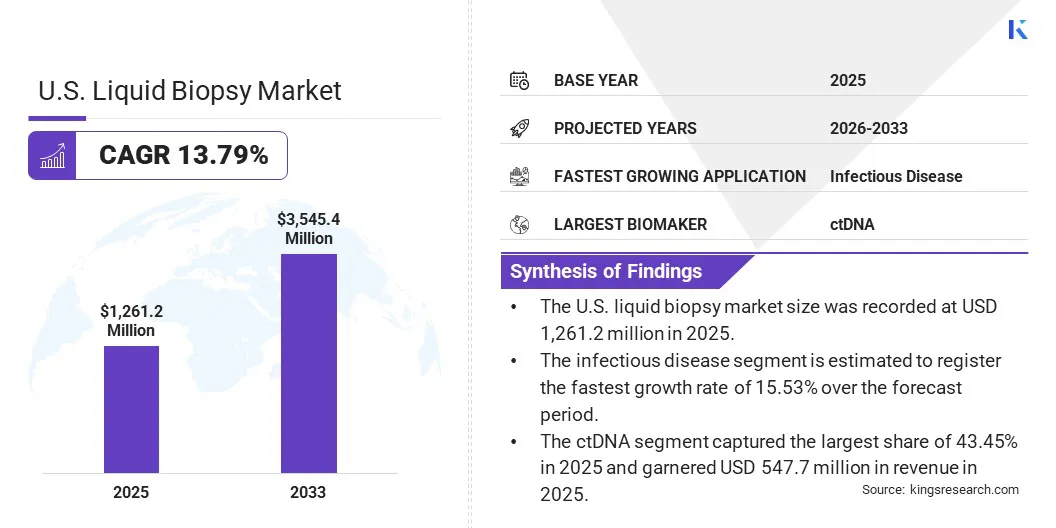
Cancer is the second-leading cause of casualties in the U.S., with more than 1.8 million new cancer diagnoses and more than 0.6 million deaths annually. Conventional tissue biopsies require invasive procedures, such as surgery or needle extraction, posing risks of complications, particularly for tumors in hard-to-reach areas. Liquid biopsy offers a non-invasive method, involving the analysis of body fluids, typically blood, to detect tumor-derived biomarkers. This approach enables healthcare professionals to detect cancer, guide therapy selection, and monitor treatment response over time. Furthermore, the expanding applications of liquid biopsy align with precision oncology objectives, supporting targeted research through tumor DNA analysis. This facilitates data-driven therapy selection, continuous monitoring, and advancements in oncology research.
Liquid biopsy is a nascent technology, limiting its widespread integration into standard clinical practice. The procedure may miss critical genetic alterations in early disease states owing to low concentrations of circulating tumor DNA (ctDNA). This can delay diagnosis and the timely administration of life-saving therapeutics. Additionally, high costs, limited insurance coverage, and unclear reimbursement pathways restrict adoption. Liquid biopsy tests require rapid sample transport, specialized processing, and advanced sequencing infrastructure, which are generally unavailable in community or under-resourced settings, thereby limiting availability. Moreover, limited clinician familiarity, along with patient and regulatory hesitation, further slows adoption. To address this challenge, market players are focusing on developing advanced liquid biopsy technologies that enhance sensitivity, improve diagnostic accuracy, and enable earlier cancer detection.
AI is broadening the scope of liquid biopsy by improving diagnostic performance and enabling rapid analysis of hundreds of proteomic signatures of cancer-related circulating proteins and nucleic acids. Its adoption supports the interpretation of complex, multi-parametric, and non-homogeneous oncology datasets, generating predictive signatures for clinical decision-making. The process utilizes machine learning models to analyze circulating tumor DNA (ctDNA) from blood-based DNA sequencing data, enhancing signal-to-noise ratios and enabling earlier detection of cancer recurrence compared to conventional clinical methods.
The integration of AI algorithms and deep learning models to leverage high-dimensional fragmentomic features is improving cancer detection accuracy and enabling analysis of fragment size profiles for early tumor microenvironment identification, emerging as a key market trend. In January 2026, researchers at Memorial Sloan Kettering Cancer Center, New York, developed an AI-powered liquid biopsy that integrates carbon nanotube nanosensors with machine learning, achieving 98% accuracy in detecting and classifying brain tumors from blood samples.
|
Segmentation |
Details |
|
By Biomarker |
ctDNA, CTC, cfDNA (non-tumor), Extracellular Vesicles & Exosomes, Others |
|
By Technology Platform |
NGS, PCR Based (PCR, qPCR, digital PCR), Microarray, Others |
|
By Product Type |
Kits & Reagents (Consumables), Instruments, Software & Services |
|
By Application |
Oncology (Lung Cancer, Breast Cancer, Colorectal Cancer, Prostate Cancer, Others), Infectious Disease, Reproductive Health, Others |
|
By End User |
Hospitals, Diagnostic & Clinical Laboratories, Reference Laboratories, Others |
|
By Country |
U.S. |
The presence of a well-established healthcare ecosystem in the U.S., comprising research laboratories and medical facilities, along with per capita healthcare spending that is nearly twice the global average, presents significant growth opportunities for the adoption of liquid biopsy solutions. Cancer screening plays a vital role in reducing mortality by enabling early detection of tumors before metastasis and facilitating the removal of precancerous lesions. Early detection further enables timely and less intensive treatment interventions, improving the likelihood of cure and survival rates. According to the U.S. National Institutes of Health (NIH), nearly 4.75 million deaths have been prevented through screening over the last 45 years, supporting the adoption of non-invasive cancer detection methods in the country.
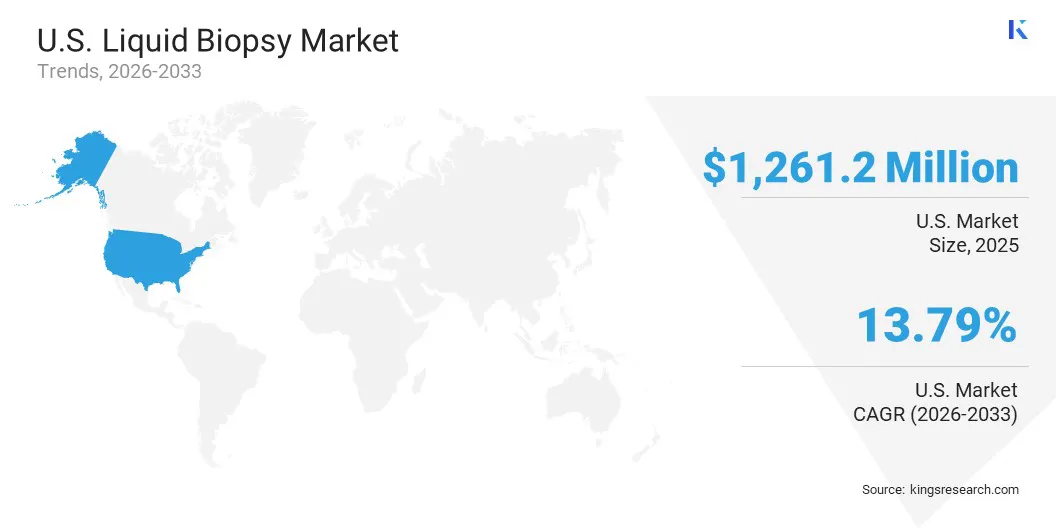
Moreover, according to the American Cancer Society (ACS), approximately 2.1 million new cancer cases are anticipated to be diagnosed in the U.S. in 2026, with deaths projected to reach nearly 626,000. Key risk factors, including excessive UV exposure and behavioral factors such as tobacco use, high body mass index, physical inactivity, and poor dietary habits, continue to drive cancer incidence and mortality. This drives the demand for early diagnosis and treatment approaches, creating growth opportunities for liquid biopsy technologies.
The U.S. liquid biopsy market has rapidly transitioned from a niche concept to a mainstream clinical tool in diagnostics. Market growth is driven by evolving federal policies aimed at improving patient outcomes and reducing cancer mortality through accurate detection of ctDNA and biomarkers. This advancement enables companies to evaluate safety, efficacy and monitor emerging therapeutics, supporting disease diagnosis and market expansion.
Companies are prioritizing strategic acquisitions and technical collaborations to strengthen their market presence across the U.S. Additionally, investments from government agencies, including those from the National Institutes of Health (NIH) and the U.S. Department of Health and Human Services, aimed at combating cancer research and treatment are creating new growth opportunities for market development.
Frequently Asked Questions

Faizy brings over four years of experience in market research and consulting, with a proven ability to support strategic engagements across diverse industries and business environments. His work focuses on understanding complex market structures, identifying emerging opportunities, and translating research findings into clear, commercially relevant insights. With strong analytical capabilities and a structured approach to problem-solving, he evaluates industry trends, competitive landscapes, customer dynamics, and evolving business models. His expertise encompasses market research, competitive intelligence, market sizing and forecasting, industry assessment, company benchmarking, and strategic analysis. Faizy combines technical proficiency with a strong research orientation, enabling him to interpret both qualitative and quantitative information effectively. He has contributed to projects that help organizations assess growth potential, strengthen market positioning, and evaluate strategic priorities. His adaptable approach allows him to work across sectors while maintaining a consistent focus on accuracy, relevance, and delivering insights that support informed decision-making for clients and stakeholders.
With many years of consulting experience across global pharma, biotech, and MedTech markets, Minaz brings deep domain expertise, strategic clarity, and analytical rigor to every engagement. She has led 130+ consulting assignments spanning market entry, competitive landscaping, and portfolio prioritization, helping clients navigate complex, high-stakes decisions with confidence. Known for her ability to synthesize primary and secondary research into executive-ready recommendations, Minaz has built forecasting models and market sizing frameworks that have informed multi-million dollar investment decisions in oncology, diagnostics, and peptide therapeutics. Beyond her analytical strength, Minaz is a trusted client partner, translating complex datasets into clear, actionable insights for senior stakeholders. She currently leads a team of research analysts, driving business expansion, and shaping client engagement strategy.