
Inquire Now
Key Strategic Points
The organ-on-a-chip (OOC) market comprises micro-engineered cell culture platforms that replicate the structural, mechanical, and biochemical environment of human organs using living cells. These systems provide a more physiologically relevant alternative to conventional 2D cell cultures and animal models for studying human biology. The market ecosystem includes the consumption of individual OOC chips, instruments, consumables, accessories, and software supporting applications in drug discovery, disease modeling, toxicity testing, and personalized medicine.
The U.S. organ-on-a-chip market was valued at USD 172.9 million in 2025 and is estimated to grow from USD 215.37 million in 2026 to USD 869.1 million by 2033, registering a CAGR of 24.34% over the forecast period (2026-2033). The growing demand for accurate human-relevant alternatives to traditional animal testing is creating significant growth avenues. The ability of OOCs to leverage microfluidics to simulate human organ functions, thereby reducing drug development costs and lowering clinical trial failure rates, is boosting market development.
Major companies operating in the market, including AlveoliX AG, Axion BioSystems, Inc., BioIVT, CN Bio Innovations Ltd., Emulate Inc., InSphero, Mimetas B.V., and Quris Technologies LTD., are forming strategic partnerships with technology providers and investment companies to expand their market reach.
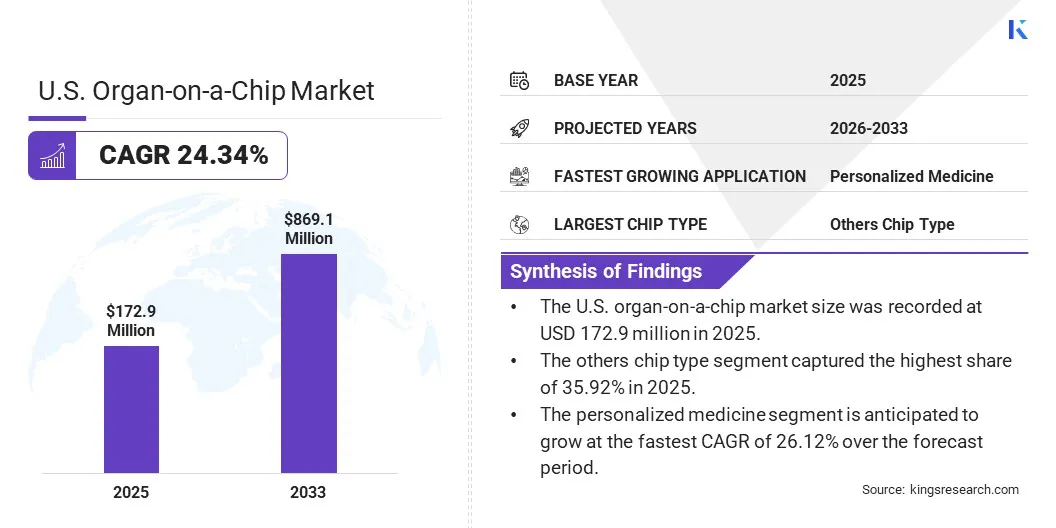
The inability of animal models to accurately replicate human physiology at molecular and cellular levels boosts the adoption of OOCs in drug discovery and pharmaceutical research. Animal models often fail to reliably predict human health and exhibit poor safety and efficacy in human trials, which restricts their effectiveness in drug discovery and pharmaceutical research.
Compounds that appear safe in animals may cause adverse effects in humans owing to differences in metabolism, immune responses, receptor biology, and tissue susceptibility. For instance, the antiviral compound Fialuridine (FIAU), despite passing animal testing, caused fatal hepatic failure and lactic acidosis in human trials. Conversely, potentially effective drugs may be rejected due to species-specific toxicity, as seen with penicillin, which is life-saving in humans but toxic to guinea pigs.
The limitations increase the demand for preclinical testing platforms such as OOCs, which replicate human tissue structure and function, enabling physiologically relevant data generation and reducing late-stage clinical failures.
The relatively short culture lifespan of the organ-on-a-chip technology stems from the tendency of cultured organ cells to lose physiological characteristics, resulting in reduced reliability and reproducibility of experimental outcomes. OOCs maintain viable, functional tissue models for only days to weeks, whereas many biological processes, disease progressions, and drug development studies require long-term observation spanning months or years. This limitation restricts the ability of OOCs to model chronic diseases, assess long-term drug toxicity, and study extended developmental processes.
Additionally, the cellular system in the OOC recapitulates the interaction of cells/tissue with blood and circulating substances, which mandates a reliable fluidic circuit that ensures stable fluid flow. The process results in the formation of bubbles in the microfluidic channels, adversely affecting culture conditions and leading to variability in cell population densities.
To address the challenge, market players are adopting strategies to extend culture longevity in order to enable the study of slow-developing diseases such as neurodegeneration, fibrosis, and cancer metastasis, which remain difficult to assess using short-term models.
Body-on-a-chip (BOC) platforms are developed by integrating multiple organ-on-chip (OOC) systems to recapitulate interactions between different tissues. BOCs represent miniature human body systems, typically comprising two or more interconnected multi-organ chip platforms. This enables the replication of key aspects of human physiology and the simulation of interactions between administered drugs and multiple organs. The critical role of tissue-to-tissue crosstalk in disease initiation and progression is further driving the development of BOC platforms that incorporate a recirculating shared medium.
BOCs integrate multiple organ units, including gut (absorption), liver (metabolism), and kidney (elimination), within a single chip, enabling coordinated communication among organ components while allowing each organ model to retain its physiological identity and function. This enhances the replication of systemic human physiology, including inter-organ interactions, drug metabolism, and disease progression, thereby improving the prediction of drug efficacy and toxicity compared to standalone organ models.
|
Segmentation |
Details |
|
By Chip Type |
Liver-on-a-Chip, Heart-on-a-Chip, Kidney-on-a-Chip, Lungs-on-a-Chip, Others |
|
By Type |
Product, Services |
|
By Product |
Instrument, Consumables and Accessories, Software |
|
By Application |
Personalized Medicine, Drug Discovery, Disease Modelling, Toxicity Testing, Others |
|
By End User |
Pharmaceutical and Biotechnology Companies, Contract Research Organizations, Academic and Research Institutes, Cosmetics and Personal Care Industry, Others |
|
By Country |
U.S. |
The U.S. remains a global leader in drug innovation and clinical research. The rise in demand for novel therapies, precision medicine, personalized healthcare, toxicology research, and advanced biotech innovations is driving the healthcare sector. Major drivers of the OOC market in the U.S. include strong R&D investment, expanding biotechnology innovation, and rising demand for advanced therapies. A robust healthcare infrastructure, diverse patient pool, and experienced research workforce boost trial efficiency, thus accelerating regional market expansion.
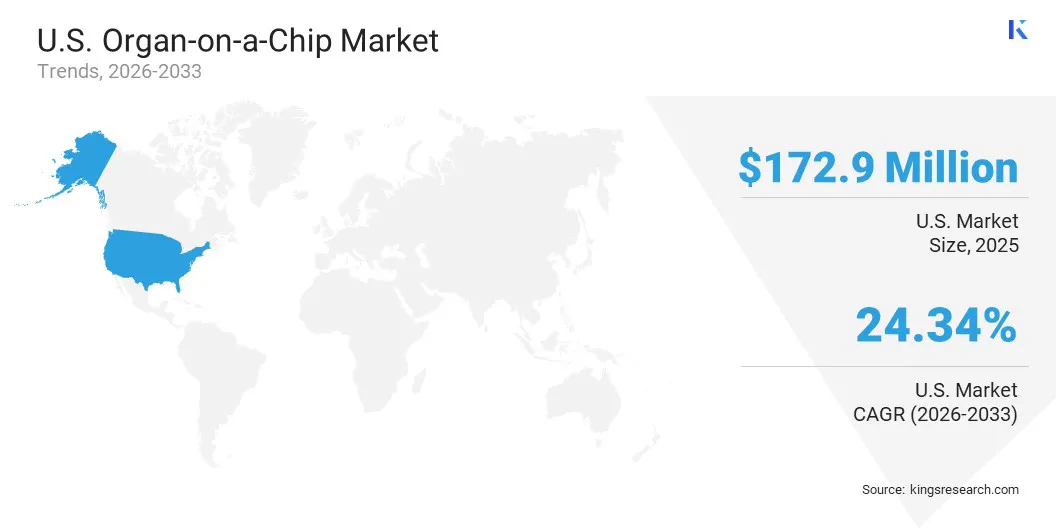
Moreover, a supportive regulatory landscape that restricts conventional animal testing and facilitates the adoption of New Approach Methodologies (NAMs) is propelling OOCs adoption. Additionally, strategic government-led initiatives supporting the use of organ-on-a-chip technology in advanced biomedical and space health research are accelerating innovation and expanding commercial potential.
Companies operating in the U.S. organ-on-a-chip market are expanding operations through strategic partnerships and securing funding from venture capital and government agencies, including the U.S. National Institutes of Health (NIH) and the U.S. Department of Defense, driven by regulations supporting the phased reduction of animal testing. Companies with strong financial positions, established partnerships, and validated OOC products are anticipated to achieve steady growth in the competitive market.
Frequently Asked Questions

Faizy brings over four years of experience in market research and consulting, with a proven ability to support strategic engagements across diverse industries and business environments. His work focuses on understanding complex market structures, identifying emerging opportunities, and translating research findings into clear, commercially relevant insights. With strong analytical capabilities and a structured approach to problem-solving, he evaluates industry trends, competitive landscapes, customer dynamics, and evolving business models. His expertise encompasses market research, competitive intelligence, market sizing and forecasting, industry assessment, company benchmarking, and strategic analysis. Faizy combines technical proficiency with a strong research orientation, enabling him to interpret both qualitative and quantitative information effectively. He has contributed to projects that help organizations assess growth potential, strengthen market positioning, and evaluate strategic priorities. His adaptable approach allows him to work across sectors while maintaining a consistent focus on accuracy, relevance, and delivering insights that support informed decision-making for clients and stakeholders.
With many years of consulting experience across global pharma, biotech, and MedTech markets, Minaz brings deep domain expertise, strategic clarity, and analytical rigor to every engagement. She has led 130+ consulting assignments spanning market entry, competitive landscaping, and portfolio prioritization, helping clients navigate complex, high-stakes decisions with confidence. Known for her ability to synthesize primary and secondary research into executive-ready recommendations, Minaz has built forecasting models and market sizing frameworks that have informed multi-million dollar investment decisions in oncology, diagnostics, and peptide therapeutics. Beyond her analytical strength, Minaz is a trusted client partner, translating complex datasets into clear, actionable insights for senior stakeholders. She currently leads a team of research analysts, driving business expansion, and shaping client engagement strategy.