
Inquire Now
Key Strategic Points
The GLP-1 receptor agonist market includes the research, development, production, and commercialization of glucagon-like peptide-1 (GLP-1) receptor agonist drugs. These medications are primarily used to manage type 2 diabetes and, increasingly, obesity, due to their ability to improve blood glucose control and support weight loss. The market includes pharmaceutical manufacturers, healthcare providers, regulatory bodies, and end users involved across the value chain, from development to patient administration.
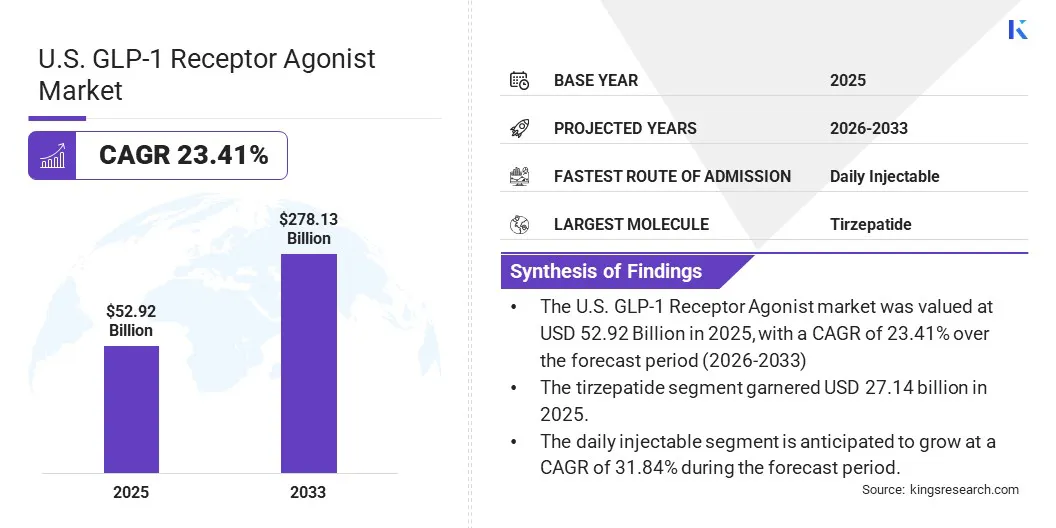
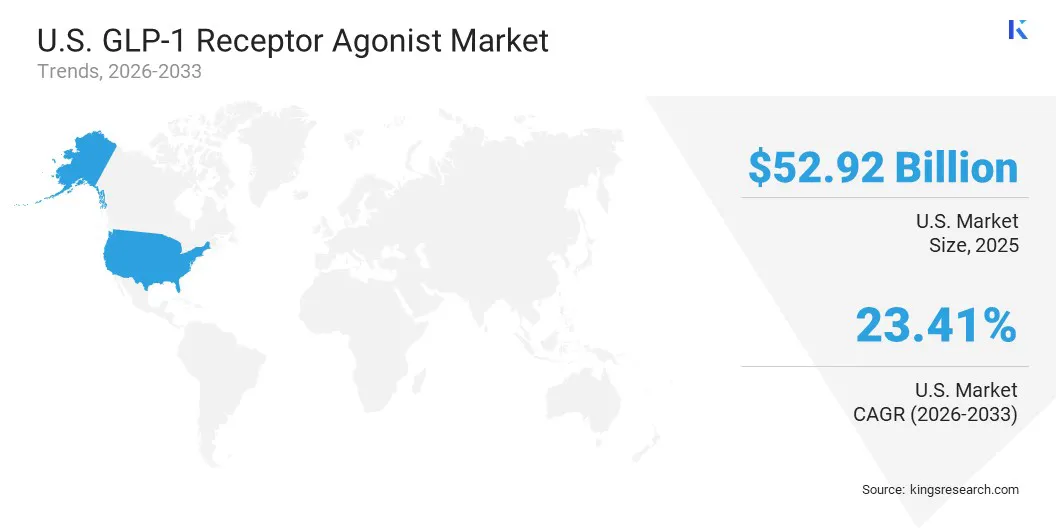
The U.S. GLP-1 receptor agonist market size was valued at USD 52.92 billion in 2025 and is projected to reach USD 278.13 billion by 2033, exhibiting a CAGR of 23.41% during the forecast period. This trajectory is supported by rising obesity and type 2 diabetes prevalence nationwide, expanding clinical indications spanning cardiovascular and renal outcomes, and the accelerating shift toward oral, needle-free formulations that broaden patient accessibility.
Major companies operating in the U.S. GLP-1 receptor agonist industry include Novo Nordisk A/S, Eli Lilly and Company, Amneal Pharmaceuticals LLC, Sanofi, Hikma Pharmaceuticals PLC, Teva Pharmaceutical Industries Ltd, Pfizer Inc., Viking Therapeutics, Structure Therapeutics, Inc., Altimmune, Sandoz Group AG, and Biocon.
Strengthening reimbursement pathways, including emerging Medicare coverage initiatives, are easing affordability constraints that previously limited adoption. These factors are positioning GLP-1 therapies as a key component of chronic disease management across the U.S. healthcare system.
More than 40 million Americans currently live with diagnosed or undiagnosed diabetes, representing nearly 12% of the population, with type 2 diabetes accounting for the majority, according to the CDC's National Diabetes Statistics Report. A substantial undiagnosed population, estimated at 27.6% of adults with diabetes, represents a latent patient pool expected to require treatment as screening and diagnosis rates improve nationwide.
GLP-1 receptor agonists have emerged as a preferred second-line therapy for glycemic control, mainly due to dual clinical benefits of blood sugar regulation and weight reduction. This efficacy profile has positioned the drug class as a key component of modern type 2 diabetes management protocols across U.S. primary care and endocrinology practices.
Navigating the clinical trial and regulatory approval process presents a major challenge impeding market expansion. Bringing new therapies to market requires companies to conduct extensive, time-consuming, and expensive studies to demonstrate long-term safety and efficacy, particularly as these drugs expand into indications such as obesity and cardiovascular risk reduction. Regulatory agencies such as the FDA require rigorous clinical evidence, robust manufacturing controls, and ongoing post-marketing surveillance, increasing development complexity and cost.
These hurdles delay patient access and slow market innovation. To address this challenge, companies are using adaptive clinical trial designs and digital health tools to speed up data collection and analysis. They are also collaborating with regulatory agencies early in the development process to clarify requirements and streamline approval pathways.
The FDA's approval of the first oral GLP-1 tablet for chronic weight management marks a structural shift from injection-based delivery in the U.S. market. Clinical trial data indicated an average weight loss of nearly 17% among fully adherent patients, comparable to injectable formulations. Novo Nordisk launched the oral tablet for weight loss in adults in January 2026, with domestic manufacturing to support supply stability.
As manufacturers progress additional oral pipeline candidates, competition between injectable and oral GLP-1 products is expected to intensify. Oral formulations attract needle-averse patients and enable distribution through standard retail pharmacy infrastructure, positioning this as a key near-term trend influencing U.S. market growth.
|
Segmentation |
Details |
|
By Molecule |
Liraglutide, Dulaglutide, Semaglutide, Tirzepatide, and Others |
|
By Route of Administration |
Daily Injectable, Weekly Injectable, and Oral Small-Molecule |
|
By Indication |
Type-2 Diabetes, Obesity/Weight Management, and Other Emerging Indications |
|
By Region |
U.S. |
The U.S. GLP-1 receptor agonist market is undergoing a structural shift from a diabetes-centric category to one increasingly driven by weight management, with obesity-focused prescribing volumes now matching and, in some segments, surpassing traditional diabetes use. The patient base is also expanding beyond adults, with clinical use increasing in adolescent obesity management following expanded pediatric guidance.
Distribution patterns are evolving, moving away from specialty pharmacy-only access to broader integration across retail and mail-order channels, supported by the growing adoption of oral formulations. Employers and health systems are increasingly incorporating GLP-1 therapies into workplace wellness and preventive health programs, reflecting a broader cultural normalization of pharmacological weight management. Collectively, these developments signal a market progressing beyond its initial therapeutic niche into a mainstream chronic disease management category.
The U.S. GLP-1 receptor agonist market remains highly concentrated, with few manufacturers controlling the majority of the branded supply through semaglutide and tirzepatide-based product lines. Competitive intensity is increasingly focused on oral formulation development, as multiple manufacturers advance pill-based candidates following the approval of the first oral GLP-1 tablet for weight management.
Leading players continue to expand domestic manufacturing capacity to strengthen supply capabilities and are pursuing patent extension strategies to delay generic and biosimilar entry. Emerging competitive pressure is also building from smaller biotechnology firms developing next-generation dual and triple agonist molecules, positioning the market for intensified competition as new mechanisms of action and delivery formats advance through late-stage clinical development in the coming years.
Frequently Asked Questions

Aswathi holds cross-domain expertise, translating market trends and competitive intelligence into decision-ready insights. Her work helps clients interpret evolving market conditions and identify growth opportunities. She brings a focused, insight-led approach to research execution. She translates these findings into clear, prioritized action plans that align with client capabilities. Her research often includes scenario modeling to test growth strategies under varying economic conditions. She maintains a rigorous validation process, cross-checking primary and secondary sources to ensure reliability. Clients value her ability to synthesize noisy data into concise executive summaries that drive board-level discussions. Her sector-specific lens, combined with a pragmatic focus on execution, consistently delivers high-impact, commercially sound recommendations. Her structured yet flexible research frameworks adapt to client timelines without compromising depth. She is known for distilling complex trade-offs into straightforward, defensible positions that facilitate confident decision-making.
With many years of consulting experience across global pharma, biotech, and MedTech markets, Minaz brings deep domain expertise, strategic clarity, and analytical rigor to every engagement. She has led 130+ consulting assignments spanning market entry, competitive landscaping, and portfolio prioritization, helping clients navigate complex, high-stakes decisions with confidence. Known for her ability to synthesize primary and secondary research into executive-ready recommendations, Minaz has built forecasting models and market sizing frameworks that have informed multi-million dollar investment decisions in oncology, diagnostics, and peptide therapeutics. Beyond her analytical strength, Minaz is a trusted client partner, translating complex datasets into clear, actionable insights for senior stakeholders. She currently leads a team of research analysts, driving business expansion, and shaping client engagement strategy.