
Inquire Now
Key Strategic Points
The medtech market refers to the industry focused on the development, manufacturing, and distribution of medical technologies, devices, and equipment. These solutions are essential for diagnosing, monitoring, treating, and managing health conditions and include technology-assisted tools such as imaging systems, surgical tools, implantable devices, monitoring equipment, and digital health platforms.
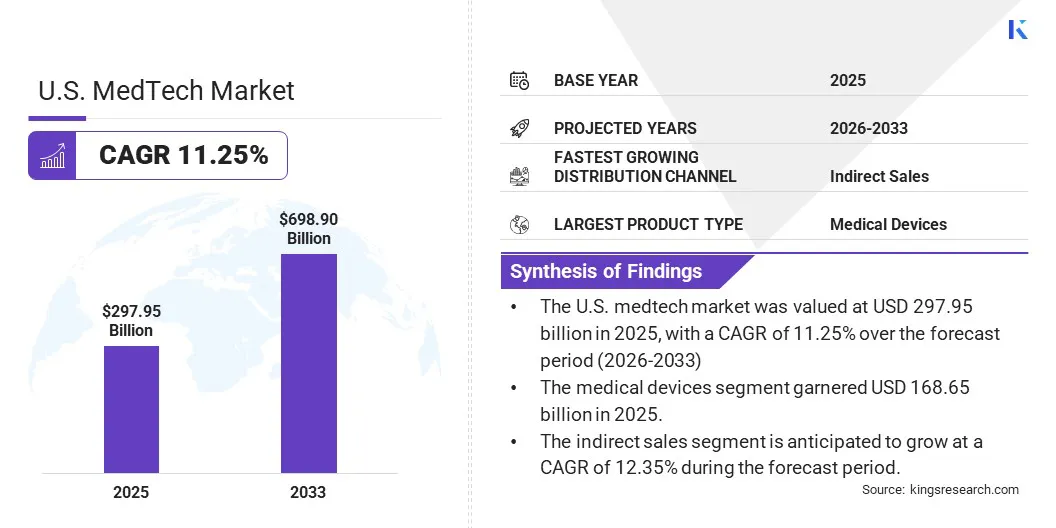
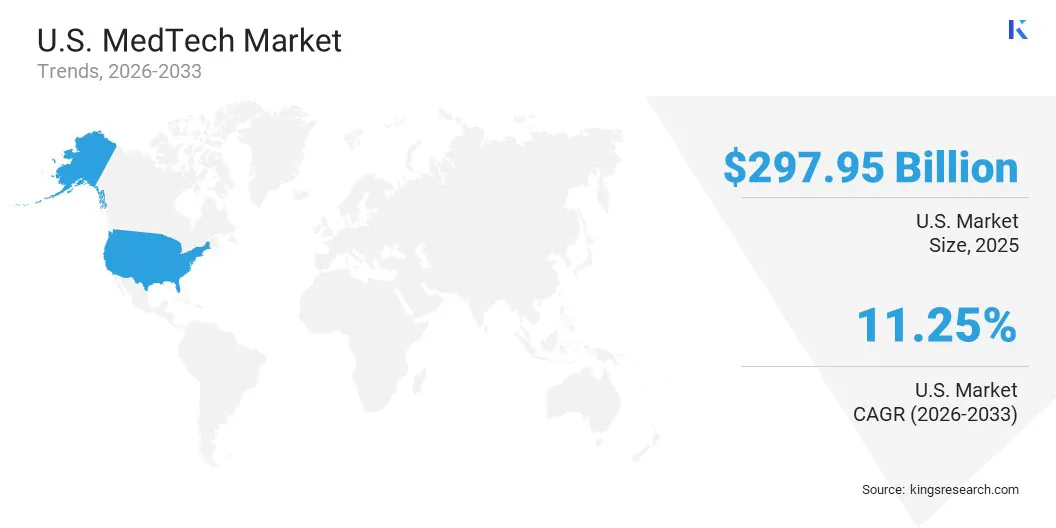
The U.S. medtech industry size was valued at USD 297.95 billion in 2025 and is projected to reach USD 698.90 billion by 2033, exhibiting a CAGR of 11.25% during the forecast period. This growth is fueled by rising demand for advanced diagnostic tools, minimally invasive procedures, and digital health solutions.
Major companies operating in the U.S. medtech market are Medtronic, Johnson & Johnson, Abbott, Stryker, Becton, Dickinson and Company (BD), GE HealthCare, Boston Scientific Corporation, Baxter, Alcon Inc., Thermo Fisher Scientific Inc., Solventum, Zimmer Biomet, Edwards Lifesciences Corporation, STERIS, and Resmed.
Increasing prevalence of chronic diseases and an aging population continue to drive innovation and adoption of new technologies. Additionally, strong investments in research and development and favorable regulatory frameworks support sustained market expansion.
The growing prevalence of chronic diseases, such as diabetes, cardiovascular disorders, and respiratory illnesses, combined with an aging population, is a significant driver of the U.S. medtech industry. According to the U.S. Centers for Disease Control and Prevention, over 90% of adults aged 65 and older live with at least one chronic condition. As this demographic segment expands, demand for advanced diagnostic, monitoring, and treatment solutions rises.
Chronic conditions often require ongoing management and frequent medical intervention, fueling the need for innovative medical devices and technologies. This demographic shift increases pressure on healthcare systems while creating opportunities for MedTech companies to develop and supply products that enhance patient outcomes, support independent living, and reduce hospitalizations.
Digitally connected devices and healthcare solutions are prone to data theft and cyberattacks, which hinder the growth of the market. The integration of electronic health records, remote monitoring systems, and telemedicine platforms exposes sensitive patient information to potential cyber threats and data breaches. Any compromise can lead to significant financial, legal, and reputational consequences for healthcare providers and MedTech companies. To address these threats, industry players are investing in tools that provide advanced encryption, secure data storage, and rigorous access controls. These companies are also adopting proactive cybersecurity strategies and collaborating with regulatory bodies to ensure compliance and build patient trust in their technologies.
AI, robotics, and minimally invasive devices are profoundly transforming the market. These technological advancements are driving changes across diagnostics, surgery, and patient care. AI-powered diagnostic tools now enable faster and more accurate detection of diseases, while robotic-assisted surgery offers greater precision and improved patient outcomes. Minimally invasive devices are reducing recovery times and hospital stays, making treatments less disruptive for patients.
These technological innovations are transforming digital healthcare by enhancing efficiency, supporting personalized medicine, and expanding access to high-quality care. These advancements empower MedTech companies to capitalize on new opportunities, drive growth and deliver improved health outcomes across the U.S.
|
Segmentation |
Details |
|
By Product Type |
Medical Devices, Digital Health & Healthcare IT, Medical Imaging & Visualization, and Healthcare Robotics |
|
By Distribution Channel |
Direct Sales and Indirect Sales |
|
By Region |
U.S. |
The U.S. medtech industry is supported by a mature healthcare infrastructure, high healthcare expenditure, and widespread adoption of advanced technologies. As chronic conditions become more prevalent and the population ages, there is growing emphasis on early detection and less invasive treatments, reinforcing the U.S. MedTech market’s move toward advanced and connected healthcare solutions. The integration of artificial intelligence, digital health platforms, remote patient monitoring, and connected medical devices is transforming healthcare delivery and improving patient outcomes. In addition, favorable reimbursement coverage for several medical technologies and a well-defined regulatory framework continue to support the adoption of innovative devices across hospitals, ambulatory care centers, and home healthcare settings.
The U.S. medtech market is characterized by strong competition, with established manufacturers, specialized device developers, and emerging technology companies competing across multiple product segments. Market participants primarily compete based on technological innovation, product quality, clinical outcomes, pricing, and regulatory compliance. Continuous investments in research and development, product commercialization, and digital health integration remain key competitive strategies.
Companies are also focusing on portfolio expansion through strategic collaborations, licensing agreements, and mergers and acquisitions to strengthen their market position. In addition, adoption of artificial intelligence, connected medical devices, and minimally invasive technologies is accelerating product differentiation, while stringent regulatory requirements, high development costs, and lengthy approval processes continue to create barriers for new entrants.
Frequently Asked Questions

Aswathi holds cross-domain expertise, translating market trends and competitive intelligence into decision-ready insights. Her work helps clients interpret evolving market conditions and identify growth opportunities. She brings a focused, insight-led approach to research execution. She translates these findings into clear, prioritized action plans that align with client capabilities. Her research often includes scenario modeling to test growth strategies under varying economic conditions. She maintains a rigorous validation process, cross-checking primary and secondary sources to ensure reliability. Clients value her ability to synthesize noisy data into concise executive summaries that drive board-level discussions. Her sector-specific lens, combined with a pragmatic focus on execution, consistently delivers high-impact, commercially sound recommendations. Her structured yet flexible research frameworks adapt to client timelines without compromising depth. She is known for distilling complex trade-offs into straightforward, defensible positions that facilitate confident decision-making.
With many years of consulting experience across global pharma, biotech, and MedTech markets, Minaz brings deep domain expertise, strategic clarity, and analytical rigor to every engagement. She has led 130+ consulting assignments spanning market entry, competitive landscaping, and portfolio prioritization, helping clients navigate complex, high-stakes decisions with confidence. Known for her ability to synthesize primary and secondary research into executive-ready recommendations, Minaz has built forecasting models and market sizing frameworks that have informed multi-million dollar investment decisions in oncology, diagnostics, and peptide therapeutics. Beyond her analytical strength, Minaz is a trusted client partner, translating complex datasets into clear, actionable insights for senior stakeholders. She currently leads a team of research analysts, driving business expansion, and shaping client engagement strategy.