
Inquire Now
Key Strategic Points
Swarm robots are groups of robots that coordinate through local interactions to collectively perform tasks without centralized control. The market encompasses hardware platforms, software, and communication systems that enable distributed coordination across diverse applications.
It includes defense, agriculture, logistics, healthcare, and environmental monitoring, where multiple robots operate together to improve efficiency and scalability. The market further covers research and commercial deployments that focus on autonomous collaboration, adaptability, and integration with advanced sensing and computing technologies for multi-robot systems.
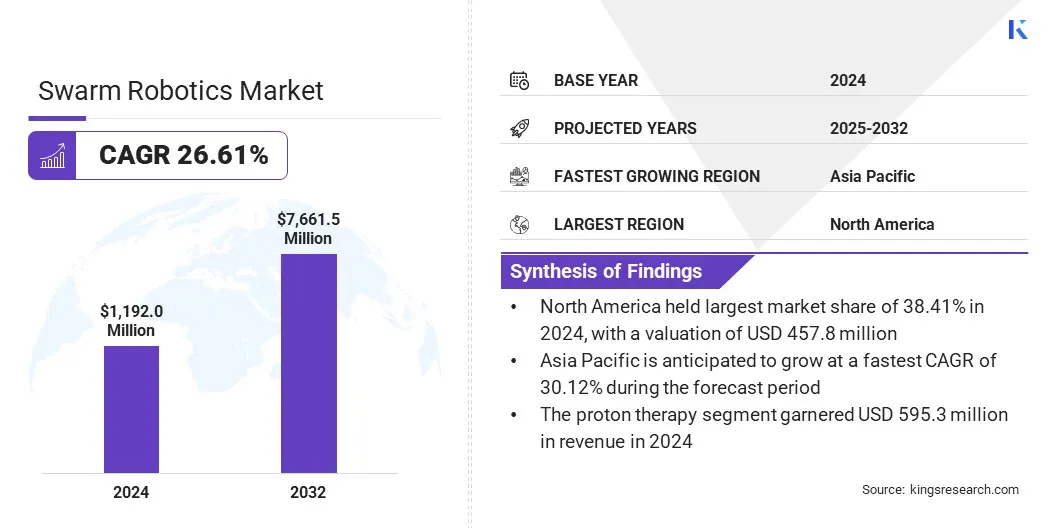
According to Kings Research, the global swarm robotics market size was valued at USD 1,192.0 million in 2024 and is projected to grow from USD 1,468.9 million in 2025 to USD 7,661.5 million by 2032, exhibiting a CAGR of 26.61% over the forecast period. The market is expanding as industries deploy autonomous multi-robot systems in defense, agriculture, logistics, and environmental monitoring.
This expansion is supported by advancements in artificial intelligence, miniaturized sensors, and cost-efficient robotic platforms. These innovations create scalable and adaptable systems with higher efficiency and wider adoption in commercial and research domains.
Major companies operating in the swarm robotics market are Swarmbotics AI, SwarmFarm, Sentien Robotics, Hydromea, Berkeley Marine Robotics Inc., FARobot, Inc., KION GROUP AG, Swarm Robotics, Unbox Robotics Pvt. Ltd., SWARM Biotactics, tmsuk co., ltd., Auterion LLC, and Swarmer.
Companies in the defense and robotics sector are securing significant investments to advance autonomous and AI-enabled systems. These investments support the development of UAV technology and drone swarms, enhancing coordination, scalability, efficiency, and real-time tactical decision-making in defense applications.
Growing Demand for Coordinated Robotic Units to Enhance Operational Capabilities
The market is growing due to the rising demand for coordinated robotic units that improve operational capabilities. Defense, logistics, agriculture, and infrastructure sectors are adopting swarms because they can complete tasks more systematically compared to individual robots.
Coordinated swarms provide wider coverage, better regulation, and higher resilience, which make them valuable in large-scale and high-risk operations. As organizations prioritize scalable and cost-effective systems for higher mission success and lower operational risks, the strengthening demand is expected to drive the swarm robotics market.
Advanced Counter-Swarm Technologies
The swarm robotics market faces a major challenge from the increasing deployment of advanced counter-swarm systems. These systems use detection, tracking, and neutralization technologies to monitor and disable multiple autonomous drones simultaneously.
This reduces the operational effectiveness of swarm robotics in defense, security, and other high-value applications, raising the risk of mission failure. To solve this, manufacturers are creating swarm AI algorithms that make robots more adaptable, agile, and better at working together.
These improved systems help drones and robots stay efficient even when facing anti-swarm defenses, so they can finish their tasks reliably in difficult or protected environments.
Rising Adoption of Interoperable Drone Systems
The market is witnessing the adoption of interoperable drone systems for improved coordination across multiple platforms. Companies are integrating artificial intelligence and computer vision to enable autonomous decision-making and accurate execution of complex, multi-target missions.
This approach has enhanced performance and minimized human involvement while supporting large-scale deployment of coordinated robotic units.
Continuous improvements in AI algorithms, sensor technology, and communication frameworks are facilitating scalable, intelligent swarms, capable of real-time task allocation and adaptive responses in dynamic environments. These trends are fueling the market in terms of technological capabilities and competitive positioning.
|
Segmentation |
Details |
|
By Platform |
Unmanned Ground Vehicles (UGV), Unmanned Aerial Vehicles (UAV), Others |
|
By Application |
Inspection & Monitoring, Supply Chain and Warehouse Management, Mapping & Surveying, Security, Search & Rescue, Others |
|
By End Use Industry |
Military & Defense, Retail, Automotive, Healthcare, Agriculture, Others |
|
By Region |
North America: U.S., Canada, Mexico |
|
Europe: France, UK, Spain, Germany, Italy, Russia, Rest of Europe |
|
|
Asia-Pacific: China, Japan, India, Australia, ASEAN, South Korea, Rest of Asia-Pacific |
|
|
Middle East & Africa: Turkey, U.A.E., Saudi Arabia, South Africa, Rest of Middle East & Africa |
|
|
South America: Brazil, Argentina, Rest of South America |
Based on region, the swarm robotics market has been classified into North America, Europe, Asia Pacific, Middle East & Africa, and South America. North America accounted for a substantial market share of 38.41% in 2024, with a valuation of USD 457.8 million in the global market.
This share is supported by a strong military presence and continuous investments in advanced defense technologies. The U.S. and other countries are focusing on unmanned systems and multi-robot coordination to improve their performance, surveillance, and tactical capabilities.
Rising demand for autonomous drone swarming in defense, security, and emergency response is driving market adoption. Government funding, research initiatives, and collaborations between defense contractors and robotics companies are accelerating the development and deployment of swarm robotics solutions.
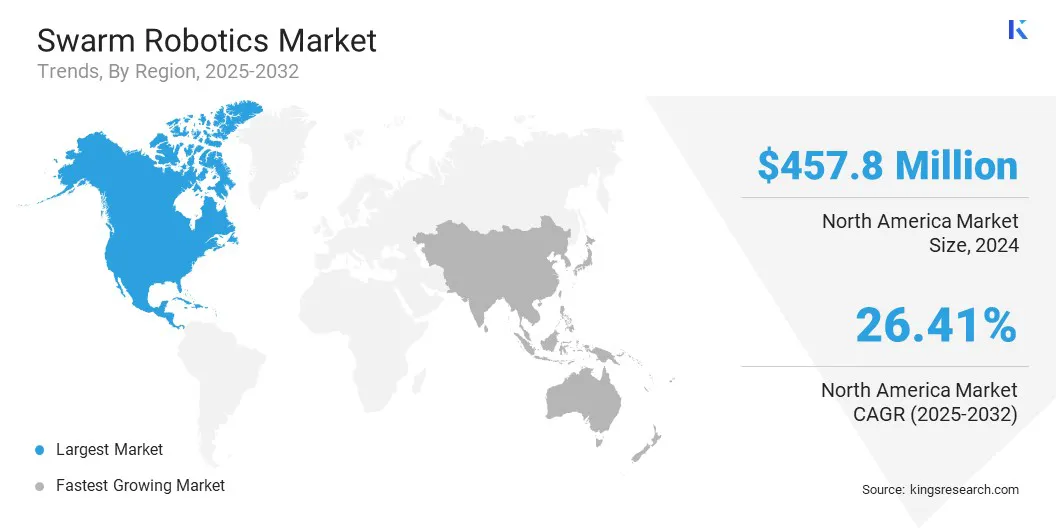
The swarm robotics industry in Asia Pacific is expected to register the fastest growth at a projected CAGR of 30.12% over the forecast period. This growth is supported by the region’s expanding industrial base and high labor demand across construction, manufacturing, and logistics sectors.
Rapid urbanization and large-scale infrastructure projects increase the need for efficient and precise operations. The presence of numerous manufacturing plants further intensifies demand for scalable automation.
Swarm robotics enhances productivity, ensures accuracy, and accelerates project timelines in labor-intensive sectors. Government support and strategic investments in robotics are also promoting the adoption of multi-robot systems in Asia-Pacific.
Key players in the swarm robotics market are strengthening their positions by investing in technological advancements. Companies are increasing investments in research and product development to enhance autonomous coordination, improve multi-robot collaboration, and expand applications across industrial, defense, and intralogistics operations.
Companies are forming strategic partnerships with robotics and AI solution providers to integrate advanced systems, helping market leaders maintain a competitive edge and drive innovation in next-generation swarm robotics.
Frequently Asked Questions

Over the years, Versha brings over 15 years of experience managing consulting assignments across industries, including Food and Beverage, Consumer Goods, ICT, Aerospace, and more. Her work has spanned diverse sectors. Her cross-domain expertise and adaptability make her a versatile and dependable professional. She is known for her keen business insight and foresight. With sharp analytical skills and a curious mindset, Versha excels at transforming complex data into actionable insights. She has a proven track record of unraveling market dynamics, identifying trends, and delivering tailored solutions to meet client needs. As a skilled leader, Versha has successfully mentored research teams and directed projects with precision, ensuring high-quality outcomes. Her collaborative approach and strategic vision enable her to turn challenges into opportunities and consistently deliver impactful results. Whether analyzing markets, engaging stakeholders, or crafting strategies, Versha draws on her deep expertise and industry knowledge to drive innovation and deliver measurable value.

Ganapathy Subramaniam Suresh
With over a decade of research leadership across global markets, Ganapathy brings sharp judgment, strategic clarity, and deep industry expertise. Known for precision and an unwavering commitment to quality, he guides teams and clients with insights that consistently drive impactful business outcomes.



.webp&w=128&q=75&dpl=dpl_DPva2LrvfsBdTJm1XZj67UTrvMHL)