
Inquire Now
Key Strategic Points
The polyoxymethylene (POM) market focuses on the production, distribution, and utilization of polyoxymethylene, also known as acetal or polyacetal. POM is an engineering thermoplastic with high stiffness, low friction, and excellent dimensional stability, suitable for precision parts in automotive, electronics, consumer goods, and industrial applications. This market includes manufacturers, suppliers, and end-users, and it is fueled by the need for durable plastic components and the development of new materials across various industries.
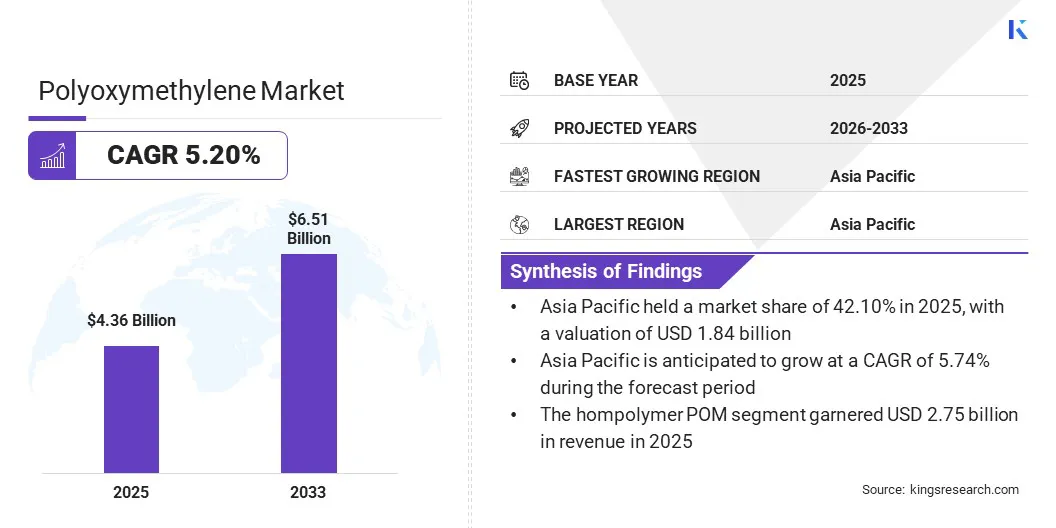
The global polyoxymethylene market size was valued at USD 4.36 billion in 2025 and is projected to grow from USD 4.57 billion in 2026 to USD 6.51 billion by 2033, exhibiting a CAGR of 5.20% during the forecast period. This growth is mainly attributed to the expanding application of polyoxymethylene in the automotive, electronics, and industrial sectors for high-performance applications, where producers are looking for materials with better mechanical properties, durability, and dimensional stability.
Major companies operating in the global polyoxymethylene industry are Celanese Corporation, Delrin USA, LLC., KEP, Mitsubishi Chemical Group of companies, BASF, Asahi Kasei Corporation, SABIC, Ensinger, Tangshan Zhonghao Chemical Co., Ltd, KOLON Corp, Röchling, Poly Fluoro Ltd., Westlake Plastics, LG Chem, and Kingfa Science & Technology (India) Limited.
Additionally, advancements in sustainable and specialty POM grades are encouraging broader adoption, particularly in industries focused on regulatory compliance and environmental responsibility. Key market players are actively investing in research and development to innovate new POM formulations with enhanced properties. They are also expanding their operations around the world through strategic partnerships and capacity expansion. These efforts are positioning the market for sustained growth and intensifying competitiveness among industry players.
Automotive companies look for lightweight, high-performing material alternatives to traditional metal parts to help cut weight, boost fuel efficiency, and increase design options. The excellent mechanical strength, dimensional stability, and wear and chemical resistance of polyoxymethylene make it highly valued in this sector.
It is widely applied in the manufacturing of high-precision parts like fuel system parts, gears, door handles, and seatbelt mechanisms. The market is projected to grow owing to the increasing demand for materials such as POM, which are reliable, lightweight, and durable, particularly with the development of electric vehicles and smart technology in the automotive industry.
POM manufacturing is highly dependent on petrochemical derivatives such as trioxane and formaldehyde, which are affected by the global oil and natural gas markets, leading to price fluctuations. These fluctuations can result in unpredictable manufacturing costs that can affect manufacturer profitability and result in higher prices for consumers. In addition, the prices of raw materials are also affected by economic uncertainties, geopolitical tensions, and changes in supply and demand. Such fluctuations make it difficult for manufacturers to plan production over the long term and can also restrict investment in expanding production capacity.
To address raw material price volatility, companies are increasingly entering into long-term supply contracts and diversifying sourcing to guarantee access to important raw materials. Furthermore, there is growing awareness among some manufacturers to optimize processes being used and invest in research on alternative raw materials, reducing dependence on traditional petrochemical sources.
The shift toward sustainable solutions is becoming a prominent market trend as industries and consumers increasingly prioritize environmental responsibility. Manufacturers are investing in the development of bio-based and recyclable POM to reduce their carbon footprint and address stricter environmental regulations. These eco-friendly alternatives offer similar performance characteristics to traditional POM, making them suitable for a wide range of applications without compromising quality.
Additionally, companies are adopting greener production processes and focusing on circular economy initiatives to further minimize waste and resource consumption. This trend helps companies meet evolving regulatory requirements while appealing to environmentally conscious customers, which supports long-term market growth and enhances brand reputation.
|
Segmentation |
Details |
|
By Type |
Homopolymer POM and Copolymer POM |
|
By Grade |
High-Impact, Food Grade, Reinforced, and Others |
|
By End Use Industry |
Automotive, Aerospace, Consumer Goods, Electrical & Electronics, Healthcare, Industrial, and Others |
|
By Region |
North America: U.S., Canada, Mexico |
|
Europe: France, UK, Spain, Germany, Italy, Russia, Rest of Europe |
|
|
Asia-Pacific: China, Japan, India, Australia, ASEAN, South Korea, Rest of Asia-Pacific |
|
|
Middle East & Africa: Turkey, U.A.E., Saudi Arabia, South Africa, Rest of Middle East & Africa |
|
|
South America: Brazil, Argentina, Rest of South America |
Based on region, the global polyoxymethylene market has been classified into North America, Europe, Asia Pacific, Middle East & Africa, and South America.
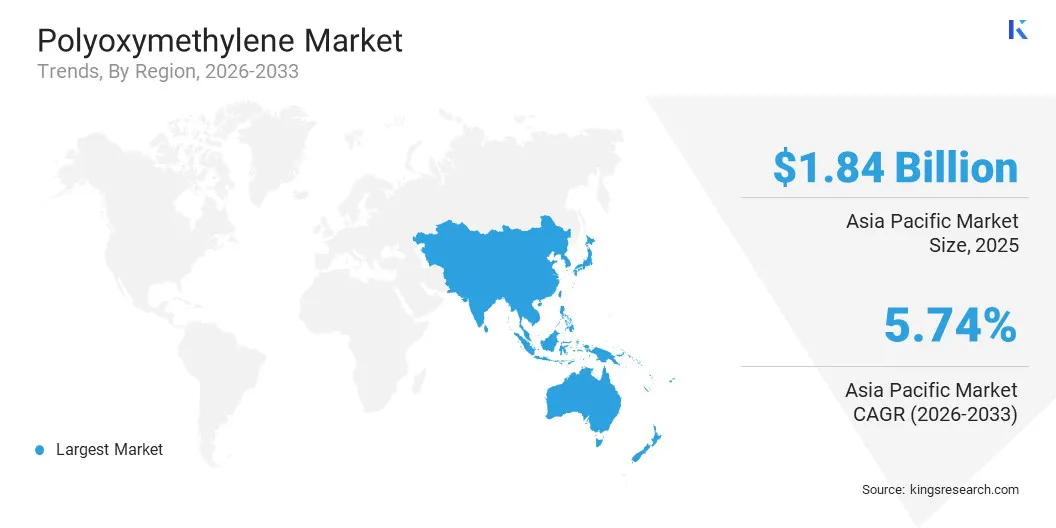
Asia Pacific polyoxymethylene market share stood at 42.10% in 2025, valued at USD 1.84 billion. This dominant position reflects the region’s strong industrial base and rapidly expanding end-use sectors such as automotive, electronics, and consumer goods. This growth is further supported by increasing urbanization, rising disposable incomes, and the ongoing shift of manufacturing activities to countries with competitive production costs.
Local manufacturers are developing advanced technologies and products to address various industry requirements, while trade policies and infrastructure improvements enable efficient distribution. The regional market further benefits from a large and growing workforce, which supports high production capacities. With these advantages, Asia Pacific is poised to remain a major hub for polyoxymethylene demand and production in the foreseeable future.
The North America polyoxymethylene market is set to grow at a CAGR of 5.30% over the forecast period. This growth is fueled by continuous improvements in precision engineering techniques, the use of lightweight materials in the transportation industry, and the need for high-strength components in medical and healthcare applications.
An active R&D base and an innovation-centric approach are driving the development of specialty POM grades for new applications. Moreover, the region’s robust distribution network and strong focus on quality standards are further supporting the regional market growth trajectory. Cooperation between manufacturers and end users continues to boost product adoption and regional growth.
Regulatory Frameworks
The competitive landscape of the polyoxymethylene (POM) market is marked by the presence of numerous global and regional manufacturers competing on the basis of product quality, technological innovation, and cost-effectiveness. Businesses are developing specialized POM grades for specific applications such as automotive, electronics, and consumer goods.
Companies are focusing on strategic initiatives like investments in sustainable product lines, alliances, and capacity expansion to strengthen their market positions. Furthermore, factors such as consistent supply, technical support, and tailored solutions for customers are increasingly intensifying competitiveness. The increasing demand in emerging markets continues to drive market players to broaden their distribution networks and decentralize manufacturing capabilities.
Frequently Asked Questions

Aswathi holds cross-domain expertise, translating market trends and competitive intelligence into decision-ready insights. Her work helps clients interpret evolving market conditions and identify growth opportunities. She brings a focused, insight-led approach to research execution. She translates these findings into clear, prioritized action plans that align with client capabilities. Her research often includes scenario modeling to test growth strategies under varying economic conditions. She maintains a rigorous validation process, cross-checking primary and secondary sources to ensure reliability. Clients value her ability to synthesize noisy data into concise executive summaries that drive board-level discussions. Her sector-specific lens, combined with a pragmatic focus on execution, consistently delivers high-impact, commercially sound recommendations. Her structured yet flexible research frameworks adapt to client timelines without compromising depth. She is known for distilling complex trade-offs into straightforward, defensible positions that facilitate confident decision-making.

Ganapathy Subramaniam Suresh
With over a decade of research leadership across global markets, Ganapathy brings sharp judgment, strategic clarity, and deep industry expertise. Known for precision and an unwavering commitment to quality, he guides teams and clients with insights that consistently drive impactful business outcomes.