
Inquire Now
Key Strategic Points
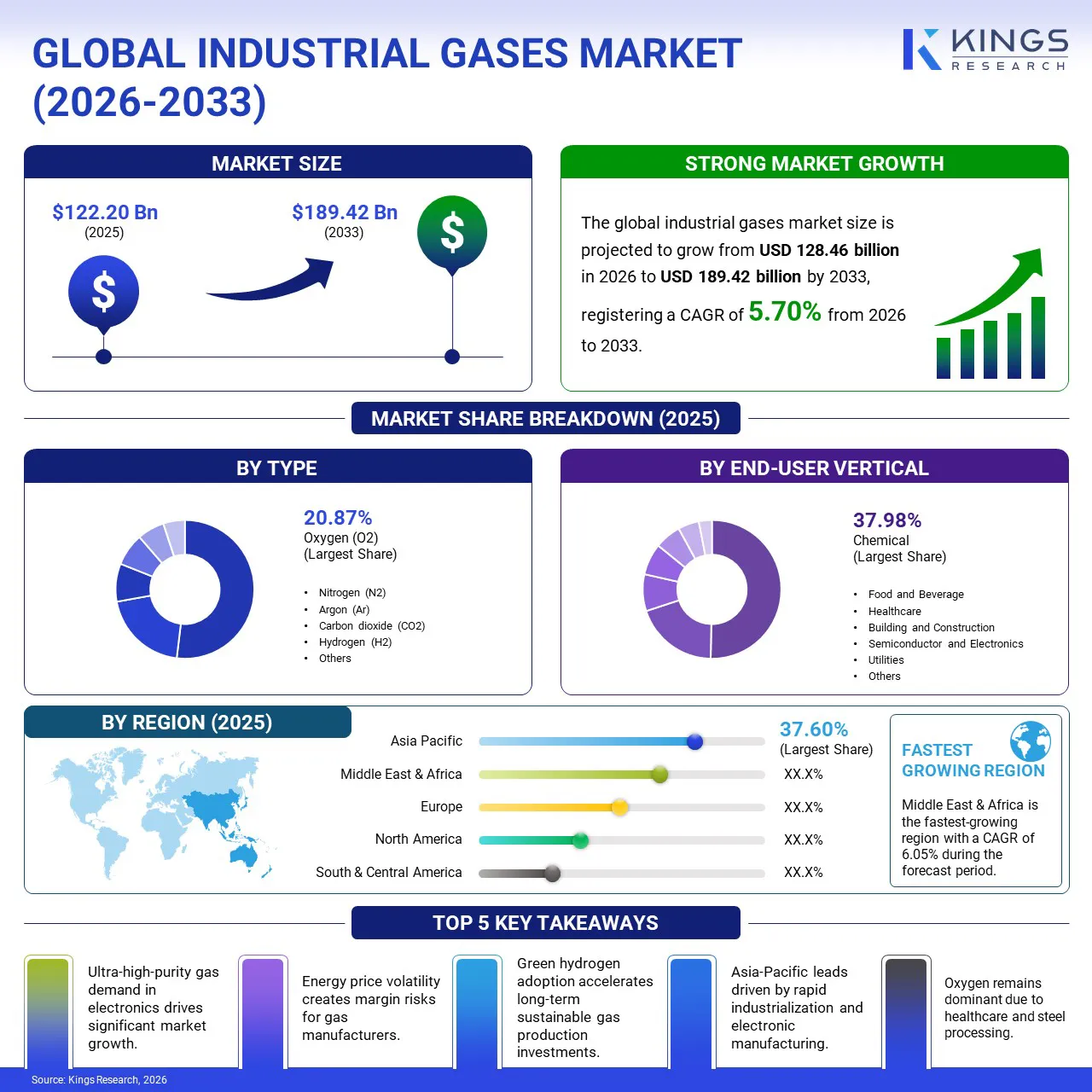
According to Kings Research, the global industrial gases market size was valued at USD 122.20 billion in 2025 and is projected to grow from USD 128.46 billion in 2026 to USD 189.42 billion by 2033, exhibiting a CAGR of 5.70% during the forecast period. This growth is primarily driven by rising demand from industries such as healthcare, electronics, chemicals, and manufacturing, where industrial gases play a vital role in daily operations. The market is also witnessing advancements in production technologies, enabling higher gas purity, improved operational efficiency, and more reliable supply.
Major companies operating in the global industrial gases industry are Linde PLC, Air Liquide, Air Products and Chemicals, Inc., Nippon Sanso Holdings Corporation, Messer SE & Co. KGaA, Iwatani Corporation, AIR WATER INC, SOL Group, BASF, Gulfcryo, INOX-Air Products Inc., Gruppo SIAD, Hangzhou Oxygen Plant Group Co., Ltd., Sapio, and PT Samator Indo Gas Tbk.
Leading market players are focusing on introducing novel solutions, including on-site gas production and advanced storage facilities, to comply with strict quality and safety requirements. This technological progress enhances the efficiency of operations and enables ongoing progress toward sustainability, including in the field of clean energy and green hydrogen. Consequently, the industrial gases market continues to evolve, delivering enhanced performance and value to a wide array of end-use industries.
Manufacturers need gases with very low concentrations of impurities as the production of semiconductors, flat panel displays, solar cells, and other high-tech electronic devices becomes increasingly complex to guarantee product quality and process reliability. Some processes, including wafer fabrication, etching, and deposition, require ultra-high purity gases such as nitrogen, hydrogen, and argon. As a result, advanced purification technologies are evolving, and industrial gas suppliers are investing in expanding their supply chains to fulfill these strict requirements, thereby fueling market expansion.
Energy intensity and cost volatility are key challenges hampering market expansion. Gases such as oxygen, nitrogen, and hydrogen are normally produced by energy-intensive processes such as air separation and electrolysis and therefore are very sensitive to energy costs. Volatility in energy prices can compress margins and raise the cost of industrial gas supply for both producers and end-users.
The volatility of prices also makes it difficult for companies involved in this industry to plan and take investment decisions in the long-term. To address these issues, firms are implementing energy-saving technologies and looking for a wider variety of energy sources. Additionally, some are moving toward long-term power purchase agreements and renewable energy sources to help stabilize costs and operations.
The decarbonization and transition to green hydrogen are emerging as significant market trends. Governments and industries are investing more in green hydrogen, a form of hydrogen generated using renewable energy, as they aim to reduce carbon emissions. The energy, transportation, and manufacturing industries are also adopting it as a measure to cut carbon emissions and promote environmental sustainability.
The industrial gases industry is expanding its research and development efforts and infrastructure to increase the production and distribution of green hydrogen. The trend enables companies to achieve their sustainability targets and offers new market potential for gas suppliers providing low-carbon solutions.
|
Segmentation |
Details |
|
By Type |
Oxygen (O₂), Nitrogen (N₂), Argon (Ar), Carbon dioxide (CO₂), Hydrogen (H₂), and Others |
|
By End-User Vertical |
Food and Beverage, Healthcare, Building and Construction, Chemical, Semiconductor and Electronics, Utilities, and Others |
|
By Region |
North America: U.S., Canada, Mexico |
|
Europe: France, UK, Spain, Germany, Italy, Russia, Rest of Europe |
|
|
Asia-Pacific: China, Japan, India, Australia, ASEAN, South Korea, Rest of Asia-Pacific |
|
|
Middle East & Africa: Turkey, U.A.E., Saudi Arabia, South Africa, Rest of Middle East & Africa |
|
|
South America: Brazil, Argentina, Rest of South America |
Based on region, the global industrial gases market has been classified into North America, Europe, Asia Pacific, Middle East & Africa, and South America.
Asia Pacific industrial gases market share stood at 37.60% in 2025, valued at USD 45.95 billion. This dominance is attributed to rapid industrialization, urbanization, and substantial infrastructure development. The growing manufacturing sector in the region, particularly in electronics, automotive, and food processing, has increased the demand for industrial gases.
Moreover, government initiatives for improving the healthcare infrastructure and the increasing focus on clean energy solutions, such as the increased adoption of green hydrogen, are contributing to regional market growth. The presence of global and regional industrial gas suppliers, along with continuous investment in advanced production technologies, is further strengthening the Asia Pacific’s leading position in the global market.
The Middle East & Africa industrial gases market is set to grow at a CAGR of 6.05% over the forecast period. This rapid growth is driven by significant investments in large-scale infrastructure and energy projects across the Gulf Cooperation Council (GCC) countries. The region’s economic diversification focus, along with the growth of sectors such as petrochemicals, metallurgy, and healthcare, is increasing the demand for industrial gases.
The ongoing development of clean energy sources such as green hydrogen and renewable projects is further contributing to regional market growth. Additionally, increasing foreign direct investment and strong government support for industrialization are expected to boost local production capabilities, aiding regional market expansion.
The competitive landscape of the industrial gases market is characterized by the presence of several large multinational corporations, regional players, and a growing number of specialized firms focusing on niche applications. Companies are competing on the basis of product innovation, technological development, reliability of supply, and the feasibility of delivering integrated solutions to meet specific end-user requirements.
Companies often invest in production capacity, on-site gas generation, and distribution infrastructure to boost operational efficiency and geographic coverage. In addition, partnerships, mergers and acquisitions, and long-term supply agreements are frequently sought to increase market share and diversify service offerings. There is also growing competition in the industry as sustainability becomes a key focus with new low-carbon and specialty gases being developed.
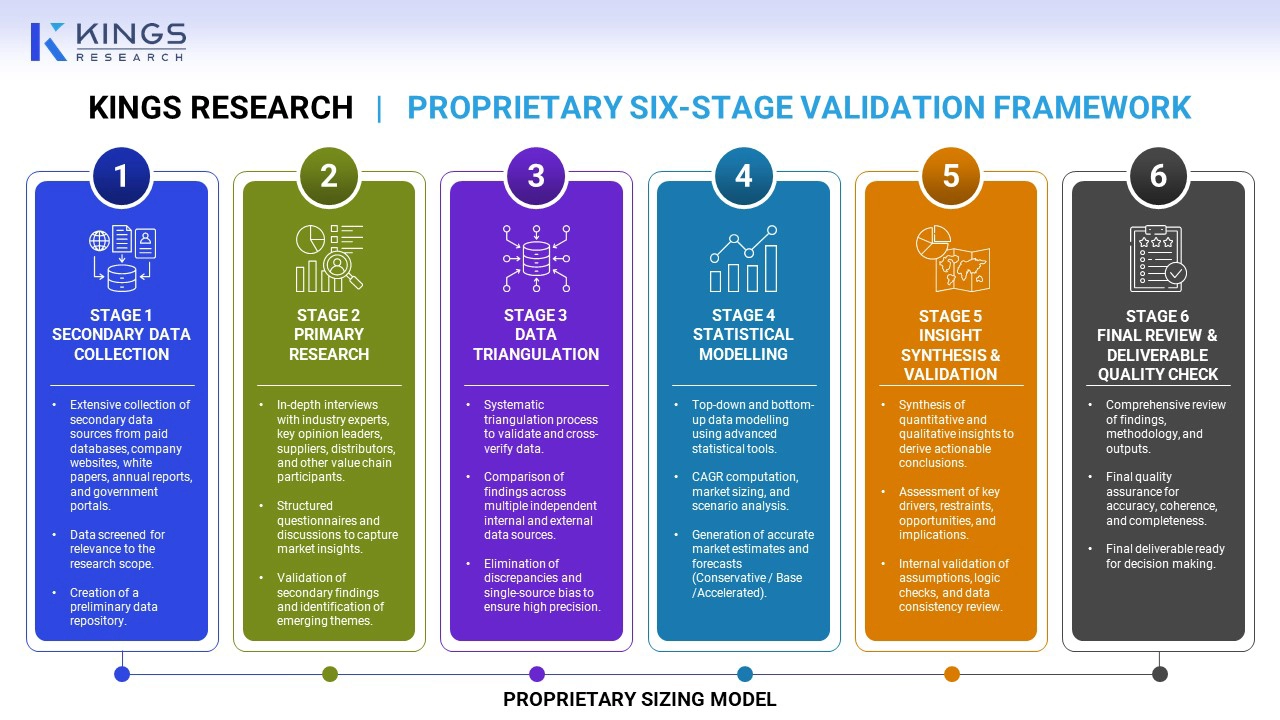
Our methodology triangulates insights from multiple independent and publicly available research databases and is further validated against regulatory filings and public company disclosures. All estimates are cross-verified; no single-source data is presented without validation.
 Why Kings Research?
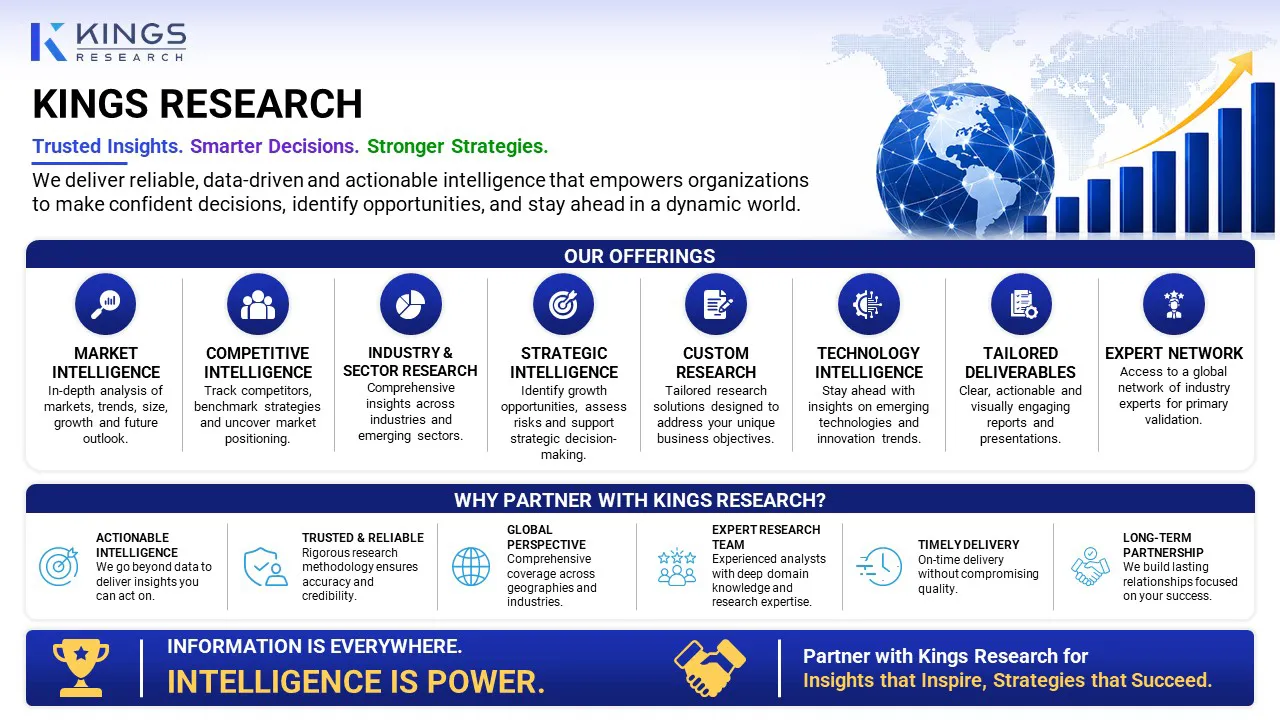
Our custom offerings deliver tailored, data-driven intelligence and strategic guidance to help organizations identify, evaluate, and capitalize on key market opportunities.
Frequently Asked Questions

Aswathi holds cross-domain expertise, translating market trends and competitive intelligence into decision-ready insights. Her work helps clients interpret evolving market conditions and identify growth opportunities. She brings a focused, insight-led approach to research execution. She translates these findings into clear, prioritized action plans that align with client capabilities. Her research often includes scenario modeling to test growth strategies under varying economic conditions. She maintains a rigorous validation process, cross-checking primary and secondary sources to ensure reliability. Clients value her ability to synthesize noisy data into concise executive summaries that drive board-level discussions. Her sector-specific lens, combined with a pragmatic focus on execution, consistently delivers high-impact, commercially sound recommendations. Her structured yet flexible research frameworks adapt to client timelines without compromising depth. She is known for distilling complex trade-offs into straightforward, defensible positions that facilitate confident decision-making.
With many years of consulting experience across global pharma, biotech, and MedTech markets, Minaz brings deep domain expertise, strategic clarity, and analytical rigor to every engagement. She has led 130+ consulting assignments spanning market entry, competitive landscaping, and portfolio prioritization, helping clients navigate complex, high-stakes decisions with confidence. Known for her ability to synthesize primary and secondary research into executive-ready recommendations, Minaz has built forecasting models and market sizing frameworks that have informed multi-million dollar investment decisions in oncology, diagnostics, and peptide therapeutics. Beyond her analytical strength, Minaz is a trusted client partner, translating complex datasets into clear, actionable insights for senior stakeholders. She currently leads a team of research analysts, driving business expansion, and shaping client engagement strategy.