
Inquire Now
Key Strategic Points
The gummy supplements market includes the manufacturing, distribution, and sale of chewable nutritional supplements made from gelatin or pectin. These supplements have a soft, candy-like gummy texture and offer vitamins, minerals, probiotics, and proteins to provide nutritional or health benefits. They are available in an edible form as an alternative for pills, capsules, or powders. The market includes products that are formulated to provide a variety of health benefits, including general wellness, immune system support, digestive health aid, and addressing specific dietary requirements.
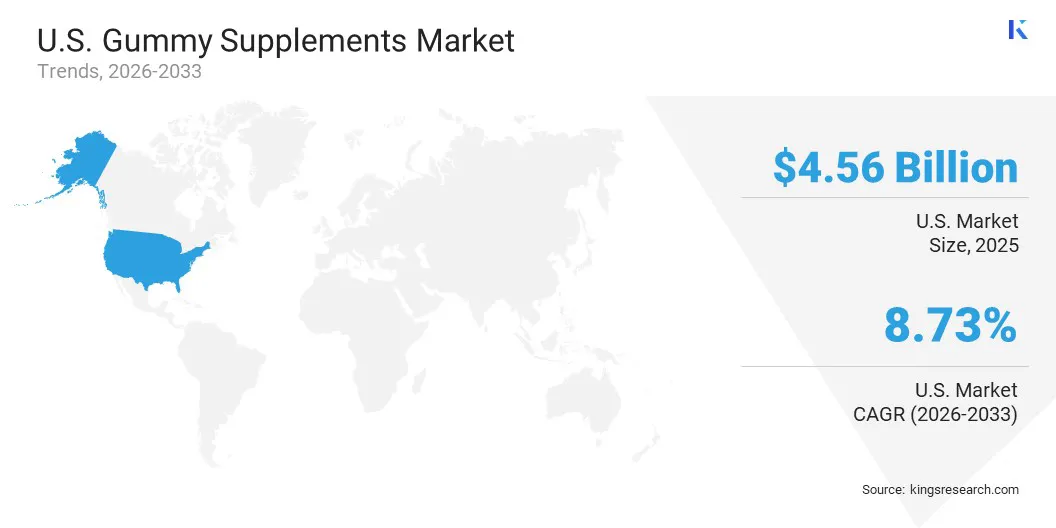
The U.S. gummy supplements market size was valued at USD 4.56 billion in 2025 and is projected to reach USD 8.91 billion by 2033, exhibiting a CAGR of 8.73% during the forecast period. This growth results from the demand for chewable supplements as a palatable alternative to traditional pills among consumers.
Major companies operating in the U.S. gummy supplements market are Makers Nutrition, LLC, Gummi World, SMPNutra, Ion Labs, Your Gummy Vitamins, Superior Supplement Manufacturing, Matsun Nutrition, Cpackmanufacturing, Nutra Solutions USA., Vox Nutrition Inc, Eagle Labs, Inc., Gummy Corp, SCN BestCo, Robinson Pharma, Inc., and Sirio Pharma Co., Ltd.
Additionally, product innovation and the introduction of gummies targeting specific health concerns are expanding the market’s reach. The presence of a wide range of flavors and formulations further enhances consumer appeal, contributing to the market expansion.
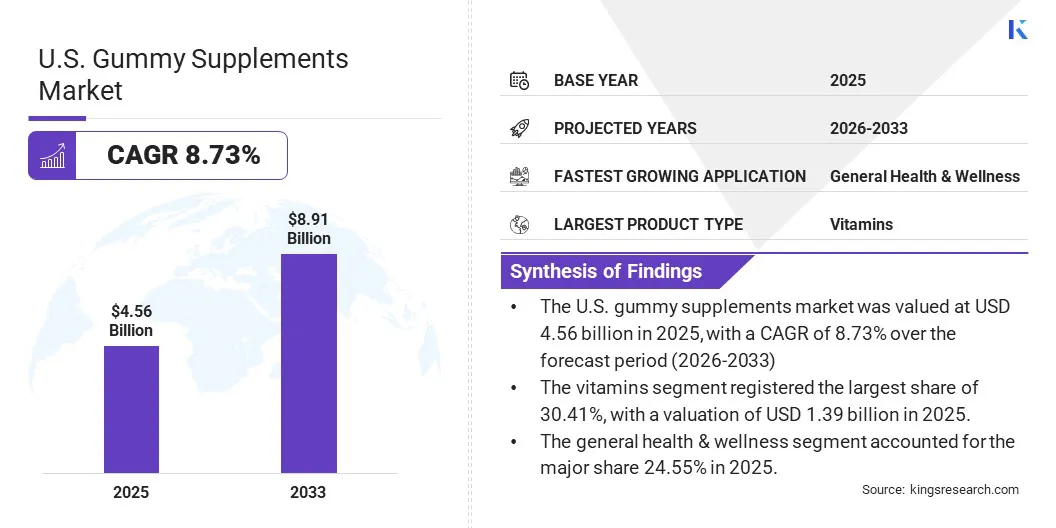
Gummy supplements deliver a superior consumer experience through enhanced palatability and ease of consumption, which has significantly increased their adoption and contributed to substantial market growth in the U.S.. A longstanding barrier to supplement adherence has been the physical difficulty of swallowing solid oral dosage forms. For instance, research published on national center for biotechnology information, indicates that up to 40% of the population experiences difficulties swallowing solid pills, resulting in reduced adherence and impaired therapeutic outcomes.
This void has opened a considerable market for gummy forms among U.S. consumers, providing a tasty, chewable alternative that promotes daily routine incorporation among children and seniors. These two groups have traditionally demonstrated the least regularity in supplement consumption, thereby rendering preventive nutrition more attainable and pleasurable for a broader consumer segment.
High sugar content in gummy supplements limits their appeal among health-conscious consumers, as it conflicts with the product’s intended health benefits and raises concerns about exceeding recommended daily sugar intake.. According to the American Heart Association, the recommended maximum daily intake of added sugar is 25 grams for women and 36 grams for men. This means that even a modest daily gummy intake can consume a notable portion of that allowance among U.S. consumers. This, in turn, becomes a concern for diabetic, weight-conscious, and clean label consumers. In response, manufacturers are prioritizing sugar reduction and artificial ingredients in gummy supplements. The adoption of plant-based gelling agents, including pectin and carrageenan, is also gaining prominence across the industry.
The growing shift toward personalized and condition-specific gummy formulations stands as one of the most defining trends reshaping the U.S. gummy supplements market. American consumers are moving away from generic multivitamins toward targeted solutions addressing specific health concerns such as sleep, immunity, cognitive function, gut health, and beauty. This shift reflects a broader preventive healthcare mindset gaining strong momentum across the country.
This trend is also supported by significant scientific investment, with organizations such as the National Institutes of Health (NIH) funding research on algorithms that predict individual dietary responses, thereby reinforcing the legitimacy of precision nutrition as a mainstream health approach. . Brands are responding by launching dedicated product lines for distinct demographics and health goals, effectively multiplying their addressable consumer base while commanding premium price points within the market.
|
Segmentation |
Details |
|
By Product Type |
Vitamins, Minerals, Omega Fatty Acid, Collagen, CBD Gummies, Probiotics, Proteins, and Others |
|
By Source |
Animal Based, Plant Based, and Synthetic |
|
By Category |
Conventional and Sugar-free |
|
By Distribution Channel |
Supermarkets and Hypermarkets, Pharmacies & Drugstores, Online Retail, and Others |
|
By Application |
Immunity, General Health & Wellness, Bone & Joint Health, Weight Management, Beauty & Skin Health, Cognitive Wellness, Sleep Support, Digestive Health, and Others |
|
By End User |
Kids and Adults |
|
By Region |
U.S. |
Gummy supplements are being used in a variety of real-world settings, demonstrating their growing appeal beyond traditional vitamin supplementation. In immune health, gummies fortified with vitamin C, zinc, and elderberry are popular for daily wellness routines among children and adults. For sleep support, melatonin gummies offer a palatable, non-habit-forming option that is widely adopted by consumers struggling with occasional sleeplessness. In digestive wellness, probiotic gummies are gaining traction as a convenient alternative to capsules, particularly for those seeking to maintain gut health. Additionally, hair, skin, and nail gummies enriched with biotin and collagen are increasingly favored by individuals focused on beauty and personal care. These diverse applications highlight the expanding role of gummy supplements in preventive health and lifestyle management throughout the U.S.
The U.S. gummy supplements market has a moderately fragmented competitive landscape with large multinational consumer goods and pharmaceutical companies competing against regional manufacturers, specialty nutrition brands and fast-growing direct-to-consumer startups. Large incumbent players rely on broad U.S. distribution networks, strong brand equity, and science-based formulations to maintain market leadership. While smaller and emerging brands compete on clean-label claims, condition-specific targeting and agile product innovation.
The market is witnessing a higher consolidation with bigger companies acquiring innovative start-ups to augment their wellness portfolios and cater to the new set of consumers. Additionally, strategic expansions in manufacturing capacity, e-commerce-led growth models, and subscription-based retail strategies are further intensifying the competition. Product differentiation and consumer trust are the most critical factors for long-term competitive advantage in this market.
Frequently Asked Questions

Aswathi holds cross-domain expertise, translating market trends and competitive intelligence into decision-ready insights. Her work helps clients interpret evolving market conditions and identify growth opportunities. She brings a focused, insight-led approach to research execution. She translates these findings into clear, prioritized action plans that align with client capabilities. Her research often includes scenario modeling to test growth strategies under varying economic conditions. She maintains a rigorous validation process, cross-checking primary and secondary sources to ensure reliability. Clients value her ability to synthesize noisy data into concise executive summaries that drive board-level discussions. Her sector-specific lens, combined with a pragmatic focus on execution, consistently delivers high-impact, commercially sound recommendations. Her structured yet flexible research frameworks adapt to client timelines without compromising depth. She is known for distilling complex trade-offs into straightforward, defensible positions that facilitate confident decision-making.
Smriti Vinodia is a market research and consumer insights professional with expertise in qualitative research, consumer behavior, and strategic market intelligence across the FMCG and FMCD industries. She has experience supporting leading brands by transforming complex consumer and market insights into actionable strategies that inform product development, innovation, positioning, and business growth. Her expertise spans qualitative consumer research, market and competitive intelligence, consumer trend analysis, and AI-enabled insight generation. She has worked across diverse research engagements, helping organizations understand evolving consumer needs, identify emerging market opportunities, and strengthen customer-centric decision-making. Combining analytical rigor with a strong understanding of consumer psychology and market dynamics, Smriti brings a strategic perspective to research and insights. She focuses on connecting consumer behavior with commercial priorities, enabling organizations to make informed decisions, develop relevant products and experiences, and build sustainable growth strategies in rapidly evolving and competitive markets.