
Inquire Now
Key Strategic Points
The global tea extract market comprises the production, processing, and commercialization of compounds from tea leaves (Camellia sinensis) for use across diverse end-use industries. The market covers various types and forms of tea extracts, meeting formulation requirements across applications, including food and beverages, cosmetics and personal care, nutraceuticals, pharmaceuticals, and other industrial applications.
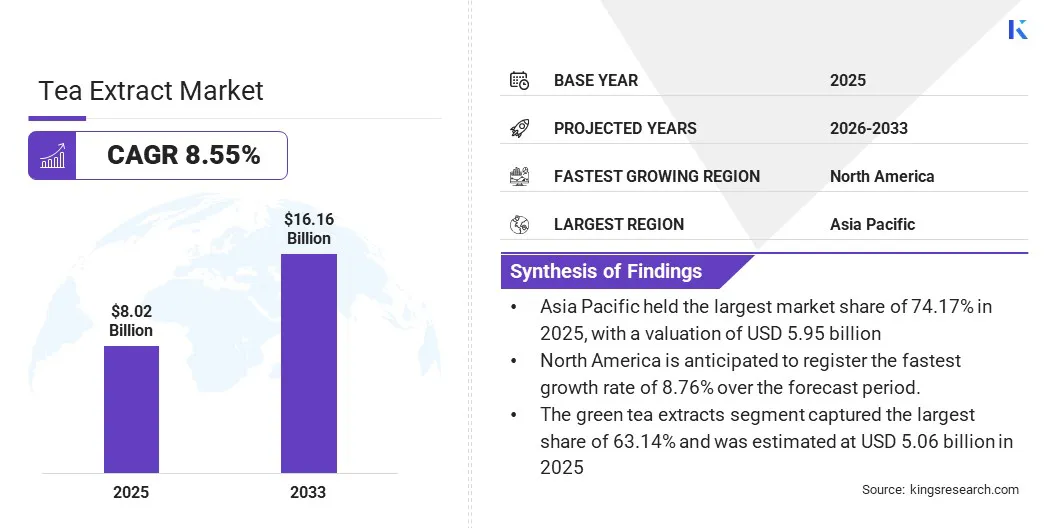
The global tea extract industry was valued at USD 8.02 billion in 2025 and is projected to grow from USD 9.10 billion in 2026, reaching USD 16.16 billion by 2033, representing a CAGR of 8.55% over the forecast period. The growing adoption of tea extracts in functional foods and beverages, dietary supplements, cosmetics, and pharmaceuticals is creating new avenues for market expansion. The widespread use of tea extracts in preventing chronic diseases, improving health, delaying the aging process, and enhancing bodily functions is contributing significantly to its rising consumption.
Key players operating in the market including ADM, FENCHEM, Finlays, Givaudan, International Flavors & Fragrances Inc., Indena S.p.A., Kemin Industries, Inc., Kerry Group plc, MartinBauer, Synergy Flavors, Inc., Synthite Industries, and Takasago International Corporation are focusing on product innovation, strategic partnerships, capacity expansions, and sustainable sourcing initiatives to strengthen their market position and meet the evolving demand for high-quality tea extract ingredients.
The rise in demand for clean-label, plant-based, and sustainably developed nutraceutical formulations is enabling tea extract manufacturers to strengthen their global presence through strategic acquisitions and partnerships.
The increasing preference for clean label and plant ingredients, rich in antioxidants, aids in reducing oxidative stress in the body by protecting cells from damage caused by free radicals. Such cell damage is associated with aging and several diseases, and thus tea extract consumption offers multiple health benefits, including support for heart, liver, and brain health; skin rejuvenation; and reduced cancer risk.
Challenges related to production efficiency and product consistency continue to hinder market growth. Market players face difficulties in procuring a reliable supply of high-quality, sustainably sourced raw materials due to the geographic concentration of tea cultivation across Africa, Asia, and South America. Maintaining consistent quality across production batches requires rigorous quality control measures to standardize flavor, aroma, and functional properties, which acts as a major constraint on growth. Additionally, compliance with stringent food safety and quality regulations across regions increases operational complexity and costs for manufacturers, thereby limiting widespread adoption.
To address this challenge, market players are investing in sustainable sourcing partnerships, strengthening traceability across the supply chain, and adopting advanced quality control. Companies are also expanding contract farming initiatives and optimizing extraction methodologies to enhance production efficiency while ensuring compliance with evolving regulatory standards.
The inclusion of sustainable extraction technologies aimed at enhancing the quality, yield, and functionality of tea-derived bioactive compounds is transforming the market. Extraction methodologies, including supercritical fluid extraction (SFE), ultrasound-assisted extraction (UAE), microwave-assisted extraction (MAE), enzyme-assisted extraction (EAE), and pulsed electric field (PEF) extraction, are enabling higher extraction efficiency, improved preservation of heat-sensitive compounds such as catechins and polyphenols, reduced solvent and energy consumption, and enhanced environmental sustainability.
The trend is further supported by rising demand for high-purity tea extracts across functional foods and beverages, dietary supplements, pharmaceuticals, cosmetics, and natural food preservation. Additionally, manufacturers are investing in hybrid extraction techniques and advanced delivery systems, including nanoencapsulation, to enhance the stability and bioavailability of tea bioactives.
|
Segmentation |
Details |
|
By Type |
Black, Green, White, Purple, Others |
|
By Form |
Liquid, Powder |
|
By End Use |
Food and Beverage, Cosmetics and Personal Care, Pharmaceuticals, Others |
|
By Region |
North America: U.S., Canada, Mexico |
|
Europe: France, UK, Spain, Germany, Italy, Russia, Rest of Europe |
|
|
Asia-Pacific: China, Japan, India, Australia, ASEAN, South Korea, Rest of Asia-Pacific |
|
|
Middle East & Africa: Turkey, U.A.E., Saudi Arabia, South Africa, Rest of Middle East & Africa |
|
|
South America: Brazil, Argentina, Rest of South America |
Based on region, the global tea extract market has been segmented into North America, Europe, Asia Pacific, the Middle East and Africa, and South America.
Asia Pacific tea extract industry share stood at 74.17%, valued at USD 5.95 billion in 2025. The presence of major tea producers such as China, India and Sri Lanka supports the concentration of tea extract manufacturing facilities in the region. Rising demand for premium and specialty tea extracts across end-use industries, including food and beverage, cosmetics, and nutraceuticals, significantly contributes to regional market expansion. Additionally, a large population and strong cultural affinity for tea further strengthen regional market potential.
North America is set to grow at the fastest CAGR of 8.76% over the forecast period. Increasing consumer preference for functional beverages, dietary supplements, and clean-label foods enriched with natural ingredients is boosting tea extract consumption in the region. The strong health and wellness trend in the U.S. and Canada, driven by demand for weight management and immunity-supporting formulations, supports domestic market development. Additionally, continuous product innovation by food and beverage manufacturers, along with expansion in ready-to-drink tea and nutraceutical sectors, is further accelerating consumption.
Key market players are focusing on strengthening product innovation and operational efficiency through technical collaborations and acquisitions to capture wider market share and address growing product demand.
Companies are also investing in advanced quality purification systems and novel formulations to enhance the bioavailability, purity, and functional performance of tea extract, thereby expanding applications across functional foods, dietary supplements, beverages, and pharmaceutical products while strengthening their competitive positioning globally.
Frequently Asked Questions

Faizy brings over four years of experience in market research and consulting, with a proven ability to support strategic engagements across diverse industries and business environments. His work focuses on understanding complex market structures, identifying emerging opportunities, and translating research findings into clear, commercially relevant insights. With strong analytical capabilities and a structured approach to problem-solving, he evaluates industry trends, competitive landscapes, customer dynamics, and evolving business models. His expertise encompasses market research, competitive intelligence, market sizing and forecasting, industry assessment, company benchmarking, and strategic analysis. Faizy combines technical proficiency with a strong research orientation, enabling him to interpret both qualitative and quantitative information effectively. He has contributed to projects that help organizations assess growth potential, strengthen market positioning, and evaluate strategic priorities. His adaptable approach allows him to work across sectors while maintaining a consistent focus on accuracy, relevance, and delivering insights that support informed decision-making for clients and stakeholders.
Smriti Vinodia is a market research and consumer insights professional with expertise in qualitative research, consumer behavior, and strategic market intelligence across the FMCG and FMCD industries. She has experience supporting leading brands by transforming complex consumer and market insights into actionable strategies that inform product development, innovation, positioning, and business growth. Her expertise spans qualitative consumer research, market and competitive intelligence, consumer trend analysis, and AI-enabled insight generation. She has worked across diverse research engagements, helping organizations understand evolving consumer needs, identify emerging market opportunities, and strengthen customer-centric decision-making. Combining analytical rigor with a strong understanding of consumer psychology and market dynamics, Smriti brings a strategic perspective to research and insights. She focuses on connecting consumer behavior with commercial priorities, enabling organizations to make informed decisions, develop relevant products and experiences, and build sustainable growth strategies in rapidly evolving and competitive markets.