
Inquire Now
Key Strategic Points
The postbiotics market comprises products containing inanimate microorganisms and their cellular components that provide health benefits to the users. These products find applicability across dietary supplements, functional foods, pharmaceuticals, animal feed and personal care. The market covers a comprehensive analysis of growth trends and emerging applications targeted at regulating gut health, modulate immune system, and maintain a healthy balance of gut bacteria.
The U.S. postbiotics market was valued at USD 37.4 million in 2025 and is projected to reach USD 94.3 million by 2033, representing a CAGR of 12.49% over the forecast period. Market growth is driven by rising consumer awareness of the benefits of postbiotics for digestive health and overall wellness. This is leading to increased demand for postbiotic ingredients in various formulations, including nutritional supplements, functional foods and beverages.
Major players operating in the market comprise ADM, International Flavors & Fragrances Inc., Cargill, Incorporated, DSM-Firmenich AG, Kerry Group plc, AB-BIOTICS, SA, ABF Ingredients, Novonesis Group, Lallemand Inc., Kemin Industries, Inc., Morinaga Nutritional Foods, KYOWA HAKKO U.S.A., INC., Sabinsa Corporation, Danone, Stratum Nutrition. Industry players are investing in new flavors and formulation development to enhance the appeal and accessibility of postbiotic products in the U.S.
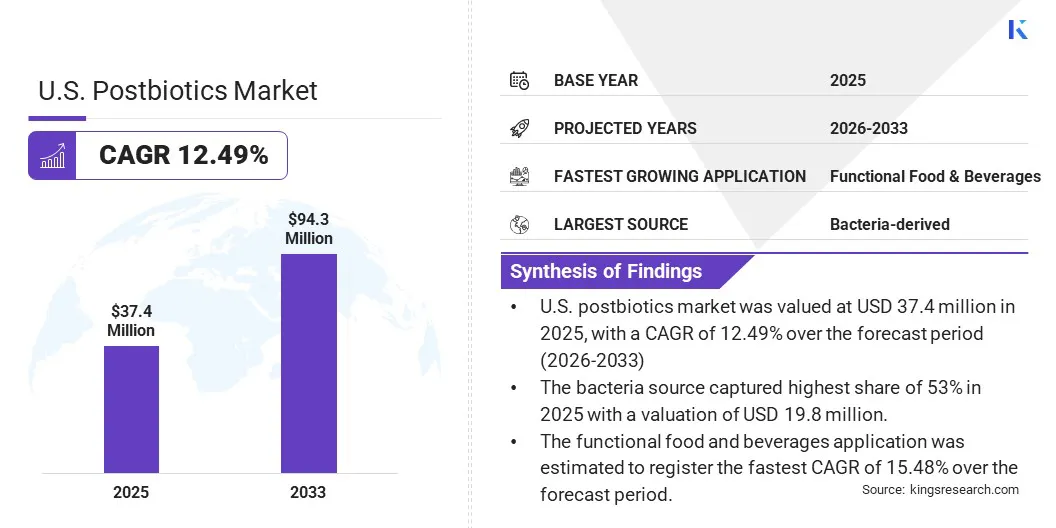
The rising popularity of postbiotics in the U.S. is attributed to their enhanced stability and longer shelf life, leading to reduced risk associated with live microbial consumption, such as potential pathogen transmission and antimicrobial resistance. Rising consumer demand for functional foods with better stability, longer shelf life, and lower risk of infection compared to live microbes is driving postbiotics market growth in the U.S. The inclusion of inanimate microbes in postbiotics eliminates the risk of infections enabling them survive harsh stomach acids and reach the intestines to deliver targeted health benefits.
The property further enables postbiotics to withstand heat, thus making them applicable in wider nutrition innovation, processing, and shelf-stable formats compared to probiotics. This drives their applicability in the food industry for bio-preservation and treating gastrointestinal disorders in pharmaceutical and biomedical fields targeted at enhancing immune functions, further driving market development. Additionally, the demand for safe and effective functional foods addressing sub-health conditions, promoting general well-being, and managing gastrointestinal issues such as diarrhea and bloating further act as major propellers for postbiotics market development in the U.S.
Key challenges comprise maintenance of consistent production yield, as microbial strains that perform efficiently in controlled laboratory conditions often exhibit variable metabolite production when transferred to large-scale fermentation systems. Moreover, the high cost of substrates and downstream processing facilities, including purification, drying, and packaging, adds to the overall cost of postbiotics at industrial volumes, thus restraining market growth avenues.
To address the challenge, postbiotic manufacturers are investing in process optimization, automation, advanced stabilization technologies, and efficient production systems to achieve cost-effective and scalable postbiotic manufacturing while maintaining product efficacy and quality.
The rise in consumer demand for convenience, improved compliance, enhanced product stability, and targeted health benefits is enabling manufacturers to expand postbiotic delivery forms beyond conventional capsules, tablets, and powder formulations. Market players are introducing innovative postbiotic products in gummies, chewable tablets or orally disintegrating tablet (ODT) formats.
Furthermore, the demand for orally disintegrating tablets, fast-melt formats or quick-dissolve formats due to their rapid dissolution and convenient administration is gaining widespread adoption in the market. Additionally, the demand for effervescent postbiotic forms is further gaining popularity due to their enhanced sensory appeal and ease of consumption, while functional foods and beverages fortified with postbiotics are expanding opportunities for daily health management and preventive nutrition.
|
Segmentation |
Details |
|
By Source |
Bacteria-Derived (Lactobacillus, Bifidobacterium, Others), Yeast-Derived (Saccharomyces, Cerevisiae, Saccharomyces Boulardii, Others) |
|
By Form |
Dry, Liquid |
|
By Application |
Functional Food and Beverages, Dietary Supplements, Animal Feed and Pet Care, Cosmetics and Personal Care, Pharmaceuticals, Others |
|
By Region |
U.S. |
The U.S. postbiotics market was valued at USD 37.4 million in 2025 and is anticipated to register a CAGR of 12.49% over the forecast period, reaching USD 94.3 million in 2033. The country is designated as the major consumer of gut health and functional nutrition-driving products. The demand for postbiotics is led by food and beverage manufacturers, dietary supplement brands, and pharmaceutical formulators, which are driving product adoption through their inclusion in functional foods, protein powders, and digestive health supplements.
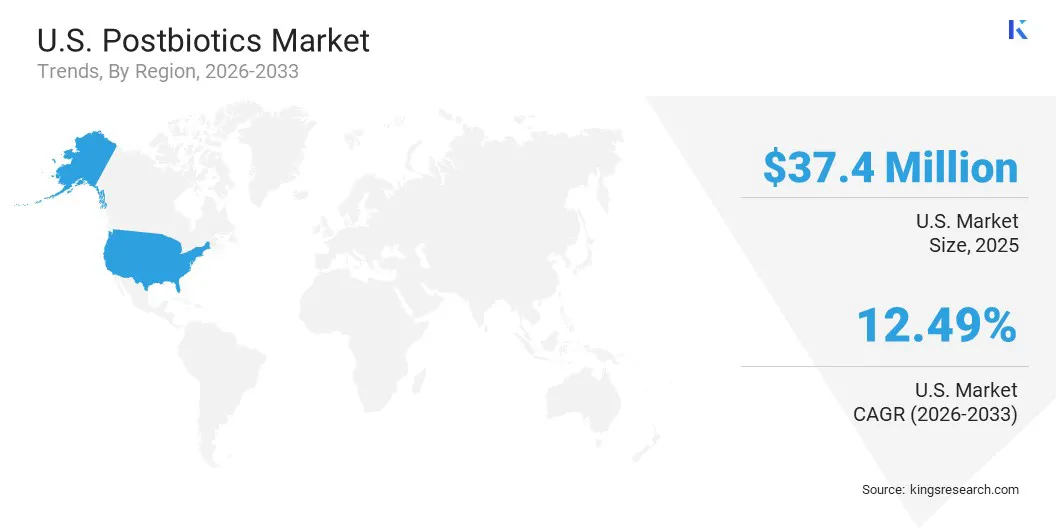
Additionally, expanding interest in immune health and digestive wellness continues to drive sustained demand across the U.S. For instance, colon and rectal cancer (CRC) is denoted as the third most commonly diagnosed cancer and the second leading cause of cancer-related death in the U.S. This fuels the demand for wellness substances that strengthen the protective lining of gut and help regulate the body's immune response.
Key players operating in the postbiotics market, including ADM, International Flavors & Fragrances Inc., Cargill, DSM-Firmenich AG, Kerry Group plc, AB-BIOTICS, SA, ABF Ingredients, Novonesis Group, Lallemand Inc., Kemin Industries, Inc., Sabinsa Corporation, and others, are focusing on strengthening their market position through technological innovation, strategic partnerships, and production capacity expansion. Companies are increasing investments in microbiome research, clinically validated postbiotic strains, and advanced fermentation technologies to develop targeted solutions for digestive health, immune support, metabolic health, and overall wellness.
Market participants are further actively engaging in strategic mergers, acquisitions, and joint ventures to expand their footprint in the U.S. The move enables them to enhance production capabilities and diversify their product portfolios with the development of innovative delivery formats, including gummies, chewable tablets, capsules, powders, stick packs, and functional food and beverage applications, to improve consumer convenience and product differentiation.
Frequently Asked Questions

Faizy brings over four years of experience in market research and consulting, with a proven ability to support strategic engagements across diverse industries and business environments. His work focuses on understanding complex market structures, identifying emerging opportunities, and translating research findings into clear, commercially relevant insights. With strong analytical capabilities and a structured approach to problem-solving, he evaluates industry trends, competitive landscapes, customer dynamics, and evolving business models. His expertise encompasses market research, competitive intelligence, market sizing and forecasting, industry assessment, company benchmarking, and strategic analysis. Faizy combines technical proficiency with a strong research orientation, enabling him to interpret both qualitative and quantitative information effectively. He has contributed to projects that help organizations assess growth potential, strengthen market positioning, and evaluate strategic priorities. His adaptable approach allows him to work across sectors while maintaining a consistent focus on accuracy, relevance, and delivering insights that support informed decision-making for clients and stakeholders.
Smriti Vinodia is a market research and consumer insights professional with expertise in qualitative research, consumer behavior, and strategic market intelligence across the FMCG and FMCD industries. She has experience supporting leading brands by transforming complex consumer and market insights into actionable strategies that inform product development, innovation, positioning, and business growth. Her expertise spans qualitative consumer research, market and competitive intelligence, consumer trend analysis, and AI-enabled insight generation. She has worked across diverse research engagements, helping organizations understand evolving consumer needs, identify emerging market opportunities, and strengthen customer-centric decision-making. Combining analytical rigor with a strong understanding of consumer psychology and market dynamics, Smriti brings a strategic perspective to research and insights. She focuses on connecting consumer behavior with commercial priorities, enabling organizations to make informed decisions, develop relevant products and experiences, and build sustainable growth strategies in rapidly evolving and competitive markets.