
Inquire Now
Key Strategic Points
The frozen bakery products market involves the production, distribution, and sale of bakery goods that are preserved by freezing. This market encompasses bread, butter-based doughs, pizza crusts, and cookies that are manufactured, stored, and transported in the frozen state to preserve freshness and extend shelf life and provide convenience to customers and businesses. The market serves both retail channels, such as supermarkets and convenience stores, and food service channels, including hotels, restaurants, and cafes.
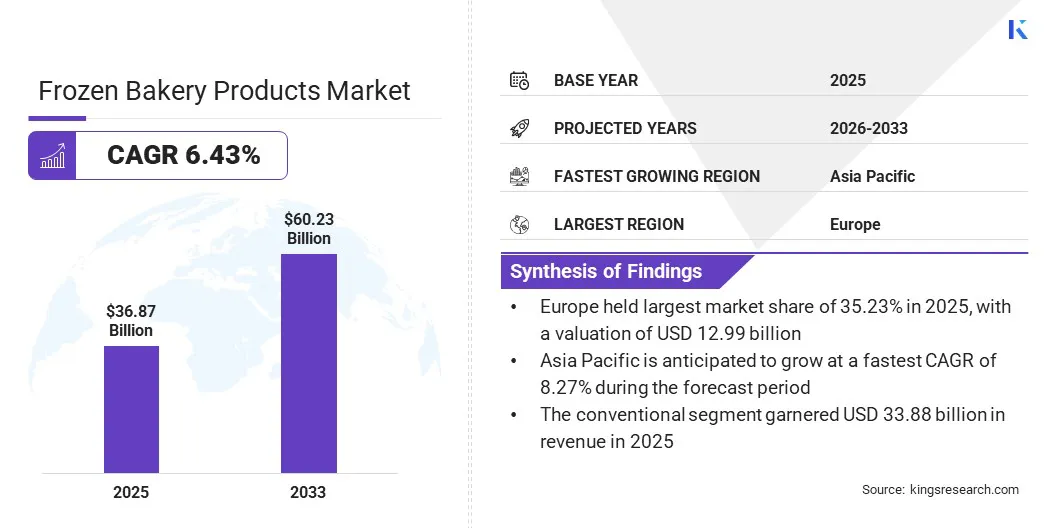
The global frozen bakery products market size was valued at USD 36.87 billion in 2025 and is projected to grow from USD 38.94 billion in 2026 to USD 60.23 billion by 2033, exhibiting a CAGR of 6.43% during the forecast period. This growth is primarily attributed to the rising consumer demand for convenient and ready-to-eat food options, along with the expansion of modern retail channels and advancements in freezing technology.
Major companies operating in the global frozen bakery products market are Lantmannen Unibake, ARYZTA AG, EUROPASTRY, S.A., Rich Products Corporation, Vandemoortele NV, Sara Lee Frozen Bakery, Grupo Bimbo, Dr. Oetker, La Lorraine Bakery Group, Flowers Foods, Ajinomoto Foods, Monbake, Sunbulah Group, BRIDOR, and Yamazaki Baking Co., Ltd.
Rapid urbanization, changing lifestyles, and the launch of novel and health-conscious bakery frozen products are contributing significantly to market growth. The market is projected to continue its positive trajectory in the coming years as manufacturers further diversify their offerings and invest in quality and sustainability.
With increasingly busy lifestyles, consumers are seeking quick, easy-to-prepare meal and snack options that fit into their daily routines. Frozen bakery products such as ready-to-bake bread, pastries, and pizza crusts are simple to prepare and offer a uniform taste and quality.
As per the update by the National Frozen & Refrigerated Foods Association (NFRA) in March 2026, 83% of shoppers agreed that frozen food makes meal planning easier, highlighting the importance of convenience in today’s food choices and the rising popularity of frozen bakery items among busy consumers.
Demand is particularly strong among urban dwellers, working professionals, and families with limited time for cooking. Furthermore, the increasing availability of different frozen bakery products in convenience stores and supermarkets has made it easier for consumers to purchase these products, thus fueling market growth.
To ensure a longer shelf life while maintaining texture and flavor, careful control of storage temperatures and humidity throughout the supply chain is essential. Any deviation from these standards can lead to quality degradation, spoilage, or food safety problems, which can result in financial losses and damage to manufacturers’ reputations. In addition, temperature fluctuations during transportation and inadequate storage conditions at the retail or consumer level can further shorten shelf life.
To address this challenge, businesses are investing in technologies that offer more advanced freezing options and better packaging solutions to preserve product integrity. Furthermore, they are working on improving their cold chain services and introducing real-time monitoring devices to ensure that the food is stored under optimal conditions throughout its journey from production to delivery.
The health and clean-label trend is influencing the market as consumers are paying increasing attention to consuming nutritious, wholesome, and transparent food. The demand for products made from whole grains, natural ingredients, and without artificial additives, preservatives, and trans fats is on the rise. Health-conscious shoppers tend to read ingredient labels and look for bakery products that fit their dietary preferences and wellness goals, which increases the appeal of clean-label products.
Manufacturers are being forced to reformulate recipes, eliminate controversial additives, and promote nutritional benefits on the packaging. This has led to the development of new and unique frozen bakery products that meet evolving consumer demands for health and authenticity, resulting in increased brand trust and loyalty.
|
Segmentation |
Details |
|
By Product |
Breads and Rolls, Cakes and Pastries, Pizza Crusts and Bases, Pies and Tarts, Cookies and Biscuits, Donuts, Pancakes and Waffles, and Others |
|
By Category |
Gluten-free and Conventional |
|
By Form |
Ready-to-Proof, Ready-to-Bake, and Ready-to-Eat |
|
By Distribution Channel |
Retail, Foodservice, and Institutional |
|
By Region |
North America: U.S., Canada, Mexico |
|
Europe: France, UK, Spain, Germany, Italy, Russia, Rest of Europe |
|
|
Asia-Pacific: China, Japan, India, Australia, ASEAN, South Korea, Rest of Asia-Pacific |
|
|
Middle East & Africa: Turkey, U.A.E., Saudi Arabia, South Africa, Rest of Middle East & Africa |
|
|
South America: Brazil, Argentina, Rest of South America |
Based on region, the global frozen bakery products market has been classified into North America, Europe, Asia Pacific, Middle East & Africa, and South America.
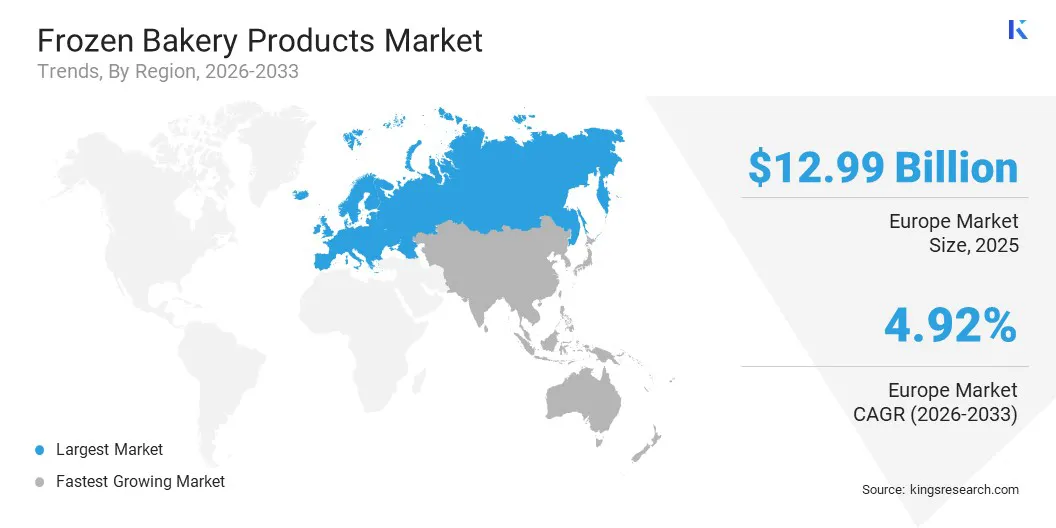
Europe's frozen bakery products market share stood at 35.23% in 2025, with a valuation of USD 12.99 billion. This dominance is supported by a strong bakery culture, high consumer acceptance of frozen products, and a large retail and food service footprint. The presence of major manufacturers and a strong cold chain infrastructure facilitates wide product availability.
Manufacturers are innovating and diversifying product lines to meet changing consumer preferences for specialty, clean-label, and health-oriented frozen bakery products. An increasing focus on clean-label and health-oriented products, along with the rising popularity of premium, artisanal, and specialty frozen bakery products, is influencing consumer preferences and aiding regional market growth.
Asia Pacific frozen bakery products market is set to grow at a CAGR of 8.27% over the forecast period, reflecting strong economic development, rapid urbanization, and shifting dietary patterns across the region. Rising disposable incomes are enabling a larger segment of the population to purchase convenient, ready-to-eat bakery items.
Increasing exposure to Western-style baked products, the expansion of modern retail infrastructure, and the growing food service industry are further creating a strong demand. Manufacturers are responding with new product launches featuring localized flavors and innovative packaging to cater to the diverse consumer tastes. With increasingly busy lifestyles, the demand for convenient, high-quality frozen bakery products is expected to propel regional market development.
The frozen bakery products market includes major multinational players, regional manufacturers, and private label products vying for market share. Companies are focused on expanding their product lines, improving distribution channels, and meeting the changing needs of consumers through innovation. Growth in the health-conscious, artisanal, and premium frozen bakery products has intensified competition, as brands differentiate themselves on the basis of quality, taste, and product range.
Other factors such as price competitiveness and effective branding are also important in attracting and retaining customers. Moreover, there is a high level of strategic cooperation, mergers, and acquisitions as market players strive to improve their market presence, optimize their processes, and gain an edge in global competition.
Frequently Asked Questions

Aswathi holds cross-domain expertise, translating market trends and competitive intelligence into decision-ready insights. Her work helps clients interpret evolving market conditions and identify growth opportunities. She brings a focused, insight-led approach to research execution. She translates these findings into clear, prioritized action plans that align with client capabilities. Her research often includes scenario modeling to test growth strategies under varying economic conditions. She maintains a rigorous validation process, cross-checking primary and secondary sources to ensure reliability. Clients value her ability to synthesize noisy data into concise executive summaries that drive board-level discussions. Her sector-specific lens, combined with a pragmatic focus on execution, consistently delivers high-impact, commercially sound recommendations. Her structured yet flexible research frameworks adapt to client timelines without compromising depth. She is known for distilling complex trade-offs into straightforward, defensible positions that facilitate confident decision-making.

With over a decade of research leadership across global markets, Ganapathy brings sharp judgment, strategic clarity, and deep industry expertise. Known for precision and an unwavering commitment to quality, he guides teams and clients with insights that consistently drive impactful business outcomes.