
Inquire Now
Key Strategic Points
The market comprises technologies and systems designed to separate suspended solids, microorganisms, and dissolved substances from liquids using semi-permeable membranes. These systems operate through pressure-driven processes such as reverse osmosis, ultrafiltration, microfiltration, and nanofiltration.
Membrane filtration enables selective separation based on pore size and molecular weight, delivering consistent purification performance. The market supports critical applications across water and wastewater treatment, food and beverage processing, dairy operations, and industrial separation processes requiring high purity and process efficiency.
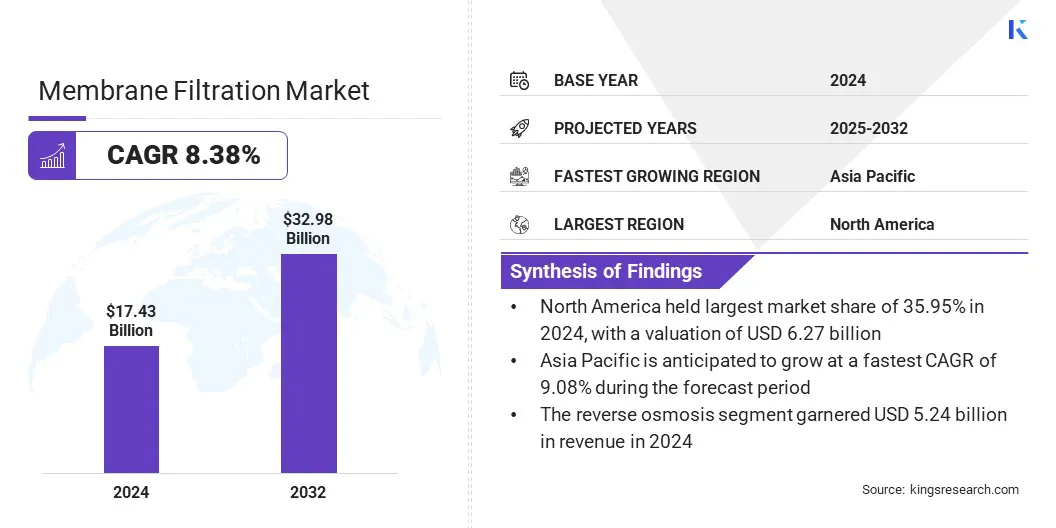
The global membrane filtration market size was valued at USD 17.43 billion in 2024 and is projected to grow from USD 18.78 billion in 2025 to USD 32.98 billion by 2032, exhibiting a CAGR of 8.38% during the forecast period.
Market growth is driven by expanding industrial activity and rapid urban population growth. This trend increases demand for advanced membrane filtration systems across municipal and industrial water infrastructure networks worldwide.
Major companies operating in the membrane filtration market are 3M, Koch IP Holdings, LLC, GEA Group Aktiengesellschaft, Pall Corporation, Veolia, ALFA LAVAL, SPX FLOW, Inc., DuPont, ProMinent GmbH, Pentair, Porvair Filtration Group, SUEZ SA, TORAY INDUSTRIES, INC., Asahi Kasei Corporation, and Nitto Denko Corporation.
Market growth is driven by the increasing production of biologics, vaccines, and cell-based therapies requiring precise separation and purification processes. Rising regulatory scrutiny on product purity and process consistency strengthens demand for advanced filtration solutions. Manufacturers invest in high-performance membranes to improve yield, scalability, and contamination control across upstream and downstream operations.
Continuous processing adoption further accelerates membrane usage for clarification, concentration, and sterile filtration. These trends reinforce membrane filtration as a critical technology within modern biopharmaceutical manufacturing workflows, supporting drug safety and efficacy.
Expanding water reuse initiatives are driving the adoption of membrane filtration technologies as water scarcity, contamination risks, and public health concerns intensify across municipal and industrial sectors. Stricter discharge regulations and higher water quality standards enforced by environmental regulators are prompting utilities and industrial operators to deploy advanced treatment solutions capable of meeting reuse requirements.
Municipal water authorities and industries increasingly adopt membrane filtration due to its effectiveness in removing pathogens, dissolved salts, and emerging contaminants from wastewater and process streams.
Investments in treatment infrastructure modernization and government supported recycling and reuse programs further accelerate deployment, positioning membrane filtration as a core technology for delivering consistent, regulatory compliant water across potable reuse, industrial reuse, and environmental discharge applications.
High upfront capital requirements limit membrane filtration adoption by increasing financial pressure on cost-sensitive municipal and industrial operators. Equipment procurement, infrastructure upgrades, and process integration demand significant initial spending, while costs for advanced membranes, pressure systems, and control units restrict affordability for small and mid-sized facilities.
Installation complexity raises expenditures further through site-specific engineering and skilled labor needs, slowing deployment in developing regions and budget-constrained applications.
Manufacturers are addressing these constraints by developing modular system designs, improving energy efficiency, and optimizing lifecycle costs. Vendors also offer leasing models and phased deployment options that reduce initial capital exposure, shorten installation timelines, and improve return on investment, supporting gradual adoption among financially constrained end users.
The membrane filtration market is influenced by the rising adoption of advanced membrane technologies that deliver higher selectivity, improved flux rates, and enhanced chemical resistance. Continuous innovation in polymeric and ceramic membranes supports efficient separation across complex industrial and municipal processes.
Industries increasingly adopt next-generation membranes to reduce fouling, lower energy consumption, and extend operational lifecycles. Integration of automation and smart monitoring improves process control and performance consistency. These advancements align membrane systems with digital tools that enable real-time diagnostics, predictive maintenance, and data-driven filtration optimization.
|
Segmentation |
Details |
|
By Type |
Reverse osmosis, Ultrafiltration, Microfiltration, Nanofiltration |
|
By Module Design |
Spiral wound, Tubular systems, Plates & frames and hollow fibers |
|
By Material |
Polymeric, Ceramic |
|
By Application |
Water & wastewater, Food & beverages, Dairy products, Drinks & concentrates, Wine & beer, and Others |
|
By Region |
North America: U.S., Canada, Mexico |
|
Europe: France, UK, Spain, Germany, Italy, Russia, Rest of Europe |
|
|
Asia-Pacific: China, Japan, India, Australia, ASEAN, South Korea, Rest of Asia-Pacific |
|
|
Middle East & Africa: Turkey, U.A.E., Saudi Arabia, South Africa, Rest of Middle East & Africa |
|
|
South America: Brazil, Argentina, Rest of South America |
Based on region, the market has been classified into North America, Europe, Asia Pacific, Middle East & Africa, and South America.
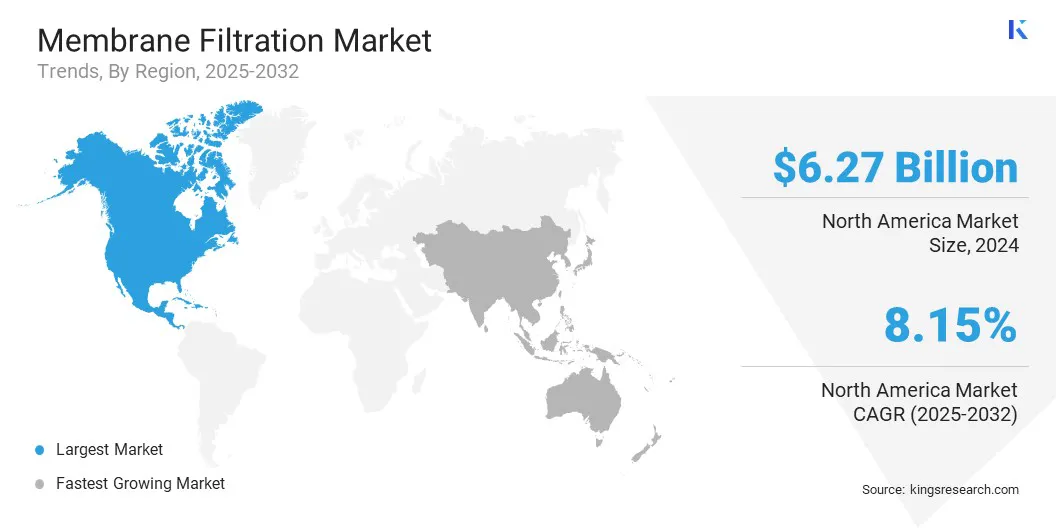
North America accounted for 35.95% of the membrane filtration market in 2024, with a valuation of USD 6.27 billion, due to the widespread deployment of membrane filtration systems for municipal drinking water treatment, wastewater reuse, industrial process water, and food and beverage filtration applications.
Moreover, the demand is driven by sustained capital investments by municipal utilities, industrial manufacturers, and commercial operators to upgrade treatment infrastructure and meet tightening federal and state water quality regulations.
Regulatory enforcement by environmental and public health agencies related to industrial discharge limits, potable water standards, and reuse mandates is accelerating the adoption of reverse osmosis, ultrafiltration, and nanofiltration technologies. Replacement of aging treatment assets across water utilities and industrial facilities further supports recurring system and membrane demand in this region. These factors are driving the growth of the market across North America.
Asia Pacific membrane filtration industry is set to grow at a CAGR of 9.08% over the forecast period due to increasing industrialization, rapid urban expansion, and rising pressure on water resources. Increasing investments in municipal water treatment capacity and industrial wastewater management are driving large-scale adoption of membrane systems.
Expansion of food and beverage processing, pharmaceuticals, and specialty chemicals manufacturing is further supporting the demand for high-efficiency filtration technologies. Governments and utilities are prioritizing advanced treatment solutions to address water scarcity and pollution challenges, thereby driving market growth in this region.
Key players in the membrane filtration industry are focusing on capacity expansion, technology advancement, and portfolio diversification to maintain competitiveness. Companies are actively investing in research and development to enhance membrane durability, fouling resistance, and separation efficiency across applications. Moreover, they are developing modular systems to address varying customer requirements and deployment scales.
Frequently Asked Questions

Antriksh is an experienced analyst specializing in cross-domain research across diverse industries. With a strong foundation in data analysis and statistical interpretation, he delivers insightful market reports that guide strategic decision-making. Antriksh excels in conducting primary research, with a focus on identifying trends and understanding consumer behavior. Thriving in dynamic and high-pressure environments, he combines analytical expertise with a commitment to delivering impactful outcomes. Beyond his professional pursuits, Antriksh's passion for travel fuels his curiosity and broadens his perspectives, enriching his ability to uncover unique insights that enhance his research capabilities. He is equally adept at synthesizing quantitative findings with qualitative context, which allows him to present holistic viewpoints to clients. His disciplined work ethic and intellectual agility make him a trusted partner in navigating market uncertainties. He consistently seeks out new methodologies to refine his analytical toolkit, and his ability to communicate complex insights clearly ensures stakeholders act confidently on his recommendations.
Habi is a seasoned research and consulting leader with renowned experience in guiding clients on strategic growth and transformation initiatives across global markets. He has led high-performing research teams that deliver actionable insights on market expansion, M&A strategies, opportunity assessment, new business development, and product launches. His project portfolio spans large petrochemical producers, electronic device manufacturers, lubricants companies, and other leading enterprises across diverse industrial and consumer sectors. He currently heads the research department at Kings Research, where he is responsible for setting the research agenda, mentoring analysts, and ensuring client-ready deliverables that support executive decision-making. With extensive experience in market intelligence, strategic research, and consulting, Habi brings a strong understanding of evolving industry dynamics, competitive landscapes, emerging opportunities, and business growth challenges. His expertise includes developing research frameworks, translating complex market data into actionable strategic recommendations, and working closely with senior stakeholders to address critical business questions. He has also contributed to building research capabilities, strengthening analytical methodologies, and driving a culture of quality and insight-led decision-making within research teams. His cross-industry exposure enables him to connect market trends with broader business implications and provide perspectives that help organizations identify opportunities, mitigate risks, and make informed strategic decisions.



.webp&w=128&q=75&dpl=dpl_DPva2LrvfsBdTJm1XZj67UTrvMHL)
