
Inquire Now
Key Strategic Points
The nutraceuticals market covers the production and distribution of products derived from food sources, offering extra health benefits along with basic nutritional value. The term combines ‘nutrition’ and ‘pharmaceutical,’ indicating its dual role in providing nourishment as well as medicinal benefits. The market constitutes a wide range of isolated nutrients, dietary supplements, herbal products, specific diets, and processed foods like cereals, soups and beverages.
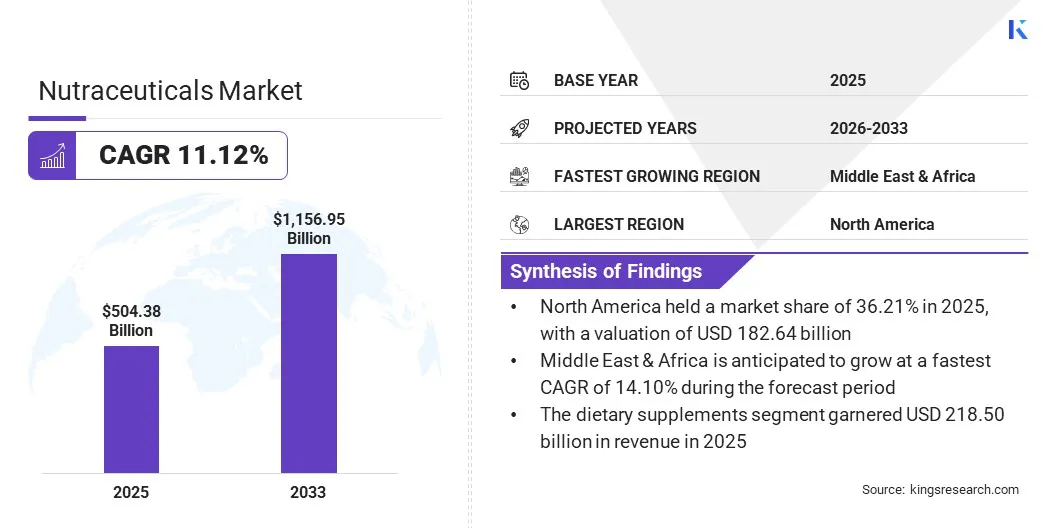
The global market was valued at USD 504.38 billion in 2025 and is projected to reach USD 1,156.95 billion by 2033, representing a CAGR of 11.12% over the forecast period. Nutraceuticals are widely used for preventing chronic diseases, improving health, delaying aging process, and enhancing bodily functions. These benefits act as major adoption drivers for the market.
There are a number of companies operating in the global nutraceuticals market, for example, Nestlé S.A., Abbott, Danone S.A., ADM, Sanofi, Amway, Glanbia PLC, Herbalife International, Guardian Healthcare Services Pvt. Ltd., Suntory Holdings Limited, Nature's Way Brands, LLC, Givaudan, Yakult Honsha Co., Ltd., DSM-Firmenich AG, and GNC Holdings, LLC.
These companies capitalize on the major market trends such as increasing lifestyle-related chronic diseases and the consequent demand for clean-label, plant-based, and sustainably developed nutraceutical formulations.
The increasing preference for preventive healthcare among consumers to maintain well-being and protect against chronic diseases is driving the market. These products are derived from food sources and provide nutrients that lack in average consumer diet. Nutraceuticals also support bodily functions, enhances the immune system, digestive system, and cardiovascular health.
One example of nutraceuticals is iron effervescent tablets. They assist consumers with iron deficiency, supporting energy levels leading to increased vitality. These nutraceuticals, specifically designed to fill nutritional gaps, are gaining considerable market share.
The increasing presence of counterfeit nutraceutical products pose a tangible risk to market growth, brand credibility, and consumer safety. The presence of grey markets reduces transparency across supply chains after dispatch from manufacturing sites.
To address these challenges, market players are adopting innovative strategies such as security labels featuring unique, serialized QR codes or NFC-enabled labels for individual sales unit. This approach offers tamper-evident security with integrated unique QR codes, real-time verification, and automated alerts for duplicate scans or suspicious activity.
Personalized nutraceutical products with dietary recommendations based on consumers’ unique biological characteristics, has emerged as a notable trend in the nutraceuticals industry. This approach involves extracting user data such as DNA tests, gut microbiome analysis, and blood biomarker assessments to determine specific nutrients and custom nutraceuticals required by specific users.
Pharmaceutical companies are transforming nutraceuticals industry by combining their expertise with nutrition resulting in pharma-nutra convergence. The approach involves rigorous clinical research to develop nutraceuticals that meet regulatory requirements and pharma-grade production standards. As a result, nutraceuticals are transforming from conventional over-the-counter (OTC) products to prescription-grade products.
|
Segmentation |
Details |
|
By Type |
Dietary Supplements, Functional Foods, Functional Beverages, Others |
|
By Distribution Channel |
Supermarkets/Hypermarkets, Convenience Stores (Pharmacies), Online Retail, Others |
|
By Application |
Immune Support, Energy & Sports Nutrition, Cognitive Health & Mental Wellness, Cardiovascular Health, Gastrointestinal/Gut Health, Others |
|
By Region |
North America: U.S., Canada, Mexico |
|
Europe: France, UK, Spain, Germany, Italy, Russia, Rest of Europe |
|
|
Asia-Pacific: China, Japan, India, Australia, ASEAN, South Korea, Rest of Asia-Pacific |
|
|
Middle East & Africa: Turkey, U.A.E., Saudi Arabia, South Africa, Rest of Middle East & Africa |
|
|
South America: Brazil, Argentina, Rest of South America |
Based on region, the global nutraceuticals market has been segmented into North America, Europe, Asia Pacific, Middle East and Africa, and South America.
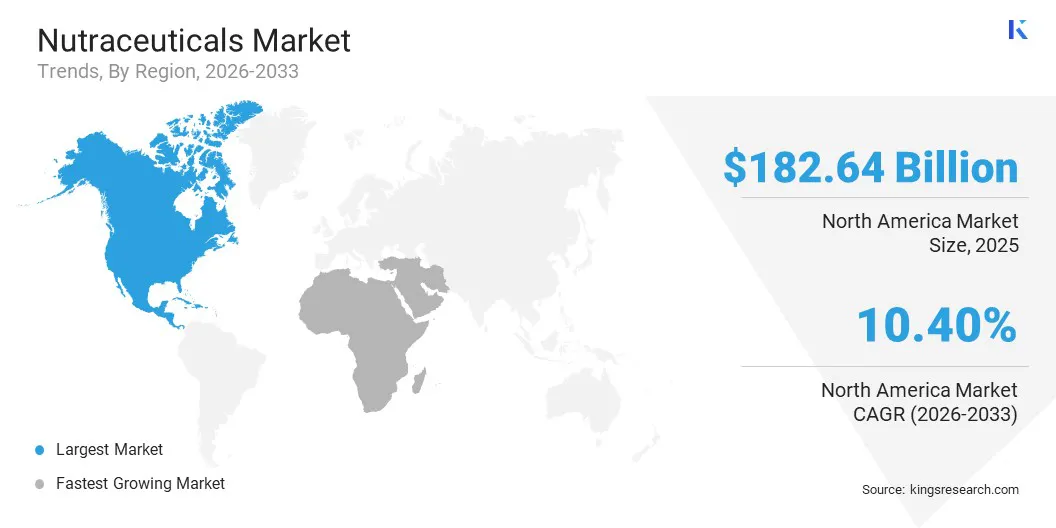
The North America nutraceuticals market share stood at 36.21% with a valuation of USD 182.64 billion in 2025. The continued shift toward preventive care and proactive wellness management across the U.S. and Canada are the major driving factors for this market.
Additionally, the aging demographics affected by joint degradation and mobility issues drives the demand for geriatric nutraceutical supplements in the region. According to Centers for Disease Control and Prevention (CDC), nearly 33 million adults in the U.S. suffer from osteoarthritis. This indicates a high demand for wellness supplements, specifically for healthier bones and joints. Such trends are further enabling consumers to adopt nutraceuticals and driving the market share.
The Middle East and Africa market is set to grow at the fastest growth rate of 14.10% over the forecast period. The increase in demand for nutraceuticals associated with aging demographics is driving the market. According to the United Nations Department of Economic and Social Affairs, in 2025, the maximum number of people aged 65 years and older in the U.A.E. were 203,356, 4.37% higher than mid-2024. This steady rise in old age population drives the demand for geriatric nutraceutical products, thus driving market development in the region.
Key players operating in the nutraceuticals market, such as Nestlé S.A., Abbott, Danone S.A., ADM, Sanofi, Amway, Glanbia PLC, Herbalife International, Guardian Healthcare Services Pvt. Ltd. and others, are focusing on strengthening product innovation and operational efficiency through technical collaborations and acquisitions to capture wider market share and meet the product demand.
Companies are further investing in advanced quality purification systems and novel formulations to enhance the bioavailability, purity, and functional performance of nutraceuticals. Players are further expanding production capacities and integrating sustainable sourcing practices to ensure adherence to clean-label and active nutraceutical ingredient inclusion in products.
Frequently Asked Questions

Faizy brings over four years of experience in market research and consulting, with a proven ability to support strategic engagements across diverse industries and business environments. His work focuses on understanding complex market structures, identifying emerging opportunities, and translating research findings into clear, commercially relevant insights. With strong analytical capabilities and a structured approach to problem-solving, he evaluates industry trends, competitive landscapes, customer dynamics, and evolving business models. His expertise encompasses market research, competitive intelligence, market sizing and forecasting, industry assessment, company benchmarking, and strategic analysis. Faizy combines technical proficiency with a strong research orientation, enabling him to interpret both qualitative and quantitative information effectively. He has contributed to projects that help organizations assess growth potential, strengthen market positioning, and evaluate strategic priorities. His adaptable approach allows him to work across sectors while maintaining a consistent focus on accuracy, relevance, and delivering insights that support informed decision-making for clients and stakeholders.
Smriti Vinodia is a market research and consumer insights professional with expertise in qualitative research, consumer behavior, and strategic market intelligence across the FMCG and FMCD industries. She has experience supporting leading brands by transforming complex consumer and market insights into actionable strategies that inform product development, innovation, positioning, and business growth. Her expertise spans qualitative consumer research, market and competitive intelligence, consumer trend analysis, and AI-enabled insight generation. She has worked across diverse research engagements, helping organizations understand evolving consumer needs, identify emerging market opportunities, and strengthen customer-centric decision-making. Combining analytical rigor with a strong understanding of consumer psychology and market dynamics, Smriti brings a strategic perspective to research and insights. She focuses on connecting consumer behavior with commercial priorities, enabling organizations to make informed decisions, develop relevant products and experiences, and build sustainable growth strategies in rapidly evolving and competitive markets.