
Inquire Now
Key strategic points
The marine collagen market includes the extraction, production, formulation, and commercialization of collagen derived from marine sources, including fish skin, scales, bones, and other seafood by-products. This market includes the production and sale of collagen and its derivatives across five primary end-use sectors: nutraceuticals, food and beverages, cosmetics, pharmaceuticals, and biomedical applications. The high demand for marine collagen in tissue engineering, wound-healing, weight management, and glycemic control are primarily fueling the growth of marine collagen market.
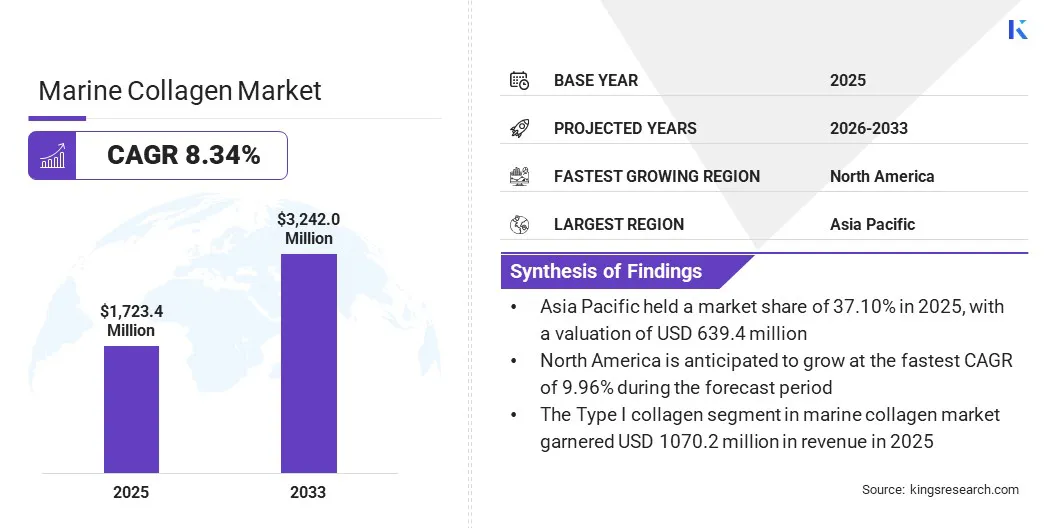
The global marine collagen market was valued at USD 1723.4 million in 2025 and is projected to reach USD 3242.0 million by 2033, at a CAGR of 8.34% over the forecast period. Its wide application in skin care formulations for enhancing hair thickness, skin hydration, and elasticity, and for reducing wrinkles and nail brittleness is fueling its market share. The aforementioned applications indicate various growth avenues for marine collagen products in skin care and nutraceutical segments.
Major companies operating in the global marine collagen market are Darling Ingredients, GELITA AG, Weishardt Group, NITTA GELATIN, INC., Nippi, Inc., Seagarden AS, Ashland, Croda International Plc, Nestlé Health Science, Titan Biotech, ITALGEL S.p.A., Amicogen, Lapi Gelatine, NORLAND PRODUCTS INCORPORATED, and innoVactiv.
Collagen manufacturers are focusing their product development strategies on novel packaging solutions and clean label ingredients sourced ethically from marine animals. Specialized formulations containing Vitamins, hyaluronic acid, amino acids, biotin, and other ingredients, are also attracting a wide base of consumers toward marine collagen products further leading to market growth.
Marine collagen offers functional benefits, such as anti-aging and beauty-enhancing properties, to skincare products. It improves skin elasticity and hydration, reducing in wrinkles and fine lines, and also improves hair and nail health. These properties support product adoption across health-conscious, aging, as well as premium beauty consumers. Furthermore, skin aging is a widely recognized problem. This process is accelerated by various external factors such as UV exposure, dietary patterns, and smoking habits.
Marine collagen products are being used across consumer groups for restoring vitality and slowing the aging process. Their high absorption and bioavailability drives their usage across nutraceuticals, functional foods, dietary supplements, cosmetics, and medical applications. The rising preference for natural and clean-label ingredients is further fueling marine collagen adoption as it is safer, more sustainable, and ethically sourced compared to bovine and porcine collagen products.
Fluctuations in raw material availability negatively impact the marine collagen market, creating an inconsistent supply base for market players. Diverse fish species, jellyfish, and sea cucumbers generally exhibit higher collagen yields (with higher levels of Type I collagen), compared to crustaceans and mollusks. This variation in extraction efficiency across marine species leads to inconsistent raw material productivity, making it difficult for manufacturers to maintain stable, large-scale production.
Marine collagen extraction in itself is a multistep and time-intensive process that reduces the process efficiency, restricts scalability, and increases manufacturing costs. Furthermore, factors such as habitat destruction, pollution, climate change, and extensive fishing activities also impact raw material availability. The State of the World Fisheries and Aquaculture (SOFIA, 2024) report exhibits decline in global marine fish stocks by 2.3% due to climate change, marine pollution, habitat degradation, overfishing, and weak marine management practices. This decline reduces raw material availability, causing supply shortages and price volatility.
Market players are, therefore, focusing on advanced technologies to increase extraction efficiency and adopting more sustainable and cost-effective processes to stabilize raw material supply and reduce dependency on wild marine resources.
A notable trend is the emergence of oral hydrolyzed marine collagen in the form of ready-to-drink (RTD) beverages in convenient, pre-packaged liquid shots or ampoules forms. The demand for easily absorbable, fast-melting powders or granules is also gaining traction in the market.
Additionally, formulations infused with a blend of hydrolyzed Type I marine collagen with Vitamin C, silica, hyaluronic acid, or resveratrol for enhanced efficacy are witnessing a growth in market share.
|
Segmentation |
Details |
|
By Type |
Type I, Type II, Type III, Type V, Type X, Others |
|
By Form |
Powder, Liquid, Pills/Capsules, Others |
|
By Application |
Food and Beverages, Coatings & Films, Nutraceuticals, Cosmetics & Personal Care, Others |
|
By Region |
North America: U.S., Canada, Mexico |
|
Europe: France, UK, Spain, Germany, Italy, Russia, Rest of Europe |
|
|
Asia-Pacific: China, Japan, India, Australia, ASEAN, South Korea, Rest of Asia-Pacific |
|
|
Middle East & Africa: Turkey, U.A.E., Saudi Arabia, South Africa, Rest of Middle East & Africa |
|
|
South America: Brazil, Argentina, Rest of South America |
Based on region, the global marine collagen market has been segmented into North America, Europe, Asia Pacific, Middle East and Africa, and South America.
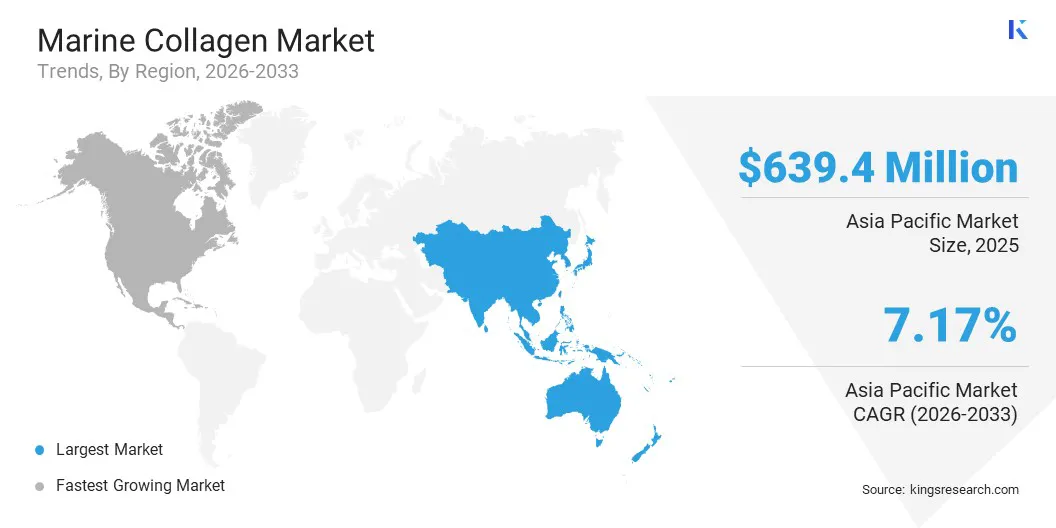
The Asia Pacific marine collagen market held 37.10% share of the marine collagen market, which was valued at USD 639.4 million in 2025. The rising demand for clean ingredients in nutraceutical formulations and personal care products across the region is fueling the Asia Pacific marine collagen market. The abundance of rich marine resources and a mature seafood processing industry serving as a key raw material supplier for the marine collagen market, acts as significant market drivers.
Additionally, awareness regarding skin, joint, and bone health supports the demand for marine collagen products due to their bioavailability. Rapid adoption of innovative formulations like gummies, shots, and injectables also acts as major driver for the marine collagen market in the region.
The North America marine collagen market is set to grow at the fastest rate of 9.96% over the forecast period. The rising aging demographics in North America drives collagen demand, affected by joint degradation and mobility issues. The Centers for Disease Control and Prevention (CDC) reports 33 million adults in the U.S. currently suffering from osteoarthritis affecting one or more joints. Additionally, Arthritis Research Canada reports 500,000 youth hurt their knees every year while playing sports with osteoarthritis burden to triple from 4 million to 12 million by 2040. This transition drives the market growth of marine collagen products owing to the willingness of consumers in the region to invest in preventive health measures.
Key players operating in the marine collagen market, such as Darling Ingredients, GELITA AG, Amicogen, NITTA GELATIN, INC., Croda International Plc, Seagarden AS and others, are strengthening innovation and efficiency through strategic collaborations and acquisitions. Market players are also investing in advanced collagen extraction technologies, enzymatic hydrolysis processes, and quality purification systems to enhance their bioavailability, purity, and functional performance. Companies are expanding production and integrating sustainable sourcing practices to ensure adherence to clean-label standards.
Frequently Asked Questions

Faizy brings over four years of experience in market research and consulting, with a proven ability to support strategic engagements across diverse industries and business environments. His work focuses on understanding complex market structures, identifying emerging opportunities, and translating research findings into clear, commercially relevant insights. With strong analytical capabilities and a structured approach to problem-solving, he evaluates industry trends, competitive landscapes, customer dynamics, and evolving business models. His expertise encompasses market research, competitive intelligence, market sizing and forecasting, industry assessment, company benchmarking, and strategic analysis. Faizy combines technical proficiency with a strong research orientation, enabling him to interpret both qualitative and quantitative information effectively. He has contributed to projects that help organizations assess growth potential, strengthen market positioning, and evaluate strategic priorities. His adaptable approach allows him to work across sectors while maintaining a consistent focus on accuracy, relevance, and delivering insights that support informed decision-making for clients and stakeholders.

With over a decade of research leadership across global markets, Ganapathy brings sharp judgment, strategic clarity, and deep industry expertise. Known for precision and an unwavering commitment to quality, he guides teams and clients with insights that consistently drive impactful business outcomes.