
Inquire Now
Key Strategic Points
According to Kings Research, the global bread market size is projected to grow from USD 215.76 billion in 2025 to USD 310.89 billion by 2033, registering a CAGR of 4.74% from 2026 to 2033.
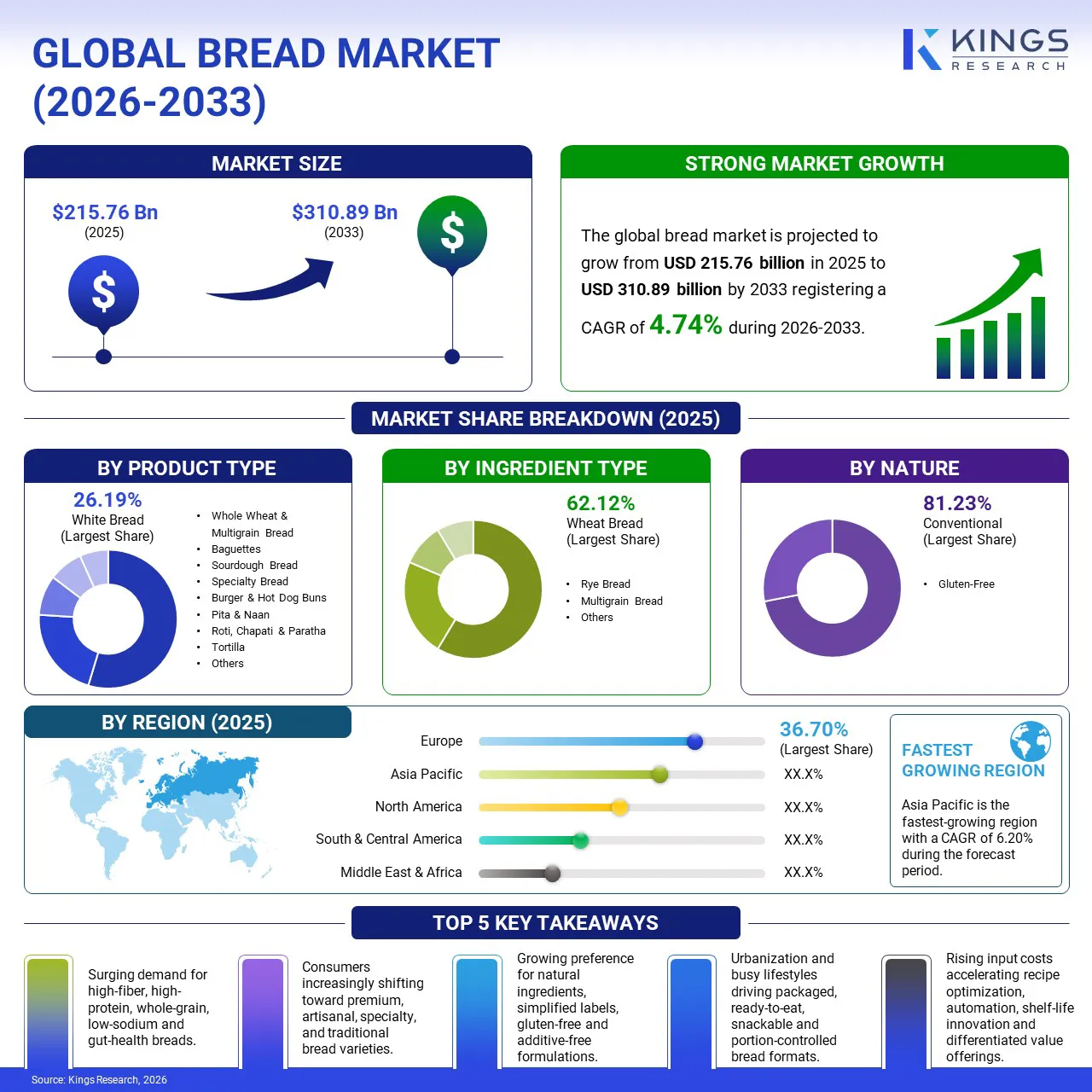
The global bread market is shifting from a basic staple toward a more premium, health-focused category. Consumers increasingly seek clean-label ingredients, sourdough, whole grains, high-fiber, and protein-rich breads. In response, major bread companies are simplifying formulations and reducing artificial additives.
Growth is expected to remain steady, driven by rapid urbanization, rising packaged bread consumption in emerging markets, and expanding e-commerce and quick commerce channels. Meanwhile, major bakery companies are adjusting product portfolios and pursuing consolidation to address declining bread consumption in mature Western markets.
|
Segmentation |
Details |
|
|
By Product Type |
White Bread, Whole Wheat & Multigrain Bread, Baguettes, Sourdough Bread, Specialty Bread, Burger & Hot Dog Buns, Pita & Naan, Roti, Chapati & Paratha, Tortilla, Others |
|
|
By Ingredient Type |
Wheat Bread, Rye Bread, Multigrain Bread, Others |
|
|
By Nature |
Conventional, Gluten-Free |
|
|
By Distribution Channel |
Off-Trade (Supermarkets & Hypermarkets, Convenience Stores, Independent Grocery Stores, Specialty Stores/Bakeries, Online Retail, Others), On-Trade (Restaurants & Cafés) Hotels, Institutional Foodservice, Others) |
|
|
By Region |
North America |
U.S., Canada, Mexico |
|
Europe |
France, UK, Spain, Germany, Italy, Russia, Rest of Europe |
|
|
Asia-Pacific |
China, Japan, India, Australia, ASEAN, South Korea, Rest of Asia-Pacific |
|
|
Middle East and Africa |
Turkey, U.A.E., Saudi Arabia, South Africa, Rest of Middle East & Africa |
|
|
South and Central America |
Brazil, Argentina, Rest of South and Central America |
|
Rising consumer preference for healthier bread products fortified with essential nutrients, including fiber, protein, vitamins, minerals, and complex carbohydrates, is fueling market growth. Whole-grain and wheat bread formulations offer higher fiber and micronutrient content, encouraging bakery companies to develop products that combine nutrition with taste and convenience.
Fermented products such as sourdough are gaining consumer interest due to their digestive health and natural benefits. This is prompting market players to adopt natural ingredients and reduce artificial preservatives, colors, and flavors to address rising consumer and retailer demand for clean-label bread products.
Key Insight: Ingredient transparency, functional nutrition, and fermentation-based differentiation are gaining importance in bread innovation, encouraging multinational and regional bakers to reformulate established products and add functional nutrition claims to mainstream formats.
The bread industry remains highly sensitive to wheat price fluctuations, as wheat is a core ingredient, apart from other essentials, including sugar, palm oil, or soybean oil, that significantly influence production costs. Exposure to weather variability, energy prices, and shifting global trade flows negatively impacts bread pricing structure, hampering its growth avenues.
According to the Food and Agriculture Organization (FAO), global wheat prices surged by 5.8 percent and were standing 9.9 percent above their year-earlier level. The increase is attributed to rising concerns over continued disruptions to Black Sea export flows and damage to export infrastructure. The increment is further compounded by the impact of recent heatwaves on crop yields in several key producing countries.
To mitigate cost pressures, bread manufacturers are adopting bakery premixes in modern baking. The solution offers simplified production, reducing batch errors and processing time, and ensures consistent bread quality.
Key Insight: Rising wheat and flour costs are squeezing bakery profits, while changing consumer diets are reducing demand in mature markets, prompting manufacturers to pursue premiumization, portfolio consolidation, and cost-pass-through pricing strategies to protect profitability.
The rising consumer preference for protein-fortified bread configurations is influencing product innovation and transforming market dynamics. Protein has emerged as a sought-after attribute, prompting manufacturers to introduce high-protein loaves, keto-positioned buns, and gluten-free formats targeting health-conscious consumers.
Common high-protein bread types, including lupin bread (22-33%), pea protein bread (20-25%), gluten-enriched bread (18-23%), and soy seed bread (16-22%), are offering diverse bread varieties to health-conscious consumers.
Additionally, the growing adoption of gluten-free bread is driven by increasing consumer awareness of celiac disease and gluten sensitivity. Consumers without diagnosed conditions are also opting for gluten-free products due to perceived digestive and wellness benefits.
Key Insight: Protein fortification and gluten-free formulations are converging as a unified innovation trend, with bakers integrating attributes once associated with specialty diets into mainstream bread products to sustain volumes amid growing low-carb preferences.
The global bread market remains moderately consolidated, led by multinational baking companies alongside strong regional and heritage brands. Market players are strengthening their positions through strategic acquisitions and capacity expansion to broaden product portfolios and expand geographic reach.
Key Insight: Competitive differentiation is shifting from shelf presence and pricing toward broader portfolios spanning premium, functional, and free-from categories, with M&A and capacity investment serving as key growth factors.
Europe dominated the market with a share of 36.7% in 2025, generating a valuation of USD 79.18 billion. Bread preferences vary significantly across European nations, primarily due to distinct local traditions and consumption habits.
France remains strongly associated with the traditional baguette, while Spain retains staples such as barra de pan. Italy shows a more balanced preference for pane casareccio/pane comune, ciabatta, and focaccia, while Germany is characterized by strong demand for bread rolls and wholegrain options. These diverse consumption patterns are encouraging manufacturers to adopt locally tailored assortments rather than a single European bread strategy.
South and Central America is projected to register the fastest CAGR of 8.5% over the forecast period. This growth is fueled by the rising demand for bakery foods and increasing reliance on imported wheat. Chile has the highest per capita bread consumption in South America, estimated at 198 pounds, with Peru continuing to see growth in bread, snacks, and other wheat-based products, according to the Washington Grain Commission.
Colombia also presents significant growth potential, with the market dominated by artisan bread, which accounts for around 91% of total bread sales, while packaged sandwich bread represents only 9%, presenting opportunities for the expansion of organized and packaged bakery formats.
Bread demand is further concentrated in key urban markets, with Bogotá and the surrounding central highland region accounting for nearly 80% of Colombia’s daily bread consumption. These trends highlight a strong consumption base and evolving bakery preferences, enabling market players to align production strategies accordingly.
Key Insight: Europe’s scale and consumption depth position it as the anchor region, even as its wrapped-bread category undergoes consolidation. Meanwhile, rising urbanization and localized product innovation in South and Central America are expected to make the region a key driver of volume growth over the forecast period.
Bread markets in developed economies operate under long-established compositional and labeling standards, while regulators are increasingly extending oversight into nutrition-based front-of-pack claims and competition review of bakery-sector consolidation.
Key Insight: Regulatory attention is increasingly focused on standardized food information, ingredient safety, and regulatory harmonization, while competition authorities continue to scrutinize consolidation across food and bakery sectors.
Capital deployment in the industrial bread sector is following a two-track strategy. Large commercial players are engaging in targeted mergers and acquisitions to consolidate capacity in declining packaged-bread categories while directing capital expenditure toward higher-margin segments like gluten-free, premium specialty products, and export-driven food service lines.
Key Insight: Investment activity is concentrated in two areas: defensive consolidation to rationalize excess wrapped-bread capacity in mature, declining markets, and offensive capital expenditure to expand gluten-free, specialty, and export-oriented capacity. Accordingly, capacity-rationalizing M&A and premium-format investments represent the highest-conviction investment opportunities over the forecast period.
How We Gather This Information
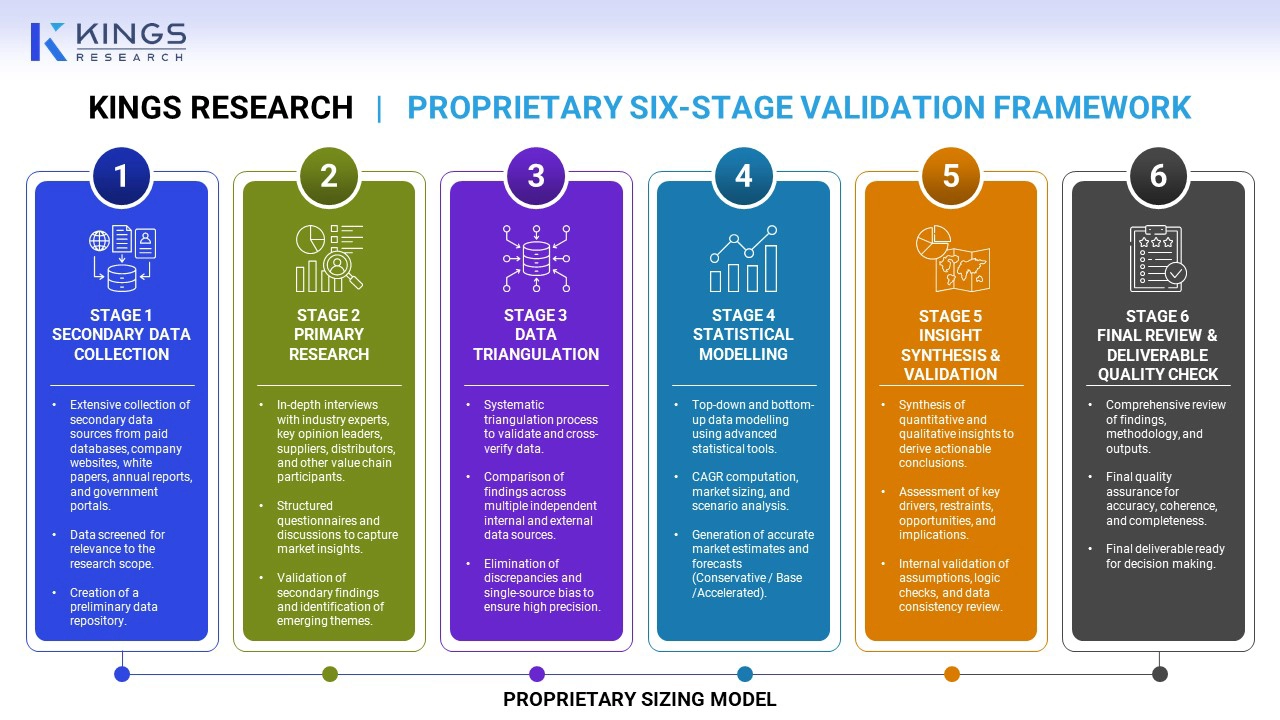
Our methodology triangulates insights from multiple independent and publicly available research databases, which is further validated against regulatory filings and public company disclosures. All estimates are cross-verified; no single-source data is presented without validation.
Our custom offerings deliver tailored, data-driven intelligence and strategic guidance to help organizations identify, evaluate, and capitalize on key market opportunities.
Frequently Asked Questions

Faizy brings over four years of experience in market research and consulting, with a proven ability to support strategic engagements across diverse industries and business environments. His work focuses on understanding complex market structures, identifying emerging opportunities, and translating research findings into clear, commercially relevant insights. With strong analytical capabilities and a structured approach to problem-solving, he evaluates industry trends, competitive landscapes, customer dynamics, and evolving business models. His expertise encompasses market research, competitive intelligence, market sizing and forecasting, industry assessment, company benchmarking, and strategic analysis. Faizy combines technical proficiency with a strong research orientation, enabling him to interpret both qualitative and quantitative information effectively. He has contributed to projects that help organizations assess growth potential, strengthen market positioning, and evaluate strategic priorities. His adaptable approach allows him to work across sectors while maintaining a consistent focus on accuracy, relevance, and delivering insights that support informed decision-making for clients and stakeholders.
Habi is a seasoned research and consulting leader with renowned experience in guiding clients on strategic growth and transformation initiatives across global markets. He has led high-performing research teams that deliver actionable insights on market expansion, M&A strategies, opportunity assessment, new business development, and product launches. His project portfolio spans large petrochemical producers, electronic device manufacturers, lubricants companies, and other leading enterprises across diverse industrial and consumer sectors. He currently heads the research department at Kings Research, where he is responsible for setting the research agenda, mentoring analysts, and ensuring client-ready deliverables that support executive decision-making. With extensive experience in market intelligence, strategic research, and consulting, Habi brings a strong understanding of evolving industry dynamics, competitive landscapes, emerging opportunities, and business growth challenges. His expertise includes developing research frameworks, translating complex market data into actionable strategic recommendations, and working closely with senior stakeholders to address critical business questions. He has also contributed to building research capabilities, strengthening analytical methodologies, and driving a culture of quality and insight-led decision-making within research teams. His cross-industry exposure enables him to connect market trends with broader business implications and provide perspectives that help organizations identify opportunities, mitigate risks, and make informed strategic decisions.