
Inquire Now
Key Strategic Points
The food enzymes market involves the production, distribution, and commercialization of enzymes tailored for food processing and manufacturing. These biological catalysts are used to enhance various processes such as fermentation, preservation, flavor development, texture improvement, and shelf life extension in food and beverage products. The market encompasses different types of enzymes, such as carbohydrase, proteases, and lipases, and serves industries, including bakery, dairy, beverages, and confectionery.
The global food enzymes market size was valued at USD 2,490 million in 2025 and is projected to grow from USD 2,637.1 million in 2026 to USD 4,150.4 million by 2033, exhibiting a CAGR of 6.69% during the forecast period. This growth is primarily driven by the increasing demand for processed and convenience foods, rising awareness of health and wellness, and the ongoing shift toward clean-label and natural food ingredients.
Major companies operating in the global food enzymes market are Novonesis, dsm-firmenich, International Flavors & Fragrances Inc., AB Enzymes, Kerry Group plc., ADM, Puratos, Lesaffre International, Amano Enzyme Inc., Advanced Enzyme Technologies, Biocatalysts, Dyadic Applied Biosolutions, SternEnzym GmbH & Co. KG, Enzyme Development Corporation (EDC), and Sunson Industry Group Co., Ltd.
Technological advancements in enzyme engineering and expanding applications in emerging markets are expected to accelerate market expansion over the coming years. As the food industry continues to innovate, the adoption of enzyme-based solutions is anticipated to become even more widespread, supporting both product quality and sustainability initiatives.
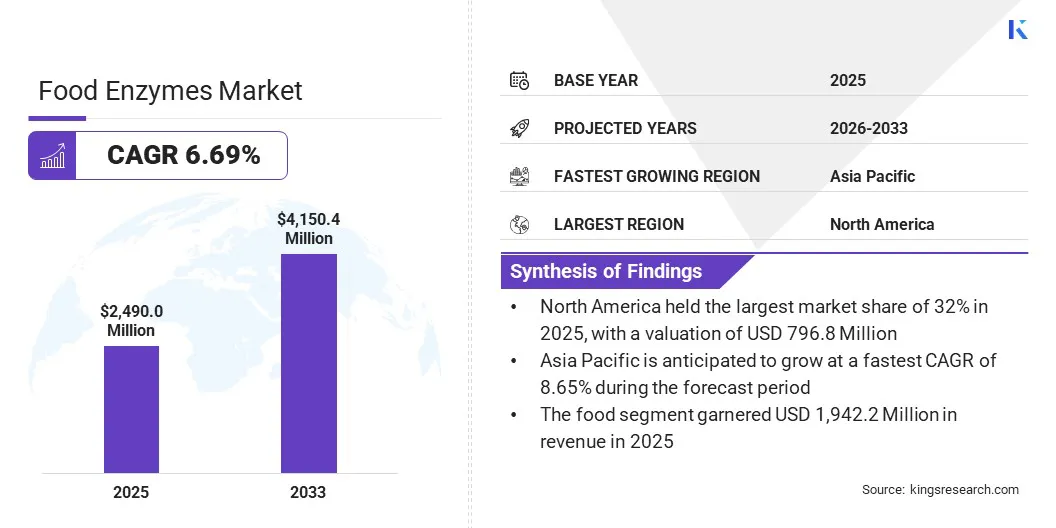
Consumers are increasingly seeking ready-to-eat, easy-to-prepare, and packaged foods to suit busy lifestyles, and manufacturers need advanced ingredients to improve texture, flavor, shelf life, and nutritional value. Food enzymes are essential for improving production efficiency, supporting clean-label initiatives, and contributing to the production of healthier and more appealing products.
The increasing demand for convenience foods is particularly strong among urban populations, which is further driving the use of food enzymes across various sectors, including bakery, dairy, beverage, and processed foods. As preferences evolve, the food enzyme market is set to witness continued expansion in the coming years.
Preserving enzyme functionality across diverse processing conditions presents a major challenge to market progress. Enzymes are sensitive to temperature, pH, moisture, and processing methods, which can significantly affect their activity and stability during food manufacturing. With the diversification of food products and processing technologies, the need to ensure uniform enzyme performance has become more complex. The variability in raw materials, the use of severe processing conditions, and the requirement for a long product shelf life further increase the complexity of using enzymes.
To overcome this challenge and to improve the robustness of enzyme preparations, manufacturers are investing in enzyme engineering and formulation improvements, including encapsulation and stabilizers. Close collaboration between enzyme producers and food manufacturers is also critical to developing tailored solutions for specific processing needs.
Advances in enzyme engineering and biotechnology are emerging as a notable market trend by enabling the development of highly specific, efficient, and stable enzymes tailored for modern food processing. Cutting-edge techniques such as protein engineering, directed evolution, and recombinant DNA technology allow for the fine-tuning of enzyme properties to deliver optimal performance under challenging conditions.
These innovations result in enzymes with improved activity, greater tolerance for temperature and pH variations, and enhanced substrate specificity. The ability to customize enzymes expands their application range while also supporting clean-label formulations and sustainability goals. As research continues to push boundaries, these technological breakthroughs are expected to drive market growth and foster the development of novel food products.
|
Segmentation |
Details |
|
By Type |
Carbohydrase, Protease, Lipase, Polymerase & Nuclease, and Others |
|
By Application |
Food and Beverages |
|
By Source |
Microorganisms, Plants, and Animals |
|
By Formulation |
Lyophilized Powder, Liquid, and Others |
|
By Functional Role |
Hydrolysis, Tenderization, Shelf Life Enhancement, and Others |
|
By Region |
North America: U.S., Canada, Mexico |
|
Europe: France, UK, Spain, Germany, Italy, Russia, Rest of Europe |
|
|
Asia-Pacific: China, Japan, India, Australia, ASEAN, South Korea, Rest of Asia-Pacific |
|
|
Middle East & Africa: Turkey, U.A.E., Saudi Arabia, South Africa, Rest of Middle East & Africa |
|
|
South America: Brazil, Argentina, Rest of South America |
Based on region, the global food enzymes market has been classified into North America, Europe, Asia Pacific, Middle East & Africa, and South America.
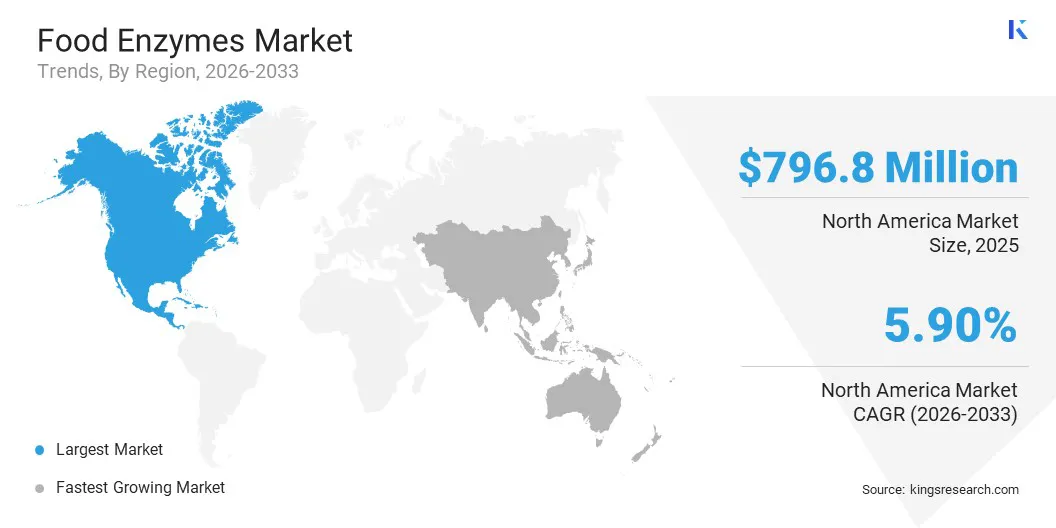
North America food enzymes market share stood at 32% in 2025, with a valuation of USD 796.8 million. The dominance is attributed to the well-established food processing industry, strong consumer demand for convenience and functional foods, and stringent regulatory standards supporting the adoption of advanced enzyme technologies. Continuous innovation by regional manufacturers, along with growing consumer health consciousness, has boosted the use of enzymes in improving product quality and safety.
In addition, the presence of major enzyme producers and ongoing investments in research & development facilitate the rapid commercialization of new enzyme solutions. The rising trend toward clean-label and sustainable products further supports domestic market growth.
The Asia-Pacific food enzymes market is set to grow at a CAGR of 8.65% over the forecast period. This growth is propelled by rapid urbanization, rising disposable incomes, and changing dietary preferences for processed and convenience foods. The expansion of the food and beverage sector is creating a strong demand for enzyme solutions to improve product quality, shelf life, and nutritional value.
Growing health & wellness awareness, along with the increasing preference for convenient and functional foods, is further accelerating the adoption of enzymes. Investments in food processing infrastructure, a supportive policy framework, and the adoption of advanced enzyme technologies by local manufacturers are also contributing to regional market expansion.
The food enzymes market is characterized by a wide range of global and regional players, all of whom are striving to increase their market share through innovation, new product launches, and strategic partnerships. Major players are focusing on developing advanced enzyme products for specific food categories such as bakery, dairy, and beverages, in line with changing consumer preferences.
Mergers, acquisitions, and exclusive distribution agreements are common strategies to expand product portfolios and penetrate new markets. The development of highly efficient and stable enzymes remains a key focus of intensive research and development activities. In addition, there is a growing emphasis on sustainability, clean-label products, and collaborations with food manufacturers to address industry challenges and explore new market opportunities.
Frequently Asked Questions

Aswathi holds cross-domain expertise, translating market trends and competitive intelligence into decision-ready insights. Her work helps clients interpret evolving market conditions and identify growth opportunities. She brings a focused, insight-led approach to research execution. She translates these findings into clear, prioritized action plans that align with client capabilities. Her research often includes scenario modeling to test growth strategies under varying economic conditions. She maintains a rigorous validation process, cross-checking primary and secondary sources to ensure reliability. Clients value her ability to synthesize noisy data into concise executive summaries that drive board-level discussions. Her sector-specific lens, combined with a pragmatic focus on execution, consistently delivers high-impact, commercially sound recommendations. Her structured yet flexible research frameworks adapt to client timelines without compromising depth. She is known for distilling complex trade-offs into straightforward, defensible positions that facilitate confident decision-making.
Smriti Vinodia is a market research and consumer insights professional with expertise in qualitative research, consumer behavior, and strategic market intelligence across the FMCG and FMCD industries. She has experience supporting leading brands by transforming complex consumer and market insights into actionable strategies that inform product development, innovation, positioning, and business growth. Her expertise spans qualitative consumer research, market and competitive intelligence, consumer trend analysis, and AI-enabled insight generation. She has worked across diverse research engagements, helping organizations understand evolving consumer needs, identify emerging market opportunities, and strengthen customer-centric decision-making. Combining analytical rigor with a strong understanding of consumer psychology and market dynamics, Smriti brings a strategic perspective to research and insights. She focuses on connecting consumer behavior with commercial priorities, enabling organizations to make informed decisions, develop relevant products and experiences, and build sustainable growth strategies in rapidly evolving and competitive markets.