

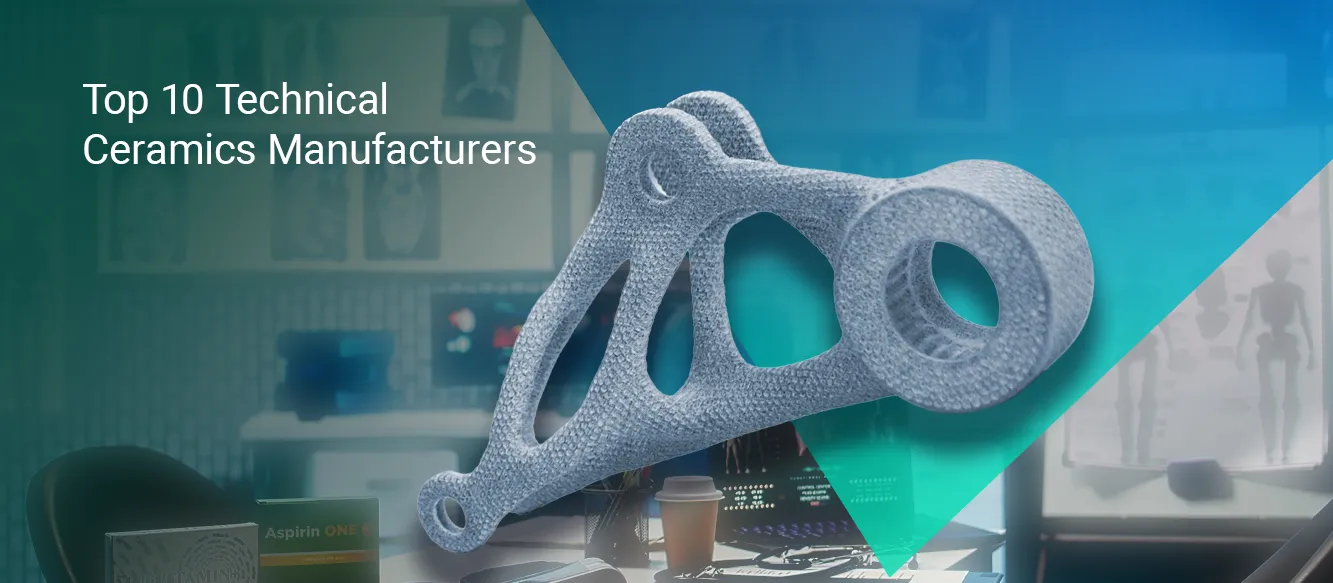
Advanced hardware demands materials that can survive extreme environments. This is why technical ceramics are rapidly replacing traditional silicon in everything from AI data centers to electric vehicles.
Industry analysts note that this sector is currently experiencing a massive influx of institutional capital. According to Kings Research, the global technical ceramics market was valued at USD 10.02 billion in 2024 and is projected to reach USD 15.15 billion by 2031, with a CAGR of 6.09% over the forecast period.
For the executives behind this innovation, a major issue is the threat to the revenues they promise. The high cost of shaping the material is the main problem. Traditional methods like precision grinding and machining are very expensive. This severely limits profit margins. To preserve capital, companies in this sector now need to shift their strategy to additive manufacturing.
This blog is your direct guide to using 3D printing. By adopting this approach, you can avoid traditional machining costs, optimize capital expenditures (CapEx), and ensure sustained, long-term profitability.
List of Key Companies in the Technical Ceramics Market
The following significant players are implementing key business strategies, including alliances, mergers, acquisitions, new product development, and joint ventures, to expand their product ranges and market share across different regions.
- 3M
- CeramTec GmbH
- CoorsTek Inc.
- Elan Technology
- Elster GmbH
- Morgan Advanced Materials
- Ortech Ceramics
- Saint-Gobain
- KYOCERA Corporation
- OC Oerlikon Management AG
The New Financial Paradigm for Industrial Ceramics Manufacturers
Defining the Modern Technical Ceramics Industry
Industrial ceramics manufacturers produce advanced, non-metallic, inorganic materials engineered for extreme performance. Unlike traditional materials, these technical ceramics have exceptional thermal stability. They also offer electrical insulation and superior wear resistance.
As modern industries push the physical limits of hardware, these materials have transitioned from niche applications to absolute necessities. They are the non-negotiable foundation of next-generation infrastructure. These materials power everything from high-voltage energy grids to advanced aerospace shielding.
The Hidden Threat to Profitability: The Machining Margin Trap
However, strong top-line market growth does not automatically translate to bottom-line corporate health. Technical ceramics are exceptionally hard and brittle. They often rank just below diamonds on the Mohs hardness scale. The machining margin trap occurs when manufacturers rely on traditional diamond-tool grinding and milling. They use these methods to achieve precise tolerances on fully sintered parts.
This subtractive process is extremely slow and destroys expensive tooling. It also causes significant material waste via micro-fractures. These compounded inefficiencies can quietly overpower the profits projected by that 6.09% market growth.
Overcoming the Machining Trap: Additive Manufacturing as a Financial Strategy
Traditional Precision Grinding vs. CapEx for 3D Printing
Treating additive manufacturing as an R&D prototyping tool is a strategic miscalculation. It is fundamentally an OpEx reduction platform. Ceramic binder jetting requires no expensive lasers, no high-temperature print environment, and no custom diamond tooling. This removes the three primary cost drivers in conventional precision grinding workflows. A 2024 peer-reviewed analysis in Additive Manufacturing Frontiers confirms that the core commercial appeal of ceramic 3D printing lies in eliminating the need for molds and tooling. This directly compresses multi-day machining schedules into shorter production cycles with lower personnel overhead.
Industrial operations use large-format ceramic additive manufacturing systems to process large ceramic components. This large-format platform features a 600-by-600-by-300-millimeter build platform. The top-down stereolithography approach enables printing without mechanically attached supports. This specialized method helps reduce cleaning time and post-processing effort for technical teams. Consequently, the platform efficiently supports the serial production of large-scale ceramic parts.
Calculating the ROI of Binder Jetting and Sintering Upgrades
To fully escape the machining trap, CXOs must reconsider their capital allocation frameworks. The average CapEx required to integrate industrial-grade ceramic printing systems is significant; the return on investment accelerates rapidly when several factors are considered.
- The outright elimination of custom diamond tooling.
- Drastically reduced scrap and fracture rates.
- Shortened time-to-market for complex, iteratively designed prototypes.
Larger production facilities benefit from design standardization and insights from early adopters.
Material Segmentation: Why Oxide Ceramics Command the Market
The Market Dominance of Oxides
Oxide ceramics are a core material group in technical ceramics because they are widely used for electrical insulation, wear resistance, and thermal stability. Alumina and zirconia are among the most common oxide materials in industrial use, which is why oxide ceramics remain central to many advanced manufacturing and semiconductor applications within the global technical ceramics market.
Substituting Silicon in High-Stress Environments (AI and 5G)
As 5G infrastructure and artificial intelligence expand globally, hardware is drawing unprecedented power to process larger workloads and increasingly complex models. In high-power applications, traditional silicon substrates are being pushed closer to their thermal limits, making heat dissipation, signal integrity, and long-term reliability harder to maintain. Materials engineered for better thermal performance help prevent critical hardware failure and signal degradation in telecom infrastructure, where uptime and consistency are essential.
Balancing Performance with Processing Costs
Material selection is an ongoing economic balancing act. While non-oxides like silicon carbide offer superior thermal conductivity and mechanical performance, processing costs remain substantially higher. A recent study on SiC ceramics notes that densification often requires high-temperature sintering under controlled or protective atmospheres, with some routes also depending on sintering aids or pressure-assisted methods. Consequently, these rigorous requirements naturally raise the processing costs of SiC relative to standard alumina ceramics.
Geopolitics and Raw Material Sovereignty in the Technical Ceramics Industry
Decoupling from Eastern Supply Chain Bottlenecks
The technical ceramics supply chain is heavily concentrated. This presents a potential geopolitical risk that corporate boards must address. Currently, market observers note that many North American and European manufacturers are highly dependent on imports from the Asia-Pacific region. This dependency involves raw, high-purity alumina and zirconia powders.
Near-Shoring as a Risk Mitigation Strategy
Near-shoring powder production closer to end-use manufacturing facilities directly reduces dependency on Asia-Pacific suppliers. Coupling this with localized ceramic 3D-printing hubs eliminates long-haul shipping dependencies and reduces lead times. Together, these measures create a resilient, regionally anchored supply network. This strategy insulates technical ceramics manufacturers from trade tariffs, export controls, and broader macroeconomic shocks.
Ranking the Top Technical Ceramics Manufacturers and Capital Allocation
To compile this list of the top 10 technical ceramics manufacturers, we anchored our selection in the proprietary data from the latest Kings Research market report. Companies were evaluated based on their disclosed revenue, proactive capital expenditure (CapEx), and overall global market share. Furthermore, we heavily prioritized vendors demonstrating mature additive manufacturing (AM) capabilities and recent strategic expansions, such as new factory openings or M&A activity. This criterion ensures the list reflects the most resilient and forward-looking players shaping the industrial supply chain in 2026.
|
Company |
Material Specialty |
Recent CapEx / M&A Move |
Additive Manufacturing Capability |
|
3M |
Silicon carbide, boron carbide |
Broad R&D and portfolio expansion |
High / Advanced materials |
|
CeramTec GmbH |
Medical ceramics (BIOLOX) |
PE-backed organic capacity expansion |
High / Medical-grade AM |
|
CoorsTek Inc. |
Semiconductor & aerospace ceramics |
Expanded manufacturing footprint in Gumi. |
High / Semiconductor components |
|
Elan Technology |
High-precision glass, alumina, zirconia |
Specialized precision capacity scaling |
Developing / Prototyping |
|
Elster GmbH |
Sensor & measurement ceramics |
Integration into industrial metering |
Niche application |
|
KYOCERA Corporation |
Electronic & semiconductor ceramics |
Continued planned capex through Mar 2028 |
High / High-volume electronics |
|
Morgan Advanced Materials |
Medical, power, & aero components |
£50–55M annual CapEx guidance |
High / Precision components |
|
OC Oerlikon Management AG |
Surface solutions & ceramic powders |
Expansion of 3D printing powders |
Leader in AM material supply |
|
Ortech Ceramics |
Specialized, low-volume components |
Capturing niche EV/aerospace share |
Early adopter / Agile AM |
|
Saint-Gobain |
Hexoloy SiC, high-purity alumina |
Global supply chain scaling |
Industrial-scale AM integration |
1. 3M
- What they make: A wide array of advanced ceramics, including silicon carbide, boron carbide, and silicon nitride.
- Market position: A massive, diversified global manufacturer using deep materials science expertise across multiple industrial verticals.
- Strategic focus: Secures its market footprint through unmatched global R&D capabilities and technical ceramics engineered specifically for high-wear, thermal management, and defense applications.
2. CeramTec GmbH
- What they make: High-performance ceramics with a dominant focus on medical technology, notably BIOLOX ceramic components that serve as a global reference standard in orthopedic implants.
- Market position: A leading medical ceramics manufacturer backed by long-term private equity ownership via CPP Investments and BC Partners.
- Strategic focus: Pursues aggressive organic capacity expansion in the high-barrier medical ceramics segment, where material precision and regulatory compliance create strong competitive advantages.
3. CoorsTek Inc.
- What they make: Engineered technical ceramics tailored for semiconductor, aerospace, defense, and electronics applications.
- Market position: A premier global manufacturer focused on meeting the expanding demand for semiconductor equipment.
- Strategic move: Announced the grand opening of its third factory in Gumi, South Korea, in August 2024 to scale production of semiconductor components.
4. Elan Technology
- What they make: High-precision glass and advanced technical ceramics, with a strong focus on alumina and zirconia components.
- Market position: A leading independent U.S.-based manufacturer known for custom-engineered parts.
- Strategic focus: Maintains a specialized focus on high-precision manufacturing to meet the demanding tolerance requirements of the electronics, telecommunications, and aerospace industries.
5. Elster GmbH
- What they make: Advanced technical ceramics integrated into highly durable precision measurement and sensing devices.
- Market position: Part of a broader industrial conglomerate, operating as a heavyweight in advanced utility metering and specialized industrial sensors.
- Strategic focus: Leverages the wear-resistant, thermally stable properties of technical ceramics to extend the lifecycle and enhance the accuracy of critical measurement infrastructure.
6. KYOCERA Corporation
- What they make: High-precision electronic components and specialized semiconductor ceramics.
- Market position: A globally dominant technology conglomerate with a strong focus on precision electronic components.
- Strategic move: Investing ¥68 billion (approximately USD 469 million) in semiconductor ceramics capacity, with manufacturing ramping up in 2026 and total spending planned through March 2028.
7. Morgan Advanced Materials
- What they make: High-precision components for the medical device, power electronics, semiconductor, and aerospace industries.
- Market position: A major international materials science company driving consistent organic capital expansion.
- Strategic move: Guiding annual CapEx of £50–55 million (approximately USD 63–70 million) to significantly increase manufacturing capacity for its core precision components.
8. OC Oerlikon Management AG
- What they make: Advanced surface solutions, functional coatings, and specialized ceramic powders.
- Market position: A recognized global leader in surface engineering and materials optimized for additive manufacturing.
- Strategic focus: Driven by advanced ceramic surface technologies and an expanding portfolio of ceramic powders designed for industrial 3D printing and wear protection.
9. Ortech Ceramics
- What they make: Specialized, low-volume, custom-engineered technical ceramic components.
- Market position: An agile mid-market player capitalizing on the operational sluggishness of legacy enterprise supply chains.
- Strategic move: Adopted 3D printing early to efficiently capture growing opportunities across niche aerospace and bespoke electric vehicle (EV) applications.
10. Saint-Gobain
- What they make: High-performance specialty ceramics, including Hexoloy silicon carbide and advanced alumina materials.
- Market position: One of the world's most established materials science conglomerates, with an extensive global manufacturing footprint.
- Strategic focus: Sustains leadership through continuous material innovation and scalable production capabilities supporting aerospace, energy, and semiconductor supply chains.
Frequently Asked Questions (FAQs)
Who are the top technical ceramics manufacturers?
The leading global manufacturers in the technical ceramics industry include 3M, CeramTec GmbH, CoorsTek Inc., Elan Technology, Elster GmbH, Morgan Advanced Materials, Ortech Ceramics, Saint-Gobain, KYOCERA Corporation, and OC Oerlikon Management AG.
What is the size of the technical ceramics market?
According to Kings Research, the global technical ceramics market was valued at USD 10.02 billion in 2024 and is projected to reach USD 15.15 billion by 2031. The sector is growing at a compound annual growth rate (CAGR) of 6.09% over the forecast period.
What does Ortech Ceramics make?
Ortech Ceramics is an agile industry innovator specializing in manufacturing low-volume, custom-engineered, high-precision ceramic components. They primarily supply specialized parts to niche aerospace developments and bespoke electric vehicle (EV) markets.
How does 3D printing cut ceramic machining costs?
Traditional technical ceramic shaping relies on subtractive diamond-tool precision grinding, which is slow, rapidly wears down tooling, and results in high material waste. Additive manufacturing methods, like ceramic binder jetting, eliminate the need for custom molds and specialized diamond tooling entirely. This shifts the manufacturing framework from an expensive precision-grinding schedule to a highly compressed, low-overhead production cycle.
Deep-Dive Intelligence: Inside the Kings Research Premium Report
The macroeconomic data provided above represent merely the surface layer of a rapidly evolving sector. For executives who need immediate, actionable intelligence, the Kings Research Premium technical ceramics report includes proprietary vendor scorecards. These scorecards rank the top global manufacturers based on their supply chain resilience and additive manufacturing maturity.
In 2026, the technical ceramics sector requires a balance between material performance and strategic operational upgrades. By embracing advanced additive manufacturing and selecting the right industrial partners, forward-looking enterprises can successfully mitigate supply chain risks, bypass traditional precision machining bottlenecks, and secure long-term profit margins.