

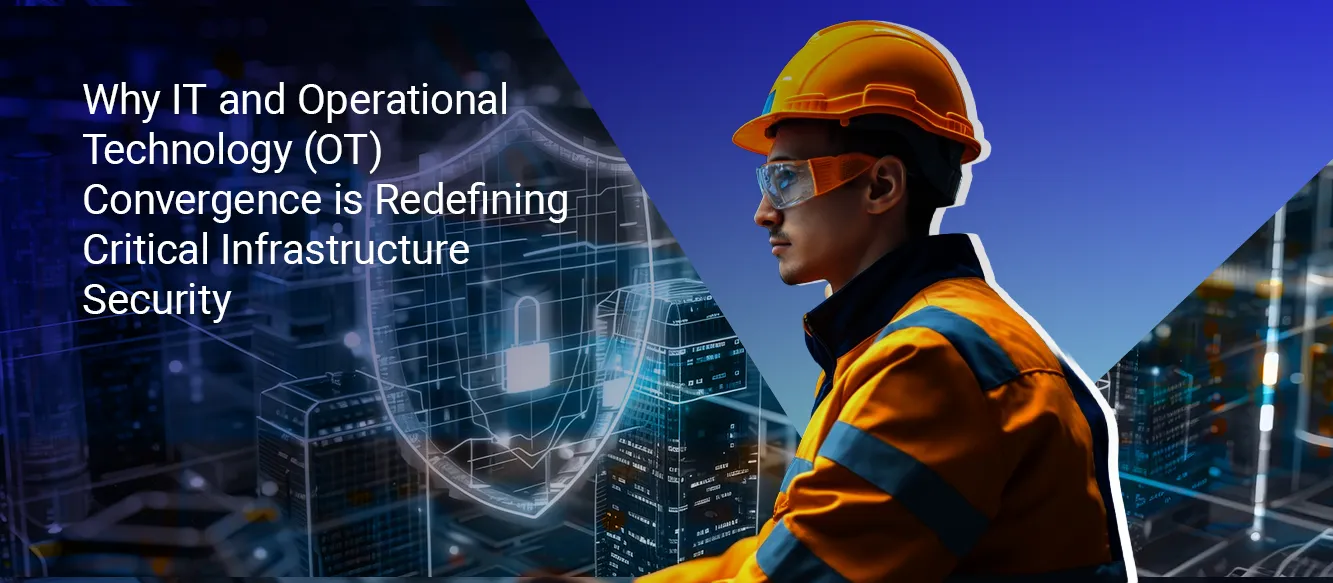
Digital transformation has connected the world's power grids, water systems, factories, and transportation networks in ways that were unthinkable a decade ago. Cloud platforms, industrial IoT sensors, AI-driven analytics, and remote monitoring tools now sit alongside the control systems that keep the physical world running. Environments that were once isolated by design are now linked directly to enterprise IT.
That linkage, often called IT/OT convergence, is reshaping how organizations approach critical infrastructure security. It brings real operational gains: faster decisions, predictive maintenance, and centralized visibility across plants, grids, and fleets. But it also stretches the cyberattack surface into territory that traditional security models were never built to defend. Securing IT and OT together has quickly become a board-level priority rather than a technical afterthought, and it's fueling investment in AI-driven monitoring, Zero Trust architectures, and cyber resilience programs across energy, manufacturing, utilities, and transportation.
According to Kings Research, the global critical infrastructure protection market was valued at USD 153.72 billion in 2025 and is projected to reach USD 250.45 billion by 2033, representing a CAGR of 6.39% over the forecast period. This growth is mainly driven by the rise in physical and cyber threats targeting industrial infrastructure.
Market Snapshot
|
Metric |
Value |
|
Global Critical Infrastructure Protection Market (2025) |
USD 153.72 Billion |
|
Forecast Market Size (2033) |
USD 250.45 Billion |
|
CAGR |
6.39% |
|
Largest Security Type |
Physical Security |
|
Fastest Growing Segment |
Cybersecurity |
Figures reflect industry market research on the critical infrastructure protection sector; see the market report referenced later in this article for full segmentation.
Three questions frame the rest of this guide:
- Why are IT and OT environments converging in the first place?
- Why does that convergence increase cyber risk rather than simply improving efficiency?
- And why is the perimeter-based security that most organizations still rely on no longer sufficient to protect them?
This blog will answer all these questions.
Why IT and OT Were Traditionally Separated
Information Technology (IT) and Operational Technology (OT) were built for different jobs. IT exists to manage data: email, applications, financial systems, and enterprise software, with confidentiality typically ranked as the top priority. OT exists to run physical processes: turbines, pumps, valves, and assembly lines, where availability and safety come first, sometimes with tolerances measured in milliseconds.
For most of their history, these two domains operated on separate networks, with separate teams, separate vendors, and separate risk models. Legacy industrial systems were frequently air-gapped from the corporate network entirely, and many were designed decades ago with an expected lifespan of 20 to 30 years, long before cyber threats were part of the design conversation. That isolation was, in effect, the security control.
What is IT/OT convergence?
IT/OT convergence is the integration of information technology systems, which manage data and business applications, with operational technology systems, which control physical industrial processes. It connects previously isolated plant-floor equipment to enterprise networks and cloud platforms, improving efficiency and visibility while expanding the pathways available to attackers.
Why IT/OT Convergence is Accelerating Across Industries
The isolation that once protected OT is disappearing because it no longer fits how modern operations need to run. A handful of forces are driving that shift:
- Industrial IoT sensors now feed real-time equipment data into analytics platforms.
- Smart manufacturing initiatives depend on shared data between plant floors and enterprise systems.
- Cloud platforms host the analytics and storage capacity that on-site infrastructure can't match.
- Predictive maintenance programs use machine data to schedule repairs before failures occur.
- Remote operations let engineers monitor and adjust equipment from outside the facility.
- Digital twins model physical assets virtually, requiring constant data exchange with the real ones.
- Industry 4.0 initiatives, broadly, treat connected data as a competitive requirement rather than an option.
Organizations can no longer run OT as a closed island. The efficiency gains of connected operations, fewer unplanned outages, faster diagnostics, and lower energy use are too significant to pass up. But every one of those connections is also a new pathway into systems that were never designed to resist intrusion.
How IT/OT Convergence is Expanding the Cyberattack Surface
Why does IT/OT convergence increase cyber risk?
- It connects legacy Industrial Control Systems (ICS) and SCADA equipment, much of it running outdated software, directly to internet-facing networks.
- It multiplies the number of connected devices, many of which cannot support modern endpoint security agents.
- It expands access to third-party and remote maintenance in environments that were previously physically isolated.
- It introduces supply chain dependencies, where a vulnerability in a vendor's equipment or software becomes an entry point into the plant.
- It removes the air gap that historically served as the primary line of defense.
A simplified view of how data and risk now flow through a converged environment:
Enterprise IT → Cloud → Industrial Network → SCADA → ICS → Physical Infrastructure
Each arrow in that chain represents a connection that didn't exist, or existed only in a controlled, isolated form, before convergence. An attacker who compromises a phishing target in enterprise IT can, in a poorly segmented environment, eventually reach the equipment that manages a power substation or a water treatment plant.
The scale of the problem is not theoretical. A Congressional Research Service brief confirms that a China-linked group known as Salt Typhoon infiltrated multiple U.S. telecommunications providers beginning around 2024, an intrusion into infrastructure that security officials have called one of the most serious telecom breaches in the country's history. The incident illustrates how a single sustained campaign against connected infrastructure can expose sensitive data and disrupt trust in essential services long after the initial breach.
Why Traditional Security Models No Longer Work
Perimeter-based security assumes a defensible edge: keep attackers out, and everything inside is safe. That assumption breaks down once IT and OT are connected, remote vendors have standing access, and cloud services sit between the control room and the equipment it manages. Static defenses, a firewall configured once and left alone, can't keep pace with environments that change daily.
|
Traditional Security |
Modern IT/OT Security |
|
Perimeter-based, "trust inside the network" |
Zero Trust, continuous verification of every user and device |
|
Periodic, manual audits |
Continuous, real-time monitoring |
|
Siloed IT and OT security teams |
Unified cross-domain security operations |
|
Static rule sets updated infrequently |
Threat intelligence feeds that update dynamically |
|
Limited visibility into OT assets |
Full asset visibility across IT and OT |
|
Reactive incident response |
Proactive detection and automated response |
The shift is about replacing an entire mindset: from defending a boundary to defending every connection, continuously, across both domains at once.
How AI Is Strengthening IT/OT Security
AI is becoming a practical tool for making converged environments defensible, mainly because it can process the volume of network activity that human analysts cannot review manually.
- Continuous behavioral monitoring establishes a baseline of normal activity for every device, then flags deviations, such as an unusual command sent to a controller or an unexpected data transfer, that would otherwise pass unnoticed.
- Machine learning-based anomaly detection identifies patterns across both IT and OT traffic simultaneously, closing the visibility gap between the two domains.
- Predictive analytics correlates threat signals with asset criticality, helping teams understand which anomalies matter most.
- Automated threat prioritization ranks alerts by their potential business and safety impact, rather than leaving analysts to sort through an undifferentiated queue.
- Automated incident response can isolate a compromised device or segment before an intrusion spreads further into the network.
The flow generally looks like this: Network Activity → AI Analysis → Threat Detection → Risk Prioritization → Automated Response.
In February 2026, Akamai introduced a solution built with NVIDIA that combines Guardicore segmentation software with NVIDIA BlueField data processing units, designed to protect industrial equipment that can’t run traditional security agents, including heavy machinery and legacy control systems. The announcement reflects a broader trend toward AI-assisted security architectures that are built for OT’s constraints rather than simply adapted from IT tools.
Why Zero Trust is Becoming Essential for Industrial Environments
What is Zero Trust in industrial cybersecurity? Zero Trust is a security model that assumes no user, device, or system should be trusted by default, even inside the network perimeter. In industrial environments, continuous identity verification, least-privilege access, and strict controls over machine identities and remote connections are required before any device or person can access a control system.
For OT specifically, Zero Trust principles address problems that perimeter security never solved:
- Identity verification for every user and device, not just those crossing a network boundary.
- Least-privilege access, so a compromised account can't move freely across the environment.
- Machine identities, since most connections in a converged environment are device-to-device rather than human-initiated.
- Continuous authentication, rather than a one-time login that grants standing access.
- Remote access controls are built for the reality that vendors and technicians increasingly connect from outside the facility.
- Third-party vendor security closes off the access paths that supply chain attacks typically exploit.
In August 2025, Forescout Technologies and Xage Security partnered to build Universal Zero Trust Network Access for industrial environments, combining real-time asset visibility with granular access control to prevent unauthorized entry into OT networks. In July 2025, Corsha secured Booz Allen investment to expand Zero Trust protections for machine-to-machine communications through machine identity and access management. Together, these moves reflect a broader shift from perimeter defense to continuous, identity-based verification in industrial networks.
Regulations Are Driving IT/OT Security Modernization
Compliance has moved from a legal checkbox to a genuine driver of security investment, largely because regulators have started treating critical infrastructure resilience as a matter of national security rather than corporate risk management alone.
|
Framework |
Region |
Primary Focus |
Affected Industries |
|
United States |
Mandatory reporting of cyber incidents and ransomware payments to CISA |
16 critical infrastructure sectors, including energy, healthcare, and financial services |
|
|
European Union |
Risk management and incident reporting for essential and important entities |
Energy, transport, health, digital infrastructure, and more |
|
|
Global |
Security levels (SL 1–SL 4) and lifecycle security for industrial automation and control systems |
Energy, manufacturing, transportation, healthcare |
|
|
Australia |
Risk management and reporting for critical infrastructure and Systems of National Significance |
Energy, water, communications, transport, and more |
|
|
United States (used globally) |
Voluntary guidance covering governance, identification, protection, detection, response, and recovery |
All sectors are widely adopted in critical infrastructure |
CIRCIA, for instance, requires covered entities to report significant cyber incidents to CISA within tight timeframes and places clear emphasis on third-party risk, an acknowledgment that many major breaches originate through vendors rather than direct attacks. The EU's CER Directive similarly requires essential service providers to conduct regular risk assessments and build resilience against a wide range of threats, not cyberattacks alone. Together, these frameworks are pushing organizations toward the same practical outcome: integrated, continuously monitored IT/OT security rather than fragmented, sector-specific programs.
Industry Examples: How Organizations Are Strengthening IT/OT Security
Vendors across the industrial and cybersecurity markets are moving in a consistent direction: combining AI, Zero Trust, and unified asset visibility to close the IT/OT gap.
|
Company |
Technology |
Strategic Focus |
|
ABB × Cognite |
Agentic AI integration with ABB Ability SafetyInsight and AlarmInsight |
Real-time data integration and automated workflows across industrial operations |
|
Siemens |
Industrial AI Suite, WinCC Unified |
AI-driven manufacturing operations and data integration |
|
Akamai + NVIDIA |
Guardicore Segmentation with BlueField DPUs |
Protecting un-agentable OT and ICS equipment |
|
Fortinet |
OT Security Platform upgrades |
Threat visibility, ruggedized hardware, and 5G connectivity for industrial sites |
|
Nozomi Networks |
Integration with NVIDIA BlueField-3 DPUs |
Edge-based, real-time OT and IoT threat detection |
|
Forescout Technologies |
Universal Zero Trust Network Access (with Xage Security) |
Secure remote access and access control for industrial environments |
What Infrastructure Operators Should Consider Before Modernizing IT/OT Security
Before committing budget to a modernization program, security and operations leaders generally need clear answers to a short set of questions:
- Asset visibility: Do you have an accurate, current inventory of every connected device across IT and OT?
- Legacy infrastructure: How much of your OT environment is running unsupported or end-of-life systems?
- AI readiness: Do you have the data pipelines and network visibility needed to feed AI-based monitoring tools?
- Cloud integration: How much of your operational data already flows through cloud platforms, and how is that connection secured?
- Third-party access: Can you identify all vendors and contractors with remote access to your systems today?
- Regulatory compliance: Which frameworks, CIRCIA, NIS2, ISA/IEC 62443, or others, apply to your sector and region?
- Incident response capability: Can your team detect and contain an incident that spans both IT and OT within the reporting windows regulators now require?
Is your organization ready for IT/OT convergence?
A simple way to think through it: if you have limited asset visibility, aging OT equipment, and standing third-party access with no continuous monitoring, modernization isn't optional; it's overdue. If you already have strong segmentation, Zero Trust access controls, and unified monitoring, the priority shifts toward refining AI-driven detection and staying ahead of new regulatory requirements.
The Future of Critical Infrastructure Security
Over the next decade, the direction of travel points toward security operations that run with far less manual intervention. AI-native security operations centers, autonomous detection and response systems, and industrial digital twins that model both operational performance and cyber risk together are all moving from early pilots toward standard practice. Unified IT/OT visibility- one dashboard, one data model, one set of policies- will likely replace the split security programs most organizations run today. Cloud-native industrial security platforms will keep expanding, giving operators the ability to monitor distributed assets, from a single substation to an entire regional grid, without the hardware footprint older systems required.
The organizations that adapt early will be better positioned to protect the infrastructure people depend on daily and to support the broader digital transformation initiatives already underway across their sectors.
Frequently Asked Questions
What is IT/OT convergence?
IT/OT convergence is the integration of information technology systems with operational technology systems that control physical industrial processes, connecting previously isolated equipment to enterprise networks and the cloud.
Why is OT cybersecurity important?
OT systems control physical processes, power generation, water treatment, and manufacturing lines, where a cyberattack can cause safety incidents, environmental harm, or service outages, not just data loss.
How does IT/OT convergence increase cyber risk?
It connects legacy industrial equipment to internet-facing networks, expands remote and third-party access, and removes the air-gapped isolation that once served as a primary defense.
What is Zero Trust in OT security?
Zero Trust is a security approach that requires continuous verification of every user, device, and machine identity before granting access, rather than assuming anything inside the network is automatically trustworthy.
What are Industrial Control Systems (ICS)?
ICS refers to the hardware and software used to monitor and control physical industrial processes, including SCADA systems, programmable logic controllers, and distributed control systems.
How does AI improve industrial cybersecurity?
AI improves industrial cybersecurity through continuous behavioral monitoring, anomaly detection across IT and OT traffic, predictive risk analytics, and automated, faster incident response.
Which industries benefit from IT/OT convergence?
Energy, manufacturing, utilities, transportation, oil and gas, and healthcare all benefit from convergence through improved efficiency, predictive maintenance, and centralized operational visibility.
What regulations govern critical infrastructure security?
Key frameworks include CIRCIA in the United States, the NIS2 Directive in the European Union, the SOCI Act in Australia, and the globally applied ISA/IEC 62443 series of standards.
Conclusion
IT/OT convergence is transforming how industrial operations run while also expanding the risks organizations must manage. Perimeter-based security, built for a world of isolated OT networks, is no longer sufficient on its own. What's replacing it is a combination of continuous monitoring, AI-driven detection, Zero Trust access controls, and compliance programs that treat regulatory reporting as part of operational readiness rather than a separate legal obligation.
Companies that invest in resilient, integrated IT/OT security today will be better positioned to protect the infrastructure their communities depend on and to support the digital transformation initiatives that got them here in the first place.
Download the Critical Infrastructure Protection Market Report to explore emerging cybersecurity technologies, competitive developments, regulatory trends, regional opportunities, and future market forecasts shaping the global critical infrastructure protection industry.
Talk to a Critical Infrastructure Security Analyst to assess where your organization stands and what modernization should look like for your sector.