
Inquire Now
Key Strategic Points
According to Kings Research, the global digital freight brokerage market size is projected to grow from USD 7.55 billion in 2025 to USD 53.99 billion by 2033, registering a CAGR of 27.9% from 2026 to 2033.
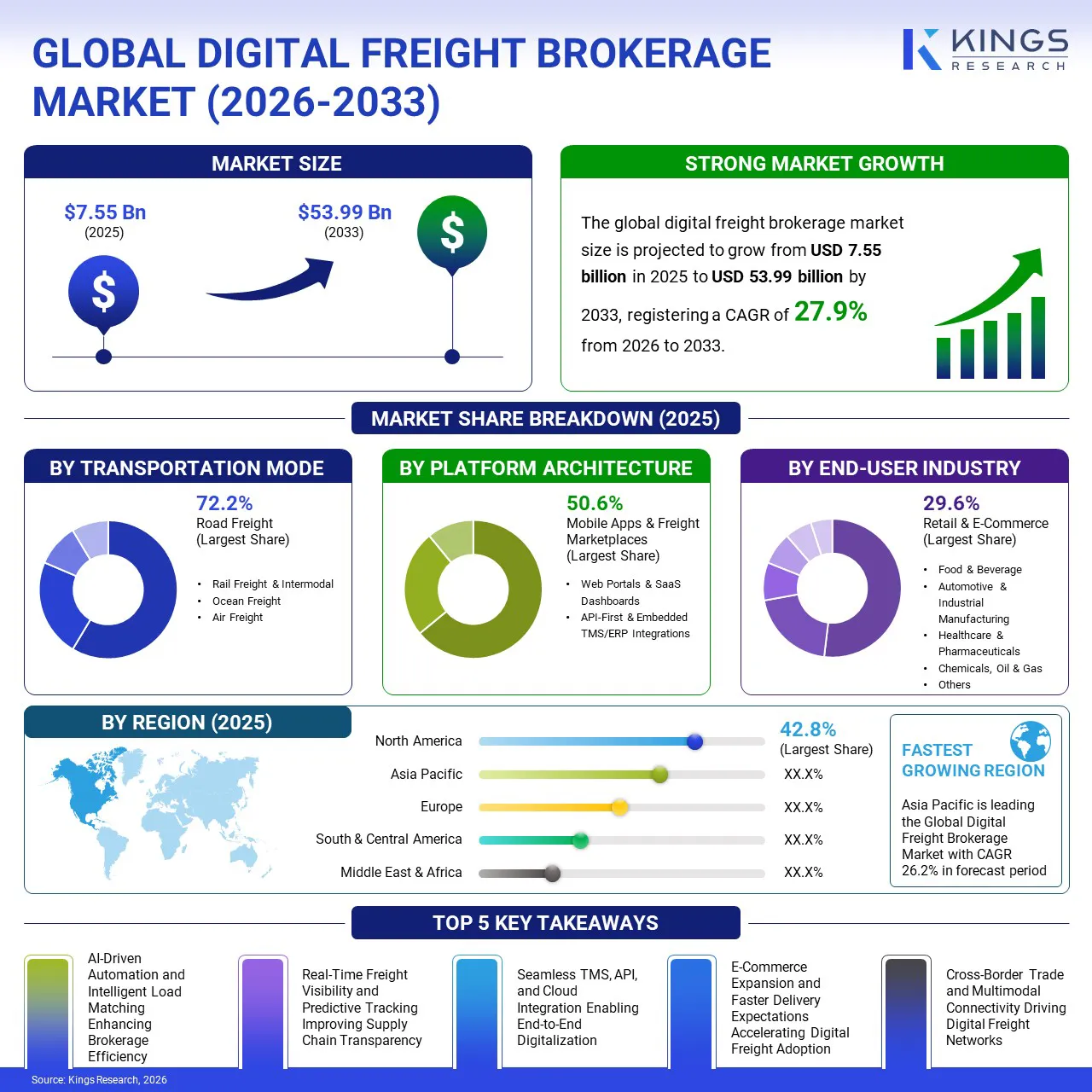
Digital freight brokerage platforms connect shippers with carriers, replacing conventional freight booking processes that rely on manual coordination. The market is evolving beyond basic load matching toward an AI- and automation-driven operating layer, enabling instant carrier matching, predictive pricing, real-time shipment visibility, and automated workflows. Market growth is supported by e-commerce expansion, increasing carrier-network digitization, and rising demand for embedded, API-first freight solutions. Digitalization is therefore becoming a critical competitive differentiator, enabling brokers to enhance operational efficiency, scalability, transparency, and service responsiveness.
Technology adoption in traditional freight brokerage operations is increasing demand for faster, transparent, and reliable shipping solutions. Freight brokerage platforms integrated with advanced Transportation Management Systems (TMS), AI-driven load matching, predictive analytics, automated documentation, real-time freight tracking, social freight-matching platforms, and business intelligence tools are gaining traction.
These technologies enable brokers to streamline operations, match shipments with suitable carriers, optimize routes and pricing, reduce empty miles and delays, automate administrative processes, and provide shippers with accurate, real-time shipment visibility. Additionally, the shift of artificial intelligence from experimental pilots toward commercial deployment in digital freight brokerage is enabling market players to focus on tangible ROI, workflow automation, accuracy, and faster decision-making.
Key Insight: The transition towards intelligent automation is making AI-driven workflow efficiency, real-time visibility, and measurable ROI critical competitive differentiators in the digital freight brokerage market.
Fragmented logistics systems and non-standardized data formats make it difficult for digital freight brokerage platforms to integrate with shippers, carriers, TMS, telematics, and other logistics applications. These challenges increase integration and onboarding costs, reduce the efficiency of automated freight matching, pricing, and tracking operations, and limit adoption among small- and mid-sized carriers.
Additionally, freight-market volatility and low carrier margins constrain investments in digital technologies, slowing digital adoption and favoring larger, better-capitalized platforms with greater capacity to sustain technology investment and expand their networks.
To address this challenge, freight brokers and carriers are employing AI-powered data integration to standardize data sources, improve data accuracy and visibility, reduce manual work, and support better cost optimization and decision-making.
Key Insight: Fragmented systems, limited data interoperability, and low carrier margins are increasing integration costs and hampering digital adoption across the freight brokerage ecosystem.
The integration of Agentic AI into freight brokerage workflows enables task automation, including rate quoting, load matching, shipment tracking, invoice auditing, and scheduling. An AI agent operates within a defined scope and executes tasks without requiring step-by-step instructions. The shift from task-level automation toward multi-agent orchestration is enabling faster execution and scalable operations while retaining human oversight for complex decisions. This supports data-driven freight operations with improved efficiency, responsiveness, and cost competitiveness among digital freight brokerage platforms.
Key Insight: The emergence of Agentic AI is shifting automation from individual tasks toward end-to-end workflow orchestration. Its adoption is enabling faster execution, greater operational scalability, and improved data quality while maintaining human oversight for complex decisions.
|
Segmentation |
Details |
|
|
By Transportation Mode |
Road Freight (Full-Truckload (FTL), Less-Than-Truckload (LTL) & Volume LTL, Refrigerated / Temperature-Controlled (Reefer), Flatbed & Specialized Heavy-Haul), Rail Freight & Intermodal, Ocean Freight, Air Freight |
|
|
By Platform Architecture |
Mobile Apps & Freight Marketplaces, Web Portals & SaaS Dashboards, API-First & Embedded TMS/ERP Integrations |
|
|
By End-User Industry |
Retail & E-Commerce, Food & Beverage, Automotive & Industrial Manufacturing, Healthcare & Pharmaceuticals, Chemicals, Oil & Gas, Others |
|
|
By Region |
North America |
U.S., Canada, Mexico |
|
Europe |
France, UK, Spain, Germany, Italy, Russia, Rest of Europe |
|
|
Asia-Pacific |
China, Japan, India, Australia, ASEAN, South Korea, Rest of Asia-Pacific |
|
|
Middle East and Africa |
Turkey, U.A.E., Saudi Arabia, South Africa, Rest of Middle East & Africa |
|
|
South and Central America |
Brazil, Argentina, Rest of South and Central America |
|
Surging cross-border direct-to-consumer (D2C) e-commerce shipments, coupled with growing demand for digital platforms supporting time-sensitive multimodal routing, are key drivers of the air freight segment's 25.31% CAGR over the forecast interval.
The retail and e-commerce segment accounted for the largest share of 29.62% in 2025. This dominance is attributed to high shipment volumes, variable consumer demand, stringent fulfillment timelines, and growing adoption of automated carrier matching to enhance real-time supply chain visibility.
The global market is moderately consolidated, with asset-light, technology-enabled brokerages competing alongside large, diversified logistics providers and emerging API-first freight technology vendors. The competitive landscape is evolving through strategic mergers and acquisitions as large players expand their technology capabilities, network reach, and service offerings.
Key Insight: Competitive advantage is increasingly shifting toward scale, financial strength, technology capabilities, and access to dense carrier networks as consolidation accelerates. Strategic acquisitions are enabling larger players to strengthen AI-driven pricing and end-to-end logistics capabilities in the booming market.
Based on region, the global digital freight brokerage market has been segmented into North America, Europe, Asia Pacific, the Middle East and Africa, and South and Central America.
North America captured the largest share of 42.81% in 2025, supported by a large, mature freight industry, broker consolidation, and established trade-associated regulatory frameworks. Continued scale-driven mergers and acquisitions, including Cervo AI's acquisition of Alanta or the Descartes acquisition of 3GTMS, reinforce the region's position as a technologically advanced market. Furthermore, the launch of Zayren by Freight Technologies, which is an AI-powered platform that provides real-time freight rate predictions and intelligent carrier matching for domestic and cross-border shipments between Mexico and the U.S., further demonstrates the maturity and continued technological advancement of North America in the market.
Asia Pacific is estimated to grow at the fastest CAGR of 26.25% over the forecast interval (2026-2033), driven by the large and diverse freight industries of China, India, Japan, and South Asian countries. Asia’s position as a global manufacturing hub and its extensive intra-regional supply chains, supported by advanced and automated mega-ports, are creating opportunities for digital freight brokerage across the region.
Key Insight: North America remains the leading regional market, primarily due to industry maturity, regulatory development, and continued consolidation, while Asia Pacific is positioned for the fastest growth, driven by expanding freight volumes, manufacturing activity, and rapid digitalization of logistics networks.
The global digital freight brokerage market is operating within an increasingly complex regulatory environment, as governments strengthen oversight of freight intermediaries, financial responsibility, data handling, and technology-enabled transportation services. Regulatory frameworks are evolving to improve transparency, protect carriers and shippers, and ensure that digital freight brokers maintain adequate financial safeguards and comply with applicable operational requirements.
Key Insight: Governments are strengthening regulations associated with financial and compliance requirements for freight brokers to enhance market transparency, protect carriers and shippers, and reduce counterparty risk.
Capital deployment in the global digital freight brokerage market is increasingly focused on strategic mergers, acquisitions, and technical partnerships aimed at expanding scale and capabilities. Investment activity is centered on scale-driven consolidation and technology-stack differentiation, as prolonged freight rate weakness has increased pressure on less-capitalized platforms to pursue acquisitions, partnerships, or strategic pivots.
Large asset-light brokerages continue to use mergers and acquisitions to expand carrier-network density and lane coverage. Echo Global Logistics' acquisition of ITS Logistics expanded its integrated full supply chain and AI-enabled logistics capabilities, generating USD 5.2 billion in combined 2025 revenue.
A parallel investment trend is emerging among digital-native brokers that lack the balance sheet to compete solely on network scale, leading them to license proprietary technology to larger 3PLs rather than compete directly for freight volumes. J.B. Hunt-backed Overroute launched as an AI-native freight execution platform in July 2026. The platform uses AI agents to automate load coordination and exception management across J.B. Hunt’s operations and is positioned for broader commercialization with enterprise carriers, highlighting the growing adoption of Agentic AI within existing logistics workflows to improve productivity and asset utilization.
Full Truck Alliance demonstrated strong platform-scale performance in Q1 2026, with fulfilled orders increasing 14.3% YoY to 55.0 million and average shipper MAUs rising 12.7% to 3.11 million. Transaction service revenue grew 33.1% YoY to RMB 1.39 billion, reflecting stronger transaction activity and platform monetization.
Key Insight: Investment activity increasingly focuses on scale-driven M&A, AI-enabled technology platforms, and strategic expansion into high-growth markets. This signals a shift toward logistics players that combine network scale with differentiated technology and integrated service capabilities.
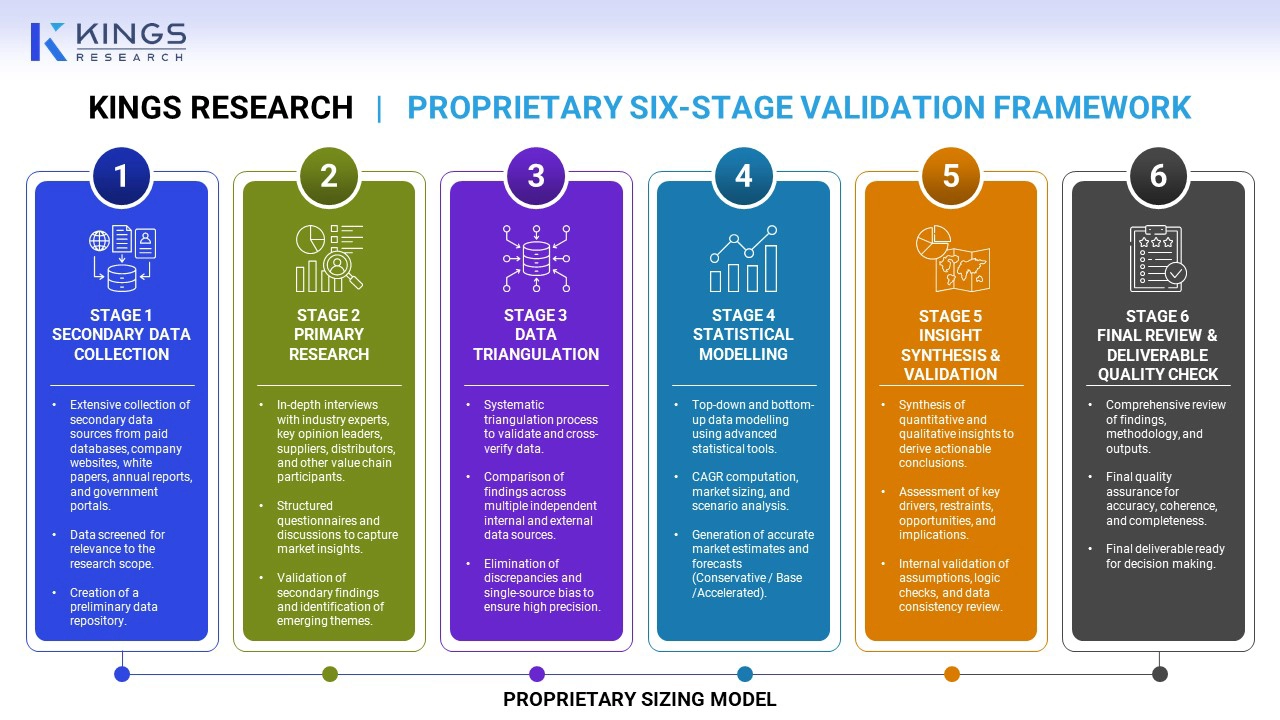
Our methodology triangulates insights from multiple independent and publicly available research databases, which is further validated against regulatory filings and public company disclosures. All estimates are cross-verified; no single-source data is presented without validation.
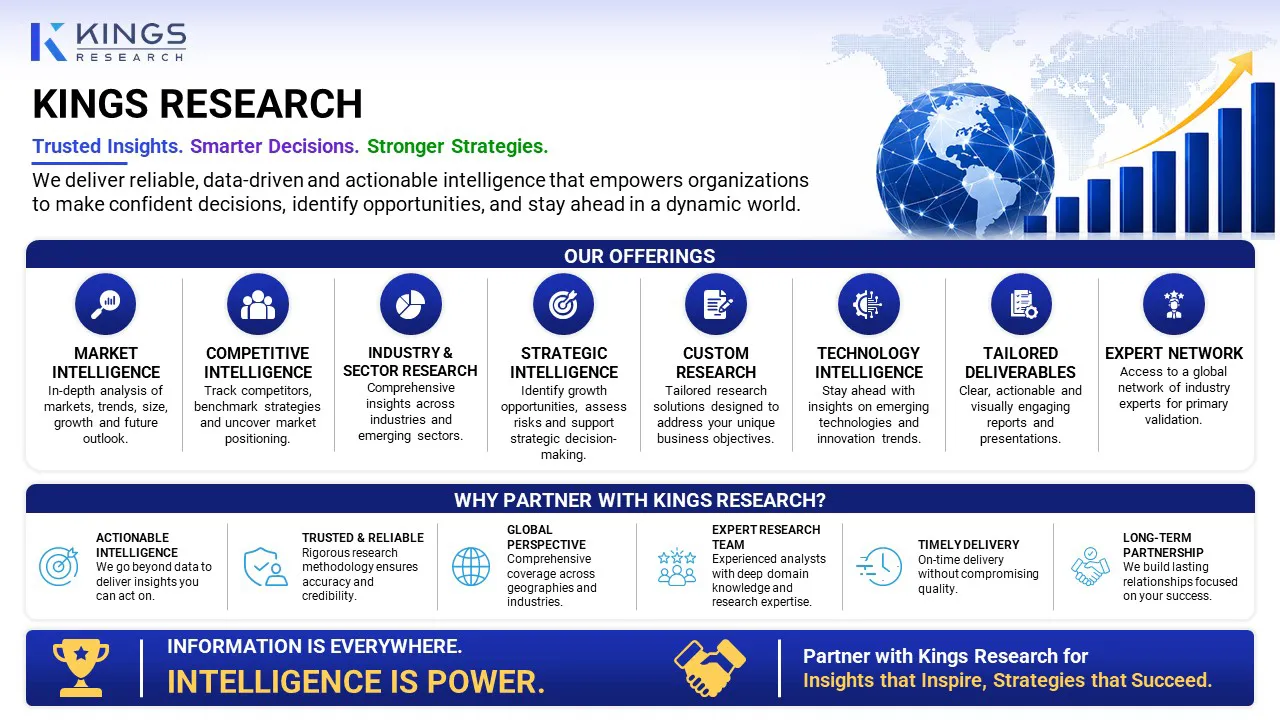
Our custom offerings deliver tailored, data-driven intelligence and strategic guidance to help organizations identify, evaluate, and capitalize on key market opportunities.
Frequently Asked Questions

Faizy brings over four years of experience in market research and consulting, with a proven ability to support strategic engagements across diverse industries and business environments. His work focuses on understanding complex market structures, identifying emerging opportunities, and translating research findings into clear, commercially relevant insights. With strong analytical capabilities and a structured approach to problem-solving, he evaluates industry trends, competitive landscapes, customer dynamics, and evolving business models. His expertise encompasses market research, competitive intelligence, market sizing and forecasting, industry assessment, company benchmarking, and strategic analysis. Faizy combines technical proficiency with a strong research orientation, enabling him to interpret both qualitative and quantitative information effectively. He has contributed to projects that help organizations assess growth potential, strengthen market positioning, and evaluate strategic priorities. His adaptable approach allows him to work across sectors while maintaining a consistent focus on accuracy, relevance, and delivering insights that support informed decision-making for clients and stakeholders.
Habi is a seasoned research and consulting leader with renowned experience in guiding clients on strategic growth and transformation initiatives across global markets. He has led high-performing research teams that deliver actionable insights on market expansion, M&A strategies, opportunity assessment, new business development, and product launches. His project portfolio spans large petrochemical producers, electronic device manufacturers, lubricants companies, and other leading enterprises across diverse industrial and consumer sectors. He currently heads the research department at Kings Research, where he is responsible for setting the research agenda, mentoring analysts, and ensuring client-ready deliverables that support executive decision-making. With extensive experience in market intelligence, strategic research, and consulting, Habi brings a strong understanding of evolving industry dynamics, competitive landscapes, emerging opportunities, and business growth challenges. His expertise includes developing research frameworks, translating complex market data into actionable strategic recommendations, and working closely with senior stakeholders to address critical business questions. He has also contributed to building research capabilities, strengthening analytical methodologies, and driving a culture of quality and insight-led decision-making within research teams. His cross-industry exposure enables him to connect market trends with broader business implications and provide perspectives that help organizations identify opportunities, mitigate risks, and make informed strategic decisions.