
Inquire Now
Key Strategic Points
The DRAM market refers to the ecosystem of volatile storage technology widely utilized in consumer electronics, automotive, and high-end computing applications. Its highly scalable, cost-effective, and fast performance drives its adoption across diverse end-use verticals in the U.S. The deployment of artificial intelligence (AI), cloud computing, and hyperscale data center infrastructure is creating growth avenues for the market, enabling manufacturers to scale capacity and develop high-capacity, low-latency memory solutions for next-generation DRAM applications.
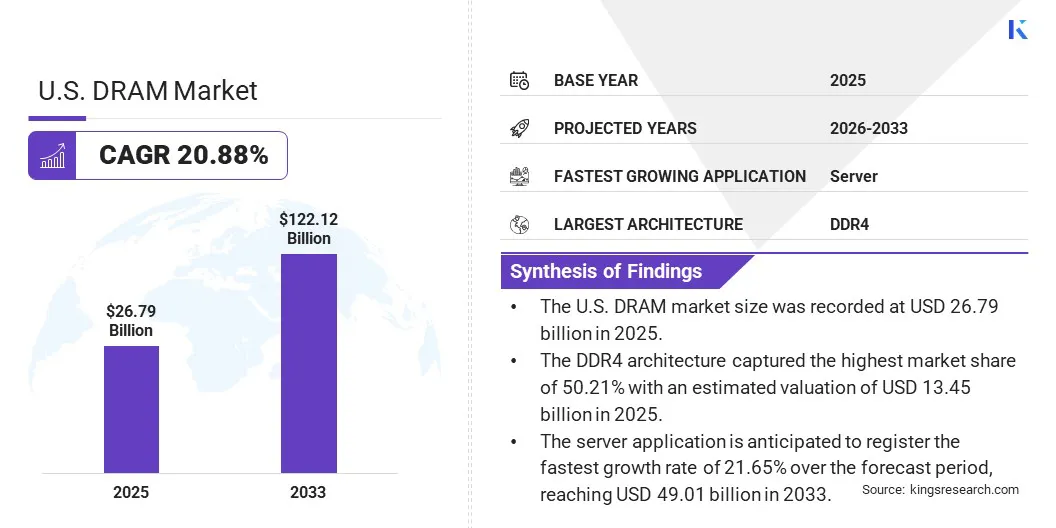
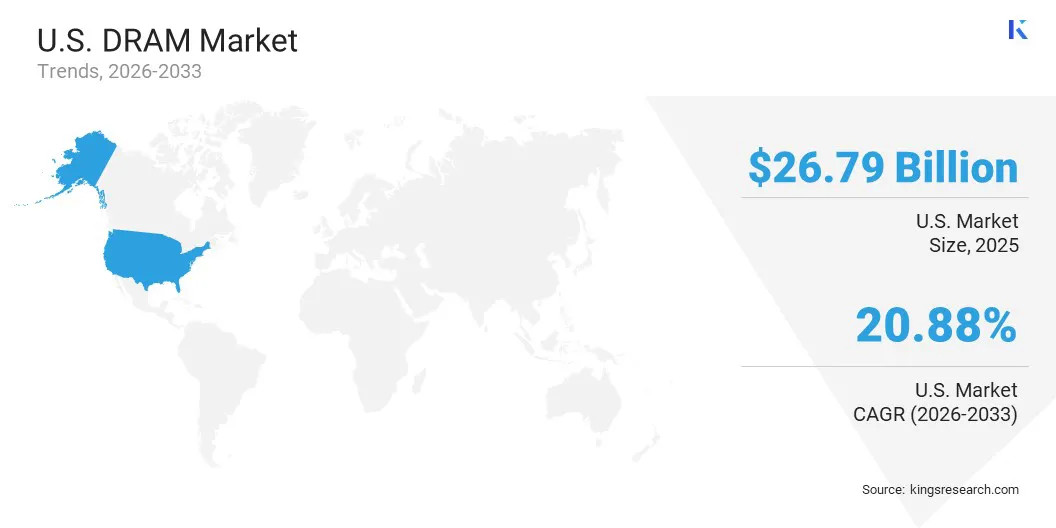
The U.S. DRAM market size was valued at USD 26.79 billion in 2025 and is projected to reach USD 122.12 billion by 2033, representing a CAGR of 20.88% over the forecast period. The market growth is driven by the surge in memory, such as LPDDR5 in AI data center infrastructure and cloud computing. The market is further driven by the growth in hyperscale data centers, which are pushing DRAM prices higher, resulting in the transforming market dynamics for DRAM in traditional computing and consumer electronics sector of the U.S.
Key players operating in the market include Micron Technology, Inc., Kingston Technology, SK Hynix Inc., Samsung Electronics, PNY Technologies Inc., Sabrent; PATRIOT MEMORY, INC., CORSAIR, Lexar, VisionTek, and others. Companies are planning to ramp up production by strategic capacity expansion in order to address the shortages in the DRAM supply across the U.S.
AI training and inference workloads process enormous datasets, which creates unprecedented demand for enterprise-grade solid-state drives relying on advanced DRAM technologies. The expansion of AI computing infrastructure by major cloud service providers (CSPs) including Microsoft, Amazon, and Google to train Large Language Models (LLMs) further drives the demand for DRAM in the U.S. Inference AI workloads operate continuously to generate responses and predictions across millions of connected devices, which results in substantially higher requirements for memory bandwidth, storage capacity, and energy efficiency. This growing characteristic creates demand for DRAM technologies that offer high-speed performance with minimal power consumption.
Additionally, the ability of DRAM to provide temporary, high-speed memory; handle multiple workloads; and facilitate smooth operations in complex contexts, including AI processing or high-performance computing, drives their applicability. Diverse DRAM technologies are identified as ideal for cloud computing, real-time data analysis, GDDR in high-performance graphics, AI workloads, and autonomous vehicles. Advanced DRAM technologies as LPDDR5X further find applications in mobile, edge devices, wearable tech, leading to their increased demand in the U.S.
The sharp rise in DRAM prices in the global semiconductor industry is attributed to constrained supply, shifting manufacturing capacity allocation, and surging AI and data center demand. The DRAM market is driven by the rapid expansion of AI infrastructure, which is reshaping supply dynamics, pricing, and investment strategies across the U.S. semiconductor industry. AI model training, deployments and inference systems lead to increased memory requirements, as high-performance GPUs rely on large volumes of high-speed memory to process complex AI models. This accelerates demand for advanced memory technologies and influences capacity allocation across the global memory market.
Chipmakers are reallocating wafer capacity towards more profitable AI-related memory products, including HBM (High Bandwidth Memory), thereby tightening the DRAM supply. Samsung Electronics, SK hynix, and Micron Technology collectively account for more than 95% of the global DRAM market and have tightened DRAM supply owing to shifting production capacity towards high-margin, high-bandwidth memory (HBM) for AI servers. This is enabling tech firms to shift DRAM procurement from Samsung Electronics, SK Hynix, and Micron to alternative low-cost domestic DRAM manufacturers in the U.S. Additionally, the U.S. declaration to include DRAM process equipment below 18 nanometers in export controls to China further leads to restricted technology access, price escalations, and increased supply-chain disruptions in the global DRAM and memory ecosystem.
To address the challenge, market players are transitioning towards adopting high-margin AI memory products such as High Bandwidth (HBM) while reducing emphasis on conventional DRAM output. Companies are further investing in advanced process technologies and expanding next-generation fabrication capacity to enhance production.
HBM is a high-performance, low-latency architecture built from stacks of advanced DRAM. Their demand in the U.S. is fueled by AI accelerator production and hyperscaler capital investment cycles, which have different cyclical dynamics than conventional PC and smartphone DRAM demand. Chipmakers are transitioning towards HBM to provide the massive amounts of memory required for AI applications. Moreover, the low pricing volatility of HBM compared to commodity DRAM and low latency and fast random data access of DRAM are less crucial for AI inference, as AI workloads follow predictable data access patterns and reduce delays using techniques such as data prefetching. This is leading to new growth opportunities for the HBM memory architectures in the U.S. DRAM market. Additionally, the migration of artificial intelligence (AI) workloads from hyperscale data centers to enterprise-grade and network edge is creating new growth avenues for HBM memory in the U.S.
|
Segmentation |
Details |
|
By Architecture |
DDR4, DDR5, Others |
|
By Application |
Gaming Console, PCs/Laptop, Automotive, Mobile Phone, Server, Others |
|
By Country |
U.S. |
The U.S. is designated as a premier hub for data centers, which drives the artificial intelligence (AI) computing infrastructure. AI chips are crucial to train, deploy, and improve AI models. The development of advanced LLMs and increasing generative AI applicability across the commercial and industrial landscape of the U.S. further fuels high-capacity and fast memory processing chips capable of handling the computing workloads. Additionally, market players are operationalizing AI, enabling its transition beyond pilot projects towards embedding it directly into the core business operations. This further drives the demand for efficient data processing solutions, creating growth avenues for DRAM in the U.S. market.
Key players operating in the market are incorporating strategic mergers, acquisitions, and technical collaborations to strengthen their competitive positioning and capture a larger share of the market. The players are prioritizing the development of new DRAM production facilities to address rising demand from end-use verticals comprising industrial, automotive and information technology. The market is witnessing enhanced focus on supply chain localization and long-term capacity planning to improve stability and reduce disruptions. Additionally, companies are engaging in strategic partnerships and new players are marking entry in the highly competitive DRAM market of the U.S.
Frequently Asked Questions

Faizy brings over four years of experience in market research and consulting, with a proven ability to support strategic engagements across diverse industries and business environments. His work focuses on understanding complex market structures, identifying emerging opportunities, and translating research findings into clear, commercially relevant insights. With strong analytical capabilities and a structured approach to problem-solving, he evaluates industry trends, competitive landscapes, customer dynamics, and evolving business models. His expertise encompasses market research, competitive intelligence, market sizing and forecasting, industry assessment, company benchmarking, and strategic analysis. Faizy combines technical proficiency with a strong research orientation, enabling him to interpret both qualitative and quantitative information effectively. He has contributed to projects that help organizations assess growth potential, strengthen market positioning, and evaluate strategic priorities. His adaptable approach allows him to work across sectors while maintaining a consistent focus on accuracy, relevance, and delivering insights that support informed decision-making for clients and stakeholders.
Habi is a seasoned research and consulting leader with renowned experience in guiding clients on strategic growth and transformation initiatives across global markets. He has led high-performing research teams that deliver actionable insights on market expansion, M&A strategies, opportunity assessment, new business development, and product launches. His project portfolio spans large petrochemical producers, electronic device manufacturers, lubricants companies, and other leading enterprises across diverse industrial and consumer sectors. He currently heads the research department at Kings Research, where he is responsible for setting the research agenda, mentoring analysts, and ensuring client-ready deliverables that support executive decision-making. With extensive experience in market intelligence, strategic research, and consulting, Habi brings a strong understanding of evolving industry dynamics, competitive landscapes, emerging opportunities, and business growth challenges. His expertise includes developing research frameworks, translating complex market data into actionable strategic recommendations, and working closely with senior stakeholders to address critical business questions. He has also contributed to building research capabilities, strengthening analytical methodologies, and driving a culture of quality and insight-led decision-making within research teams. His cross-industry exposure enables him to connect market trends with broader business implications and provide perspectives that help organizations identify opportunities, mitigate risks, and make informed strategic decisions.