
Inquire Now
Key Strategic Points
The critical infrastructure protection market includes tools and services for the protection of vital infrastructural assets, comprising transportation, utilities, and commercial and industrial sectors. The market involves layered, intelligence-driven defense techniques that utilize biometrics, AI, advanced surveillance, and cyber resilience to safeguard physical assets.
The rapid increase in the volume of data generated by digital assets, consumer activities, and public infrastructure utilization has led to the inclusion of machine learning, predictive modeling, and other advanced data analytics platforms to develop and enhance the security layers of protection models. This enables optimized real-time decision-making, faster security response, and enhanced risk management, thereby presenting market development avenues.
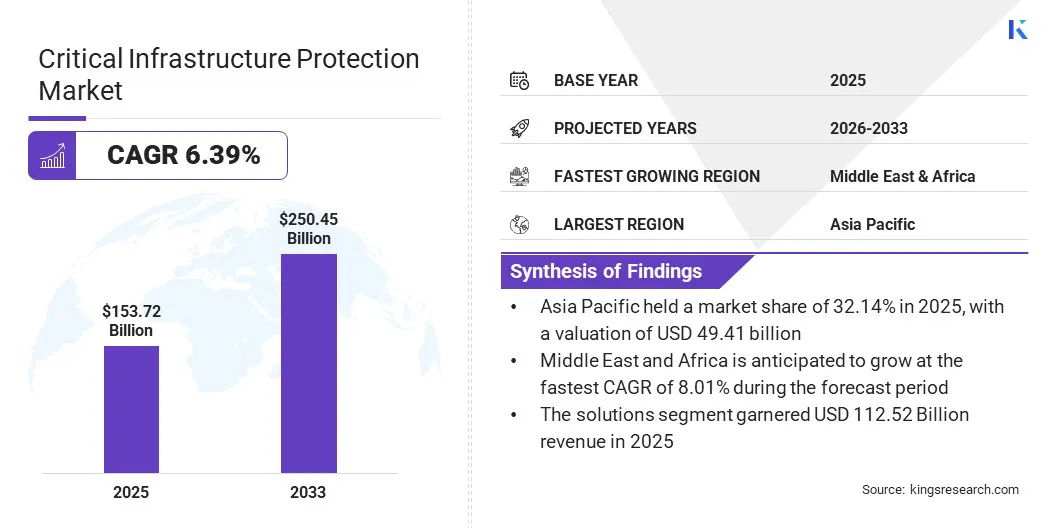
The global critical infrastructure protection market was valued at USD 153.72 billion in 2025 and is projected to reach around USD 250.45 billion by 2033, representing a CAGR of 6.39% over the forecast period. This growth is mainly driven by the rise in physical and cyber threats targeting industrial infrastructure. The surge in reliance on interconnected systems across energy, transportation, and utilities further amplifies cyber threats, highlighting the need for robust critical infrastructure protection (CIP) frameworks.
Major companies operating in the global critical infrastructure protection industry include 3xLogic, Axis Communications AB, BAE Systems, Booz Allen Hamilton Inc., Cisco Systems, Inc., General Dynamics Corporation, Hexagon AB, Honeywell International, Inc., Huawei Technologies Co., Ltd., Johnson Controls Inc., Module X Solutions, OPSWAT Inc., Raytheon Technologies Corporation, Thales Group, and TYCO International.
The widespread adoption of digitization, increasing reliance on cloud and edge computing infrastructure, and the implementation of artificial intelligence solutions boost the adoption of CIP measures. These measures involve the fusion of modern security systems, combining physical protection, biometric access control, environmental monitoring, and advanced surveillance technologies to safeguard critical IT assets. This, in turn, prevents risks including unauthorized access, environmental hazards, and operational disruption, thereby ensuring compliance with regulatory standards and maintaining uninterrupted industrial operations.
The inability of conventional organizational risk models to cope with the evolving industrial threat scenario, due to their design and operational architecture being suited for static environments rather than dynamic, converged operational networks, acts as a major driving factor. The integration of traditional Industrial Control Systems (ICS) and SCADA with enterprise IT systems accelerates this shift due to an expanded attack surface and increased operational complexity, leading to a surge in demand for advanced cybersecurity solutions, real-time monitoring, and resilient infrastructure frameworks.
For instance, a coordinated cyberattack led by a Russian military agency-linked hacker group, Sandstorm, disabled Poland’s power grid in January 2026, which led to the compromise of control and communication systems across around 30 distributed energy facilities. The attack involved the use of destructive malware, which disabled key operational equipment and disrupted systems used to manage wind, solar, and combined heat and power operations.
The exploitation of system vulnerabilities and sensitive data remains a major challenge for market expansion. Cyberattacks such as phishing, ransomware, and malware, combined with human errors like weak passwords and misconfigurations, enable unauthorized access and data breaches. These incidents often result in the stealthy exfiltration of critical information, as seen in the Salt Typhoon cyberattack (January 2025), which compromised major U.S. telecom networks and exposed sensitive communications data.
Market players are addressing this challenge by strengthening cybersecurity frameworks through measures such as multi-factor authentication, continuous monitoring, secure remote access, and regular patching to reduce vulnerabilities and prevent unauthorized access. Additionally, collaborations like Dragos Inc. and Microsoft are enabling unified IT and OT security, enhancing threat visibility and accelerating detection and response across critical infrastructure.
The expansion of digitalization exposes critical infrastructure, including hospitals, power grids, water facilities, and transportation networks, to nation-state attackers and cybercriminal groups. The interconnection of conventional operational technology and IT systems fuels the demand for fast and scalable threat detection in real time, primarily through AI-driven security measures.
The adoption of these solutions enables continuous analysis of network activity, identification of anomalies, and faster response to threats at high speed, minimizing their impact. Advancements driven by AI and machine learning integration in real-time data processing, along with the implementation of stronger security features such as liveness detection, anti-spoofing systems, 3D facial mapping, multimodal biometrics, and cross-spectrum recognition, are transforming the market.
|
Segmentation |
Details |
|
By Component |
Solutions, Services |
|
By Security Type |
Physical Security, Cybersecurity |
|
By Deployment |
On-Premise, Cloud-Based |
|
By Organization |
Large Enterprise, Small & Medium Enterprise (SMEs) |
|
By End Use Industry |
Banking, Financial Services & Insurance (BFSI), Government & Defense, Healthcare, Industrial, IT & Telecommunications, Utilities, Others |
|
By Region |
North America: U.S., Canada, Mexico |
|
Europe: France, UK, Spain, Germany, Italy, Russia, Rest of Europe |
|
|
Asia-Pacific: China, Japan, India, Australia, ASEAN, South Korea, Rest of Asia-Pacific |
|
|
Middle East & Africa: Turkey, U.A.E., Saudi Arabia, South Africa, Rest of Middle East & Africa |
|
|
South America: Brazil, Argentina, Rest of South America |
Based on region, the global critical infrastructure protection market is split into North America, Europe, Asia Pacific, Middle East and Africa and South America.
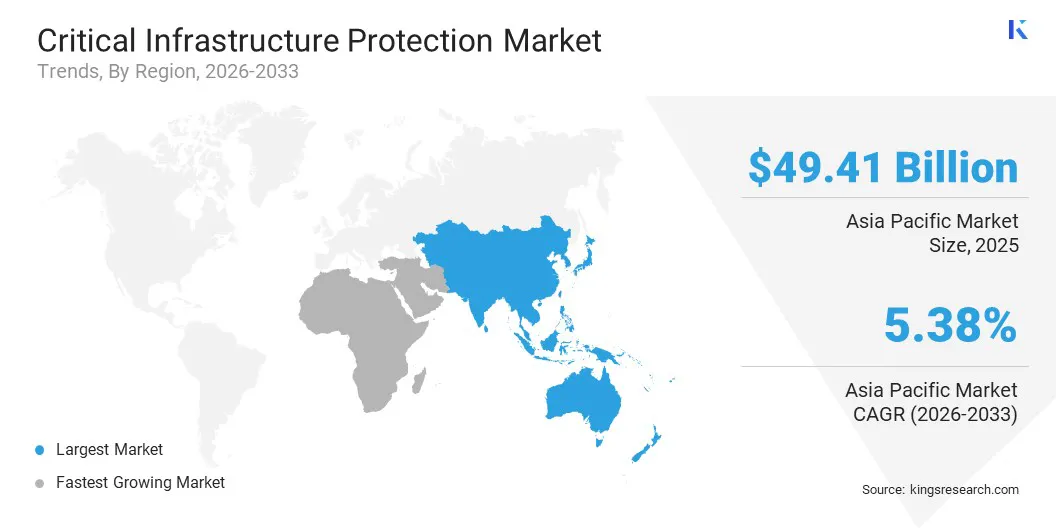
Asia Pacific captured the largest market share, which stood at 32.14% with a valuation of USD 49.41 billion in 2025. This notable growth is fueled by rapid urbanization, industrialization, and increasing cyber threats targeting infrastructure and disrupting industrial operations across utilities, financial, and industrial sectors. The surge in investments in smart city projects across China, India, South Korea, and Southeast Asian economies fuels the development of cyber-resilient digital infrastructure, and energy networks. This highlights the need for critical infrastructure protection solutions across the region.
According to the Adversarial Threat Report published by Meta, India ranks second globally as the most targeted country for cyber incidents. The BFSI sector accounts for the highest volume of threats across industries, representing 14.49% of total observed incidents, with nearly half of these directly targeting Indian entities. This signals the elevated risk profile of Asia Pacific and necessitates the implementation of critical infrastructure protection measures.
The Middle East and Africa critical infrastructure protection market is estimated to grow at the fastest CAGR of 8.01% over the forecast period. Rising digital transformation initiatives across the region, coupled with the presence of extensive oil and gas infrastructure, necessitate the implementation of critical infrastructure protection measures. The rise in cyber threats due to geopolitical tensions in the region, along with a significant shortage of a skilled cybersecurity workforce, is likely to increase the demand for CIP solutions to secure critical national infrastructure (CNI).
Additionally, rising tourism and urbanization in the region are enabling the development of smart city projects which reflect the broader push of the Middle East region towards digital transformation and intelligent urban management, supported by the efficient implementation of CIP measures.
Key players operating in the critical infrastructure protection market are focusing on the integration of artificial intelligence (AI) and machine learning (ML) to handle predictive analytics, real-time threat monitoring, and countermeasures against advanced, sophisticated cyberattacks targeting critical industrial and commercial infrastructure. They are also developing advanced security platforms, centralized monitoring systems, and scalable cloud-based security infrastructure. These initiatives are aimed at processing threat intelligence data and proactively identifying vulnerabilities, optimizing security management, and accelerating digital resilience initiatives.
Frequently Asked Questions

Faizy brings over four years of experience in market research and consulting, with a proven ability to support strategic engagements across diverse industries and business environments. His work focuses on understanding complex market structures, identifying emerging opportunities, and translating research findings into clear, commercially relevant insights. With strong analytical capabilities and a structured approach to problem-solving, he evaluates industry trends, competitive landscapes, customer dynamics, and evolving business models. His expertise encompasses market research, competitive intelligence, market sizing and forecasting, industry assessment, company benchmarking, and strategic analysis. Faizy combines technical proficiency with a strong research orientation, enabling him to interpret both qualitative and quantitative information effectively. He has contributed to projects that help organizations assess growth potential, strengthen market positioning, and evaluate strategic priorities. His adaptable approach allows him to work across sectors while maintaining a consistent focus on accuracy, relevance, and delivering insights that support informed decision-making for clients and stakeholders.
Habi is a seasoned research and consulting leader with renowned experience in guiding clients on strategic growth and transformation initiatives across global markets. He has led high-performing research teams that deliver actionable insights on market expansion, M&A strategies, opportunity assessment, new business development, and product launches. His project portfolio spans large petrochemical producers, electronic device manufacturers, lubricants companies, and other leading enterprises across diverse industrial and consumer sectors. He currently heads the research department at Kings Research, where he is responsible for setting the research agenda, mentoring analysts, and ensuring client-ready deliverables that support executive decision-making. With extensive experience in market intelligence, strategic research, and consulting, Habi brings a strong understanding of evolving industry dynamics, competitive landscapes, emerging opportunities, and business growth challenges. His expertise includes developing research frameworks, translating complex market data into actionable strategic recommendations, and working closely with senior stakeholders to address critical business questions. He has also contributed to building research capabilities, strengthening analytical methodologies, and driving a culture of quality and insight-led decision-making within research teams. His cross-industry exposure enables him to connect market trends with broader business implications and provide perspectives that help organizations identify opportunities, mitigate risks, and make informed strategic decisions.